
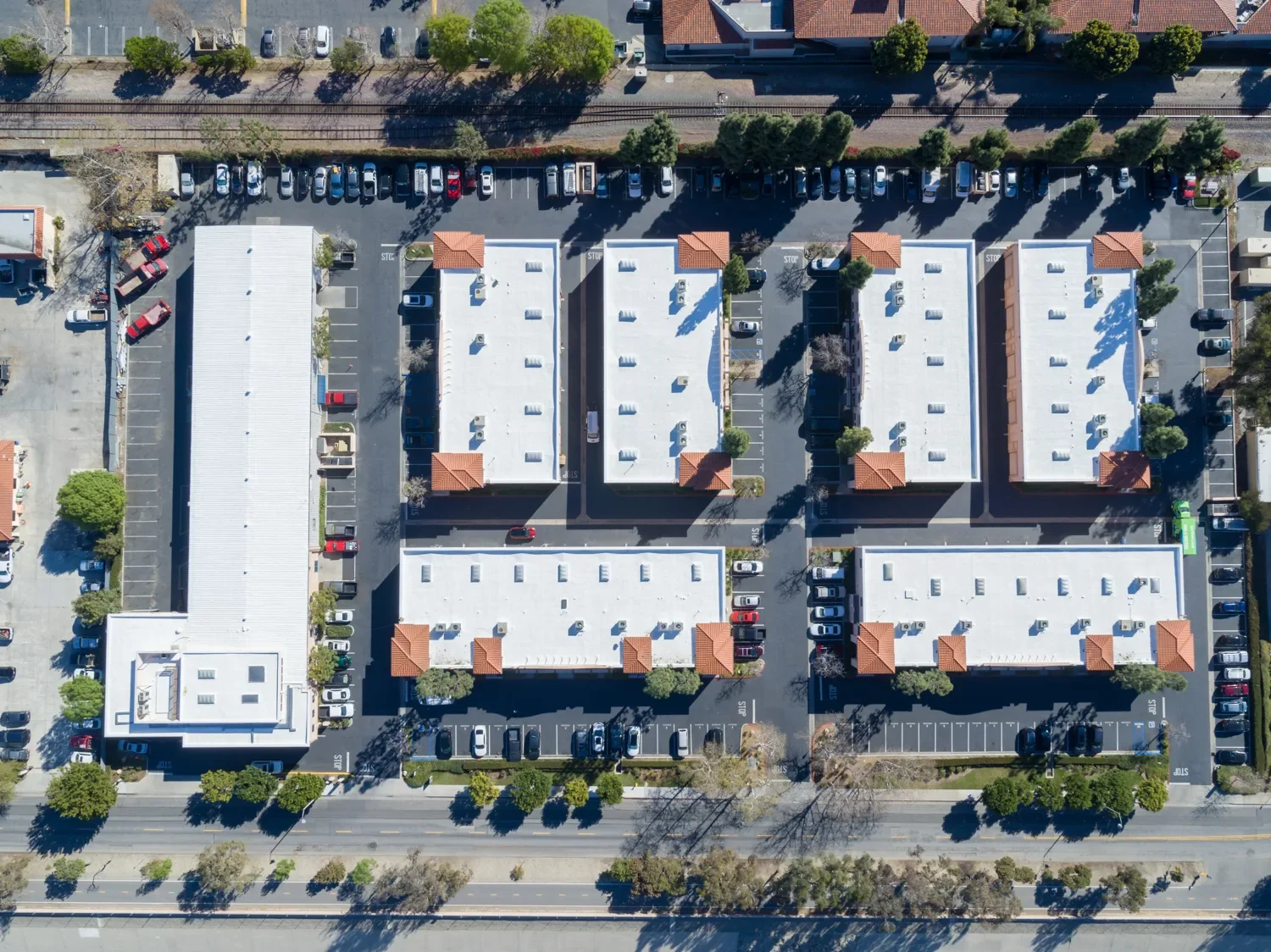
Spray Foam Roofing In Palm Desert, CA
Vision Roof Services installs spray polyurethane foam roofs on commercial and residential buildings in Palm Desert, out of an office on Boardwalk. We hold California contractor license 651509, class C-39, current and active. Of our 60 roofers, 12 are certified spray foam applicators, certified through General Coatings. Since 1 January 2026, a commercial low-slope re-roof in California triggers a cool-roof requirement the moment it covers more than 2,000 square feet, and a coated foam roof is one of the few systems that meets it without adding structural weight. Every project starts with a free Roof Health Check: we walk the roof, photograph it, and send you a written report in 24 to 72 hours.
Commercial foam roofing in Palm Desert
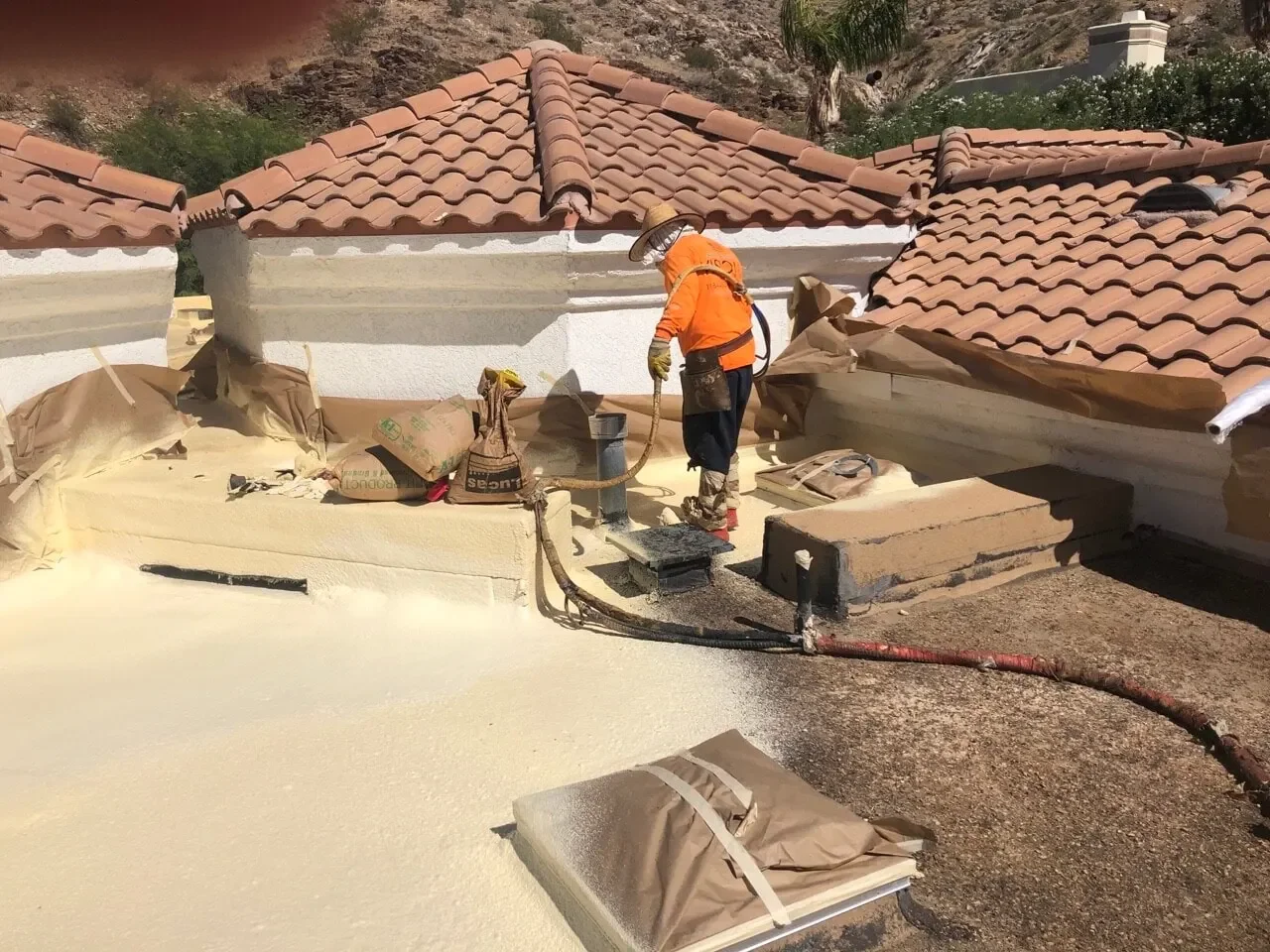
Our commercial work is built for building owners, property managers and HOA boards with low-slope roofs they need to stop thinking about. Secondary: developers, general contractors and custom home builders. The call we get most is a leak on an aging flat roof, usually a built-up or modified bitumen system somewhere past year 20.
Foam is the answer to that call more often than tear-off is, for 1 structural reason. Foam goes over the existing roof. No tear-off means no dumpster, no exposed deck overnight, no landfill tonnage, and a building that keeps operating while the work happens. On a self-storage facility, a medical office or an occupied HOA building, the disruption saved is usually worth more than the material difference.
The limit on that: foam only goes over a roof that is dry and sound. If the existing insulation is saturated, it comes out first. Foam over wet insulation traps the water permanently, and the only way to find out how bad it got is a core cut 3 years later. We take moisture readings during the Roof Health Check and tell you which case you are in before anyone writes a proposal.
Residential foam roofing, and the HOA question first
In a Palm Desert HOA, the roof you are permitted to install may not be the roof that performs best on your house. Sort that out before you get attached to a system.
Many of the traditional and Mediterranean-style neighborhoods in Palm Desert and La Quinta require clay or concrete tile for visual continuity. Where white foam is approved, it is often approved on the condition that it sits behind a raised parapet or out of sight from the street, or in the modern and flat-roof communities where it is already the norm. That is our read of the local architectural pattern rather than a published rule, and your association's guidelines are the only document that governs your house.
California law gives you more standing in that process than most homeowners use. Under Civil Code Section 4765:
A decision on a proposed change has to be made in good faith, and it may not be unreasonable, arbitrary, or capricious.
If your application is disapproved, the written decision has to explain why, and describe the procedure for reconsideration.
You are entitled to reconsideration by the board at an open meeting.
The association's own procedures have to state the maximum time for a response to an application or a reconsideration request.
The association has to notify members annually of any requirement for approval of physical changes, and include a copy of the review procedure.
One limit on that reconsideration right: it does not apply where the decision was made by the board itself, or by a body with the same membership as the board, at a meeting that already satisfied the open-meeting requirements. If your board decided it in a properly noticed open meeting, that was your hearing.
Practical order of operations: request the architectural guidelines and the review procedure in writing, confirm the stated maximum response time, then design the roof to what the guidelines actually say. If the answer is tile, foam is off the table for the visible slopes and we will tell you so on the first visit. If the answer is a flat roof behind a parapet, foam is usually the strongest system available to you, and the reflectance requirement in the code becomes an argument in your favor rather than a hurdle.
What kills a foam roof in the Coachella Valley
Foam roofs do not fail from age. They fail from an unrepaired breach in the coating, and the desert finds breaches faster than a coastal climate does. The coating is the wearing surface. The foam underneath is the waterproofing and the insulation, and it has no UV resistance of its own.
RICOWI and IBHS describe the exposure sequence plainly: SPF surfaces degrade under ultraviolet radiation, starting with discoloration, then a friable surface skin, then actual erosion of thickness. Once the coating is breached and foam is exposed, the clock runs.
Where we see it start, in order:
South and west slopes and parapet faces. More hours of direct sun, more thermal cycling. On a valley roof these sections are visibly further along than the north side of the same roof, which is why a single spot check tells you almost nothing.
Around rooftop HVAC. Foot traffic from service techs is the most common cause of a coating breach we find. Every unit that gets serviced twice a year is a wear path.
Around solar penetrations and conduit runs. Same mechanism, plus mounting hardware that moves with thermal expansion.
Ponding areas. Standing water is a coating endurance test. Silicone handles it better than acrylic.
On recoat timing, here is the split. RICOWI and IBHS publish that coating systems generally need reapplication every 10 to 20 years, and that maintained SPF roofs run in excess of 30 years. The Spray Polyurethane Foam Alliance FAQ gives 5 to 20 years. Dry film thickness is the variable that moves you inside that range. Our position from valley roofs: plan on the shorter half of the published interval, inspect on schedule rather than on a calendar reminder, and treat the south and west sections as a separate wear zone from the rest of the roof.
The reason this matters financially is the cost step. A recoat is maintenance on a roof you already own. A foam rebuild, after exposed foam has oxidized and eroded, is a different scope with a different number. Deferred recoating is what moves you from the first to the second, and it happens quietly, because a foam roof that is 3 years overdue for a recoat usually does not leak yet.
Maintenance is the warranty
RICOWI recommends 2 inspections a year on an SPF roof, 1 in spring and 1 in fall. That is the schedule, and it is also the condition most manufacturer warranties run on. A foam roof with no inspection history is a foam roof with a warranty argument waiting to happen.
What we do after the install: annual inspections, documented, with recoat recommendations and a schedule as the coating wears. Small repairs caught early, because a pinhole is a 10-minute fix and the same pinhole 4 years later is a wet foam section that has to be cut out and replaced.
What you can do between visits, and it takes 5 minutes: after any HVAC or solar work on the roof, have someone look at the coating along the path the technician walked. Foot traffic during service calls is the most common cause of a breach we find, and it is the easiest one to catch, because you know exactly when and where it happened.
The Palm Desert Spray Window
Spray foam cannot be applied in 4 conditions, and Palm Desert produces 3 of them on a schedule you can plan around. These limits come from the technical data sheet for the foam we install, and they are not negotiable by a contractor who wants the warranty to hold.
| Limit | What the spec says | What Palm Desert does to it |
|---|---|---|
| Temperature | Minimum application temperature 50F. Above 90F requires the summer reactivity grade of the foam | Winter mornings sit below 50F and delay a start by hours. Summer runs a July average high of 106.9F and an average of about 120 days a year at or above 100F, so summer grade is the default here from roughly May through October |
| Wind | No spraying above 15 mph | Afternoon valley wind is the most common reason a crew stops. Overspray lands on cars, glass and neighboring roofs, and it does not come off easily |
| Moisture | No spraying with rain, dew, or relative humidity above 80% | Monsoon season runs 15 June to 30 September per the National Weather Service. July through September carries 19% of the annual precipitation |
| Substrate | Foam cannot be applied to a wet or damp surface, and the surface must be structurally sound, dry, and free of oil, grease, dirt and loose gravel | A roof that took rain overnight is not sprayable in the morning, even under clear sky. Dew burns off; trapped water in an old built-up system does not |
Climate figures are NOAA 1991-2020 Climate Normals for the Thermal station, which NOAA still labels Desert Resorts Regional Airport and which was renamed Jacqueline Cochran Regional Airport in 2004. It is the nearest long-record station to Palm Desert. Application limits are from the General Coatings Ultra-Thane 230 HFO technical data sheet. The substrate requirement is from the RICOWI and IBHS spray foam roof guide.
What that means for your project. 3 things.
Summer foam work in the valley starts early. Crews are on the roof at first light and off the hot side of the roof by early afternoon, which means a large commercial job takes more days here in August than the same job takes in Irvine in March. Any bid that does not reflect that is either optimistic or planning to spray in conditions the manufacturer excludes.
Monsoon season is a scheduling risk, not a stop. July through September is 19% of the annual rain, and it arrives as short cells rather than long systems. We schedule around the forecast and we build float into the timeline. What we will not do is spray a damp deck to keep a date, because moisture under the foam is the single failure mode you cannot fix later without cutting the roof open.
When foam is the wrong call
We turn work down. These are the cases.
Your HOA requires tile on the visible slopes. Foam is not going to get approved, and pushing it wastes your time and ours. We will look at the flat sections behind a parapet if there are any.
The existing roof holds saturated insulation. Foam cannot be applied to a wet or damp surface. Wet insulation comes out first, which changes the project into a tear-off with a different budget. We would rather tell you that at the inspection than discover it mid-job.
Very small repairs outside our core service areas. We are not built for it and you will get better service and a better price from a local repair outfit.
Gutter cleaning. Not a service we offer.
Standalone wall foam insulation. We are moving away from it and do not sell it separately from a roof.
If your roof is in one of those cases, the Roof Health Check still gives you the written report with photos. Free, either way, and we will tell you what the roof actually needs.
Frequently Asked Questions
Can foam go over my existing roof?
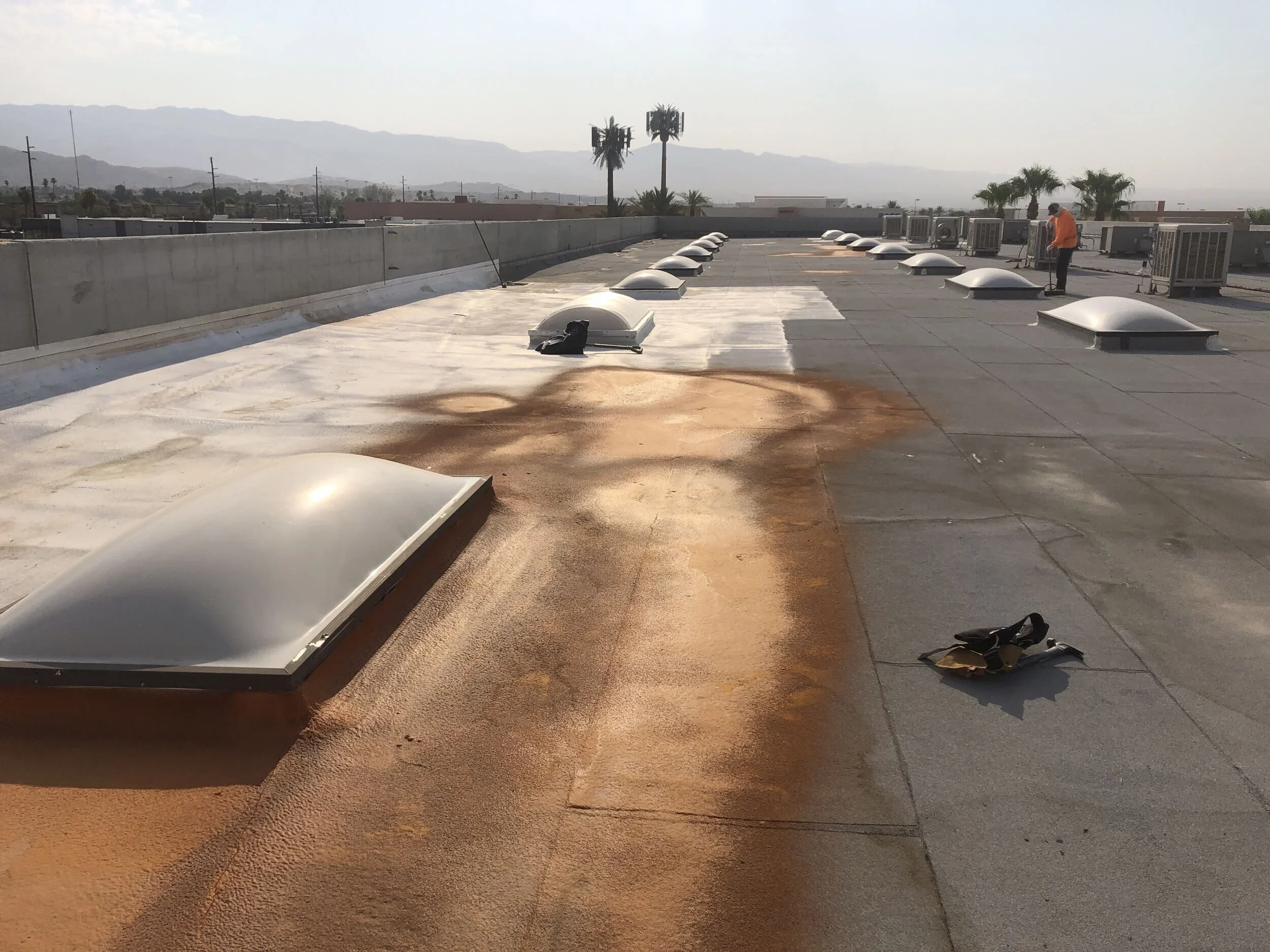
Usually, and that is most of the reason to choose it. The existing system has to be structurally sound, dry, and free of loose gravel, oil and grease. Saturated insulation has to come out first. We take moisture readings at the Roof Health Check so you know which case you are in before you get a proposal.
How long does a foam roof last in this climate?
RICOWI and IBHS report that maintained SPF roofs run in excess of 30 years, with the coating reapplied every 10 to 20 years. The word carrying the weight there is maintained. Our position from valley roofs is to plan toward the shorter half of that recoat interval and to inspect the south and west sections separately, because they wear first. We do not publish a 50-year figure, because no source does.
Will my HOA approve a white foam roof?
Depends entirely on your association's architectural guidelines. Many traditional and Mediterranean neighborhoods in Palm Desert and La Quinta require tile on visible slopes, and approve foam only behind a parapet or out of street view. Under Civil Code 4765 the association has to decide in good faith, cannot be arbitrary, has to explain a denial in writing, and has to give you reconsideration at an open board meeting. Request the guidelines and the review procedure in writing before you spec anything.
When can you actually spray in Palm Desert?
Year-round, inside the limits. The foam needs a minimum of 50F, wind under 15 mph, and no rain, dew or humidity above 80%. In practice that means early starts in summer, weather-watching from mid-June through September during monsoon season, and occasional wind delays in the afternoon. A bid that promises a fixed date in August with no float in it is a bid worth questioning.
What happens if I skip a recoat?
The coating thins, then breaks, then the foam is exposed. Exposed foam discolors, develops a friable skin, and erodes in thickness. At that point you are no longer buying a recoat, you are buying foam replacement in the affected areas. It rarely announces itself with a leak first, which is why the inspection schedule matters more on a foam roof than on most systems.
Get a written report on your roof in 72 hours
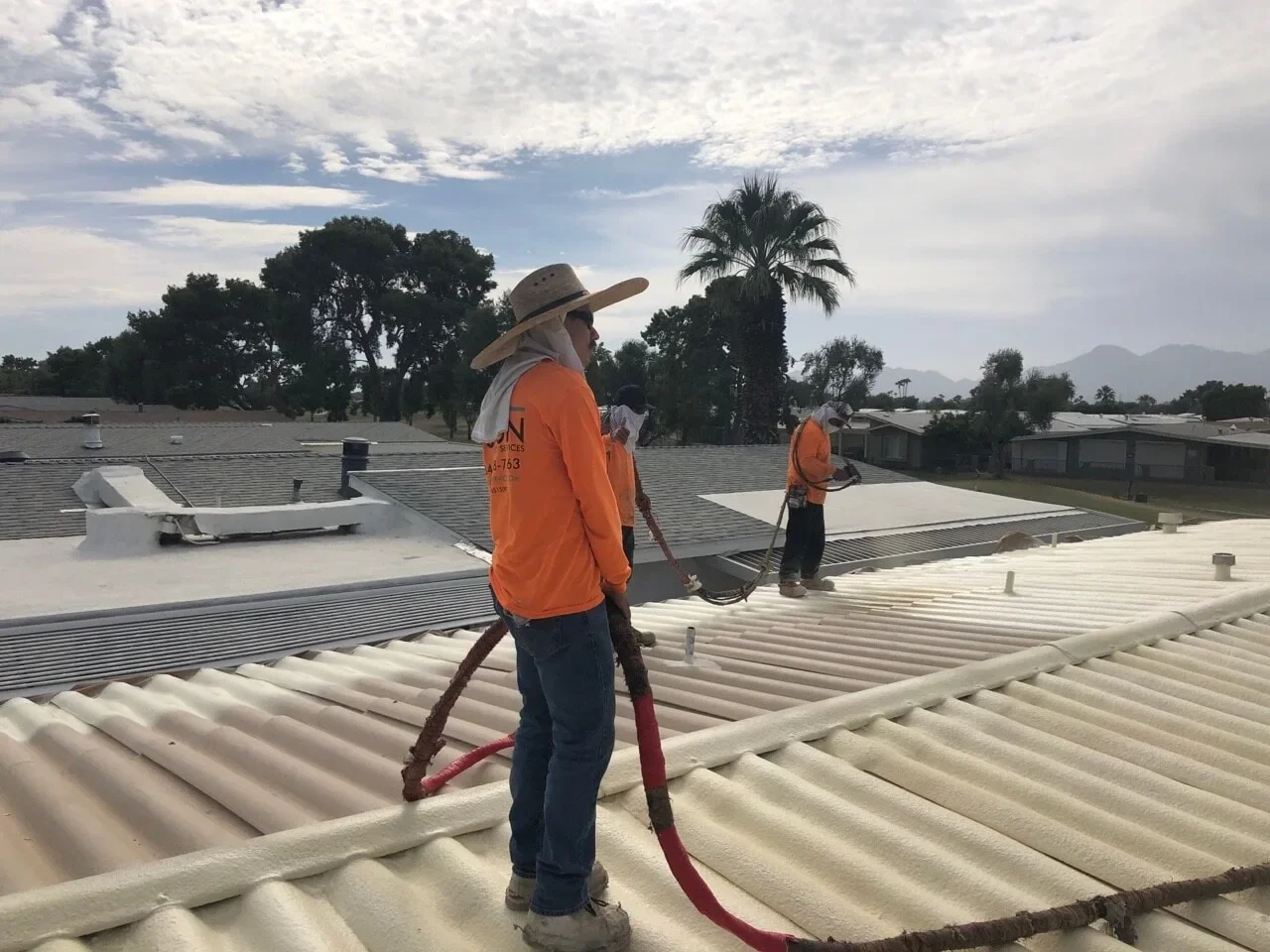
Free Roof Health Check. We walk the roof, photograph it, take moisture readings, and send you a written report with a recommendation. If foam is the wrong system for your building, the report says so and tells you what is right.