
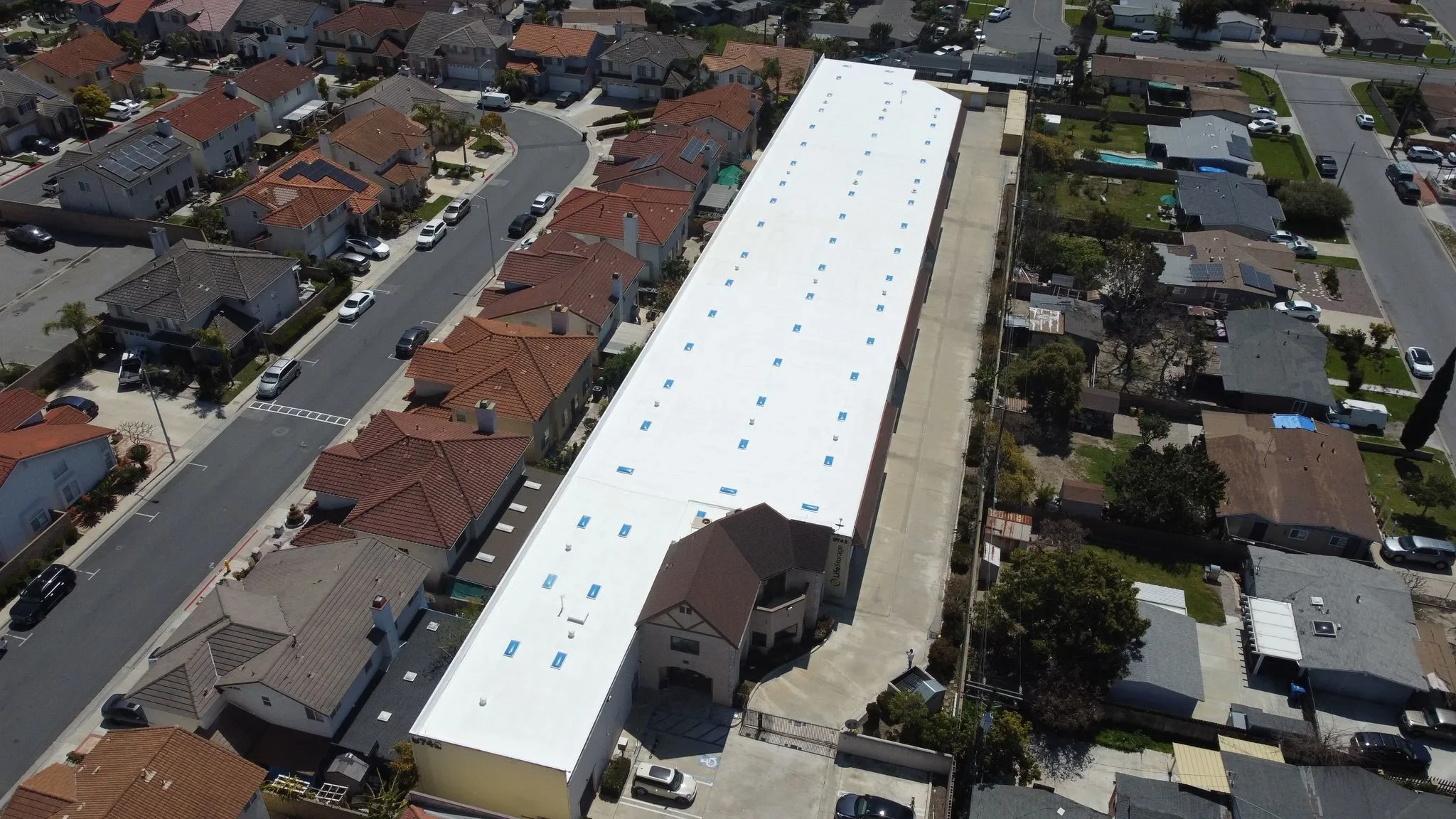
Roofing Services In Mission Viejo, CA
Repair, recoat, recover or replace.
Vision Roof Services operates from 41905 Boardwalk, Suite L in Palm Desert under California contractor license 651509, C39 Roofing, issued in July 1992 and currently active, with the required bond and workers' compensation coverage on file. We provide roof repairs, spray polyurethane foam and coatings, roof rejuvenation, tile and flat-roof replacement, roof removal, new construction, and roofing work beneath solar arrays throughout Palm Desert, La Quinta, Rancho Mirage, Indian Wells, Palm Springs, Indio, and Cathedral City. Instead of simply listing roofing services and leaving you to determine what your roof needs, this page explains which options your roof may qualify for using four published thresholds you can check yourself.
Start with the smallest fix the code allows
The right roofing service is the least invasive one your roof's condition and the building code still permit. Call it the Least-Intervention Rule. 5 rungs, and you want the lowest one you qualify for, because every rung up multiplies the paperwork, the code obligations and the disruption. Exactly 4 published thresholds force you up a rung. None of them is a matter of anyone's judgment.
This runs against how the trade gets paid. A tear-off is the largest invoice on the ladder, so a bid that opens there is the path of least resistance for the person writing it. Ask which rung your roof is on and why. The answer should cite a threshold.
Rung 1. Maintain. Inspection, drain and scupper clearing, sealant checks at penetrations. No permit, no code trigger. Almost nobody stays here, because a sound roof produces no symptoms to react to.
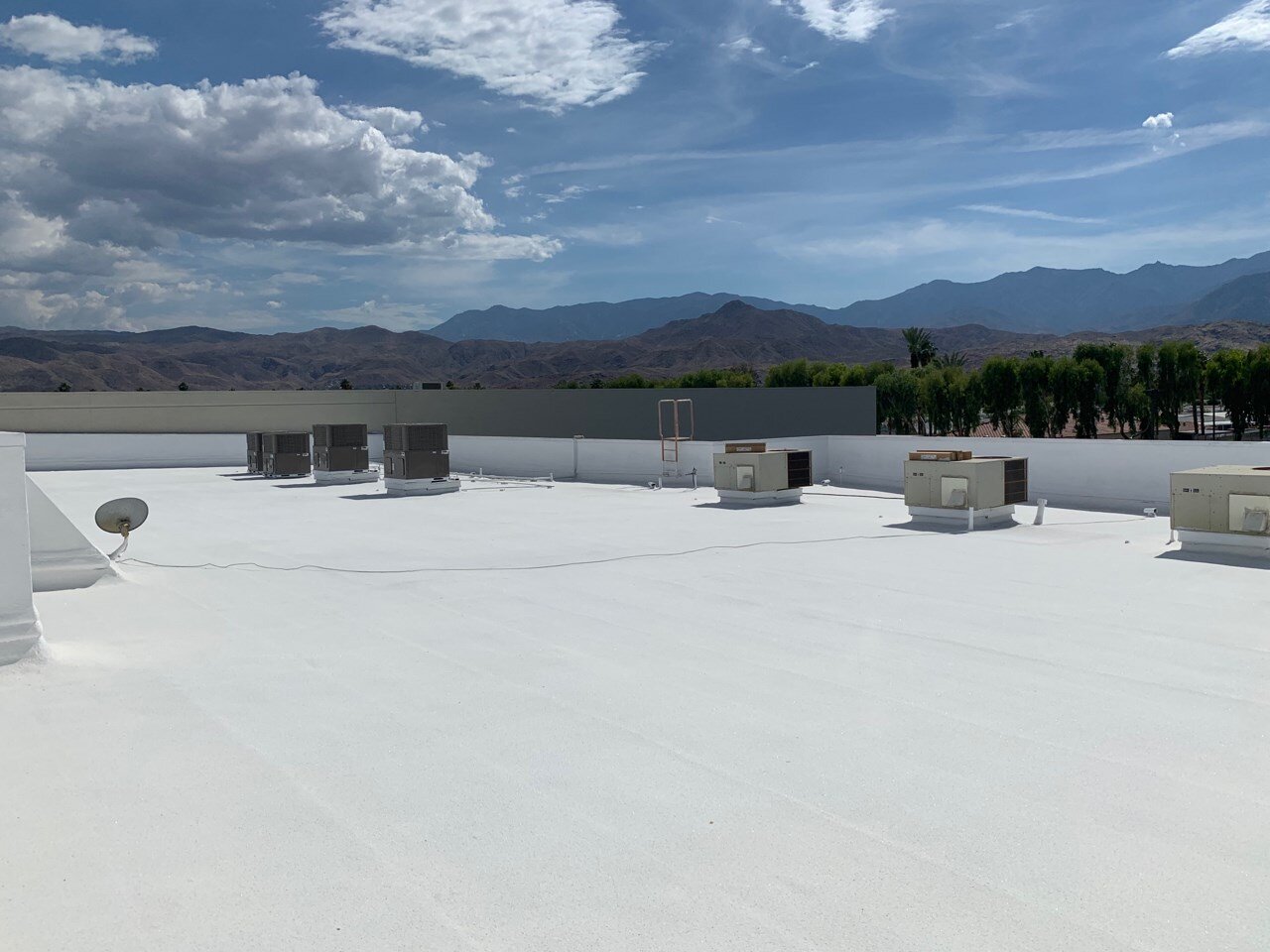
Rung 3. Renew the surface. A silicone or acrylic recoat on foam or low-slope, or a rejuvenation treatment on a sound asphalt shingle roof. A coating is not a covering replacement, so it pulls in neither the cool-roof requirement nor a re-roof permit. This is the rung the industry under-sells.
Rung 5. Replace. Tear-off to the deck. Permit, energy-code documentation at 2 points in the job, fire classification across the entire roof.
Rung 2. Repair. Localized work: a failed pipe boot, cracked tile, a split seam, a section of flashing. Below every threshold, with one exception. In a Fire Hazard Severity Zone the patch material still has to carry a Class A fire classification, on a repair of 1 square foot.
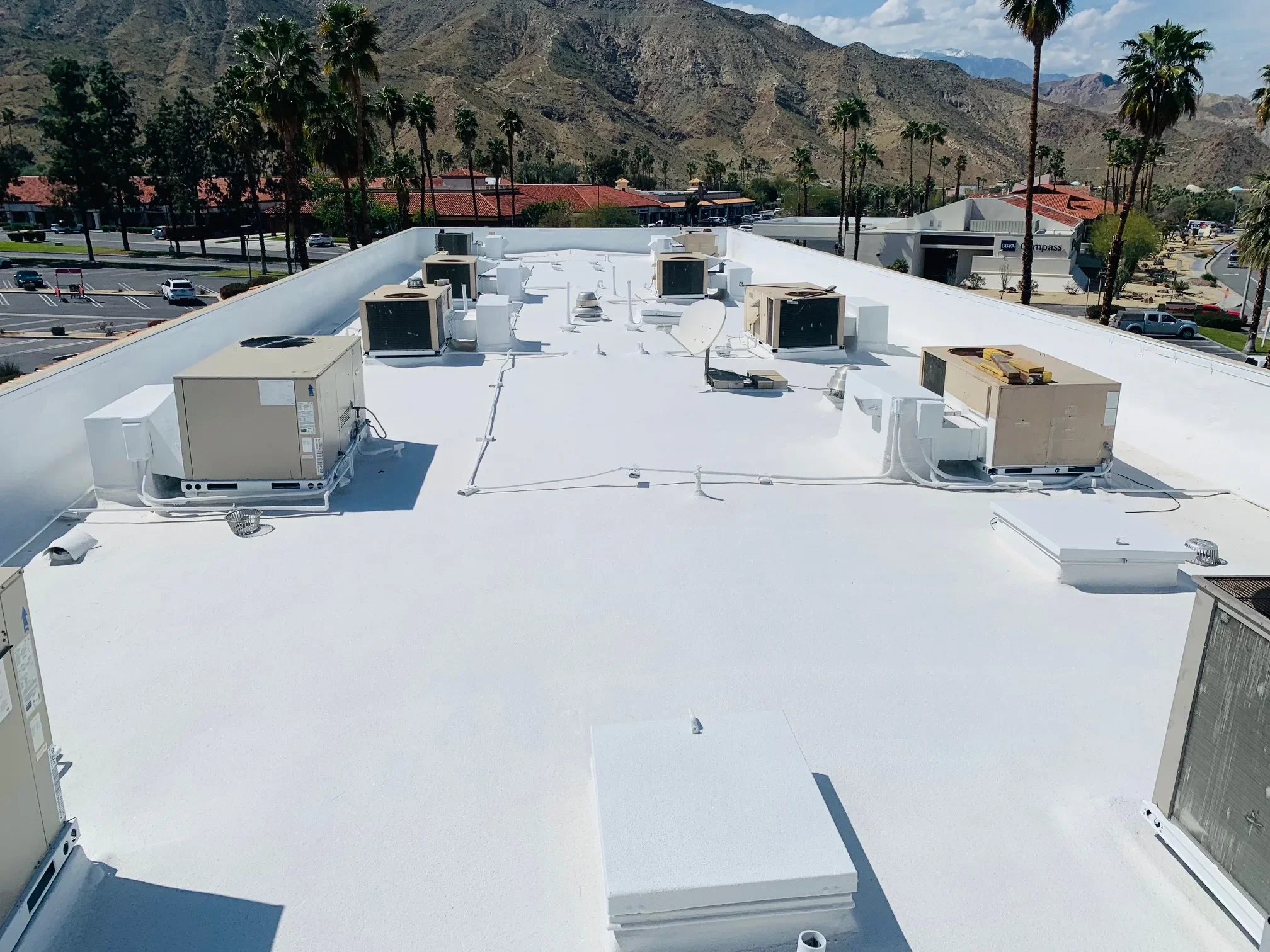
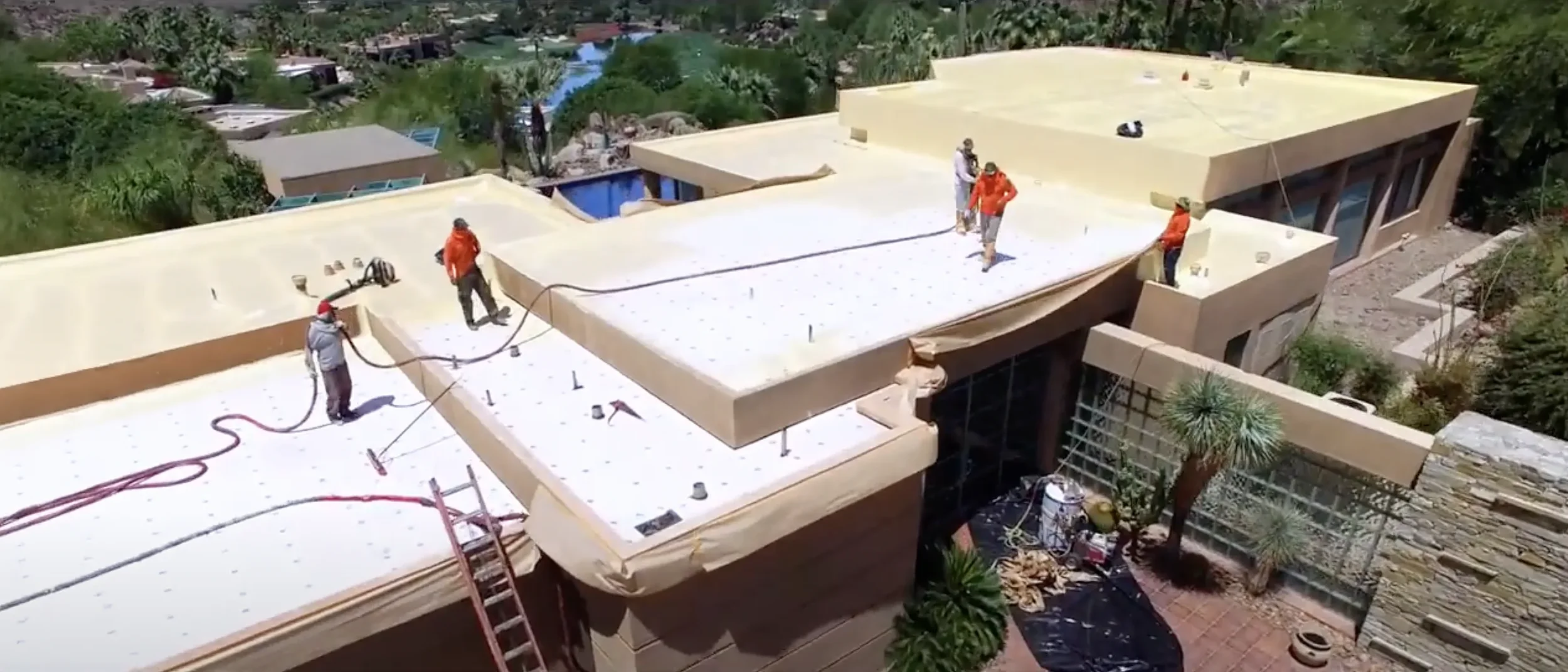
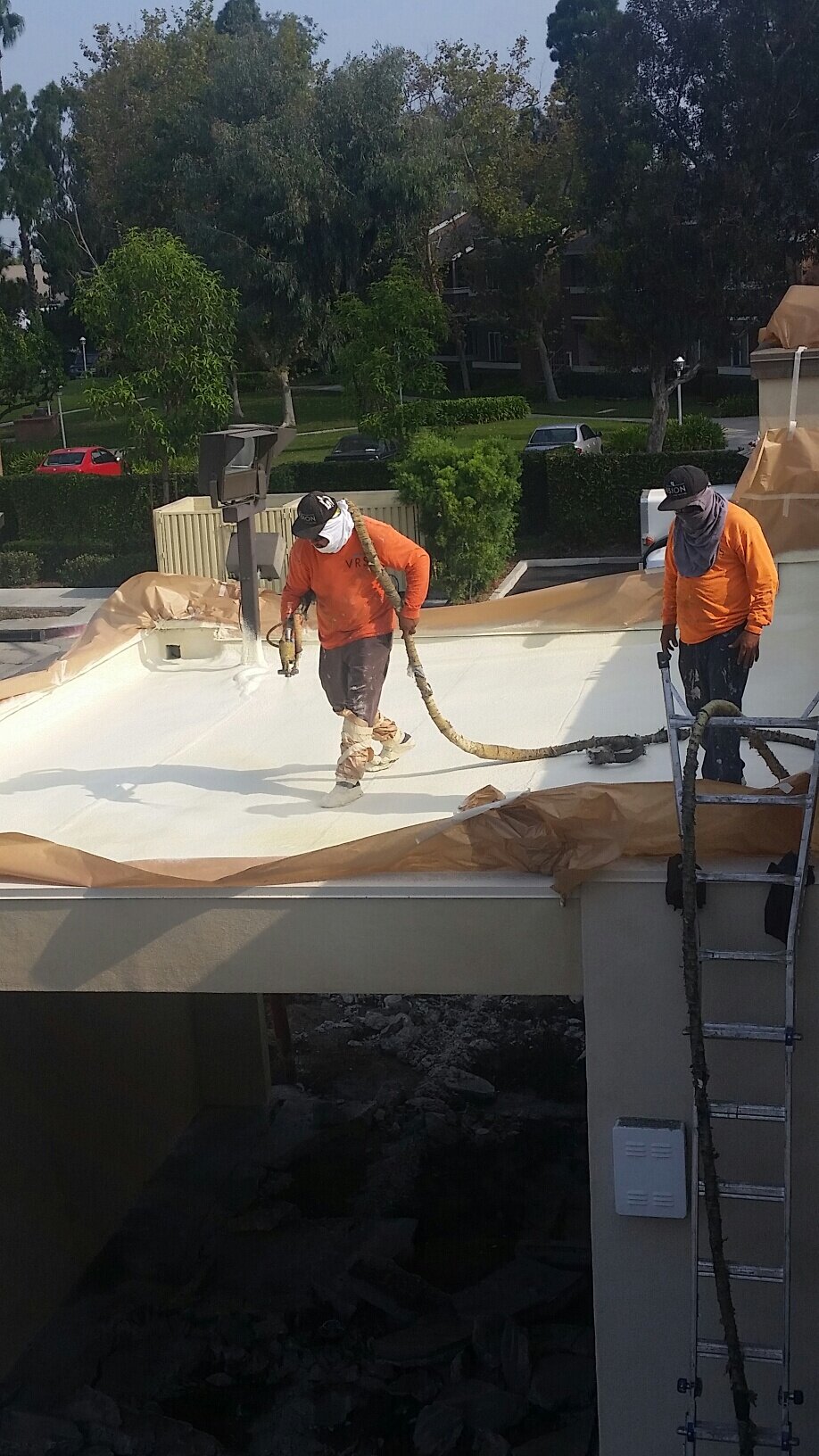
Rung 4. Recover. New roofing over the existing roof instead of after tearing it off. Foam over an existing low-slope roof is the common case here: no tear-off, no disposal, the building stays open. First rung that counts as a roof alteration, so Thresholds 2, 3 and 4 all apply.
A roof does not climb this ladder because it got old. It climbs because one of 4 measurable things happened.
What changed for Palm Desert roofing in 2026
3 things changed in January 2026, and the city's own Building and Safety web page has not caught up with any of them.
The code edition moved. Palm Desert Municipal Code 15.04.010 adopts the 2025 California Building Code by Ordinance 1439, adopted 8 January 2026, along with the 2025 California Fire Code at Chapter 15.26 and the 2025 California Wildland-Urban Interface Code at Chapter 15.16. Riverside County did the same by Ordinance 457.107, effective 7 January 2026. Meanwhile palmdesert.gov/build-develop/building-and-safety still reads "Effective January 1, 2023, the 2022 California Building Standards Code are in effect," citing Ordinance 1388. The codified ordinance governs. A contractor quoting the website's edition in 2026 is quoting a superseded page, and which edition your plan check runs under is a question for the plans examiner.
The wildfire roofing rules moved to a different book. California created the California Wildland-Urban Interface Code for the 2025 cycle by relocating chapters out of several parts of Title 24, and Chapter 49 was deleted from the California Fire Code as a result. The operative roofing requirement now sits at CWUIC 504.2: roofs in scope need an assembly with a Class A fire classification tested to ASTM E108 or UL 790. Any page still citing CBC Chapter 7A for 2026 Palm Desert work is citing the old location.
Palm Desert now carries designated fire hazard severity zones. Ordinance 1429, adopted 26 June 2025, adopts the city's CAL FIRE zone map, and Municipal Code 15.16.020(G)(1) designates moderate, high and very high zones inside the city. Local reporting on the 2025 state maps indicates most of the valley floor came out moderate, with very high confined largely to the mountain edges. That is reporting rather than a map read, so check your own parcel on the Office of the State Fire Marshal's viewer. In a zone, the material restriction reaches a small repair.
The 2025 Title 24 energy standards also took effect 1 January 2026, and the permit application date sets which edition applies to your job.
A rainless monsoon and a record El Nino signal, in the same year
Palm Springs recorded 0.00 inches of rain in July 2026 and 0.00 inches in August through the 23rd, while NOAA's Climate Prediction Center holds an El Nino Advisory with a greater than 90% chance of a very strong event this winter. Those 2 facts point opposite directions. The gap between them is your window.
| Station | Period | Actual | Normal |
|---|---|---|---|
| Palm Springs Regional | July 2026 | 0.00 in | 0.25 in |
| Palm Springs Regional | 1 to 23 Aug 2026 | 0.00 in | 0.10 in |
| Palm Springs Regional | Year to date | 1.23 in | 3.22 in |
| Thermal | Since 1 July 2026 | Trace | 0.20 in |
| Thermal | Year to date | 0.68 in | 1.89 in |
Source: National Weather Service climate reports, 23 August 2026. The monsoon window NWS Phoenix defines as 15 June through 30 September has delivered nothing measurable on the valley floor this year.
The winter signal inverts it. The Climate Prediction Center's ENSO Diagnostic Discussion of 13 August 2026 states that "El Nino is strengthening, with a greater than 90% chance of a very strong event during the Northern Hemisphere fall and winter 2026-27," and puts a 69% chance on a historic event exceeding +2.5C during October through December. CPC's seasonal discussion of 20 August 2026 raised the probability of above-normal precipitation above 50% across much of coastal California and adjacent southern Arizona for December through February. Palm Desert sits inland of that coastal zone, so read it as a regional signal, not a figure for this city.
What that does to a roof: it has been baking, not leaking. Dark roofing surfaces run 165 to 185F at midday in summer per EPA measurement, against 110 to 115F on a cool roof. Asphalt's oxidation rate roughly doubles for every 18F of temperature rise, per Lawrence Berkeley National Laboratory. The same research finds UV is not the main driver on granule-surfaced shingles, because the granules absorb most of it. Heat is. So this year's damage is real and invisible, because no water has arrived to reveal it. The first significant rain is the test.
Which service each roof type needs here
Roof type decides your service options before condition does. The 8 roof types on our regional page are not interchangeable in this market, and 3 of them behave differently here than they do 60 miles west.
| Roof type | The service that usually applies here | The threshold to watch |
|---|---|---|
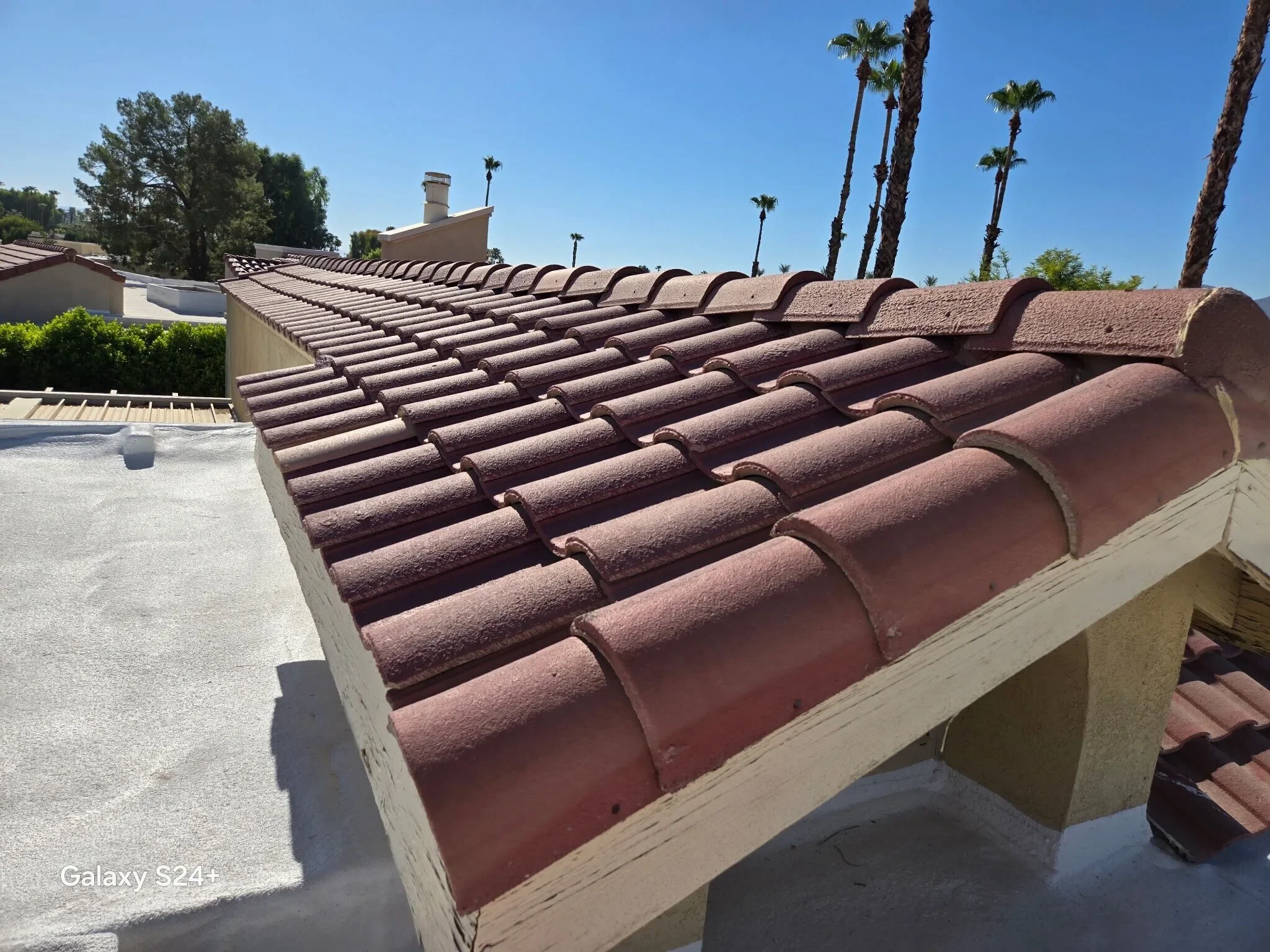
| Concrete and clay tile | Underlayment replacement with the tile lifted and reset. The tile commonly outlives 2 underlayments | Threshold 3: slate, clay and cement tile cannot be recovered over. Threshold 4 if adding tile to a structure that never carried it |
| Low-slope and flat | Recoat if the surface is inside its service window, spray polyurethane foam recover if it is not | Threshold 2, and on a commercial building the 2,000 sq ft leg, not the 50% one |
| Spray polyurethane foam | Recoat on schedule. A maintained foam roof is renewed, not replaced | Coating runs 20 to 40 mils dry film on a new install, recoat generally every 10 to 20 years per RICOWI and IBHS |
| Asphalt shingle | Repair, rejuvenation if the mat still flexes, or replacement | Threshold 1 on fire classification. Threshold 3 if 2 layers are already up, common on 1980s stock here |
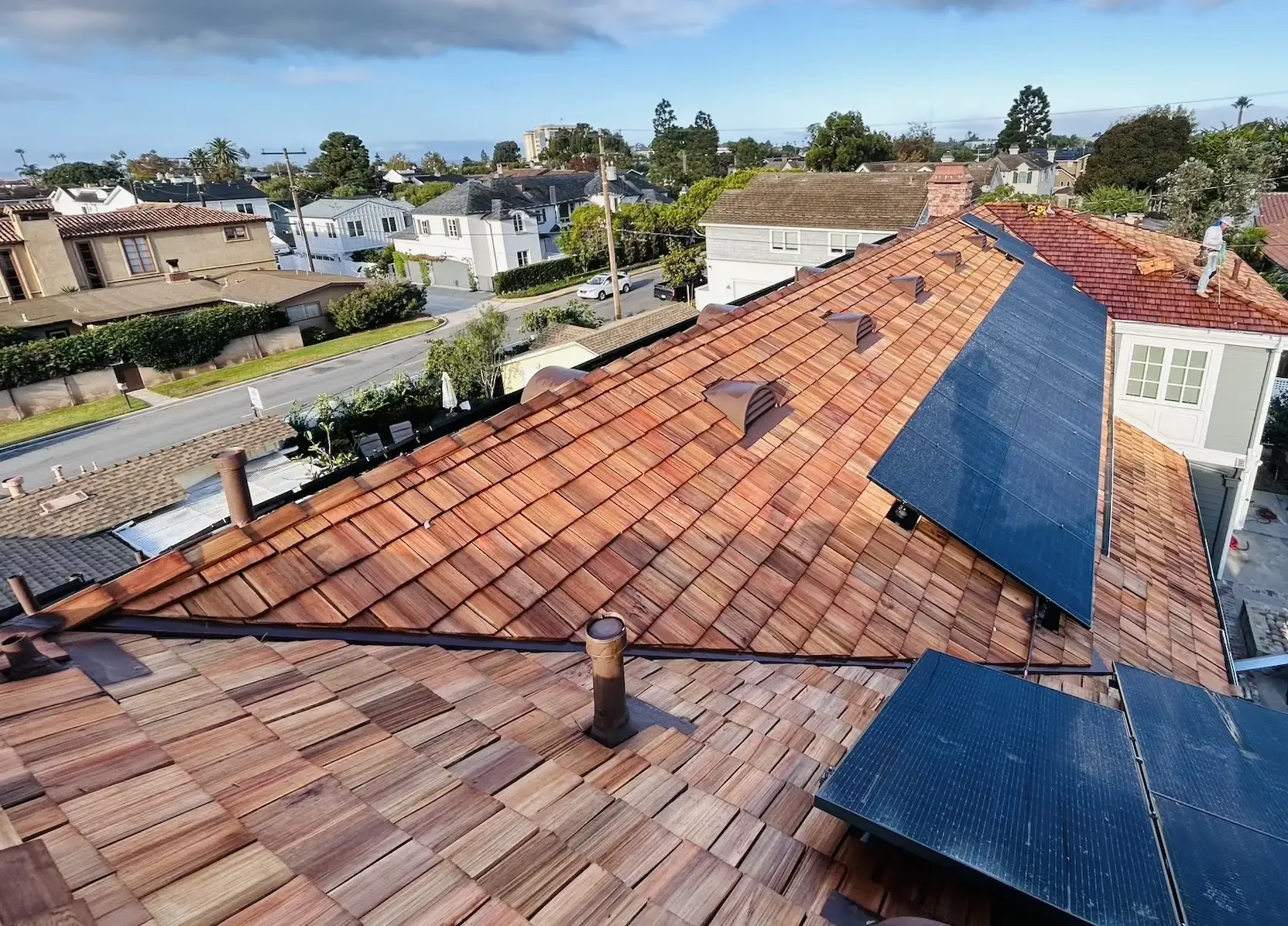
| Wood shake and wood shingle | Replacement with a compliant assembly, in nearly every case | Untreated shake cannot meet the statewide Class C floor, and shakes and shingles are prohibited in Fire Hazard Severity Zones |
| Metal | Repair, fastener and seam service, coating | Threshold 4 if the panel system weighs more than what came off |
| Modified bitumen | Recoat, foam recover, or replace | Threshold 2. Dark cap sheet will not meet the low-slope reflectance figure on a triggering alteration |
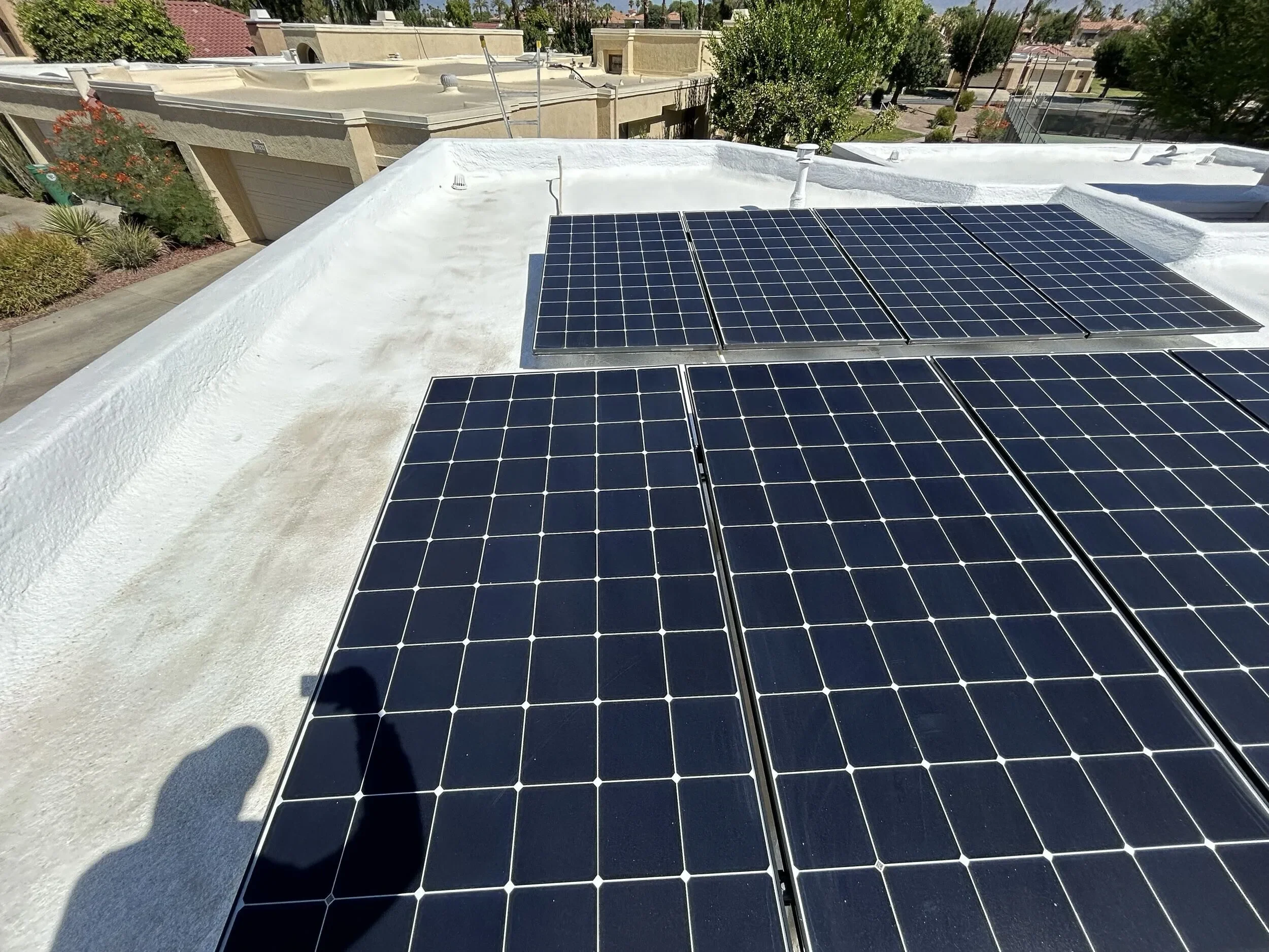
| Solar | The roof under the array is its own scope, and not a solar contractor's | Sequencing. A roof with less life left than the array commits you to detaching and resetting the panels |
Tile is the type most often mishandled here. The Tile Roofing Industry Alliance puts concrete and clay tile service life at 50 to 100 years or more, with most manufacturers warranting 50 or more, while TRI's own installation manual for moderate climate regions specifies 1 layer of ASTM D226 Type II No. 30 felt over the deck as the baseline underlayment. A tile roof failing at year 25 is usually not a tile problem. Ask what underlayment is going back down and what its temperature rating is: high-temperature products run to 260F or 265F, and their warranty terms differ by an order of magnitude.
Spray polyurethane foam, and the product most pages describe instead
Roofing foam is closed-cell, thermosetting, and 2.5 to 4.0 pounds per cubic foot. Open-cell foam is an insulation product and it is never installed on a roof. Nearly every page describing "spray foam," including the version that has been on our own regional services page, describes insulation: wall cavities, attic decks, crawlspaces, sound dampening for media rooms. That is a different material for a different job, and the density figures the insulation industry publishes belong to it, not to a roof.
The roofing figures, from the RICOWI and IBHS spray polyurethane foam roof guidance:
| Property | Roofing-grade SPF |
|---|---|
| Chemistry | Closed-cell, thermosetting |
| Density | 2.5 to 4.0 lb per cubic foot |
| Thermal resistance | R-5.5 to R-6.5 per inch |
| Minimum applied thickness | 1 inch |
| Compressive strength | Typically above 40 psi |
| Coating dry film thickness, new install | 20 to 40 mils total |
| Recoat interval | Generally every 10 to 20 years |
| Service life, maintained | In excess of 30 years |
3 consequences, and they are why foam owns commercial low-slope work in this valley. It goes over the existing roof, keeping you on Rung 4 instead of Rung 5. It is renewed rather than replaced, because the coating is a wear surface you recoat while the roof underneath keeps going, and no other common assembly works that way. And it self-flashes: foam is sprayed continuous around a penetration, so there is no separate flashing part and no seam at the base of a stanchion. On a roof carrying equipment or panels, that last one matters more than anything else in the table.
One attribution correction, because it circulates wrongly. SPFA-122 does not publish a fixed recoat interval or a renewal thickness. It says inspect twice a year and defer to the manufacturer. The 10-to-20-year figure belongs to RICOWI and IBHS; the SPFA FAQ page gives a wider 5-to-20-year window.
HOAs and gated communities: what the law gives you and what it does not
California gives you a 45-day deemed-approval right on a solar application and no equivalent right at all on a roof application. This is the most commonly mis-stated point in Coachella Valley roofing content, and having it backwards costs you a season.
Roof replacement, and any other physical change: Civil Code 4765. The association must provide "a fair, reasonable, and expeditious procedure," it must sit in the governing documents, it must "provide for prompt deadlines," and it must "state the maximum time for response to an application." A decision must be in writing, and a denial must include an explanation plus a description of how to ask the board to reconsider. The statute sets no day count and contains no deemed-approval provision. The number is whatever your own CC&Rs say. Go read them.
Solar: Civil Code 714(e)(2)(B). "If an application is not denied in writing within 45 days from the date of receipt of the application, the application shall be deemed approved," absent a reasonable request for more information. Solar energy systems only. It does not reach the roof underneath.
Disaster reconstruction: Civil Code 4766, added by SB 625, effective 1 January 2026. Real deadlines here: a completeness determination within 30 calendar days, with the application deemed complete if the association misses it, then approval or a full set of revision comments within 45 calendar days, and a final appeal determination within 60. It applies only to "a substantially similar reconstruction of a residential structure that was destroyed or damaged in a disaster," tied to a federal declaration or a Governor's proclamation. A routine re-roof sits outside it. Note the wording: deemed complete, not deemed approved.
2 more things before you file. Your association cannot force you into a code violation, because Civil Code 4205 puts the law above the governing documents and 4765(a)(3) bars a decision that violates a building code. That does not mean the committee has to accept the product you want; if a compliant option exists inside its palette, it can hold you to the palette. And submittal requirements are set by each association, not by state law, so pull your own architectural guidelines. Some valley associations want a physical tile sample and a manufacturer color chip on the table before review, which means ordering samples weeks before ordering material.
The sequence that works: read the CC&Rs for the response deadline, pull the guidelines for the submittal list, file the application, then book the work. Reverse it and a crew stands on a driveway waiting on a committee with no statutory clock running against it.
What we turn down
4 things, and saying so saves you a phone call.
Gutter cleaning. We do not do it.
Very small repairs outside our core service areas. Inside Palm Desert, La Quinta, Rancho Mirage, Indian Wells, Palm Springs, Indio and Cathedral City, a small repair is a normal job. 2 hours past that, the drive costs more than the fix.
Standalone wall foam insulation. We are moving out of it. If insulation is the real problem, an insulation contractor is the right trade.
Solar panel and electrical work. A C39 roofing license covers the roof, the mount blocking and the flashing. Panels and wiring need a C46 or C10 contractor. We do the roof half and work alongside whoever does the array.
Roofing Services
Repairs & Restorations
Spray Foam & Roof Coatings
Roof Inspections & Project Planning
New Construction Services
Roof Removal
Solar & Skylights
Certifications
Wall Foam Insulation
Roof Types
Tile
Foam
Pitched
Flat
Modified
Shake
Shingle
Solar
New Construction Services
Pre-construction planning
Safety and compliance advisory
Material sourcing and cost strategy
New residential roof implementation (single home, apartments, communities)
New commercial roof build out (foam, solar, traditional materials)
Post-construction maintenance
Frequently Asked Questions
Which roofing service does my Palm Desert property actually need?
The least invasive one your roof's condition and the code still allow: maintain, repair, renew the surface, recover, or replace. 4 published thresholds decide when you can no longer stay on the lower rung. An inspection tells you which applies.
Do I need a permit to re-roof a house in Palm Desert?
Yes. "Reroof: Replace roof" is a listed permit type, and Building and Safety is at 73510 Fred Waring Drive, (760) 776-6420. Minor spot repairs generally stay under the threshold. The city publishes no flat fee, so call with your square footage rather than trusting a range from a contractor site.
Can I put a new roof over the old one?
Sometimes. Not if 2 or more coverings are already up there, not if the deck is water-soaked or deteriorated, and not over slate, clay, cement or asbestos-cement tile. Those are the California Building Code's reroofing conditions and they are the most common real reason a tear-off is required. On 1980s Palm Desert stock, 2 existing layers is a frequent finding.
Are wood shake roofs allowed in Palm Desert?
Not in any practical sense. Untreated wood shake cannot meet California's statewide Class C minimum roof fire classification, and wood shingles and shakes are prohibited in Fire Hazard Severity Zones. Palm Desert has designated moderate, high and very high zones under Ordinance 1429, so check your parcel on the Office of the State Fire Marshal's viewer. In a zone, the restriction reaches even a small repair.
How long does my HOA have to answer a roof application?
As long as your CC&Rs say. Civil Code 4765 requires a fair, expeditious written procedure with prompt deadlines and a stated maximum response time, but the statute sets no day count and has no deemed-approval provision. The 45-day deemed-approval rule you may have read about is Civil Code 714, and it covers solar applications only.
Will my insurer drop me over the roof's age?
It is a real risk in California and it depends on your carrier. The California FAIR Plan, at 696,562 policies as of June 2026, excludes dwellings built more than 25 years ago from optional replacement-cost coverage unless the roof was updated within that period. No roofing service other than replacement changes the age in the file. A dated, photographed condition report is what helps in the meantime.
When should I get the roof looked at this year?
Before the first significant rain. Palm Springs recorded 0.00 inches in July 2026 and 0.00 inches through 23 August, while the Climate Prediction Center holds an El Nino Advisory with a greater than 90% chance of a very strong event this fall and winter. A dry summer hides heat damage because no water has arrived to reveal it. If the property is seasonal, which describes 27% of housing units in this city, book before you leave.
Book the Roof Health Check
We inspect, photograph, and tell you which rung your roof is on and which threshold, if any, has been crossed. Written report in 24 to 72 hours. No charge, and no obligation.
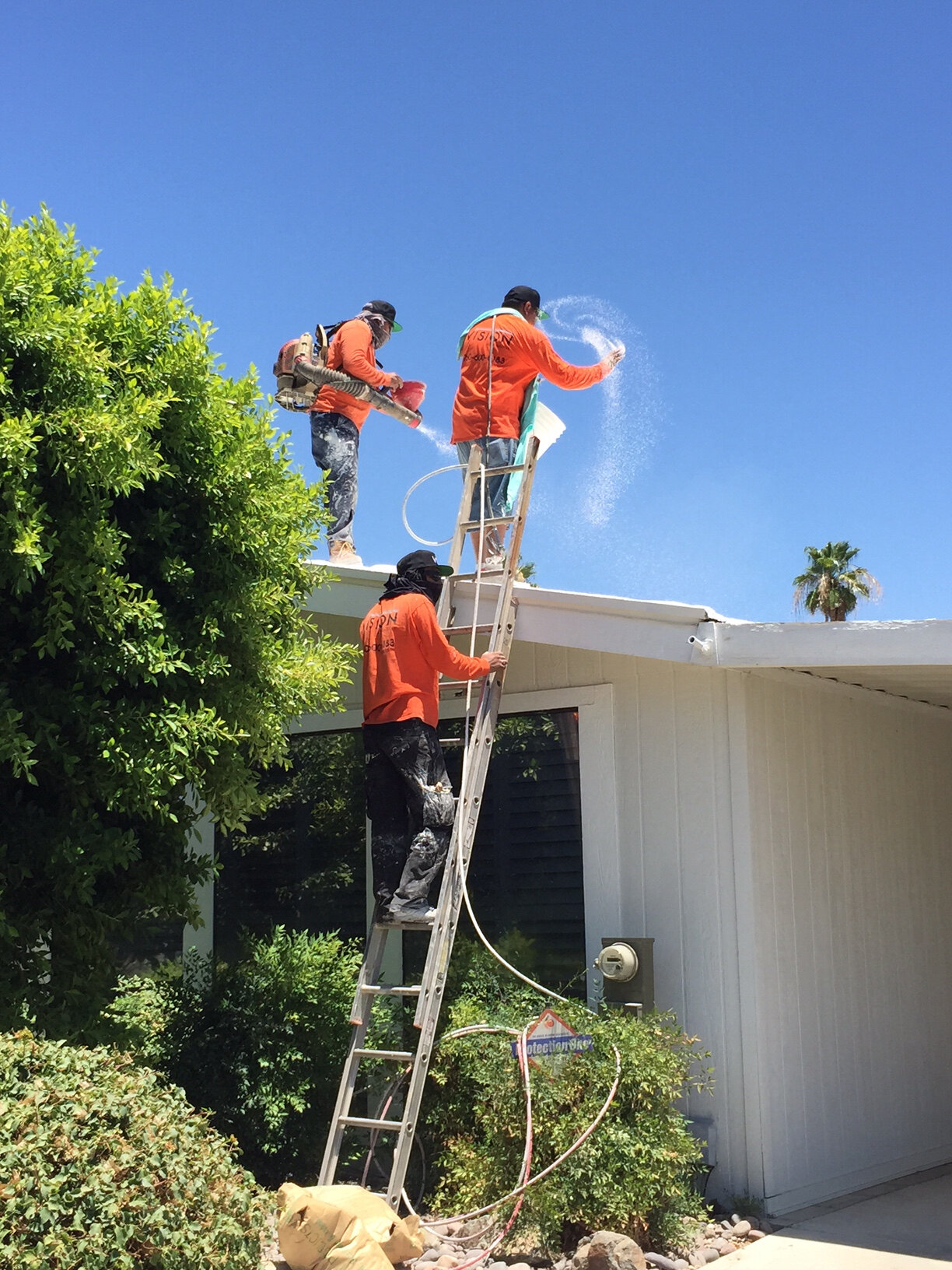
Our Unique Spray Foam ROOFING Service






Interested in seeing more of our work?
Visit our Featured Projects page for specific, challenging jobs we’ve completed.