Residential Roofing In Palm Desert, CA
Tile, shingle and flat-roof systems for Palm Desert homes.
Vision Roof Services is a roofing contractor at 41905 Boardwalk, Suite L in Palm Desert, holding California license 651509, issued 31 July 1992 and current through 2028. We reroof, repair and recoat tile, asphalt shingle, stone-coated steel, spray foam and low-slope roofs across the Coachella Valley.
Palm Desert's median home was built in 1985. That one fact drives most of this page: what your roof is made of, what the 2025 code now asks of it, whether your carrier will write replacement-cost coverage on it, and how long the thing on top of your house has left.
Start with the inspection. Written report, photographs, back to you in 24 to 72 hours. No charge, no obligation.
What changed for a Palm Desert reroof in 2026
Palm Desert moved to the 2025 California codes on 8 January 2026, and the city's own website has not caught up.
Four things shifted. None of the 13 pages competing for this search mentions any of them.
| What | Before | Now | Where it is written |
|---|---|---|---|
| Building, Energy and Wildland-Urban Interface codes | 2022 California codes, Ordinance 1388 | 2025 California codes, Ordinance 1439, effective 8 January 2026 | Palm Desert Municipal Code 15.04, 15.14, 15.16 |
| Fire hazard severity zones inside city limits | 2011 state maps, state responsibility area | Moderate, High and Very High designated in the Local Responsibility Area, Ordinance 1429, adopted 26 June 2025 | PDMC 15.16, section 302.1.1 |
| Cool roof requirement on a re-roof | 2022 Title 24 Part 6 | 2025 Title 24 Part 6, statewide from 1 January 2026, local from 8 January 2026 | California Energy Commission |
| The city's Building and Safety webpage | 2022 codes | still says 2022 codes as of 24 August 2026 | palmdesert.gov |
Your permit application date sets which edition your project runs under. If a proposal in front of you cites the 2022 standards, it was priced against a code that no longer applies here. Ask which edition the number is based on.
The Title 24 number your roof has to hit, and the tile exemption that does not apply
Palm Desert is California Energy Commission Climate Zone 15, the highest cooling-load zone in the state. A residential re-roof replacing more than 50% of the exterior roof surface has to meet a cool roof threshold, and the threshold depends on your slope.
From the Cool Roof Rating Council's 2025 Energy Code summary, effective 1 January 2026:
| Slope | Aged solar reflectance | Thermal emittance | Or SRI | Code section |
|---|---|---|---|---|
| Steep-slope, 2:12 and over | 0.20 | 0.75 | 16 | 150.2(b)1I |
| Low-slope, under 2:12 | 0.63 | 0.75 | 75 | 150.2(b)1I |
The product has to be CRRC-rated and labelled, listed in the CRRC Rated Product Directory, per section 10-113. Your contractor files a CF1R-ALT-05-E certificate at permit and a CF2R-ALT-05-E installation certificate at final inspection. If nobody has mentioned those forms, they have not priced the compliance work.
Now the part that is wrong on most contractor pages. The code does exempt heavy roofs: a roof construction weighing at least 25 pounds per square foot is exempt from the minimum requirements. Contractors reach for that constantly to explain why a tile roof needs no cool color.
It does not work. The heaviest clay tile in the code evaluation reports runs 14.7 lb per square foot. Standard concrete tile runs 9.0 to 12.4. Lightweight concrete runs 5.4 to 7.2. No residential tile system reaches 25. Tile complies on color, verified by CRRC ID per individual product, or it takes an alternative path. It does not comply on mass.
The alternative steep-slope paths are sometimes cheaper than changing color: a ceiling U-factor at or under 0.025 or R-38 and better, an attic radiant barrier per 150.1(c)2, or R-2 and better continuous insulation above or below the deck. Which one wins depends on what is already in your attic. That is a measurement, and it is one of the things we look at during the inspection.
Aged values are the ones that count, and they come from real desert exposure. ANSI/CRRC S100 requires 3 continuous years of outdoor exposure at 3 sites before a product can publish an aged rating, and one site has to be hot and dry. The standard names Phoenix as its example. That protocol is the closest thing in any standard to a Palm Desert aging test.
Worth knowing if you are recoating a low-slope roof: one widely used white silicone publishes an initial solar reflectance of 0.88 and an aged reflectance of 0.63, with an aged SRI of 76. The requirement is 0.63 and SRI 75. That product complies with no margin at all. So do not accept "silicone meets Title 24" as an answer. Ask for the CRRC listing, the aged number, and the product named on your CF1R.
What each system does in this climate
Concrete and clay tile
Tile is the valley's default and it earns it. The tile outlasts most of what it is fastened to, and the failure mode is underneath: underlayment, flashings, fasteners.
Weights from the code evaluation reports: lightweight concrete 5.4 to 7.2 lb per square foot, standard concrete 9.0 to 12.4, clay 7.5 to 14.7. That matters on a reroof over an existing structure, and to anyone moving up to a heavier system without a load review. Concrete tile code reports publish no mph rating at all, because attachment is designed roof by roof. Which is why the wind question above is the one to ask.
Stone-coated steel
Stone-coated steel is not Class A fire-rated on its own. Every listed Class A assembly for both major brands requires a purchased fire-barrier layer.
We install this product and have since 1992, and you should hear that from us rather than from a plan checker. Westlake Royal's Unified Steel reaches Class A with Sol-R-Skin BLUE thermal underlayment or GAF VersaShield over minimum 15/32-inch plywood, and over an existing wood roof it needs 1/2-inch gypsum, 1/4-inch DensDeck, or 2 layers of VersaShield. DECRA's assemblies require VersaShield mechanically fastened, or 1/2-inch UL gypsum board, or 1/4-inch DensDeck. That barrier is a line item. A bid promising Class A without naming it has not priced the roof.
The rest, from the code reports: panel weight 1.3 to 1.6 lb per square foot, roughly a fifth of standard concrete tile. Steel 0.017 inch, ASTM A792 Grade 33, AZ50 coating. Tested uplift resistance 53 to 128 lb per square foot direct-to-deck and 83 to 150 over battens for Unified Steel, 38 to 154 for DECRA. Minimum slope 3:12, or 4:12 on some profiles.
The widely quoted "120 mph" is a warranty term, not a test result. DECRA warrants panels resistant to blow-offs in wind velocities up to 120 mph. The tested values are the pounds per square foot above. Anyone quoting 120 mph as a rating is reading the warranty brochure.
On cool roofs, Unified Steel has 5 CRRC-listed products that clear Climate Zone 15 steep-slope at aged SRI 20 to 22. DECRA publishes no CRRC data for any product, so nobody should tell you a DECRA roof meets Title 24 without a listing to show you.
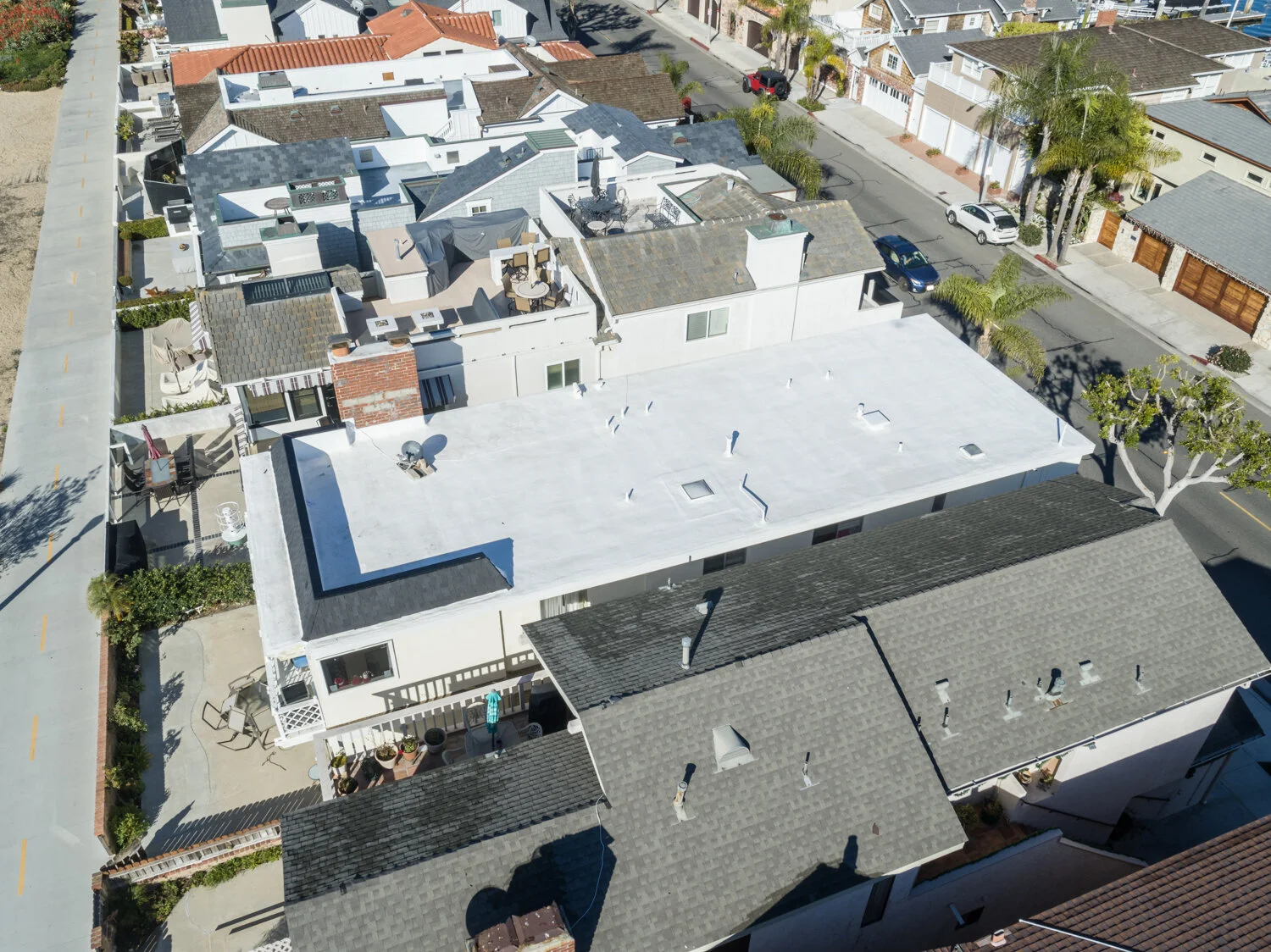
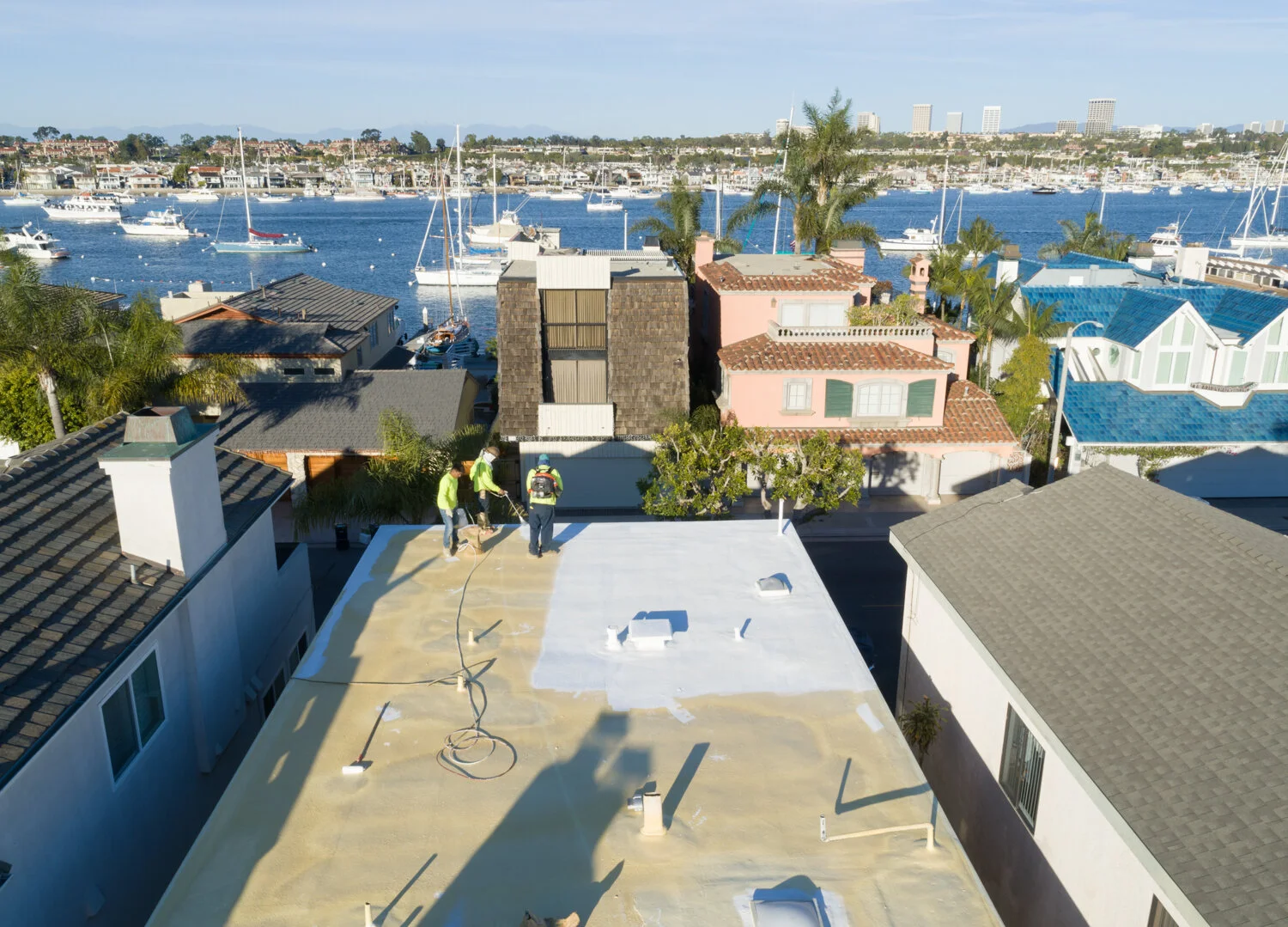
Silicone or acrylic coating over an existing low-slope roof
A restoration, not a replacement, and the cheapest protection per year on this page when the substrate qualifies. It seals seams, reflects heat and buys 10 to 20 years before the next coat. It does not fix wet insulation, failed decking or a drainage problem, and coating over any of those 3 is money spent hiding a fault. Compliance, once more: aged reflectance at or above 0.63 for low-slope in this zone, CRRC-listed, and the listed product has to be the one named on your CF1R.
Architectural asphalt shingle
The cheapest roof to install here and the one we replace youngest.
Shingles are a mat saturated with oil-based asphalt, surfaced with mineral granules. Heat drives the oil off. Lawrence Berkeley National Laboratory's review of roofing weathering reports that the rate of thermal oxidation roughly doubles for every 10 degrees Celsius of temperature rise, and LBNL's own field data show a 64 degree Fahrenheit rise at solar noon on asphalt shingles exposed in Redding, California in August. The EPA puts standard black asphalt roofs at 165 to 185 degrees Fahrenheit at midday in summer, against 110 to 115 for a cool roof.
Two findings worth reading before you pick a shingle. In 2016 NRCA tested 17 samples straight from manufacture, before any weathering: tear strength ran 797 to 1,797 grams against an ASTM D3462 minimum of 1,700, and only 2 of the 17 cleared it. Work by Shyti, Baskaran and Dragomirescu published in ASTM STP1650 in 2023, across more than 325 specimens, found field-aged shingles "displayed a maximum reduction of over 50% in tear strength," and that "the majority of the evaluated properties after aging no longer met the minimum requirements that are specified by the North American standards."
Shingles are failing spec before they go on the roof, and losing more than half of what is left once they are up there.
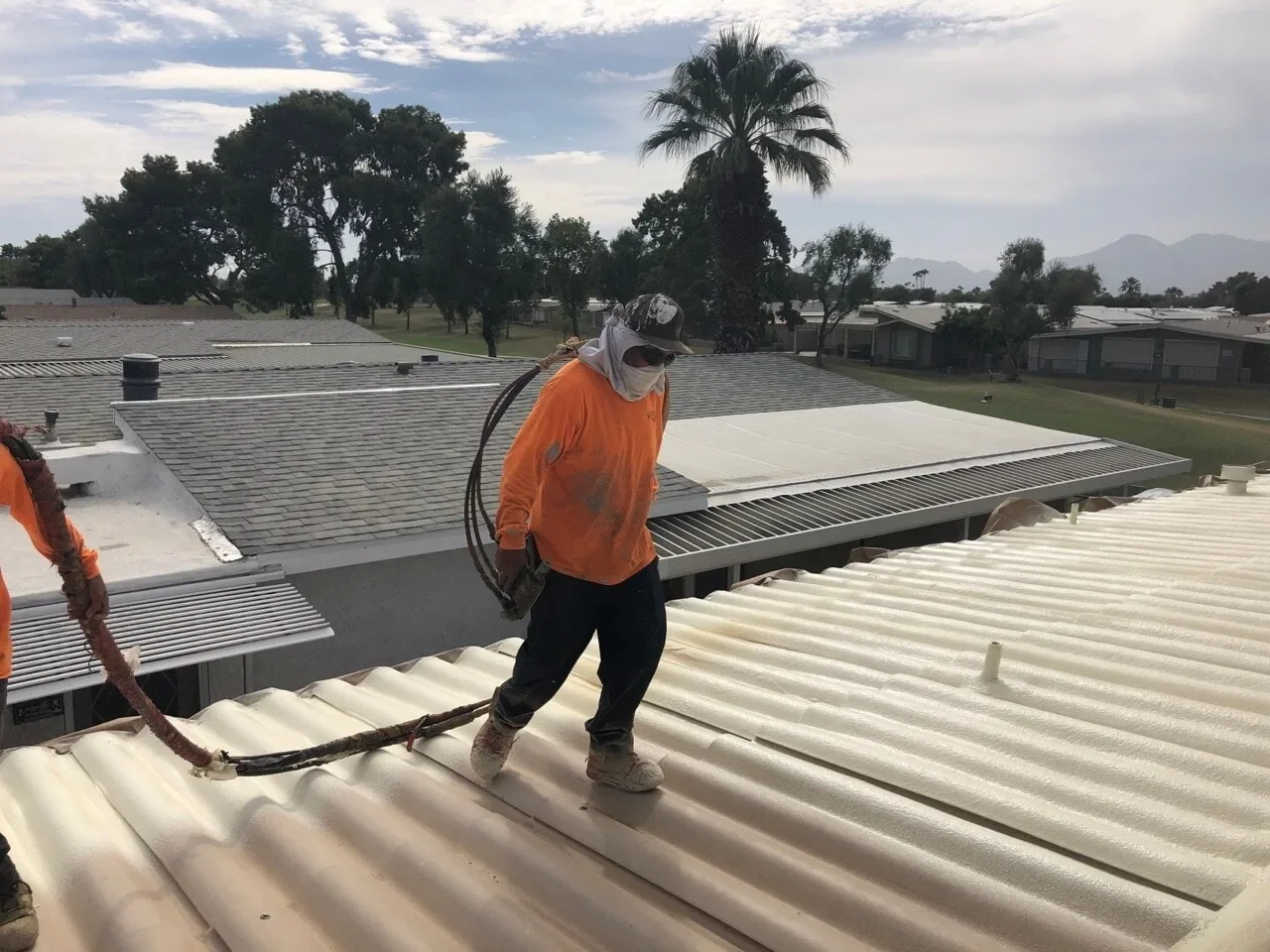
Spray polyurethane foam with a coating
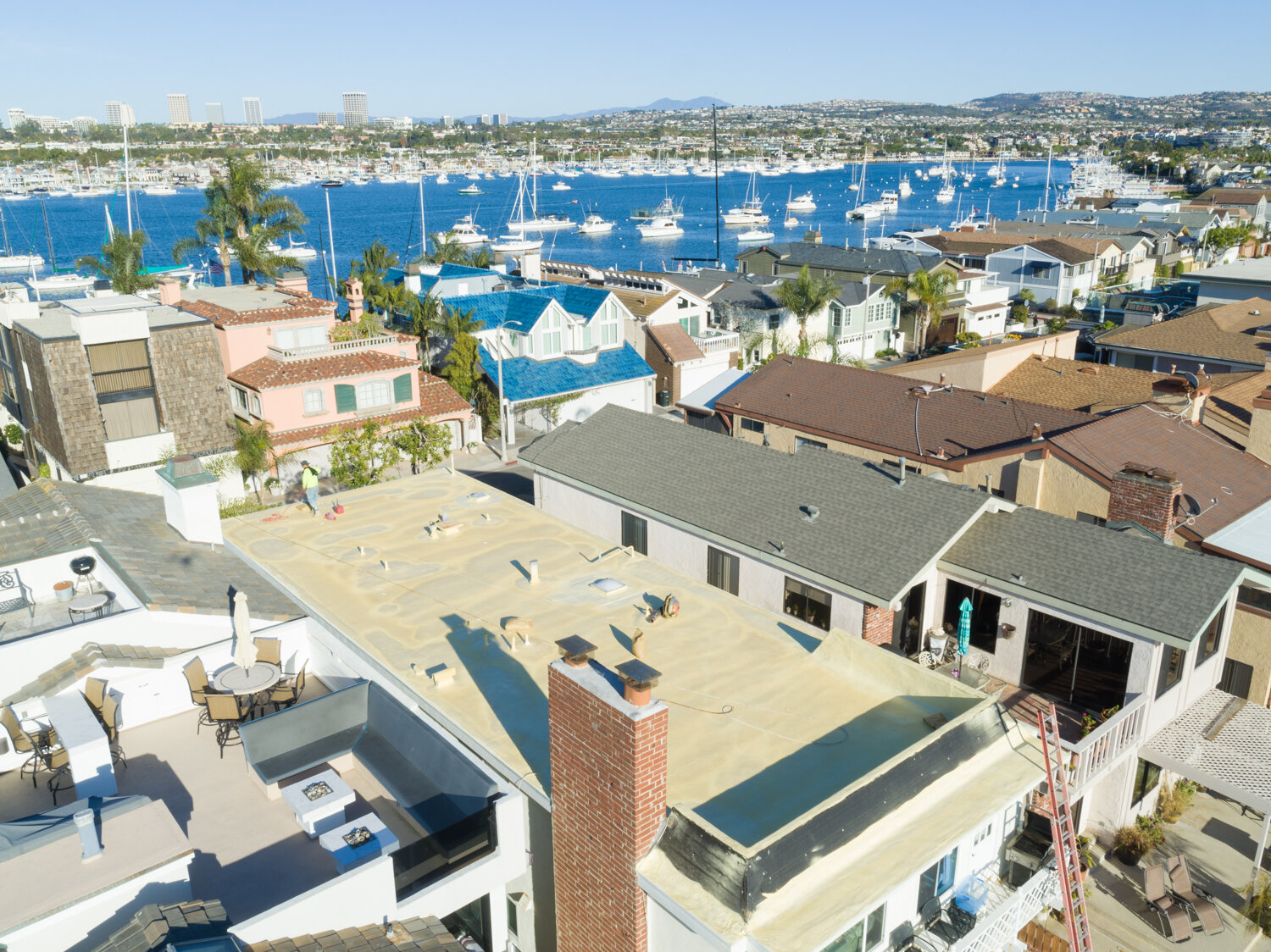
Our specialty, and on a low-slope Palm Desert roof it is the strongest dollars-per-year case on this page.
From the RICOWI and IBHS guidance: closed-cell roofing foam runs 2.5 to 4.0 lb per cubic foot at R-5.5 to R-6.5 per inch, compressive strength typically above 40 psi, minimum 1 inch thick. Coating goes on at 20 to 40 mils dry film thickness and needs re-application every 10 to 20 years. Maintained systems have shown service lives in excess of 30 years.
Foam self-flashes. On a membrane roof every penetration needs its own flashing component, and every component is somewhere a leak can start. Foam is sprayed continuous with the field of the roof, so there is no seam at the penetration because there is no separate part. That is why foam and rooftop equipment get along, and why it works under a solar array.
The failure mode is UV on bare foam. Left uncoated it darkens, turns friable and erodes. The coating is not cosmetic and the recoat date is not optional.
HOA and architectural review, and the deadline that does not exist
California Civil Code 4765 sets no numeric deadline for an association to decide an architectural application. Anyone telling you the HOA has 30 days by state law is wrong.
What 4765 requires, in its own words: the association "shall provide a fair, reasonable, and expeditious procedure for making its decision." A decision "shall be made in good faith and may not be unreasonable, arbitrary, or capricious." It "shall be in writing," and a disapproval has to explain why and describe how to seek reconsideration at an open board meeting. The deadline comes from your association's own governing documents, which the statute requires to state a maximum response time without saying what that time is.
30.7% of Palm Desert's housing units are single-family attached, which is condo and country-club product, and much of the detached stock sits inside an association too. For most of this city, the roof decision runs through a committee.
Two real examples. Palm Valley runs a Design Review Committee under guidelines last revised in December 2022: preliminary review decided "within thirty (30) days from the date of submittal," final design review "no later than forty-five (45) days," a variance within 30 days, and a fee may be charged. Roof color is controlled through the exterior color package, and each package "will be offered in at least three choices in roof tiles." Vents and flues "shall be located to occur on the least prominent side of the ridgeline whenever possible and shall be coated with a flat paint to match the color of the roof."
Sun City Palm Desert runs a Lifestyle Enhancement Committee. On a sale the LEC inspects the exterior for Design Guidelines compliance, and violations have to be resolved between seller and buyer before closing. So a roof that has drifted out of compliance surfaces in escrow, at the worst possible moment. Alterations line: (760) 200-2278.
The finding that will save you the most time. Most Palm Desert associations publish their Rules and Regulations online and keep the CC&Rs and the Architectural Guidelines behind a member portal. The binding roof language is almost always in the documents that are not published. Request both in writing before you sign a roofing contract, and ask for the approved material and color list in the same email.
One thing your solar rights do not cover. Civil Code 714 voids covenants that prohibit a solar energy system, caps added cost at $1,000 for PV, and deems an application approved if it is not denied in writing within 45 days. That clock applies to the array. Section 714 says nothing about roofs, roof structure or reroofing. A reroof under existing panels runs on your association's ordinary timeline.
We prepare the HOA submittal package as part of the job: material and color specification, the CRRC listing for your Title 24 compliance path, product data, and the fire-assembly detail where the zone requires it.
5 jobs we turn down
We say no to work in this valley every week. These are the 5 reasons.
Gutter cleaning. We do not do it. Ask and we will tell you who does.
Very small repairs outside our core service areas. A single cracked tile 90 minutes from the shop costs you more in the truck roll than the repair is worth. Inside Palm Desert, La Quinta, Rancho Mirage, Indian Wells, Indio, Cathedral City and Palm Springs, call us for anything.
A coating over a wet roof. If the insulation is saturated or the decking soft, a coating traps the problem and bills you for hiding it. The tear-out comes first or we walk.
Standalone wall foam insulation. We are moving away from it.
A roof somebody else has to survey. If the structure needs a load review before it can carry a heavier system, that is an engineer's signature, not ours. We will say so rather than guess it.
If your job is one of these, the inspection still tells you what the roof needs and what it should cost. No charge either way.
Why homeowners call us
A roofer who grew up in HOA roofing
Vision Roof Services was founded by Dave Bienek, who started roofing at 15 alongside his father, a roofer who specialized in HOA communities. That is the exact world a Mission Viejo homeowner lives in: tile roofs, architectural committees, and color rules. Dave has worked in roofing since 1992 and founded Vision Roof Services in 2014.
Today the company runs a 60-person crew and has completed roughly 7,500 roofs across Southern California. We are a maintenance-first shop, which means the goal is the roof that lasts, not the quickest sale. Homeowners pick us for responsiveness, the documented inspection process, and straight answers.
We also back the community we work in, including El Toro High School football here in South Orange County.

CSLB #651509 · Licensed & Insured

BBB A+ Accredited

Best of BuildZoom 2024

Spray Polyurethane Foam Alliance
Services for Custom Homes
VRS works with custom home owners (and builders) to consult on projects during the architectural planning phase, as well as post-construction for existing homes that require new roofs or repairs.
Single Home Roof Installation
Community Roof Installation
Project Planning
Materials Consultation
Solar Installation
Frequently Asked questions
Does my new roof have to be a cool roof?
If you are replacing more than 50% of the exterior roof surface, yes. Palm Desert is Climate Zone 15. Steep-slope needs an aged solar reflectance of at least 0.20 and thermal emittance of at least 0.75, or SRI 16. Low-slope needs 0.63, 0.75, or SRI 75. The product has to be CRRC-listed and named on a CF1R certificate. Alternative steep-slope paths exist through attic insulation or a radiant barrier, and which is cheaper depends on your attic.
Is my tile roof exempt because tile is heavy?
No. The mass exemption starts at 25 lb per square foot. The heaviest clay tile in the code reports runs 14.7, standard concrete tile 9.0 to 12.4, lightweight concrete 5.4 to 7.2. No residential tile system reaches the exemption. Tile complies on color, verified per individual product listing, or through an alternative path.
Will my insurer drop me over roof age?
It happens, and roof age is the field they score. The California FAIR Plan's own form states that buildings over 25 years old are not eligible for Dwelling Replacement Cost Coverage unless the roof has been updated in the last 25 years. As reported by Insurance Business in May 2026, Mercury and Wawanesa generally decline roofs over 25 years with exceptions for tile and slate, and Farmers may limit asphalt roofs past 15 years to actual cash value. Get your carrier's requirement in writing before you spend anything, and ask exactly what documentation they accept.
How fast does my HOA have to answer?
That depends entirely on your association's documents. California Civil Code 4765 requires a fair, expeditious written procedure with stated deadlines, and sets no number itself. Palm Valley's guidelines give its Design Review Committee 30 days for preliminary review and 45 for final. Yours may differ. Request the CC&Rs and the Architectural Guidelines as well as the Rules and Regulations, because the roof language usually lives in the 2 documents associations do not publish online.
Does my solar array give me a faster roof approval?
No. Civil Code 714's 45-day deemed-approval rule applies to the solar energy system. The statute says nothing about roofs or reroofing. A reroof under existing panels runs on your association's ordinary architectural timeline.
Is stone-coated steel fireproof?
It is not Class A on its own, and any contractor who says otherwise has not read the code report. Both major brands reach Class A only in listed assemblies that include a purchased fire barrier: Sol-R-Skin BLUE, GAF VersaShield, 1/2-inch gypsum board or 1/4-inch DensDeck, depending on the deck. It is a strong roof in a fire zone. It needs the barrier to get there, and the barrier belongs in the bid.
What wind speed should my roof be fastened for?
Riverside County lists Palm Desert as an ASCE 7 special wind region. The county's published design load criteria put special wind regions at 130 mph against 100 mph for Risk Category II construction elsewhere in the county. Ask any bidder what design wind speed their fastening schedule assumes. On the same day in June 2008, the Palm Desert station recorded 48 mph gusts while the Whitewater Wash monitor recorded 76.
My house is empty half the year. What should I be doing?
27% of Palm Desert's housing is vacant for seasonal or occasional use, so this is the most common situation in the city. Two things. Get the roof inspected before monsoon season, which the National Weather Service runs from 15 June to 30 September, and inspected again when you come back. A leak in an unoccupied house is found by the damage, not by the drip. We schedule pre-season and post-season checks for absentee owners, and the written report is what you forward to your property manager or your carrier.
Start with the report, not the quote
No charge for the inspection. Written report with photographs in 24 to 72 hours, covering condition by slope, the Title 24 compliance path your roof needs, the fastening schedule for a 130 mph zone, and one of 4 recommendations. If the roof has years left, we say so.