
Solar Roofing In Palm Desert, CA
We build the roof your panels sit on. A licensed solar contractor installs the array.
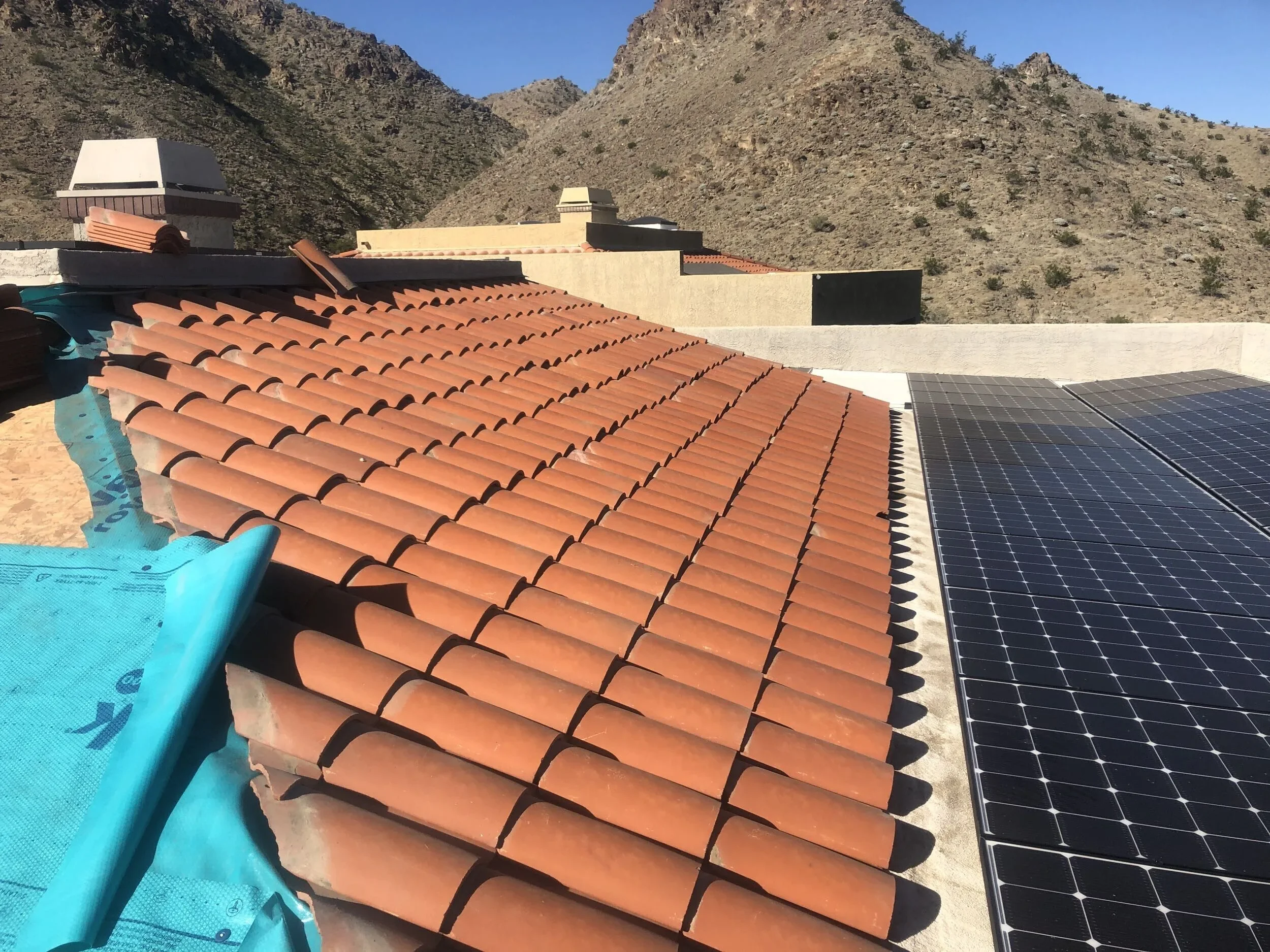
Vision Roof Services is a roofing contractor based at 41905 Boardwalk, Suite L in Palm Desert, holding California license 651509. On a solar job we handle one half of it: tear-off or recover, spray polyurethane foam, mount blocking, flashing, and the waterproofing warranty. Panels and wiring go in by a licensed C-46 solar or C-10 electrical contractor, because California puts PV modules and electrical outside the scope of a roofing license. Most solar quotes in the Coachella Valley price the array and say nothing about the roof under it. In Climate Zone 15, where the July average high is 107 F, that is the part that gives out first.
What we do on a solar job, and what we don't
We do the roof. We do not install panels or electrical.
That line matters more than it sounds. Under California contractor licensing, a C-39 roofing contractor may install solar mounting brackets and the flashing that waterproofs them as part of a roofing project, but cannot install the modules or the wiring without also holding a C-46 Solar or C-10 Electrical classification. Plenty of companies blur this. We would rather tell you where the line is, because it is the line that decides who owes you a repair when water shows up on a ceiling three years from now.
| Roof scope: Vision Roof Services | Solar scope: your C-46 or C-10 contractor |
|---|---|
| Roof condition report and remaining-life call | Array design, module and inverter selection |
| Tear-off, recover, or spray foam application | Racking layout and module mounting |
| Mount blocking and structural attachment points | DC and AC wiring, rapid shutdown, labeling |
| Flashing and waterproofing at every penetration | Inverter, battery, and main panel work |
| Coating, recoat schedule, roof warranty | Utility interconnection application |
| Detach and reset coordination on a re-roof | System monitoring and production warranty |
Two contractors, one roof, and a clear seam between who owns what. When a leak appears at a stanchion, nobody spends 6 weeks arguing about whose bracket it was.
The Solar-Ready Roof Gate
Six checks decide whether your roof should carry an array yet. We run all 6 during the Free Roof Health Check and give you a written pass or fail on each. Every threshold below comes from published code or published industry standards, not from our opinion.
Remaining roof life against array life.
Module power warranties run 25 to 30 years. If your roof has fewer than 15 years left, the array will outlive it and somebody will be paying to take the panels off and put them back. Pass: remaining roof life of 15 years or more, or a re-roof scheduled before the install. Fail: anything shorter, with no plan.
Attachment load.
Penetrating rack systems add roughly 2 to 3 pounds per square foot. Ballasted systems add 4 to 6 pounds per square foot in the field and 12 to 17 at the perimeter. Sprayed polyurethane foam typically exceeds 40 psi compressive strength, which handles it, but the structure underneath has to be checked too. Pass: a structural review that clears the method chosen. Fail: ballast added to a roof nobody calculated.
Drainage under the array.
Shaded roof dries slower than exposed roof. Water that used to evaporate in an afternoon now sits. Racking that blocks flow toward a drain or scupper turns a dry roof into a wet one. Pass: rack layout that preserves the drainage path, with notched pads under ballast contact points. Fail: rails laid across the flow line.
Substrate and slope.
Tile, low-slope foam, modified bitumen, and metal each want a different attachment. Low-slope roofs in Palm Desert carry a Title 24 cool roof obligation that a dark membrane will not meet. Pass: a substrate the mount manufacturer publishes a detail for. Fail: brittle or delaminated tile, saturated insulation, or a substrate with no published detail.
Coating and UV protection.
Uncoated spray foam darkens, turns friable, and erodes under desert sun. A coating system at 20 to 40 mils dry film thickness is what stops that, and it needs re-application every 10 to 20 years. Pass: coating within its service window, with a recoat date on the calendar. Fail: exposed foam, or a coating past due with an array now sitting on top of it.
Code and permit path.
The permit application date sets which code edition applies, and since 1 January 2026 that is the 2025 Title 24 standards. Under the 2025 code, required PV is sized at the lesser of an equation result or the solar access roof area at 14 watts per square foot on low-slope and 18 watts per square foot on steep-slope. A qualifying battery of at least 7.5 kWh cuts the required PV by 25%. Pass: the roof plan and the permit path agree before anything is ordered. Fail: finding out at inspection.
Why Climate Zone 15 is harder on your roof than on your panels
Palm Desert sits in California Energy Commission Climate Zone 15, the zone with the highest cooling load in the state. July averages a 107 F high and a 77 to 80 F low. Incident solar energy in July runs 7.7 to 8.5 kWh per square meter per day.
Those are good numbers for production. They are hard numbers for roofing material. Sun that generates well also breaks down membranes, bakes plasticizers out of coatings, and erodes uncoated foam. The roof takes that load every day whether or not there are panels on it, and the array only shades part of it.
There is an upside worth knowing, and it runs both directions. Modules mounted 4 to 5 inches above the roof surface get enough airflow to cool themselves, which is where you want them in this heat, and they shade the roof underneath at the same time. A reflective coating under the array does the same job from the other side by keeping the surface temperature down. Cooler roof, cooler modules, more output. Title 24 already asks for reflectance on low-slope roofs in this climate zone. In the desert, the code requirement and the performance choice happen to be the same choice.
How solar mounts attach to a foam roof without leaking
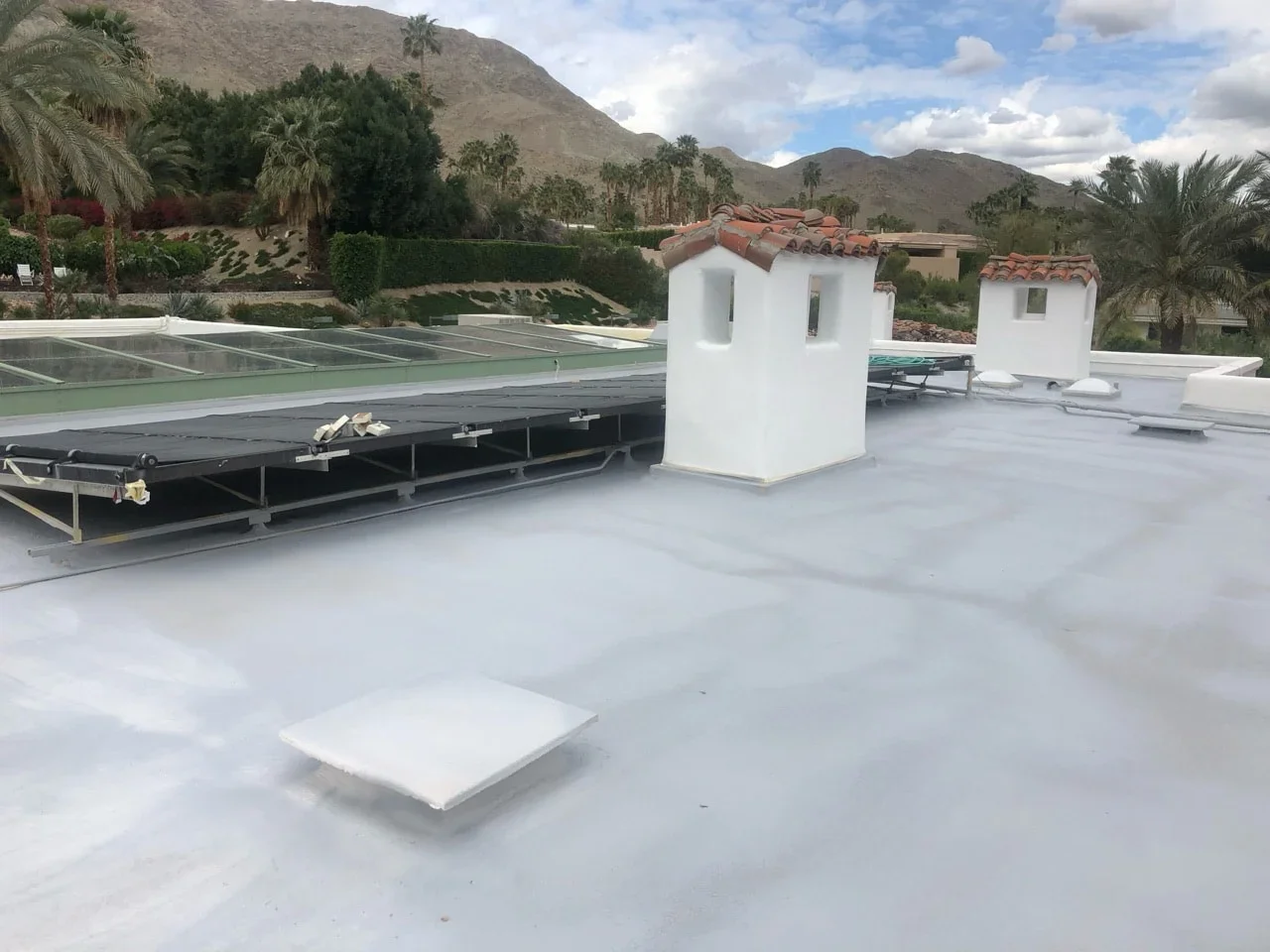
Spray polyurethane foam self-flashes. That is the short answer, and it is the reason foam and solar work well together.
On a membrane roof, every stanchion is a hole that needs a separate flashing component, and every one of those components is a place a leak can start. On a foam roof, foam is sprayed around the mounting base and becomes continuous with the field of the roof. There is no seam at the penetration because there is no separate part.
The material specifics, from the IBHS and RICOWI roofing guidance: closed-cell SPF gives R-5.5 to R-6.5 per inch, densities run 2.5 to 4.0 pounds per cubic foot, compressive strength typically exceeds 40 psi, coatings are applied at 20 to 40 mils dry film thickness with the base coat going on within 24 hours of the foam, and maintained SPF roofs have shown service lives beyond 30 years.
One local constraint on method: Palm Desert's SolarAPP+ auto-issue path covers roof-mounted residential PV only. Ballasted and ground-mounted systems are excluded, so if you were planning to skip penetrations with ballast, that design leaves the fast permit track.
HOA boards, property managers and commercial roofs
Commercial and multifamily buildings kept the tax credit that homeowners lost. Section 48E remains available to the system owner, which is why lease and PPA structures still work on commercial roofs in 2026 when a cash residential purchase no longer pencils the same way.
Our commercial specialty is spray polyurethane foam, and on a low-slope roof carrying an array the argument for foam gets stronger, not weaker. Foam goes over most existing roofs without a tear-off, which cuts disposal cost and keeps the building operating. It self-flashes at every stanchion. It is recoated rather than replaced, on a 10 to 20 year cycle, which means the roof under the array can be renewed without the array coming off.
For HOA boards and property managers, the sequencing question is the whole question. An array installed over a roof with 8 years left commits the association to a detach-and-reset bill inside the next capital cycle. Get the roof assessed and the remaining life documented before the solar vote, not after.
We are a fit for commercial and HOA low-slope work, flat roof replacement, recoats, and roof maintenance programs. We are not a fit for very small repairs outside our core service areas, or gutter cleaning.
Frequently Asked Questions
Is there any battery rebate money left in California?
Very little for a standard residential project. The CPUC's SGIP dashboard shows small residential storage at Step 7, closed, in all 4 utility territories as of 23 August 2026, and Equity Resiliency closed as well. Some AB 209 sub-budgets under the Residential Solar and Storage Equity program remain open in SCE and PG&E territory, and the ratepayer variant is closed. Check the current dashboard before budgeting anything.
Can the City of Palm Desert hold my solar permit until my HOA signs off?
No. Chapter 15.17 of the Palm Desert municipal code, adopted January 2026, bars the city from conditioning a solar permit on association approval. The HOA process and the permit process run separately.
Am I on SCE or IID, and does it matter?
Most of Palm Desert is Southern California Edison. The valley boundary runs roughly along Washington Street, with La Quinta, Indio, and Coachella on Imperial Irrigation District. It matters: IID credits exports at a flat 6.98 cents per kWh, while SCE uses hourly avoided-cost values. That difference changes whether a battery pays for itself. Verify your parcel with the utility rather than assuming from your city name.
Will solar void my roof warranty?
It can, and the detail that decides it is who penetrates the roof and how. Manufacturer coverage generally survives a properly detailed and flashed penetration. Workmanship coverage is where the exposure sits, and a second contractor working on a roof somebody else warrantied is the usual way it gets voided. Before the array is ordered, get in writing which contractor owns the penetration detail and which warranty covers a leak at a stanchion.
Can Vision Roof Services install the panels?
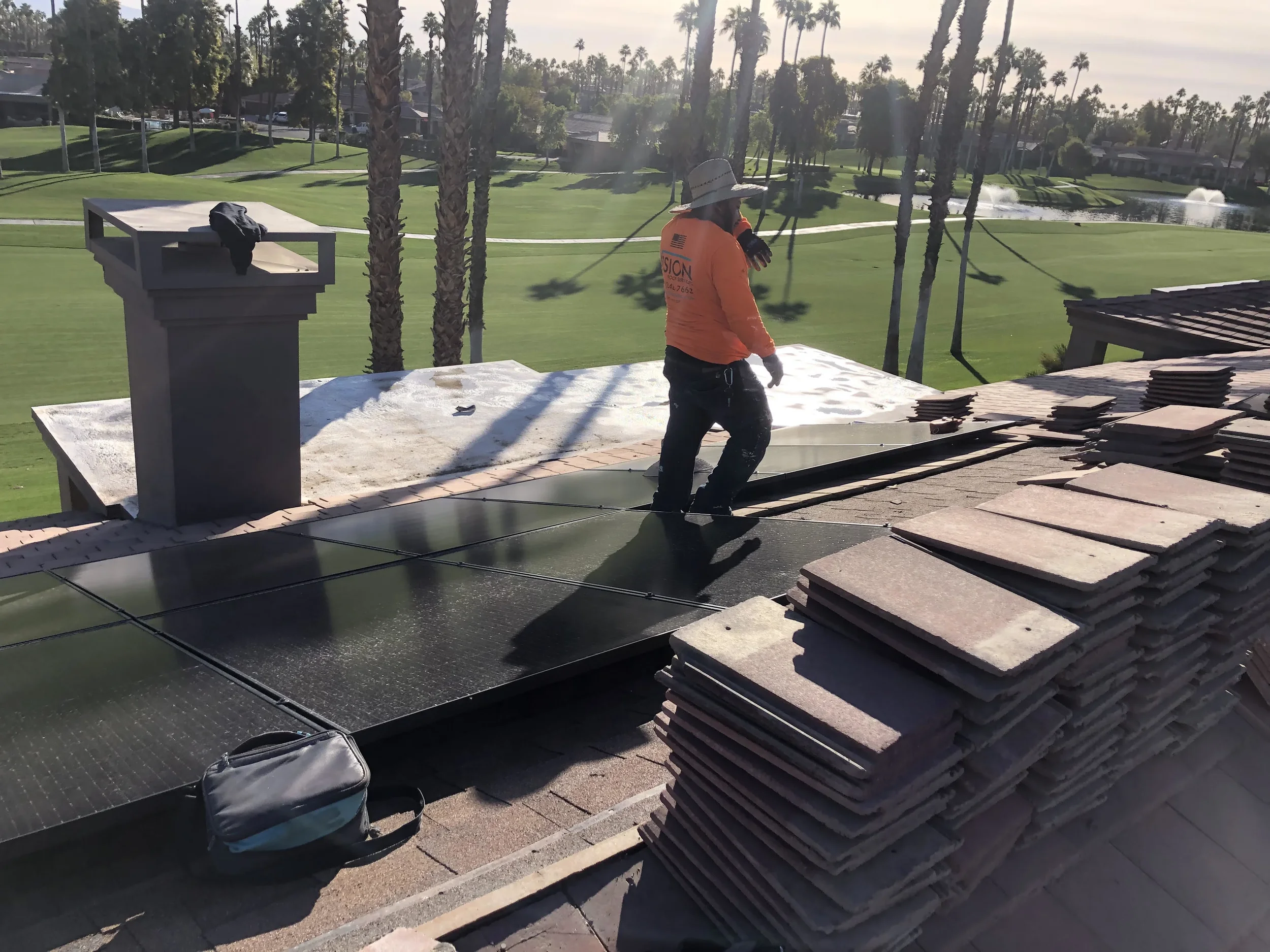
No. We hold a roofing license, and California requires a C-46 Solar or C-10 Electrical classification to install PV modules and wiring. We do the roof, the mount blocking, the flashing, and the waterproofing warranty, and we work alongside the licensed solar contractor doing the array. If you do not have one yet, we can tell you what to ask them.
Start with the roof
Book the Free Roof Health Check. We inspect, photograph, and score your roof against all 6 gates, then send a written report in 24 to 72 hours. You get a documented remaining-life number and a pass or fail on each gate, whether or not you ever hire us.