Commercial Roofing In Palm Desert, CA
Spray foam, coatings and low-slope systems for commercial buildings.
Vision Roof Services is a commercial roofing contractor based at 41905 Boardwalk in Palm Desert, holding California license 651509 in classification C-39, issued in 1992 and active. We install and maintain spray polyurethane foam and coating systems on low-slope commercial buildings across the valley. Palm Desert sits in California Energy Code Climate Zone 15, which the city states on its own plan review page. On a commercial building, the state's cool roof and insulation requirements fire on any roof alteration covering more than 50% of the roof area or more than 2,000 square feet, whichever is less. That threshold is what separates a maintenance line item from a capital project, and it is the first thing we work out on your building. You get the answer in writing, with photographs, inside 24 to 72 hours.
The 2,000 square foot line
On a commercial building in California, the energy code's cool roof and insulation requirements fire on a roof alteration covering more than 50% of the roof area or more than 2,000 square feet, whichever is less. On a 30,000 square foot roof, 2,000 square feet is 6.7% of the area. Most commercial re-roofs in this valley cross that line before the first crew arrives.
That is the sentence to carry into every bid conversation you have this year. The 2025 Building Energy Efficiency Standards took effect 1 January 2026. The rules below are not new in kind, but the current cycle is what your plan check runs against, and almost nobody selling roofs in the Coachella Valley is putting the numbers in front of you.
What a low-slope commercial roof in Climate Zone 15 has to hit.
Aged solar reflectance of at least 0.63 and thermal emittance of at least 0.75, or a Solar Reflectance Index of at least 75. That is the prescriptive requirement in Section 140.3(a)1, applied to alterations by Section 141.0(b)2B. Steep-slope commercial in this zone is lighter, though by less than the figures still circulating suggest: aged solar reflectance of 0.25 and thermal emittance of 0.80, or SRI of 23. The 0.20 and SRI 16 numbers belong to the 2019 cycle and, in the current code, to Climate Zones 1 and 3. SRI is an alternative to giving reflectance and emittance separately, calculated under ASTM E1980-11(2019).
The insulation number, which almost every cost guide gets wrong.
On a low-slope roof, the area of a roof recover or roof replacement has to be insulated to the level in Table 141.0-C. For Climate Zones 1 through 5 and 9 through 16, which covers all of Riverside County, that is R-23 continuous insulation, or a U-factor of 0.037 where continuous and cavity insulation are combined with at least R-10 continuous above the deck. Cost guides published this summer still print R-30. On a 30,000 square foot roof that is not a rounding difference in either direction. Ask every bidder which number they used and which table they read it from.
A white roof is not automatically a compliant roof.
Section 110.8(i)1 requires the aged solar reflectance and thermal emittance of the roofing product to be certified and labeled under Section 10-113, and Section 10-113 designates the Cool Roof Rating Council as the supervisory entity for that rating. A product with no certified rating does not fail outright: the code assigns it default values instead, 0.10 aged solar reflectance for most products, 0.08 for asphalt shingles, and 0.75 emittance. Those defaults sit nowhere near the Climate Zone 15 threshold, so on the prescriptive path an unrated product is a non-compliant product. Ask any bidder to show you the product in the CRRC Rated Product Directory before you sign.
3 exceptions worth knowing before you choose a path:
• A recover does not have to meet the full R-23 if at least R-10 continuous of new insulation goes above the existing roof system.
• Areas receiving only a liquid-applied coating are not required to be insulated at all.
• Where insulation thickness would break the flashing height at equipment curbs, it can be limited to the greater of R-10 continuous or the maximum thickness that still allows proper flashing per the manufacturer.
And 1 escape hatch, with a floor under it.
An aged solar reflectance below 0.63 is allowed on a low-slope roof provided the maximum roof and ceiling U-factor in Table 141.0-B is not exceeded. That path buys reflectance back with insulation. It is not unlimited: the table bottoms out around aged solar reflectance 0.25 to 0.29, at U-0.024 in Climate Zone 15, so it is a trade rather than an exemption. On a building with rooftop units and a heavy summer cooling load it is rarely the cheaper side of that trade, and it is still worth pricing if your assembly makes reflectance difficult.
Recoat, recover, replace: what each path pulls in
The 3 paths carry 3 different sets of obligations, and the difference is worth more than the difference in the bid. Here is what each one triggers.
| Recoat | Recover | Replace | |
|---|---|---|---|
| What happens to the existing roof | Stays. Liquid-applied coating over a sound substrate | Stays. New system installed over it | Torn off to deck |
| Cool roof requirement, 141.0(b)2B | Coating still has to be CRRC rated to count | Yes | Yes |
| Insulation requirement, Table 141.0-C | Not required on coated-only areas | R-10 continuous minimum above the existing system | R-23 continuous, or U-0.037 |
| CRRC rated and labeled product, 110.8(i) and 10-113 | Yes | Yes | Yes |
| CF1R energy compliance at permit | Confirm with the plans examiner | Yes | Yes |
| City of Palm Desert plan review | Confirm with the plans examiner | Yes | Yes |
| Tear-off and disposal | None | None | Full |
| Building down time | Lowest | Low | Highest |
| What rules it out | Wet or failing substrate | Existing layer count, wet insulation, deck condition | Nothing rules out a tear-off |
What rules out a recover. The recovering versus replacement provision of the California Building Code requires the existing roof covering to be removed, rather than recovered, in 3 situations: where the existing roof or roof covering is water-soaked or has deteriorated to the point that it is no longer an adequate base for additional roofing; where the existing covering is wood shake, slate, clay, cement or asbestos-cement tile; and where the existing roof already carries 2 or more applications of any type of roof covering. There is an exception for a complete, separate roofing system that carries its loads directly to the structure, which is how a standing-seam metal system over an existing roof gets handled.
Watch the section number if a bidder quotes one at you. Reroofing sat at Section 1510 in the 2019 code and 1511 in the 2022 code, and the 2024 International Building Code that the 2025 California code is built on moved it to 1512. The 3 conditions have not changed. The numbering has, and it is worth confirming the current citation with the plans examiner rather than repeating a number off an old handout.
If your building has been recovered once already, a second recover is off the table, and any contractor offering one has not looked.
Which means a core cut is not optional. Nobody can tell you how many layers are on your roof from the parapet, and nobody can tell you whether the insulation under a 20-year-old membrane is dry by looking at it. We cut cores and read moisture before we scope a recover or a recoat. If we cannot get that information, we tell you the scope is unknown rather than price the risk into a number and hope.
The reason this matters to a budget rather than to a roofer: a recoat that does not trigger the insulation requirement and a tear-off that triggers R-23 continuous across 30,000 square feet are different projects on a capital plan, in a different year, with different approval paths. Work out which one your building is in before you go to your board, not after.
Why we lead with spray foam on low-slope buildings here
Spray polyurethane foam is the system we specify most on Palm Desert commercial buildings, for 3 reasons that have nothing to do with preference. It goes over most existing roofs without a tear-off. It carries insulation value in the roof covering itself, so it can do the work the code's above-deck insulation requirement is asking for. And it renews by recoating rather than by replacement, which changes what the roof costs you over the life of the building rather than in the year you buy it.
The specifications, from the RICOWI and IBHS spray polyurethane foam roof guide:
| Property | Figure |
|---|---|
| Density, roofing grade | 2.5 to 4.0 lb per cubic foot, closed cell, thermosetting |
| Thermal resistance | R-5.5 to R-6.5 per inch |
| Minimum thickness | 1 inch |
| Compressive strength | Typically above 40 psi |
| Coating dry film thickness, new install | Generally 20 to 40 mils total |
| Recoat interval | Generally every 10 to 20 years |
| Service life, maintained | Historical data indicate maintained SPF roofs exceed 30 years |
The Spray Polyurethane Foam Alliance gives a wider recoat range of 5 to 20 years on its FAQ pages. Both are ranges rather than schedules, because the interval that governs your roof is the one in your coating manufacturer's specification, and it is tied to the film thickness that went on and the exposure it gets. In this valley, exposure is at the hard end of the range. Ask for the interval in writing and put it in your maintenance calendar the week the job closes.
What actually voids a 20-year coating warranty
A long coating warranty is a maintenance agreement, and the building owner is usually the party who breaks it. 4 ways it happens on commercial roofs in this valley.
1. Missed inspections. Manufacturer warranty programs generally require inspections at a stated interval, documented. Buildings change hands, facilities staff change, the file goes missing, and 6 years later the paperwork that would have supported a claim does not exist.
2. Missed recoat. The interval in your specification is a condition of coverage, not a suggestion. A roof that should have been recoated at year 12 and gets looked at in year 17 is a different conversation with the manufacturer.
3. Penetrations cut after the fact. This is the most common one on commercial buildings. A new rooftop unit goes in, a conduit run gets added, a grease duct moves, and the mechanical or electrical contractor cuts the roof and flashes it themselves. That area is now outside the roofing warranty, and it is usually where the leak shows up 2 summers later. Any trade that opens your roof should be coordinated through your roofing contractor, in writing, before the cut.
4. Coating applied below specification. California's energy code sets minimum performance requirements for liquid-applied roof coatings used to meet cool roof compliance, in Table 110.8-C. Among them: minimum 200% elongation at break at 73F and minimum 100 psi initial tensile strength at 73F, both under ASTM D2370; minimum 100% elongation at break at 73F after 1,000 hours of accelerated weathering, the elongation under ASTM D2370 and the weathering exposure under ASTM D4798; maximum 50 perms permeance under ASTM D1653; and no cracking or checking after 1,000 hours. The 2025 cycle also opens an alternative path through ASTM C836, D3468, D6083 or D6694, so ask which standard your coating is being qualified under. Either way the code requires the coating to go on across the entire roof surface at the dry mil thickness or coverage the manufacturer specifies. A thin coat passes the eye test and fails the code, and the shortfall does not show up until the coating does.
Client Testimonials
“Vision Roof Services has been an invaluable partner in managing and maintaining the roofs of all my commercial buildings. Over the years, they have re-roofed multiple properties with their superior SPF roofing system, and the results have been outstanding. Not only have my buildings remained completely leak-free, but the energy demand has significantly decreased, which has saved me a great deal on operating costs. Their professionalism, attention to detail, and commitment to quality set them apart. I trust Vision Roof Services entirely to protect and enhance the value of my properties.”
“Vision Roof Services is our go-to partner for SPF roofing on our design-build custom homes in the Madison Club, La Quinta. Vision’s quality of work is exceptional, and their installations are always fast, efficient, and seamlessly integrated into our projects. Vision’s attention to detail and professionalism makes them an invaluable part of our team. I highly recommend them to anyone looking for top-tier roofing solutions.”

Clients


The commercial roofs we turn down
We say no to work in this market, and it is faster for both of us if you know where the lines are.
A recover on a roof that already carries 2 or more coverings. The Building Code rules it out. The honest answer is a tear-off, and we will say so even when it is the more expensive recommendation.
Foam or coating over a wet assembly. Putting a sealed system over saturated insulation traps the water and buys you a bigger problem with a warranty attached. If the moisture read says wet, the wet material comes out first.
A bid without a core cut. We do not scope a recover or a recoat off a walk-around. If access or ownership rules out cutting cores, we will tell you the scope is unknown.
Very small repairs outside our core service areas. A 2-hour repair 90 minutes from the shop is a job somebody local should have.
Gutter cleaning, and standalone wall foam insulation. Neither is what we do.
If your building is in one of those groups, the Roof Health Check still tells you what it needs, at no charge, and we will point you toward the right scope even when the right scope is not ours.
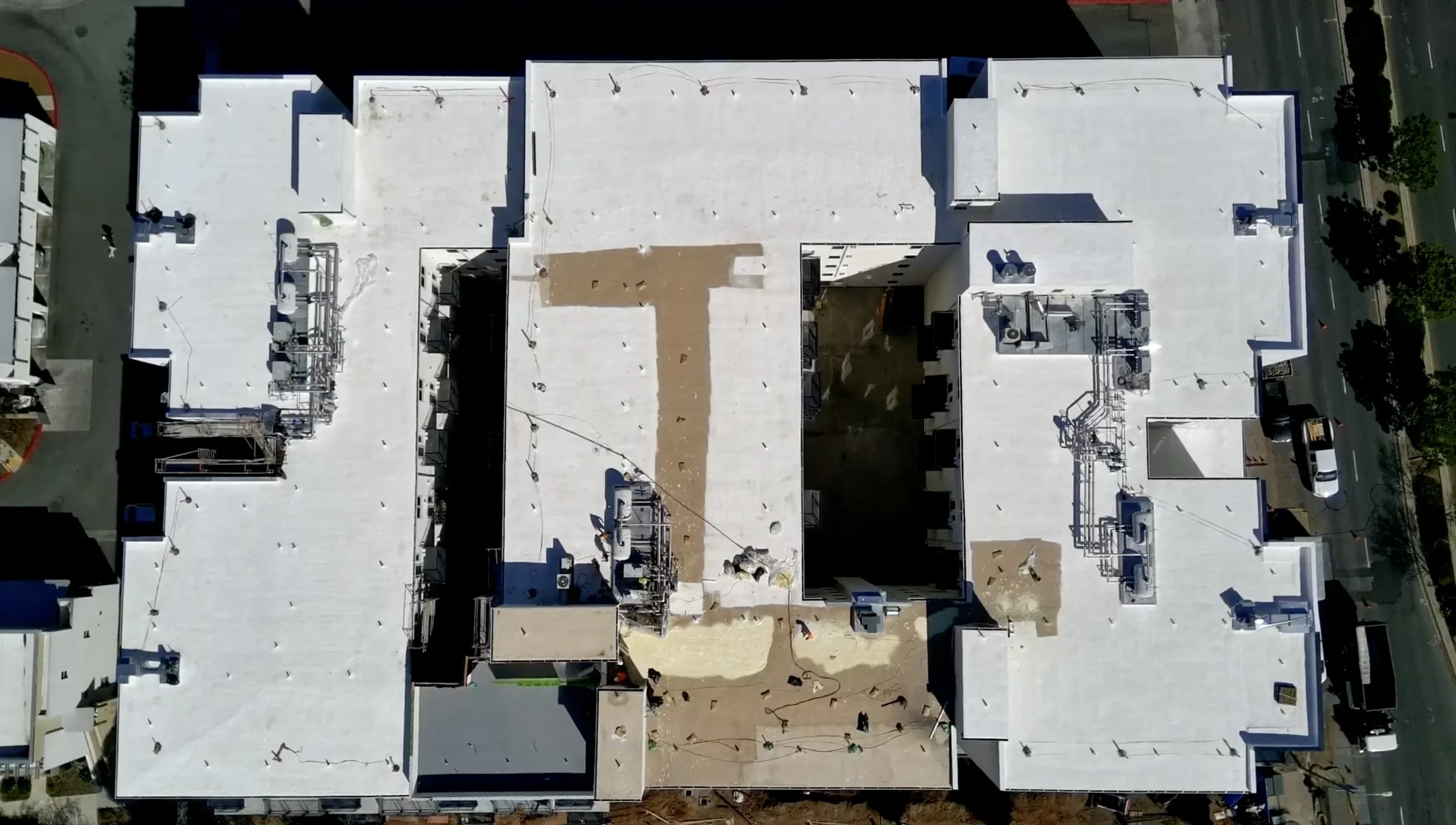
Our Commercial Roofing Services
Properties with spray foam roofs save up-to 40% per month on their electricity bill.
Vision Roof Services offers a comprehensive range of commercial roofing services, with a particular focus on polyurethane spray foam solutions for both new and existing properties.
Our expert team specializes in installing and maintaining spray foam roofing systems that provide superior insulation, energy efficiency, and weather resistance.
By creating a seamless, airtight barrier, our spray foam roofs protect commercial buildings from harsh environmental elements while significantly reducing energy costs. Whether you're upgrading an existing roof or installing a new system, Vision Roof Services delivers customized roofing solutions designed to enhance the durability and longevity of your commercial property.
Roof Installation
New Roof Construction
Roof Replacement
Roof Retrofitting
Roof Coating and Specialty Services
Spray Polyurethane Foam Roofing (SPF)
Fire-Resistant Coatings
Waterproofing and Green Roof Installation
Solar Roof Panel Installation and Integration
Cool Roof Systems
Energy Efficiency and Sustainability
Energy-Efficient Roofing Solutions
Sustainable and Eco-Friendly Roofing Options
Consultation and Advisory Services
Pre-construction Planning and Consultation
Material Sourcing and Cost Strategy
Safety and Compliance Advisory
Roof Maintenance and Repair
Routine Inspections and Maintenance
Leak Detection and Repair
Roof Cleaning and Debris Removal
Emergency Roof Repairs
Specializing in Spray Polyurethane Foam (SPF)
This General Coatings video displays the commercial spray foam roofing process.
For property owners and managers, polyurethane spray foam roofing is an ideal solution for preserving the value of commercial buildings. This advanced roofing system provides unparalleled protection against the region's intense sun, heat, and occasional heavy rains.
By offering superior insulation and creating a durable, seamless seal, our spray foam roofs help maintain stable indoor temperatures and significantly reduce energy costs. This not only improves the building's energy efficiency but also enhances its overall structural integrity, ensuring long-term value and reliability.
Our spray foam roofing is adaptable to various roof shapes and sizes, making it the perfect choice for commercial properties seeking sustainable and cost-effective roofing solutions. With VRS, you can trust that your investment is protected by a high-performance roofing system designed to last.
FRequently Asked questions
Do I need a permit to re-roof a commercial building in Palm Desert?
Yes. Palm Desert lists a re-roof permit type and applications go through the Clariti portal. Virtual inspection is available on residential re-roofs only, so a commercial roof gets an in-person inspection. Where a scope goes to plan review, the city's published goal for commercial and light industrial is 10 to 15 working days on a first pass and 8 to 10 working days on a resubmittal. If a contractor tells you a commercial re-roof here does not need a permit, end the conversation there.
Does my project trigger Title 24?
On a nonresidential building, the requirements apply to an alteration covering more than 50% of the roof area or more than 2,000 square feet, whichever is less. On most commercial roofs in this valley, 2,000 square feet is the number that binds, and it is a small fraction of the roof. Areas receiving only a liquid-applied coating are treated differently, which is why the recoat, recover or replace decision is worth making carefully.
What insulation does the code require on a commercial re-roof here?
On a low-slope roof, R-23 continuous insulation, or a U-factor of 0.037 where continuous and cavity insulation are combined with at least R-10 continuous above the deck, under Table 141.0-C for Climate Zones 1 through 5 and 9 through 16. A recover is allowed at a minimum of R-10 continuous of new insulation above the existing system. Coated-only areas are not required to be insulated. Several 2026 cost guides still print R-30, which is not the code text for alterations.
Can I recover instead of tearing off?
Sometimes. The recovering versus replacement provision of the California Building Code rules out a recover where the existing roof is water-soaked or has deteriorated past being an adequate base, where the existing covering is wood shake, slate, clay, cement or asbestos-cement tile, and where the roof already carries 2 or more applications of any roof covering. Cores and moisture readings answer it for your building. A visual from the ground does not.
Will a reflective roof actually cut my electricity bill?
It will cut cooling energy. How much depends on your building. The Lawrence Berkeley National Laboratory monitoring study of California commercial buildings measured 52% at a Sacramento retail store, 17 to 18% at a school, and 3 to 4% at a cold storage facility, with maximum roof surface temperature down between 60 and 75F depending on the site. We will not put a percentage on your building before we have seen your roof and your load, and you should be careful with anyone who does.
How often does a foam roof in this valley need recoating?
The published intervals are 10 to 20 years from the RICOWI and IBHS guide, and 5 to 20 years from the Spray Polyurethane Foam Alliance. The interval that governs your roof is the one in your coating manufacturer's specification, tied to the film thickness installed and the exposure it gets. Desert exposure sits at the hard end of every published range. Get the interval in writing and calendar it.
Can you work on an occupied building without shutting my tenants down?
Yes, with phasing. Occupied commercial work gets sequenced by area so tenants keep operating, and we coordinate roof access, staging and any hot work with your property management ahead of the first day rather than on it.
What happens to my rooftop HVAC units?
They stay. Curbs, ducts and conduit get detailed and flashed as part of the roof scope. The important part comes later: once the roof is warranted, any trade that opens it should be coordinated through us in writing first. Uncoordinated penetrations are the most common way a commercial roof warranty gets compromised.
Do you handle HOA and gated-community access?
Yes. Several of the valley's commercial and mixed-use properties sit inside gated communities with their own architectural review and access rules. Those approvals run on their own calendar, alongside the city's plan review rather than after it, and we will tell you at the inspection whether your property has that layer.
What does the free Roof Health Check include?
A walk of the roof, photographs, an assessment of penetrations, drains, flashings and equipment curbs, cores and moisture readings where the scope calls for them, and a written report inside 24 to 72 hours. It tells you what your roof needs, whether or not you hire us for the work.
Find out which path your building is on
No charge for the inspection. Written report with photographs inside 24 to 72 hours, telling you whether your roof is a maintenance item or a capital project, and what the code will ask of it either way.
Or call us at (844) 348-ROOF to discuss your project’s requirements.
Our Work
Take a look at some of the projects we’ve completed in the gallery below.
Visit the Featured page to see more.