

Roofers In Palm Desert, CA
Commercial and residential roofing, run from an office on Boardwalk in Palm Desert.
Palm Desert is Climate Zone 15, and that sets the numbers your re-roof has to hit
Vision Roof Services is a C-39 roofing contractor at 41905 Boardwalk, Suite L, Palm Desert, CA 92211. California license 651509 has been active since July 31, 1992. We run 60 roofers, 12 of them certified spray polyurethane foam applicators, and we have completed roughly 7,500 roofing projects. Palm Desert sits in California Energy Commission Climate Zone 15, the hottest of the state's 16 zones, which sets the cool-roof numbers a re-roof here has to hit and shortens how long a roof lasts before it needs work. The two calls we take most often in the Coachella Valley are leaks on tile roofs and flat-roof systems past their service life. Book a Free Roof Health Check and you get a written report with photos in 24 to 72 hours. We cover Palm Desert, La Quinta, Rancho Mirage, Indian Wells, Palm Springs, Indio and Cathedral City.
California's 2025 Building Energy Efficiency Standards (Title 24, Part 6) took effect January 1, 2026. Palm Desert falls in Climate Zone 15. If your job crosses the alteration threshold, the roofing product you install has to carry a Cool Roof Rating Council rating and be listed in the CRRC Rated Product Directory, and it has to hit a minimum aged solar reflectance and thermal emittance. An unrated product fails the energy inspection no matter how well it is installed.
The threshold is not the same for a house and a building.
| Building type | What triggers cool-roof compliance | Code section |
|---|---|---|
| Single-family home | More than 50% of the exterior roof surface is replaced | 150.2(b)1I |
| Commercial, high-rise residential, hotel and motel | More than 50% of the roof area or more than 2,000 square feet, whichever is less | 141.0(b)2B |
Read that second row again. On a 30,000 square foot commercial roof, 2,000 square feet is 6.7% of the area. A section tear-off that size pulls the whole scope into compliance. Ask any bidder on a commercial roof whether the 2,000 square foot clause applies to your scope. If they have not heard of it, that is your answer, and it is cheaper to find out now than in a change order after plan check.
Here are the numbers themselves.
| Roof slope | Aged solar reflectance | Thermal emittance | Or use SRI |
|---|---|---|---|
| Low-slope, under 2:12 | 0.63 minimum | 0.75 minimum | 75 minimum |
| Steep-slope, 2:12 and over | 0.20 minimum | 0.75 minimum | 16 minimum |
Steep-slope residential has alternative compliance paths, and one of them applies to a lot of desert homes. If the roof assembly weighs at least 25 pounds per square foot, or the ceiling carries R-38 insulation, or there is a radiant barrier meeting Section 150.1(c)2, or the attic has no ducts in it, or there is R-2 or better insulation above the roof deck, the reflectance number can be met a different way. Which path is cheapest depends on what is already in your attic. That is a measurement, not a guess, and it is one of the things we take readings on before we write a proposal.
Two forms move with the permit. A CF1R-ALT-05-E certificate of compliance, signed by the document author and the building designer, goes in at permit. A CF2R-ALT-05-E installation certificate goes in at final inspection. Liquid-applied coatings are handled under Section 110.8(i)4, which matters if you are recoating rather than replacing. If a bidder cannot name those two forms, they have not pulled a Title 24 re-roof permit recently.
One caution. Palm Desert's published code adoption ordinance, 1388, references the 2022 code cycle. State energy standards apply on the state's own effective date, but the edition your plan check runs under is a question for the plans examiner, not for a contractor's website. Call Building and Safety at (760) 776-6420 and ask before you sign anything.
What 119 days a year over 100 degrees does to a roof
Heat is the thing that ages a roof here, and it is not close.
NOAA's 1991 to 2020 climate normals for Desert Resorts Regional Airport in Thermal, the nearest long-record station to Palm Desert, put the July average high at 106.9 degrees, with 119.8 days a year at or above 100 and 187.2 days at or above 90. Annual precipitation is 2.96 inches. Palm Springs Regional Airport runs hotter still at a 108.6 degree July average high.
Air temperature is not what the roof feels. The US EPA's Reducing Urban Heat Islands compendium measures standard black asphalt roofs at 165 to 185 degrees at midday in summer, and puts conventional roofs 55 to 85 degrees above air temperature on any given day. A roof with high reflectance and high emittance peaks at 110 to 115 degrees and stays within 10 to 20 degrees of the air.
That temperature gap is the whole argument, because of how asphalt breaks down. Lawrence Berkeley National Laboratory's Weathering of Roofing Materials found the rate of thermal oxidation in asphalt roughly doubles for every 10 Kelvin, or 18 degrees Fahrenheit, of temperature rise. Heat drives the lower molecular weight oils out of the asphalt, and what is left hardens and gets brittle. The same paper makes a point most roofing copy gets backwards: on a granule-surfaced shingle, UV photo-oxidation is not a major factor, because the granules absorb most of the incident UV. It is the heat.
The measured consequence shows up in testing. Reporting on a 2023 ASTM study of more than 325 shingle specimens, the National Roofing Contractors Association noted that some field-aged specimens lost more than 50% of their tear strength, and that most properties evaluated no longer met the minimum requirements of ASTM D3462.
Which is why we do not quote a shingle's warranty back at you as if it were a service life. NRCA's own position is that warranty length should not be the primary criterion for selecting a roofing product, that documented in-place performance is the primary indicator of service life, and that the industry shift to lifetime warranties was a marketing decision rather than a technological one. A 30-year shingle is a 30-year warranty. It is not a 30-year roof, and in Zone 15 it is further from one than it is in Zone 8.
On a Palm Desert tile roof, the tile is usually not what failed
If you have a concrete or clay tile roof and you have a leak, the tile is probably fine. What failed is underneath it.
The Tile Roofing Industry Alliance states that tile roofs can last 50 to 100 years or more, and that most manufacturers warrant them for 50 years or more. A tile roof can reasonably outlast the building. The layer directly under the tile does not get anywhere near that.
TRI's own installation manual for moderate climate regions, the document behind ICC-ES ESR-2015, specifies one layer of ASTM D226 Type II No. 30 felt covering the deck. Felt. Under a roof surface the EPA measures at up to 185 degrees. The upgrade products built for exactly this problem tell you their own limits: Boral TileSeal HT is rated to 260 degrees and carries a 30-year limited warranty. Polyglass Polystick MTS PLUS is approved to 265 degrees, allows a maximum 180 days of exposure, and carries a 1-year manufacturer warranty against leakage.
So the best self-adhered high-temperature underlayment on the market warrants for 30 years, sitting under a tile the manufacturer warrants for 50 or more. That gap is not a defect. It is the design. And it means a tile roof in Palm Desert has a service event built into it that has nothing to do with how the tile looks from the street.
What that changes about your job: when the underlayment is the failure, replacing cracked tiles does nothing. The fix is lifting and stacking the tile, tearing off the old felt, re-decking anything soft, installing new underlayment, and re-laying the same tile. Most of your existing tile is salvageable, which is why a re-underlayment job on a tile roof costs less than the tile replacement most homeowners assume they are facing. We tell people that before we measure, because it changes whether they call us at all.
The Four-Layer Check
A roof is 4 layers, and in this climate they fail in a fixed order. An inspection that only looks at the layer you can see from the driveway tells you almost nothing.
Layer 1: the covering
Tile, shingle, metal, foam, single-ply. This is the layer every roofer photographs and the one that fails last on a tile roof. Cracked tiles and slipped courses are real, and they are also the cheapest thing on the roof to fix.
Layer 3: penetrations and terminations
Pipe boots, curbs, skylights, parapet flashings, HVAC stands, drains and scuppers. Thermal cycling across 119 days above 100 degrees works fasteners loose and opens sealant joints faster than it degrades field material. On flat roofs this is where most of the leaks we chase actually start.
Layer 2: the underlayment or membrane
The waterproofing. This is where a Palm Desert roof goes. On tile, it is the felt. On a flat roof, it is the membrane or the foam and its coating. Getting to it means lifting tile or cutting a test square, and a bidder who did not open the roof did not check this layer.
Layer 4: the deck and the attic side
Sheathing condition, moisture staining, insulation, ducts, and whether there is a radiant barrier. This layer decides your Title 24 compliance path, and it is the one nobody looks at. We check it because the answer can move the cost of your re-roof.
Every Free Roof Health Check covers all 4. You get the photos from each layer, not a shot of the roof from the sidewalk.
Repair, recoat, or replace: where we draw the line
We take the repair when the repair is the right answer. Here is the actual decision, in the order we work through it.
Repair, when the failure is at layer 3 and the field material still has service life. A pipe boot, a curb flashing, a drain, a run of parapet. Localized, and worth doing on its own.
Recoat, when a foam or single-ply roof has a sound substrate and the coating is what wore out. The Roofing Industry Committee on Weather Issues puts total coating dry film thickness generally between 20 and 40 mils on a foam roof, and says coating systems generally need re-application every 10 to 20 years. Recoating on that cycle is the cheapest roof you will ever own. Skipping 2 cycles is how a maintenance line item becomes a tear-off.
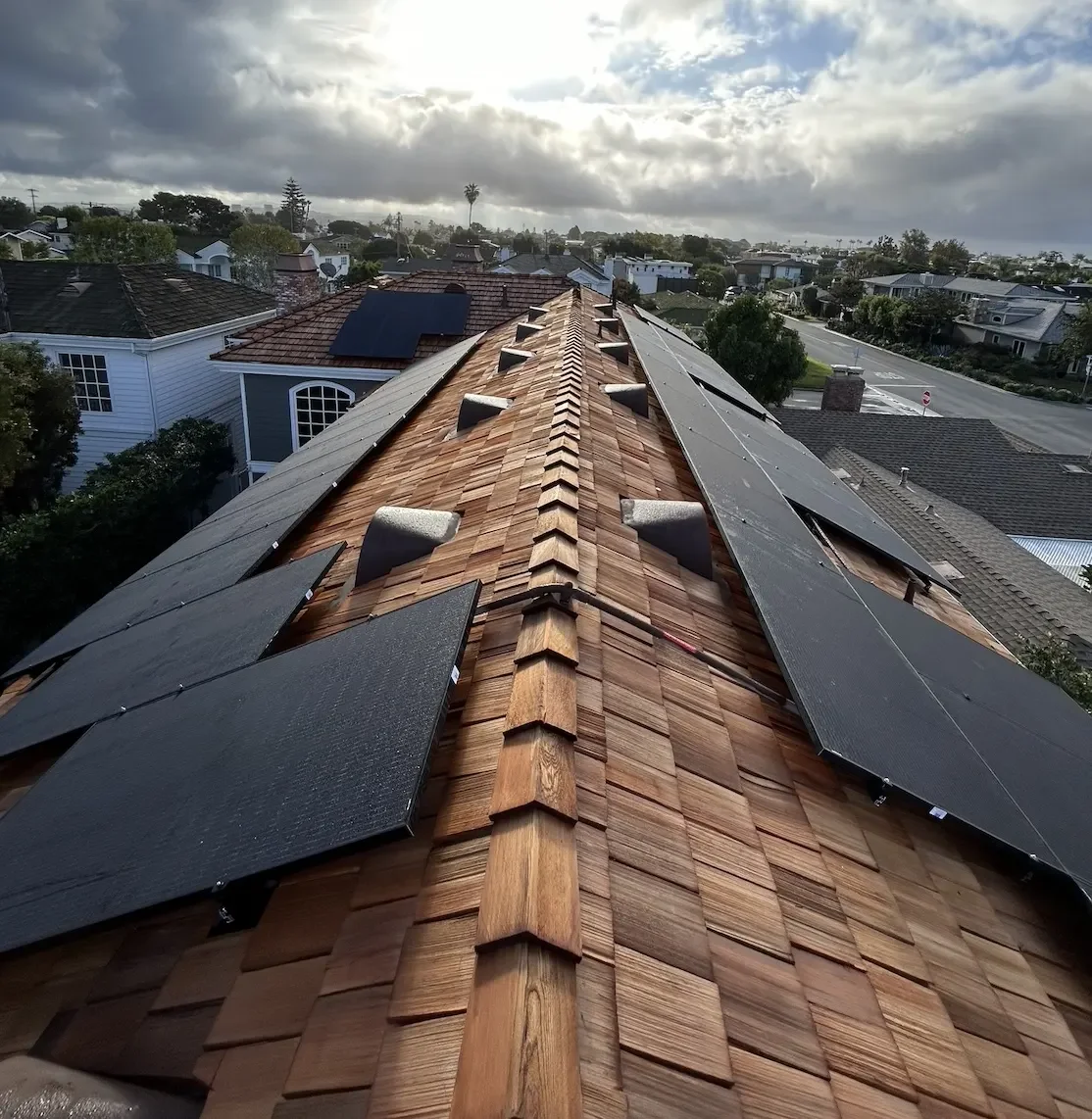
Replace, when layer 2 has failed across the field, or the deck is compromised, or you are already past 50% of the roof area and the code is going to catch you anyway. At that point the marginal cost of doing the whole roof is lower than doing it twice.
One claim we will not make, because the evidence does not support it yet. The US Department of Energy's Guidelines for Selecting Cool Roofs says plainly that cool roofs "may degrade slower and last longer than similar noncool roofs, but more data are needed to establish this benefit." Plenty of roofing pages in this valley will tell you a cool roof lasts longer. The reflectance requirement is a code obligation and an energy question. Treat any durability promise attached to it as unproven, including one from us.
What moves the number on a Palm Desert roof
We don't publish prices, because a number without your deck condition attached to it is a guess that costs you money either way. What we will do is tell you exactly which variables set it, so you can read 3 bids side by side and see where they differ.
| Variable | Why it moves your number |
|---|---|
| Layers to remove | One layer of tile lifted and re-laid is a different job from a 2-layer tear-off with disposal. Ask every bidder how many layers they assumed. |
| Deck condition | Nobody knows how much sheathing is soft until the tile is off. A bid with no unit price for deck replacement has that risk priced in, hidden, or excluded. |
| Title 24 compliance path | Meeting reflectance with the roofing product, versus R-38 in the ceiling, versus a radiant barrier, versus R-2 above deck. Different trades, different totals. |
| Tile salvage rate | How much of your existing tile survives the lift. This is a measurement, and it belongs in writing. |
| Slope and access | Steep-slope staging, gated-community access windows, and crane or conveyor needs on commercial. |
| Penetration count | Every curb, skylight, drain and HVAC stand is a detail with labor attached. |
| Season | Summer deck temperatures shift crews to early starts and shorten productive hours. |
Commercial spray foam and flat roofs
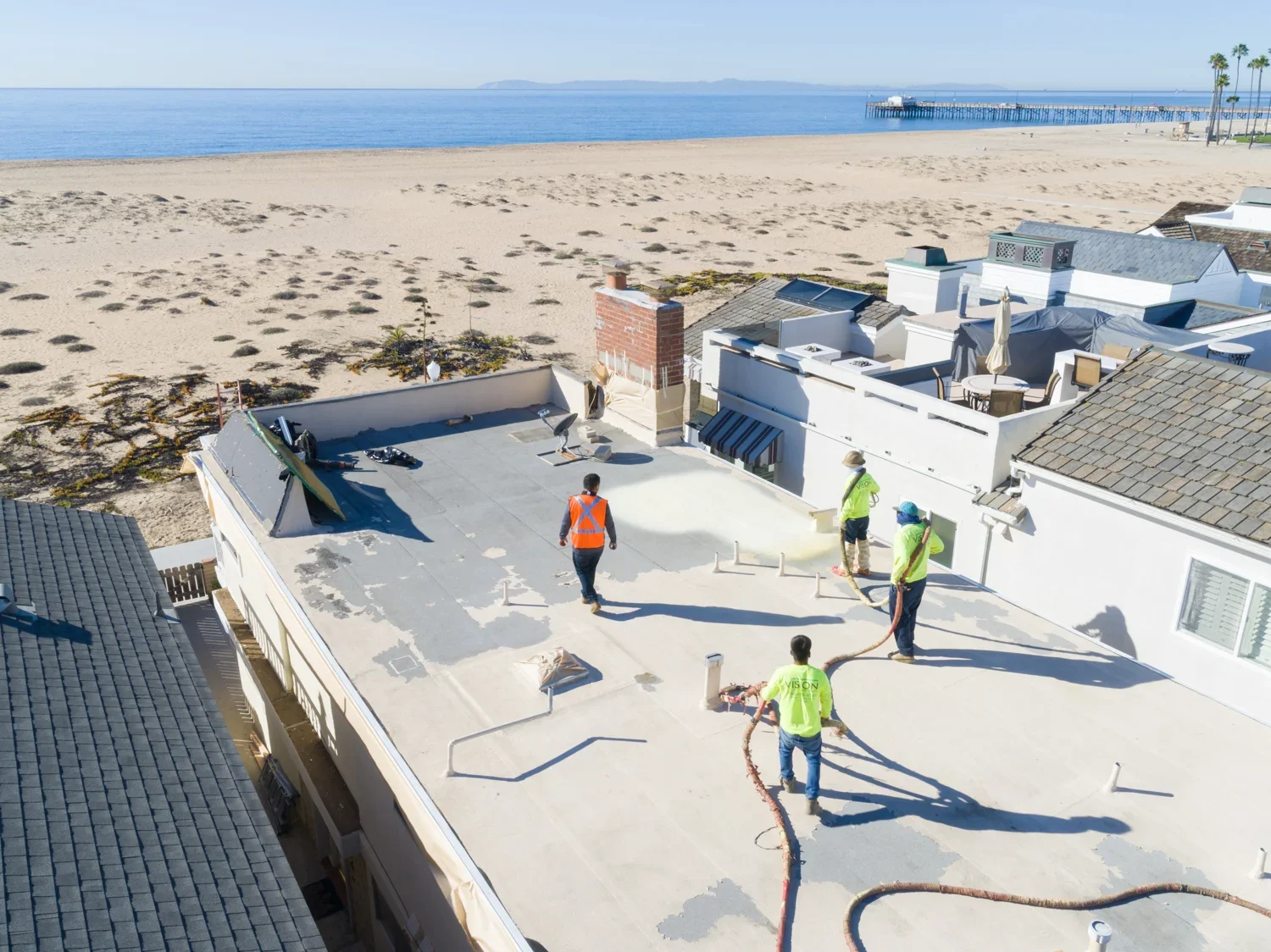
Commercial spray polyurethane foam is the work we are built around, and 12 of our 60 roofers are trained and certified applicators through General Coatings. We are members of the Spray Polyurethane Foam Alliance.
The technical case, with the published numbers rather than adjectives. RICOWI puts roofing-grade SPF at 2.5 to 4.0 pounds per cubic foot closed-cell density, R-5.5 to R-6.5 per inch, compressive strength typically above 40 psi, and a 1 inch minimum thickness. Maintained SPF roofs show service lives in excess of 30 years. Foam is sprayed as a monolithic layer, so there are no seams to fail, and at roughly 3 pounds per cubic foot it usually goes over an existing roof without a tear-off, which takes disposal and structural weight off the table.
The objection we hear most is that foam costs more upfront than a patch or a single-ply overlay. It does. What it buys you is a 10 to 20 year recoat cycle instead of a replacement cycle, and no seams to fail. Whether that math works on your building depends on how many years you plan to hold it, and we will tell you when it does not.
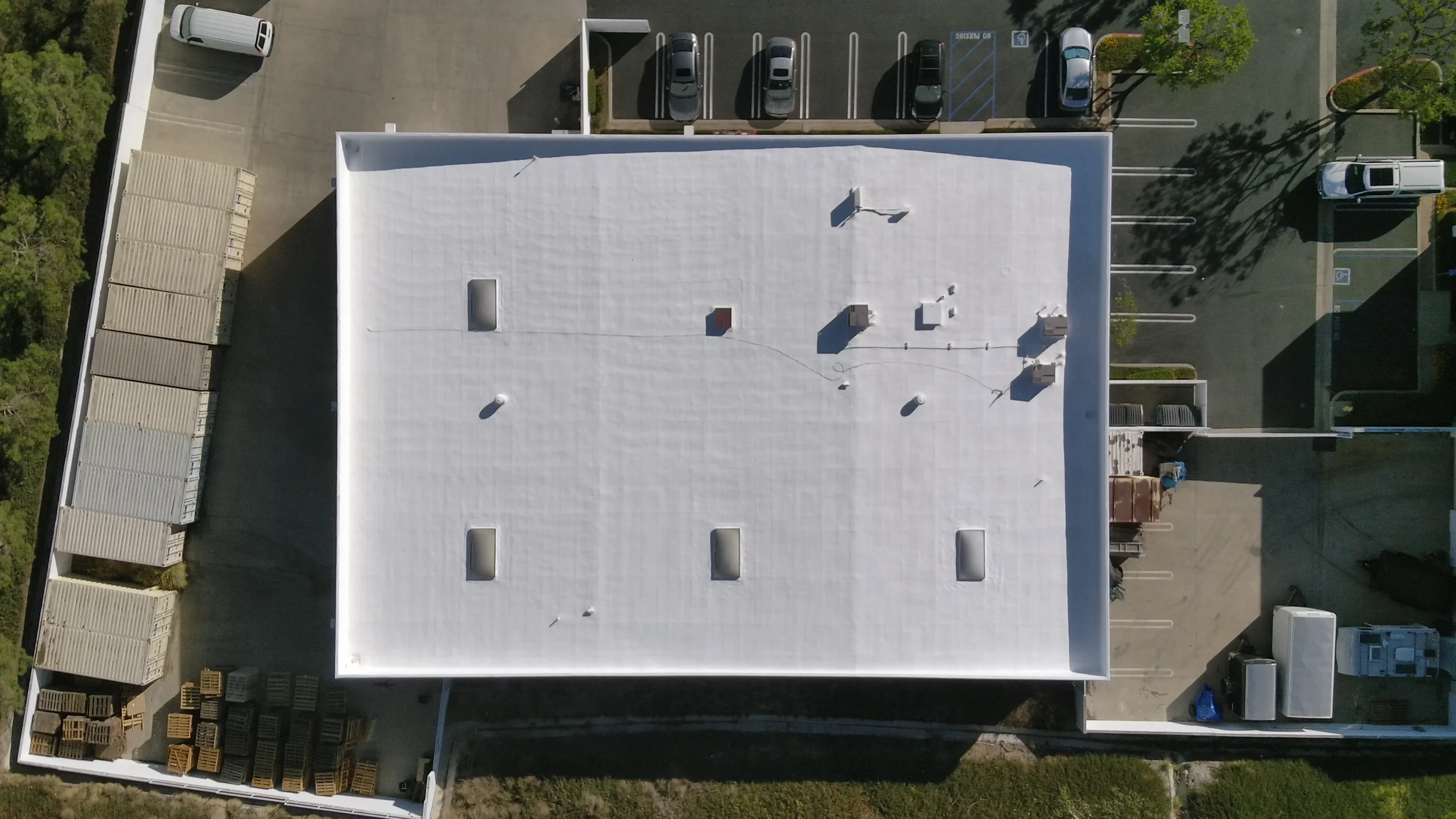
Low-slope commercial roofs in Palm Desert carry the strict end of Title 24: aged solar reflectance of 0.63 and thermal emittance of 0.75, or an SRI of 75, under Section 141.0(b)2Bi. Silicone coating systems are what get most foam roofs there.
Our commercial work includes roofs for Yamaha in Buena Park, Paramount Studios, LifeStorage in Costa Mesa, KPRS and American Tower. Building owners, property managers and HOA boards are who we do our best work for.
How to verify any Palm Desert roofer in about 4 minutes
Every roofing site in the valley says licensed and insured. That claim's free. Checking it takes 4 minutes on the state board's site, and almost nobody does it.
Go to cslb.ca.gov and look up the license number. Check 6 things: that the status reads current and active, that the classification is C-39 for roofing, that the business name on the license matches the name on your contract, that a contractor's bond is posted and current, that workers' compensation coverage is in force, and that the complaint and judgment section is clear.
Here is ours, so you can compare it against anyone else's.
| Field | Vision Roof Services |
|---|---|
| License | 651509 |
| Entity on file | Vision Roof Services Inc, a corporation |
| Address on file | 41905 Boardwalk, Suite L, Palm Desert, CA 92211 |
| Classification | C-39, Roofing |
| Original issue date | July 31, 1992 |
| Status | Current and active |
| Workers' compensation | In force |
| Complaints, judgments, arbitrations | None disclosed |
Every project starts with a Free Roof Health Check
The Roof Health Check is an inspection and a written record. It isn't a sales visit. We run the Four-Layer Check, photograph each layer, and send you a written report with the photos in 24 to 72 hours. The report's yours whether you hire us or not.
What happens after that, in order: initial contact, the Roof Health Check with documentation, a written proposal, contract approval, scheduling, installation, final inspection, invoicing, then the warranty and maintenance program. Annual inspections with a recoat schedule where the system needs one.
Jobs we turn down
We're not the right call for everything, and saying so saves you a phone call.
We turn down very small repairs outside our core service areas, because the drive time makes the price unfair to you. We don't do gutter cleaning, and we're moving away from standalone wall foam insulation. If your job is a single cracked tile and you are in Palm Desert, call anyway and we will tell you whether it is worth a truck roll or whether a handyman is the better call.
If you want the lowest bid on the street, we'll lose that one on purpose. The jobs we win, we win on responsiveness and on the inspection being real.
Customer Testimonials
VRS has been building trust among the SoCal community for decades.


Get your Palm Desert roof looked at properly
One visit, all 4 layers, photographs, a written report in 24 to 72 hours, and a straight answer on whether you need a repair, a recoat or a replacement.
Our Service Areas
Serving Southern California's Key Regions
Vision Roof Services is dedicated to providing top-tier roofing solutions across Southern California’s bustling cities. Our primary focus includes Riverside, Orange, and San Diego Counties, with comprehensive services extending to Los Angeles County.

Riverside County, CA

San Diego County, CA

Orange County, CA

Los Angeles County, CA
Featured Projects
Explore Our Portfolio
Throughout Southern California, Vision Roof Services has a proven track record of excellence, with a diverse portfolio of both large-scale and smaller projects. Discover how our expertise has transformed spaces and how we can do the same for your property.
Get to Know Us
Curious About The Team & Our Roofing Solutions?
Visit our About page to explore our company's history, values, and the dedicated group behind our Commercial and Residential roofing services.
