
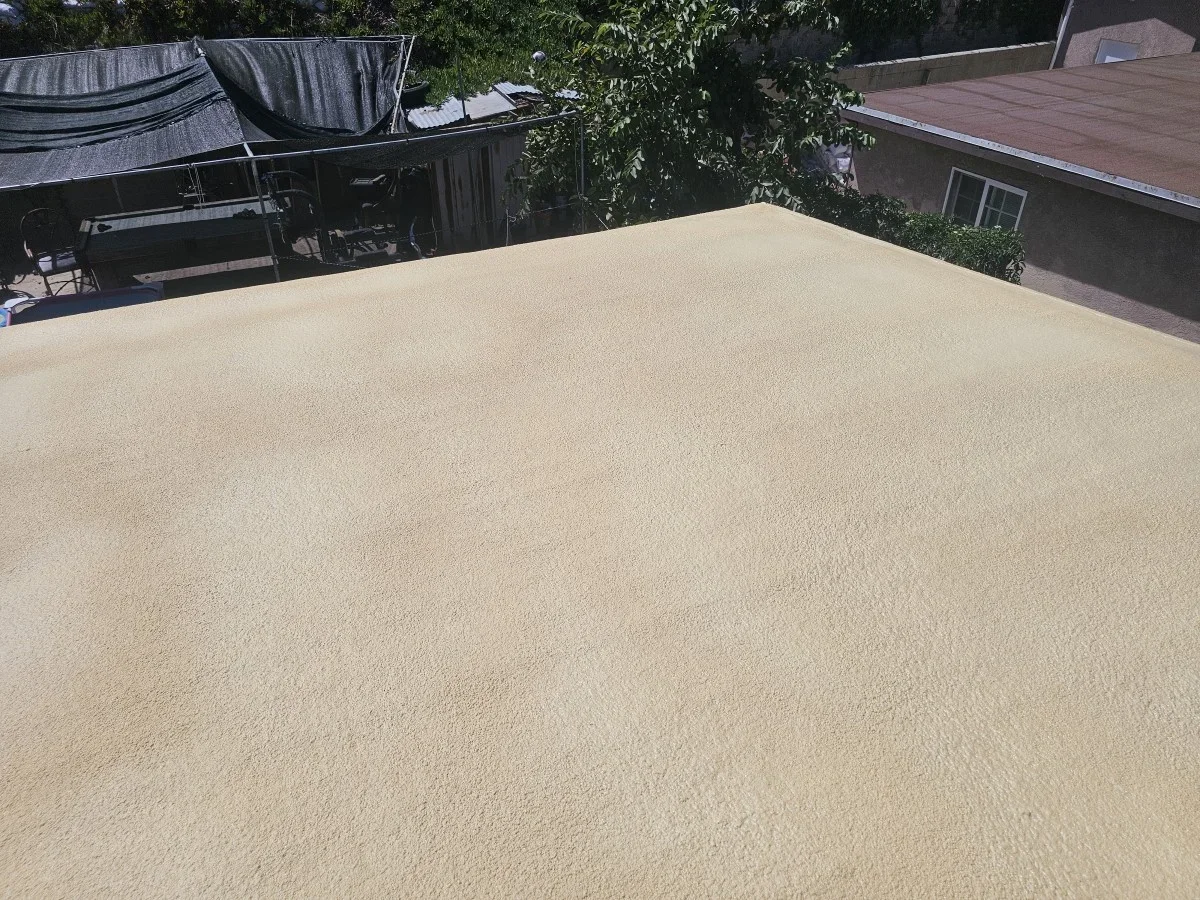
Spray Foam Roofing In Los Angeles, CA
Vision Roof Services installs and recoats spray polyurethane foam (SPF) roofs on commercial, industrial and HOA-managed flat roofs across Los Angeles. In LA, the first question is what sits under the new foam. City code (LAMC Table 1512.1) lets foam go over an existing built-up roof and lists it as not permitted over modified bitumen or asphalt shingles. A foam recover that touches more than 2,000 sq ft also needs at least R-10 of new insulation and a coating that meets LA's cool roof numbers. Market pricing in Southern California runs about $4.00-$7.00 per sq ft for a foam system and $1.50-$5.00 for a recoat, and job length scales with roof size, from days on a small roof to weeks on a large one.
We start every LA foam job with a free Roof Health Check: a roof walk, photos, core and moisture readings, and a written report in 24-72 hours. If foam is the wrong system for your roof, the report says so.
Spray foam roofing in Los Angeles: who it fits
Spray foam roofing fits a low-slope LA building with a sound, dry deck, an aging built-up roof, and an owner who plans to keep the building long enough to recoat it at least once. That describes a lot of the Los Angeles flat-roof stock: warehouses in the Valley, studio and production buildings, retail strips, self-storage, medical offices, and HOA-managed condo roofs behind parapets.
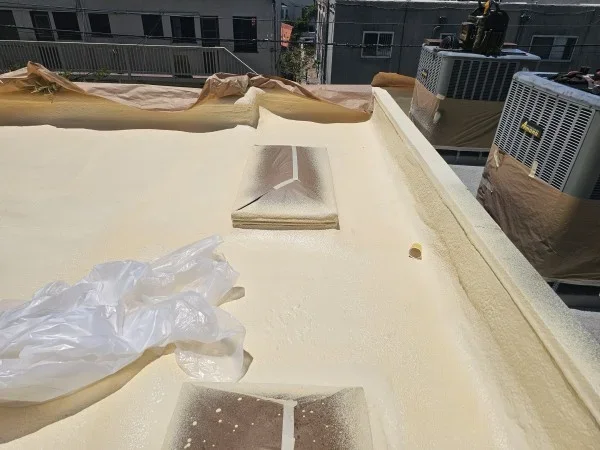
The calls we get in LA sound alike. A roof leaks at the parapet or around a rooftop unit, the original gravel built-up roof is 20-plus years old, and a full tear-off means dumpsters, an open deck in the rainy season, and tenants who can't shut down. A foam recover sprays a liquid that expands into a single closed-cell layer over the existing roof. It fills the low spots, wraps curbs and penetrations without seams, adds insulation, and gets a reflective coating on top.
Foam is not a fit for every LA roof. The code table below rules out some substrates outright, and a roof with wet insulation needs those sections cut out before anything is sprayed. Our commercial roofing work in Los Angeles covers the other systems when foam loses the comparison.
The LA Foam-Over Test: 5 checks before anyone sprays
The LA Foam-Over Test is the 5-question screen we run on every Los Angeles roof before we price foam. A roof has to clear all 5, or the bid changes. Each question maps to a specific LA rule or a manufacturer limit, so you can check any contractor's bid against it.
| # | Check | The LA rule behind it | Fail means |
|---|---|---|---|
| 1 | What's under it? | LAMC Table 1512.1: SPF over built-up roofing is permitted. Over modified bitumen, asphalt shingle or tile it is listed NP (not permitted). | Tear-off first, or a different system |
| 2 | Is it dry? | The foam maker's spec bars spraying on wet or damp surfaces. Core cuts and moisture readings find saturated insulation. | Wet sections are removed and replaced before foam |
| 3 | How thick? | Title 24 Section 141.0: a recover over 2,000 sq ft (or 50%, whichever is less) needs at least R-10 of new insulation above the deck. | Thicker foam, or an insulation board under it |
| 4 | Which fire class? | Class A in Very High Fire Hazard Severity Zones. The foam listing (ICC-ES ESR-3239) gives Class A only on certain decks and with granule surfacing. | Deck board, granules, or a different assembly |
| 5 | Which coating number? | LA Green Building Code cool roof values for low-slope nonresidential roofs: 0.68 aged reflectance, 0.85 emittance, or SRI 82. Title 24 alone asks for 0.63. | Pick a coating with a CRRC-rated aged value that clears 0.68 |
Most bids we review in LA cover check 2 and check 5 loosely and skip checks 1, 3 and 4. Those 3 are where a cheap foam bid becomes a failed inspection or a roof that is out of code from day one.
What LA code lets spray foam go over
Los Angeles writes its own reroofing table. Section 91.1512 of the Los Angeles Municipal Code replaces parts of the California Building Code's reroofing rules and points to LAMC Table 1512.1 for what may go over what. For spray polyurethane foam, the table reads like this:
| Existing roof | New SPF over it? | What that means for your building |
|---|---|---|
| Built-up roofing (tar and gravel, cap sheet) | Yes | The classic foam recover. Loose gravel is removed, the surface is cleaned and primed, wet areas are replaced, then foam goes on. |
| Modified bitumen | NP | Listed not permitted. Expect a tear-off to the deck before foam, or a different system. |
| Asphalt shingle, or asphalt over asphalt | NP | Not permitted. Low-slope shingle roofs are rare, and foam is not the answer for them in LA. |
| Tile | NP | The table permits nothing over tile. |
| Metal | NP | Only metal over metal is listed. |
| Existing spray foam | Coating: yes, no tear-off | LAMC 91.1512 lets a new protective coating go over an existing SPF roof without tearing it off. That is the recoat path. |
Source: LAMC Section 91.1512, Reroofing. The online text of the table is hard to read, so we confirm the reading with LADBS on any job where it decides the scope.
The foam maker's own paperwork says the same thing. General Coatings' evaluation report for Ultra-Thane 230 roofing foam (ICC-ES ESR-3239, which carries a City of Los Angeles code supplement) allows recover only over existing uninsulated built-up roofing, and only after inspection and approval by the building official. So a modified bitumen roof from the 1990s or 2000s, which is common on LA commercial buildings, is a tear-off conversation before it is a foam conversation.
The good news sits in the last row. Once your building has a foam roof, LA lets you renew it with a coating and no tear-off, as many times as the foam stays sound. That is why the cheapest foam roof over 30 years is the one that gets recoated on schedule.
How thick spray foam has to be in Los Angeles
A spray foam recover in Los Angeles that covers more than 2,000 sq ft, or more than half the roof if that is smaller, has to add at least R-10 of insulation above the deck. At the R-5.5 to R-6.5 per inch range we plan with for roofing foam, R-10 means about 1.5-1.8 inches of foam. A plain recoat adds no insulation and needs none.
The rule is California Energy Code Section 141.0(b)2B for nonresidential buildings. A full roof replacement in LA's climate zones has to meet Table 141.0-C: R-17 continuous in zones 6 and 8 (coastal and central LA, including San Pedro, Venice and South LA), and R-23 in zones 9 and 16 (Downtown, Hollywood and most of the San Fernando Valley). Recovers get an exception: R-10 of new insulation above the deck is enough. Energy Code Ace lists the exceptions, including one for rooftop units that stay in place and one that exempts recoats from insulation entirely.
Foam thickness per insulation target, at R-5.5 to R-6.5 per inch. Light bar = low end of the range, dark bar = high end. Insulation targets from Title 24 Table 141.0-C and its recover exception. Climate zone areas per SoCalREN; confirm your zone by ZIP code.
The chart shows why the recover exception matters in LA. A full R-23 build in the Valley would take about 4 inches of foam, which is past the 2-inch maximum in the fire-classified assemblies of the General Coatings listing. An R-10 recover lands inside it. When a building needs the full table value, we plan insulation board under thinner foam, or we price a different system.
Weight is rarely the problem. ESR-3239 lists the roofing foam at a nominal 3.0 lb per cubic foot, so 1.6 inches of foam adds about 0.4 lb per sq ft and 2 inches adds about 0.5 lb. Granule surfacing adds about 0.33 lb more. A gravel built-up roof carries more than that in loose rock alone, and the loose gravel comes off before we spray.
Watch the rooftop units. If adding R-10 means raising a rooftop unit to keep the flashing height the manufacturer requires, Title 24 drops the equipment exception and the full table value applies. We measure curb heights during the Roof Health Check for that reason.
Cool roof numbers for spray foam roofs in Los Angeles
In the City of Los Angeles, a nonresidential low-slope roof that is replaced over more than 50% of its area has to meet the LA Green Building Code cool roof table: 0.68 aged solar reflectance and 0.85 thermal emittance, or an SRI of 82. The statewide Title 24 number is 0.63 aged reflectance and 0.75 emittance, or SRI 75. LA asks for more, and that gap is where white foam roofs fail on paper.
The coating on top of the foam carries the cool roof rating. Its CRRC listing decides compliance, and it has to be the aged (3-year) value, not the initial value printed on a sales sheet. White coatings start bright and lose reflectance as LA's dust and soot settle on them. We specify a coating by its CRRC Product ID and check its aged reflectance and emittance against 0.68 and 0.85 before it goes in the bid.
Recoats count too. The 2025 California Energy Code applies cool roof rules when more than 50% of a nonresidential roof, or more than 2,000 sq ft, whichever is less, is replaced, recovered or recoated. On a 10,000 sq ft LA warehouse, 2,000 sq ft is the line, so a full recoat is a code event and not just maintenance.
| Building | Low-slope cool roof line in LA | Notes |
|---|---|---|
| Nonresidential (LA Green Building Code, Division 5) | 0.68 aged reflectance / 0.85 emittance, or SRI 82 | Exempt: repairs, replacing 50% or less, the area under solar, 25 psf or more of ballast or pavers |
| Residential low-rise, 1-3 stories (includes many HOA condo roofs) | 0.65 / 0.85, or SRI 78 | Same exemption list |
| Statewide Title 24 nonresidential alteration (for comparison) | 0.63 / 0.75, or SRI 75 | Trigger: over 50% or over 2,000 sq ft, whichever is less, including recoats |
2 more LA rules shape the coating choice. South Coast AQMD Rule 1113 caps roof coatings at 50 grams of VOC per liter (100 g/L for aluminum roof coatings), so solvent-heavy products sold in other states are off the table here. And LA's Existing Buildings Energy and Water Efficiency program (EBEWE) requires audits or retro-commissioning every 5 years for private buildings of 20,000 sq ft or more. Buildings without central cooling can qualify for an exemption with 4 of 6 listed measures, and a cool roof is one of them, documented by a finaled permit inside the 5-year window. Building IDs ending in 0 or 1 are due December 1, 2026. If yours is one of them, the permit on your foam recover is part of your compliance file.
Fire zones and Class A spray foam roofs in Los Angeles
A foam roof in a Los Angeles Very High Fire Hazard Severity Zone has to be a Class A roof assembly, and spray foam only earns Class A on certain decks with certain surfacing. CAL FIRE's 2025 hazard maps added about 20,000 City of LA properties to the Very High zone, according to news reporting on the update, so buildings that never needed Class A may need it now. Look up your parcel on the state fire hazard map before you compare bids.
The General Coatings listing (ESR-3239, Table 1) shows how narrow the Class A paths are for Ultra-Thane 230 foam with its acrylic coating system:
| Deck | Foam | Top surface | Fire class |
|---|---|---|---|
| Noncombustible (concrete, steel), slope up to 4:12 | 1-2 in | No. 11 granules over the coating | Class A |
| 15/32 in plywood plus 1/4 in gypsum roof board | 2 in | Granules | Class A |
| Class A built-up roof over 15/32 in plywood | 2 in | Granules | Class A |
| 15/32 in plywood alone | 1-2 in | Granules | Class B |
Source: ICC-ES ESR-3239, General Coatings Ultra-Thane coated foam roof system. Other foam and coating systems carry their own listings with different tables.
Read the last row again. Foam sprayed straight onto a plywood deck is Class B in this listing. In a Very High zone that fails. Granules also change the coating math from the section above, so a fire-zone foam roof needs both its fire listing and its cool roof rating checked against the same final surface. We pull the listing for the exact system on your deck and attach it to the proposal.
The LA Spray Window: when foam can go on
Spray foam can only go on inside the manufacturer's weather limits, and in Los Angeles the limit that stops work most often is morning moisture, not heat. The data sheet for General Coatings Ultra-Thane 230 HFO roofing foam bars spraying below 50°F, in wind over 15 mph, on a wet or damp surface, or when rain, dew or relative humidity over 80% is present.
| Spec limit | What LA weather does to it | How we schedule around it |
|---|---|---|
| 50°F minimum | Downtown LA's normal lows are 48.2°F in December and 48.9°F in January (NWS, 1991-2020 normals). Valley mornings run colder. | Winter starts wait for the surface to warm, usually mid-morning. |
| No dew, RH 80% max | May Gray and June Gloom: the marine layer peaks at dawn and clears mid-morning to early afternoon. Downtown gets 64% of possible sunshine in May and June vs 83% in July (1981-2010 normals). | Coastal and basin roofs in May and June get short spray days. We check surface moisture before the first pass. |
| 15 mph wind max | Santa Ana winds run roughly October through March and can gust far past 15 mph. | Santa Ana days are stand-down days. Overspray on cars and neighbors is the risk. |
| No wet substrate | NOAA issued an El Niño Advisory on October 8, 2026, with a strong event likely through January-March 2027. Downtown's normal year is 14.25 in of rain. The 2025-26 season brought 19.07 in. | Fall is the time to recover. After a storm, a roof needs dry-out days before foam. |
In practice, a foam recover on a coastal LA roof in June may run longer than the same roof in September. Winter jobs lose their early mornings. And a bid that promises a fixed finish date in January without weather days built in is guessing. Foam sprayed on a damp deck can lose adhesion, and that kind of failure doesn't show up until later.
The full foam thickness also has to go on the same day it starts, in passes of 1/2 inch up to 2 inches, per the ESR-3239 installation section. So a 20,000 sq ft roof gets split into sections that can each be finished inside one spray window, and the coating follows once the foam surface is ready.
Spray foam roofing cost in Los Angeles
A spray foam roof system in Southern California runs about $4.00-$7.00 per sq ft installed, a silicone recoat about $2.00-$5.00, and an acrylic recoat about $1.50-$4.00. A full tear-off and replacement runs about $8.00-$15.00 or more per sq ft. Those are 2026 Southern California market ranges published by a regional roofing firm, not a Vision Roof Services quote. Your number comes from your roof.
| Scope (commercial, installed) | Per sq ft, SoCal market range | 10,000 sq ft roof | 20,000 sq ft roof |
|---|---|---|---|
| Acrylic recoat over existing foam | $1.50-$4.00 | $15,000-$40,000 | $30,000-$80,000 |
| Silicone recoat over existing foam | $2.00-$5.00 | $20,000-$50,000 | $40,000-$100,000 |
| Spray foam system (recover over built-up) | $4.00-$7.00 | $40,000-$70,000 | $80,000-$140,000 |
| Full tear-off and replacement | $8.00-$15.00+ | $80,000-$150,000+ | $160,000-$300,000+ |
Per-sq-ft ranges: Method Roofing Group, Roof Coating Cost in Southern California (2026). Roof totals are those ranges multiplied out, shown for planning only. National guides land in the same band: HomeGuide lists $3.50-$7.00 per sq ft for SPF and $1.50-$4.50 for a silicone restoration recoat.
What moves an LA foam price up or down:
Wet insulation found in the core cuts, which gets cut out and replaced before foam
A modified bitumen roof that needs tear-off to the deck under LAMC Table 1512.1
Thickness: an R-10 recover vs a full Table 141.0-C build, or insulation board under the foam
Fire zone surfacing: granules and, on a plywood deck, gypsum roof board for Class A
Rooftop units that have to be lifted to keep flashing height
Coating choice: silicone for ponding areas, acrylic where water drains, and the CRRC aged value you need
Access, crane time, street parking permits, and tenant hours in dense parts of the city
The objection we hear most is that foam costs more upfront than a recoat or patch. It can. The math that matters is the 20-30 year cost: one recover, plus recoats on schedule, against a tear-off now and another tear-off later. Financing is available through Acorn Finance for owners who want to spread the cost.
Recoats and maintenance decide how long a foam roof lasts
A spray foam roof lasts as long as its coating stays intact. Foam has no UV resistance of its own. Once the coating wears through, the foam surface discolors, turns powdery, and starts losing thickness. RICOWI and IBHS publish a 10-20 year recoat range and report maintained SPF roofs past 30 years, and the Spray Polyurethane Foam Alliance gives 5-20 years for recoats. We plan toward the shorter end.
On LA roofs the coating wears first in predictable places. South- and west-facing parapet walls take the most sun. The walking path to rooftop HVAC takes boot traffic from service techs who never call the roofer. Solar mounts and conduit move with heat and cut the coating at their feet. And any spot that holds water after rain wears faster, which is where silicone beats acrylic.
RICOWI recommends 2 inspections a year, spring and fall. In Los Angeles we tie them to the rain season: a fall inspection in October or November before the storms, and a spring inspection after the last rain to catch what winter opened up. With an El Niño Advisory in effect for the 2026-27 winter, this fall's inspection matters more than most. Manufacturer warranties on coated foam systems commonly depend on that kind of documented upkeep.
Our maintenance program covers annual documented inspections, recoat recommendations with a schedule, and small repairs done early, when a breach is still a patch and not a section of new foam. If you are adding panels later, read how we prep LA roofs in our solar roofing guide for Los Angeles first. Solar over a foam roof works, but the mounts and the walkways have to be planned with the coating.
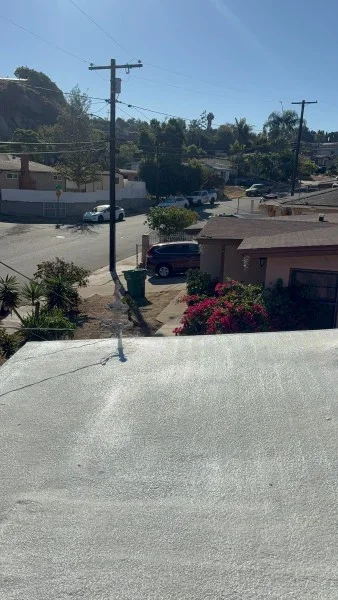
How a Vision Roof Services foam job runs in LA
Every foam job we run follows the same 9 steps, and the first one costs you nothing.
Initial contact. You call or book online. We ask for roof size, building use, age of the current roof, and any leak history.
Roof Health Check. A roof walk with photos, core cuts, moisture readings, curb heights and drain checks. We note the existing roof type against LAMC Table 1512.1 and look up the fire zone.
Written report. Delivered in 24-72 hours, with a recommendation. That can be a repair, a recoat, a foam recover, or a different system.
Proposal. Foam thickness and R-value, the coating by CRRC Product ID, the fire listing for your deck, the permit path, and a weather plan.
Contract approval.
Scheduling. Sections are planned around tenant hours and the LA spray window.
Installation. Prep, prime, foam in passes, coating in 2 coats, granules where the fire listing calls for them. The building stays in use.
Final inspection. Our walk, then the LADBS inspection on the permit.
Warranty and maintenance program. Manufacturer-backed warranty options depend on the system selected, and the inspection schedule starts.
Job length runs from days to weeks depending on size, weather and how much wet material comes out. You get the permit number for your records, which matters if the roof is part of an EBEWE exemption.
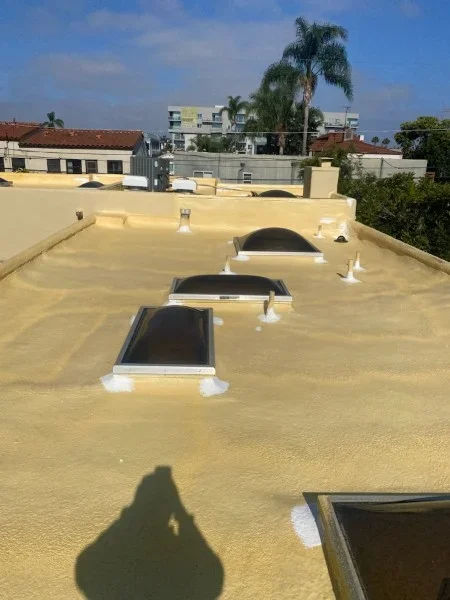
Who sprays your roof
Dave Bienek started roofing at 15, working HOA roofs with his father. That was 1992. He went full-time in 1998 and founded Vision Roof Services in 2014, and he still walks roofs. The company has finished about 7,500 jobs since, and foam is the work Dave wants the company known for. Read the full story on our About Vision Roof Services page.
Our crew is 60 roofers. 12 of them are trained and certified spray foam applicators under the General Coatings program, so the people holding the spray gun on your roof are certified by the maker of the foam. We are members of the Spray Polyurethane Foam Alliance and hold California contractor license 651509 (C-39 roofing).
In Los Angeles, our client list includes Paramount Studios at 5555 Melrose Ave in Hollywood. See photos and scopes from LA jobs in our featured projects. Vision Roof Services is BBB A+ accredited and a Best of BuildZoom 2024 winner.
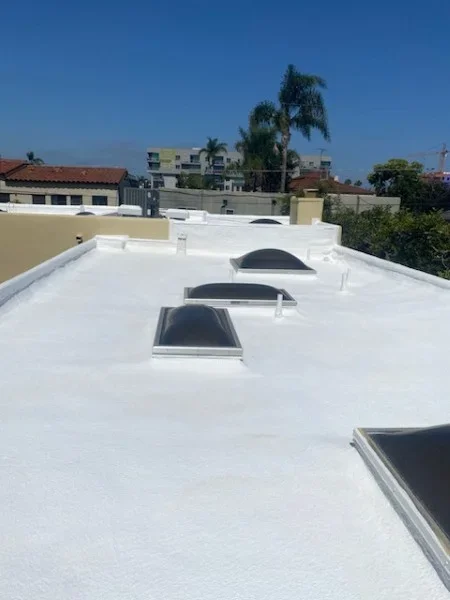
When spray foam is the wrong call in Los Angeles
We turn down foam work, or change the scope, in these situations, and the Roof Health Check is still free:
Modified bitumen, shingle, tile or metal roofs. LAMC Table 1512.1 lists foam over them as not permitted. Tear-off first, or a different system.
Saturated insulation across most of the roof. If the core cuts come back wet across the board, a foam recover becomes a tear-off with foam on top, and other systems may price better.
A plywood deck in a Very High fire zone with no room for roof board. Foam alone on plywood is Class B in the General Coatings listing.
A building that needs the full R-23 value and can't take board under the foam. About 4 inches of foam is outside the fire-rated listing.
An owner who won't recoat. A foam roof with no maintenance plan is a short-lived roof. We'd rather sell you something else.
Very small repairs outside our core service areas, gutter cleaning, and standalone wall foam insulation. We don't offer these.
For a broader look at repair, recoat, recover and replace options on LA roofs, see our Los Angeles roofing services page.
Spray foam roofing in Los Angeles: FAQ
Can spray foam go over my existing roof in Los Angeles?
If it is a built-up roof that is sound and dry, usually yes. LAMC Table 1512.1 permits SPF over built-up roofing and lists it as not permitted over modified bitumen, asphalt shingle, tile and most metal. Wet sections found in core cuts come out first.
How much does a spray foam roof cost in LA?
Southern California market ranges for 2026 run about $4.00-$7.00 per sq ft for a foam system and $1.50-$5.00 per sq ft for a recoat, vs about $8.00-$15.00 or more for a full replacement. The Roof Health Check gives you the scope your roof needs, and the proposal prices it.
Does a recoat trigger LA's cool roof rules?
Often. The 2025 California Energy Code counts recoats when more than 2,000 sq ft or more than half the roof, whichever is less, is coated. In the City of LA, plan for the LA Green Building Code value of 0.68 aged reflectance on nonresidential low-slope roofs. A recoat does not need added insulation.
Do I need a permit for a foam roof in Los Angeles?
Yes. A foam recover is reroofing work under LAMC 91.1512. A coating over an existing roof is listed as an express permit item in LADBS bulletin P/GI 2026-003 (Item 25). We pull the permit and give you the number when the job is finaled.
How long does a foam roof last in LA?
RICOWI and IBHS report maintained SPF roofs lasting past 30 years with recoats every 10-20 years. In LA sun, plan on the shorter half of that recoat range for south and west exposures. We don't publish 50-year figures.
Can you spray in winter or during June Gloom?
Yes, inside the foam maker's limits: 50°F minimum, no dew or humidity over 80%, and wind under 15 mph. Winter and marine-layer mornings start later, and Santa Ana days are off. Fall is the cleanest window before the rains.
Will a foam roof help with EBEWE?
It can. For buildings without central cooling, a cool roof is one of the 6 measures in the EBEWE exemption, and LADBS accepts a finaled permit inside the 5-year window as proof. The engineer or architect on your EBEWE filing makes the call. Questions about LA roofs in general are in our Los Angeles roofing FAQ.
Is a foam roof Class A in a fire zone?
It depends on the deck and the surfacing. In the General Coatings listing, foam with granules is Class A on noncombustible decks, on plywood with gypsum roof board, or over a Class A built-up roof on plywood. On plain plywood it is Class B.
Get a written report on your LA roof in 72 hours or less
Book a free Roof Health Check and we will walk your roof, take photos, cut cores, read moisture, check your fire zone and your existing roof type against LA code, and send a written report with a recommendation in 24-72 hours. If foam is the wrong call, the report tells you that too.
Or call (949) 779-5664
Know a building owner with a leaking flat roof? Our referral program pays $500 on jobs of $10,000 or more and 5% on smaller ones. More on our Los Angeles work at Roofers In Los Angeles, CA.
Vision Roof Services Inc. · 23372 Madero Ste E, Mission Viejo, CA 92691 · (949) 779-5664 · connect@visionroof.net · CA License 651509 · Mon-Fri 8-5