
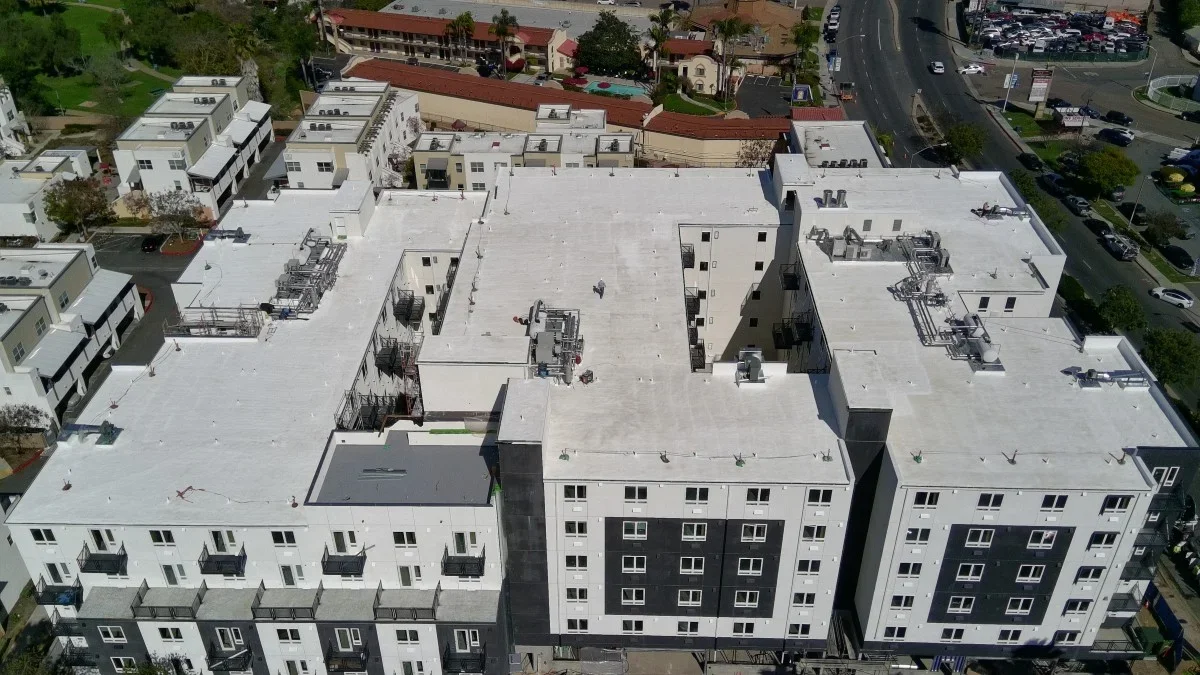
Roofers In Los Angeles, CA
For LA building owners, property managers and HOA boards with a leaking or aging flat roof. You get a documented Roof Health Check, with photos and a written report in 24 to 72 hours, before anyone talks price.
El Niño roof readiness for Los Angeles buildings, winter 2026-27
NOAA's Climate Prediction Center has an El Niño Advisory in effect. Its October 8, 2026 discussion calls a strong to very strong El Niño likely through January-March 2027. That is a forecast about Pacific Ocean temperatures. The CPC does not forecast Southern California rain totals, and neither will we. What it does tell a building owner is that this is the season to find the weak spots before a storm finds them.
LA's own record shows why. Downtown's 1991-2020 normal is 14.25 inches a year. The 2024-25 season brought 7.74. The 2025-26 season brought 19.07 (Los Angeles Almanac, from National Weather Service data). A roof that went 18 months nearly dry can hide cracked seams, split flashing and blocked drains, then show all of them in the first week of heavy rain.
Our El Niño Roof Readiness Check is the standard Roof Health Check with the storm items moved to the top:
Roof drains, scuppers and overflow drains cleared and flow-tested where we can.
Ponding areas measured and photographed, because standing water 48 hours after rain is where flat roofs fail first.
Seams, laps and coating checked for splits, blisters and bare spots.
Flashing at walls, curbs, skylights and rooftop HVAC units checked for gaps.
Penetrations added since the last roof job (conduit, solar mounts, antennas) checked for seals.
You get the photos, a map of what we found and a priority list. Small fixes can happen before the rain. Bigger work gets scoped and scheduled.
CA License 651509 (C-39 Roofing) · Roofing in Southern California since 1992 · About 7,500 jobs completed · General Coatings certified spray foam crews · Spray Polyurethane Foam Alliance member · BBB A+ · Best of BuildZoom 2024
Roofers in Los Angeles for commercial flat roofs, spray foam and coatings
Vision Roof Services is a C-39 licensed roofing contractor that works on commercial flat roofs across the City of Los Angeles: spray polyurethane foam (SPF), silicone restoration coatings, recoats and full flat roof replacement. Most LA projects start with a free Roof Health Check and a written report within 72 hours. Time on the roof for a commercial job runs from days to weeks, depending on square footage and how much of the old roof has to come off. We run Los Angeles work from our Mission Viejo office, about 50 to 60 miles south on I-5, and we schedule it as planned projects. Same-day service calls are not what we do in LA.
Los Angeles is a harder city to roof than the state code suggests. The city writes its own cool roof numbers into the LA Green Building Code, and they ask more of a roof than California's Title 24 does. The city also spans 4 energy climate zones, keeps its own reroof table that says which roofs can be covered over and which must be torn off, and runs a benchmarking program that reaches every private building of 20,000 sq ft or more. A bid that ignores any of those can pass a sales meeting and fail an LADBS inspection.
This page lays out the LA rules we build to, the systems we install, who we are a poor fit for, and what happens after you book. Commercial work is most of what we do in Los Angeles. Residential projects get their own section further down.
LA's cool roof code asks more of a roof than California's Title 24
The short answer: a commercial low-slope roof in the City of Los Angeles faces 2 sets of cool roof numbers, and the city's set is the harder one. California's 2025 Energy Code (Title 24, Part 6) sets a nonresidential low-slope reroof at an aged solar reflectance of 0.63 and a thermal emittance of 0.75, or an SRI of 75, in every climate zone. LA's Green Building Code, as amended by Ordinance 187,208 (effective November 5, 2021), sets its nonresidential low-slope table at 0.68 and 0.85, or an SRI of 82.
| Roof | Rule | Aged solar reflectance | Thermal emittance | Aged SRI |
|---|---|---|---|---|
| Nonresidential, low slope (under 2:12) | California Title 24, 2025 Energy Code | 0.63 | 0.75 | 75 |
| Nonresidential, low slope (under 2:12) | LA Green Building Code, Table 99.05.106.13 | 0.68 | 0.85 | 82 |
| Residential low-rise, low slope (under 2:12) | LA Green Building Code, Table 99.04.106.5.1 | 0.65 | 0.85 | 78 |
| Nonresidential, steep slope | California Title 24, 2025 Energy Code | 0.25 | 0.80 | 23 |
| Nonresidential, steep slope | LA Green Building Code, Table 99.05.106.13 | 0.28 | 0.85 | 27 |
Sources: California Energy Commission, 2025 nonresidential cool roofs and LA Ordinance 187,208.
The number that catches people is thermal emittance. Title 24 accepts 0.75. LA's table asks for 0.85. A coating can clear the state minimum and still fall short of the city's, so a bid that says "Title 24 compliant" has not answered the LA question.
The triggers differ too. Title 24 kicks in when you replace, recover or recoat more than 50% of the roof or more than 2,000 sq ft, whichever is less. On a 20,000 sq ft warehouse, that means 2,000 sq ft. LA's Green Code exempts a replacement of 50% or less of the roof area, plus repairs, areas under new solar and roofs carrying 25 lb per sq ft or more of thermal mass over the membrane. So on that same warehouse, a 5,000 sq ft replacement triggers Title 24 and leaves the city table out of it. Replace 12,000 sq ft and both apply.
What we do about it: every LA bid we write names the coating or membrane, its Cool Roof Rating Council product ID and its 3-year aged values, so you can check them against both tables yourself. If a product misses LA's numbers, you hear it from us before you sign.
One city, 4 climate zones
Los Angeles sits in 4 of California's 16 energy climate zones. Per SoCalREN's climate zone directory: Zone 6 covers the coast (San Pedro, Wilmington, Venice, Pacific Palisades). Zone 8 covers South LA, Watts, Palms and West Adams. Zone 9 covers Downtown, Hollywood and most of the San Fernando Valley. Zone 16 covers Sunland, Shadow Hills and Tujunga at the foothills.
For a low-slope commercial cool roof, the zone does not change the Title 24 reflectance numbers, because those apply statewide. It does change the insulation requirement when a job strips the roof down to the deck, and it changes how hard the summer sun works on a dark membrane. A warehouse in Sylmar and a storefront in San Pedro get different specs from us, even when they look the same from the street. We confirm the zone by ZIP on the CEC's climate zone tool before we write the insulation line of a bid.
The LA 5-Code Roof Check
We built the LA 5-Code Roof Check because most commercial roofing bids in Los Angeles answer 1 or 2 of these questions and skip the rest. Ask every bidder, us included, to answer all 5 in writing.
Which cool roof table governs this roof? Title 24, the LA Green Building Code, or both, with the product's aged values listed next to each.
Does the scope trip a trigger? State the replaced area against the 50% and 2,000 sq ft thresholds.
Can the existing roof legally stay in place? LA's reroof table (LAMC Table 1512.1) decides which new systems may go over which existing ones. The answer belongs on the bid, along with a core sample if the layers are unknown.
Is the building inside a Very High Fire Hazard Severity Zone? If yes, the roof needs a Class A rating, and LADBS bulletin P/BC 2026-013 bans wood shakes and shingles citywide regardless.
Is the building covered by EBEWE? Private buildings of 20,000 sq ft or more report to LADBS, and a cool roof can count toward an audit exemption. The roofer should hand you the paperwork that proves it.
A bidder who can answer these has read the LA code. A bidder who can't is pricing a roof for some other city.
Spray foam over an existing LA roof: when the code allows it
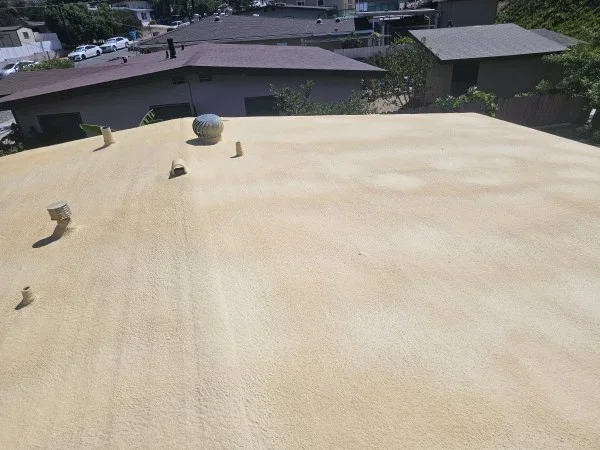
Spray foam can often go over an existing built-up roof in Los Angeles without a full tear-off. LA's reroof table, LAMC Table 1512.1, lists SPF as a permitted recover over an existing built-up roof. The same section lets a new protective coating go over an existing spray foam roof without tearing anything off, which is how an SPF roof gets renewed instead of replaced.
The table is not a blanket yes. As published, it does not list SPF as a permitted recover over an existing modified bitumen roof. That is why question 3 of the 5-Code Check exists. We confirm what is actually on your deck with a core sample before we quote foam.
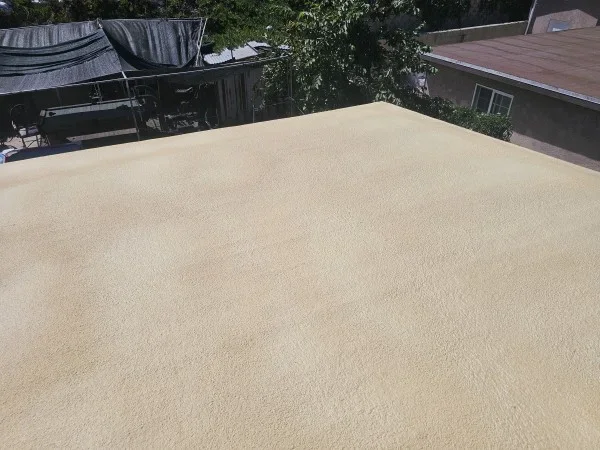
Weight matters here as well. LADBS issues express, over-the-counter reroof permits for Class A or B coverings under 6 lb per sq ft over solid sheathing (Information Bulletin P/GI 2026-003, items I.4 and I.5), and a coating over an existing roof is its own express item (I.25). Roofing foam is commonly sprayed at about 2.5 to 3 lb per cubic foot, so a 1.5 inch layer adds roughly 0.3 to 0.4 lb per sq ft before the topcoat. That is a fraction of what a second layer of built-up roofing or a tile roof adds to an old frame.
Why owners in LA choose foam, in their own words to us: no seams for water to find, a lighter load on older buildings, less tear-off, insulation added in the same pass, and a roof that gets recoated on a schedule.
The objection we hear most is cost. Spray foam costs more up front than a basic recoat. What it buys is lower maintenance spend and insulation over the roof deck, and a properly maintained foam roof can be renewed with new coating for decades. We will not promise you a dollar figure on your power bill. Measured results vary too much. When Lawrence Berkeley National Laboratory instrumented cool roof retrofits on California commercial buildings (report LBNL-54770), cooling energy savings ran about 52% at a Sacramento retail store, 17 to 18% at a San Marcos school and 3 to 4% at a Reedley cold storage building. Same idea, 3 very different buildings. Your result depends on your building.
If your LA building is 20,000 sq ft or larger: EBEWE
Every privately owned building in the City of LA with 20,000 sq ft or more is covered by the Existing Buildings Energy and Water Efficiency program, Ordinance 184,674. Covered buildings benchmark their energy and water use with LADBS every year. Every 5 years they also complete an energy and water audit and retro-commissioning (A/RCx), on a schedule set by the last digit of the LADBS Building ID.
The next deadline is close. Buildings whose ID ends in 0 or 1 have an A/RCx due December 1, 2026. IDs ending in 2 or 3 follow on December 1, 2027 (LADBS EBEWE program). Missing it costs a $202 non-compliance fee, plus a 250% late charge if it goes unpaid for 30 days.
The roof connects in 2 ways. A building with no central cooling system can claim the energy audit exemption by completing 4 of 6 listed measures within the 5-year cycle, and one of the 6 is a cool roof installed to the LA Green Building Code. A licensed engineer or architect certifies that report. Separately, a roof replacement that strips to the deck is the cheapest moment you will ever get to add roof insulation, and the audit will look at it.
We do not perform EBEWE audits. What we hand you is the documentation an auditor or engineer asks for: product name, CRRC product ID, aged values, roof area covered and install date.
Commercial roofing systems we install in Los Angeles
| System | Best fit | Tear-off needed? | How it is maintained |
|---|---|---|---|
| Spray polyurethane foam with silicone or acrylic topcoat | Aging built-up roofs, ponding, many penetrations, older frames | Often no over built-up; confirm with a core sample | Annual inspection, recoat on the schedule set at install |
| Silicone restoration coating | Sound roof with failing surface, no wet insulation | No, if the substrate tests dry and sound | Annual inspection, recoat as the coating wears |
| Recoat of an existing SPF roof | Foam roofs with worn or thin coating | No (LAMC 91.1512 permits it) | Same as above |
| Flat roof replacement | Wet insulation, failed deck, or a roof the code will not let us cover | Yes | Annual inspection under a maintenance program |
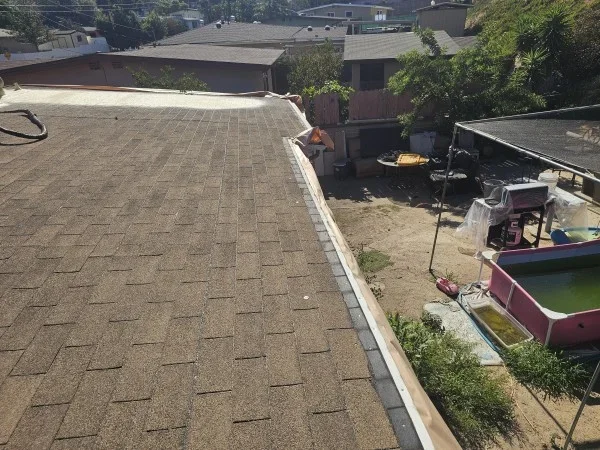
| Roof rejuvenation | Asphalt shingle roofs with life left | No | Re-treatment on a set interval |
Every system above starts from the same documented Roof Health Check, and the report tells you which row your roof belongs in. Our commercial roofing services page covers each system in more depth, and the spray foam roofing page explains how foam roofs are built and recoated.
If a contractor offers you one system no matter what the core sample shows, ask why.
Who calls us in Los Angeles
Most LA calls come from 3 groups: commercial building owners, property managers and HOA boards. Developers, general contractors and custom home builders make up the rest. The reason is almost always the same. A flat roof is leaking, or it is old enough that the owner expects it to start.
Our commercial clients across Southern California include Paramount Studios in Hollywood, Yamaha's facility in Buena Park, LifeStorage in Costa Mesa, KPRS and American Tower. Paramount's lot at 5555 Melrose Avenue sits inside City of LA limits, in Climate Zone 9. Photos and specs from those jobs are on our featured roofing projects page.
Rooftop equipment is where we see LA commercial roofs fail early. HVAC units get serviced by crews who are not roofers, panels get dropped on the membrane, and condensate runs onto the same spot for years. If that sounds like your roof, ask for the rooftop equipment pages of the Health Check report before your next HVAC service visit.
For tenants who cannot shut down, we stage the work in sections so the building stays open.
Residential roofing in Los Angeles: where we take the job
In Los Angeles we take residential work selectively: HOA communities, multifamily buildings and larger homes. The city's housing is old. Per LA City Planning's citywide profile (ACS 2020-2024), 69.9% of housing units were built in 1979 or earlier, and 19.1% before 1940. A roof that old has usually been worked on more than once, and what sits under the current surface decides what the code lets you do next.
LA's residential rules that change a reroof:
Replacing more than 50% of a residential roof requires a CRRC-rated cool roof (LADBS Information Bulletin P/GI 2026-003). The city's low-rise low-slope table is 0.65 / 0.85 / SRI 78, above the state's numbers.
Wood shakes and shingles are prohibited citywide (LADBS IB P/BC 2026-013).
A reroof of more than 50% in any 1-year period brings the whole roof up to current code.
In a Very High Fire Hazard Severity Zone, the covering must be Class A.
For owners rebuilding after the January 2025 Palisades and Eaton fires, the Mayor's Emergency Executive Order No. 1 allows like-for-like rebuilds up to 110% of the prior size without discretionary review. The new roof still has to meet current city building codes. More on our residential roofing services.
How a Los Angeles roof project runs
Every LA project follows the same 9 steps, and you see a written document at the 3 that matter most: the Health Check report, the proposal and the warranty paperwork.
| Step | What happens | What you get |
|---|---|---|
| 1. First contact | You call (949) 779-5664 or book online | A scheduled visit |
| 2. Roof Health Check | Inspection, photos, core sample if needed | Written report in 24 to 72 hours |
| 3. Proposal | System, product, CRRC values, scope and permit plan | A bid that answers the 5-Code Check |
| 4. Contract approval | You sign, financing through Acorn Finance if you want it | Start date window |
| 5. Scheduling | Permit pulled, crew and material booked | Confirmed dates |
| 6. Installation | Days to weeks, by roof size | Work in sections if the building stays open |
| 7. Final inspection | Our walk, then the LADBS inspection | Passed permit |
| 8. Invoicing | Final invoice against the signed scope | Invoice that matches the contract |
| 9. Warranty and maintenance | Manufacturer-backed warranty program, annual inspections | Recoat schedule and inspection dates |
Warranty length depends on the system and the manufacturer program behind it, so we put the actual term in the proposal rather than on this page. What keeps a warranty alive is maintenance. Skipped annual inspections and rooftop penetrations made without the warranty holder's approval are 2 ways owners lose one.
Who we are not the right roofer for in LA
We are 50 to 60 miles from downtown, and we would rather say so up front.
If you need a single small leak patched on a duplex in Van Nuys this week, a local repair crew will get there faster and cost you less than we will. We do not take very small repairs this far outside our core service area, and we do not clean gutters.
If the deciding factor is the lowest bid, we will probably lose. Price is the most common reason we lose jobs, and we are fine with that. We would rather answer the 5-Code Check than undercut someone who skipped it.
And if the core sample shows wet insulation under the whole roof, we will not sell you a coating or foam over it. Foam and coatings need a dry, sound substrate. Covering a wet roof traps the water. The honest answer then is a replacement, even when it is the more expensive one. The core sample is a small cut through every layer down to the deck, patched after we read it, and it is the only way to know for sure.
Dave Bienek and the crew behind the work
Dave Bienek started roofing at 15, working beside his father, who roofed HOA communities. He went full-time in 1998. The company's CSLB license, 651509, was first issued in 1992, and the business has operated as Vision Roof Services since 2014. His view hasn't changed in 30 years of roofing: the inspection is where most roofing mistakes get caught or get made, so every job we take starts with one.
Today about 60 trained roofers work for us. A dozen of them are trained and certified spray foam applicators under General Coatings' certification program, and the company is a member of the Spray Polyurethane Foam Alliance. We have completed about 7,500 jobs. Customers who pick us over another bidder usually tell us it came down to how fast we responded and how much the inspection showed them.
We work from 2 offices, Palm Desert and Mission Viejo. Los Angeles projects are run from Mission Viejo. The full company history and team are on our about Vision Roof Services page.
Los Angeles roofing questions we get
Can spray foam go over my existing roof in Los Angeles?
Often, if the existing roof is built-up and the substrate is dry. LA's reroof table permits SPF over built-up roofing, and a new coating over an existing foam roof needs no tear-off. Modified bitumen is less clear in the table, so we confirm with a core sample before quoting.
Do I need a permit for a roof recoat in LA?
Yes. LADBS lists an approved coating over an existing roof as an express permit item (I.25 in Information Bulletin P/GI 2026-003). Fees are based on project valuation. We pull the permit.
Do I need a new roof or a coating?
It depends on what is under the surface. A sound, dry roof with a worn surface is a coating candidate. Wet insulation or a failing deck means replacement. The Health Check report tells you which, with photos.
How long does a spray foam roof last?
A foam roof that is inspected every year and recoated on schedule can last decades. The foam itself is protected by the topcoat, and the topcoat is the part that wears. Skip the recoats and the foam degrades in the sun.
Will solar void my roof warranty?
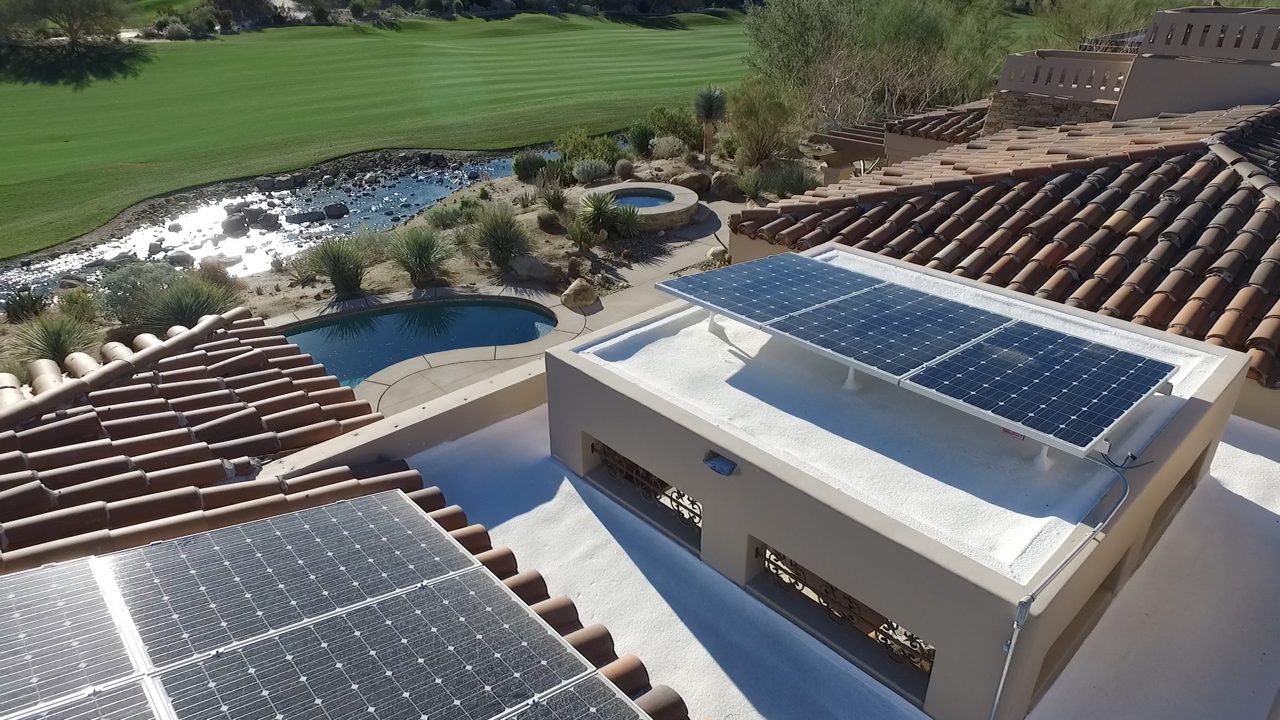
It can, if the installer penetrates the roof without coordinating with the roofer or the warranty holder. Tell us before solar goes on, and we will plan the mounts and flashing with your installer. Our solar roofing in Los Angeles page covers the sequence.
Do LA city rules apply in Burbank, Glendale or Santa Monica?
No. The LA Green Building Code, the LADBS bulletins and EBEWE apply inside City of LA limits. Independent cities in LA County run their own building departments, and unincorporated areas go through LA County Public Works. We check which code governs your address before we write the bid.
Customer Testimonials
VRS has been building trust among the SoCal community for decades.


Book your free Los Angeles Roof Health Check
You get an inspection, photos and a written report in 24 to 72 hours, with no obligation to hire us. If you manage more than one LA building, ask us to check them in the same visit.
Call (949) 779-5664, Monday to Friday, 8 am to 5 pm. Financing is available through Acorn Finance.
Vision Roof Services Inc. · 23372 Madero Ste E, Mission Viejo, CA 92691 · (949) 779-5664 · connect@visionroof.net · CA License 651509
Know a building owner with a roof problem? Our referral program pays $500 on completed jobs of $10,000 or more, and 5% of the contract on smaller ones.
Our Service Areas
Serving Southern California's Key Regions
Vision Roof Services is dedicated to providing top-tier roofing solutions across Southern California’s bustling cities. Our primary focus includes Riverside, Orange, and San Diego Counties, with comprehensive services extending to Los Angeles County.

Riverside County, CA

San Diego County, CA

Orange County, CA

Los Angeles County, CA
Featured Projects
Explore Our Portfolio
Throughout Southern California, Vision Roof Services has a proven track record of excellence, with a diverse portfolio of both large-scale and smaller projects. Discover how our expertise has transformed spaces and how we can do the same for your property.
Get to Know Us
Curious About The Team & Our Roofing Solutions?
Visit our About page to explore our company's history, values, and the dedicated group behind our Commercial and Residential roofing services.
