Residential Roofing In Los Angeles, CA
Tile, shingle and flat-roof systems for Los Angeles homes.
Residential roofing in Los Angeles, CA runs on a city code that is stricter than the state's. Vision Roof Services replaces, repairs and recoats tile, shingle and flat roofs on Los Angeles homes, and we build every reroof to the City of LA cool roof values, not the lower Title 24 numbers LA roofing guides often quote. Book a free Roof Health Check and you get a written report with photos within 24-72 hours.
Book a Free Roof Health Check or call (949) 779-5664
CSLB #651509 · Licensed & Insured · BBB A+ · 2024 Best of BuildZoom · General Coatings certified · Spray Polyurethane Foam Alliance member
Who we reroof for in Los Angeles, and what it takes
Vision Roof Services reroofs single-family homes, duplexes and small HOA buildings inside the City of Los Angeles. A standard reroof on a house goes through LADBS as an express permit with no plan check, typically takes 2-5 working days on the roof for an average home, and closes with an LADBS inspection and final. Our crews have finished about 7,500 roofing jobs since Vision Roof Services opened in 2014, and our founder, Dave Bienek, has worked on Southern California roofs since 1992.
Leaks and aging flat roofs are the 2 problems Southern California homeowners call us about most. In Los Angeles the calls tend to look like this:
A 1950s-1970s home leaking at the flashings, valleys or a flat section over the den
A flat or low-slope roof (tar and gravel, torch-down, rolled roofing) that ponds water every winter
In fire-zone neighborhoods, an insurer asking for a dated, photographed roof condition report
The age of the housing explains the first 2. 69.9% of the housing in the City of Los Angeles was built in 1979 or earlier, according to the Census Bureau's 2020-2024 American Community Survey. A house that old is on its third or fourth roof, and every one of those reroofs may have changed the deck, the flashing or the drainage. We don't quote until we've been on it.
What changed for a Los Angeles reroof in 2026
4 rule changes since late 2025 decide what goes on an LA roof this year.
Wood shakes are gone citywide. LAMC 91.1505.1 now bars wood shake and wood shingle roof coverings anywhere in the City of Los Angeles, fire-retardant-treated or not. If you have shakes, the replacement is a different material, full stop. LADBS Information Bulletin P/BC 2026-013 also says that once more than 50% of a roof is reroofed within 1 year, the whole roof has to meet current code.
The express permit rules were reissued. LADBS Information Bulletin P/GI 2026-003 took effect January 1, 2026 and was revised June 10, 2026. It is the document that decides whether your reroof skips plan check, and it carries the cool roof condition for houses (more on that below).
The 2025 Energy Code applies. Permits applied for on or after January 1, 2026 fall under the 2025 California Energy Code. A bid written from a 2022-cycle template may cite the wrong section numbers.
Zone 0 is coming. The State Board of Forestry adopted emergency "Zone 0" ember-resistant rules on August 19, 2026, and sent them to the Office of Administrative Law on August 28. They are not operative yet. In the City of LA they reach homes in locally designated Very High Fire Hazard Severity Zones. For existing homes, the first duties when they take effect include keeping roofs and gutters clear and keeping the first 5 feet around the house free of combustibles.
LA's cool roof number is higher than the state's
If you replace more than 50% of a house roof in the City of Los Angeles, the new roof has to be a cool roof product rated by the Cool Roof Rating Council (CRRC). That condition is written into express permit items 4 and 5 of LADBS bulletin P/GI 2026-003. The values come from the Los Angeles Green Building Code, and they are higher than the Title 24 values most contractors quote.
| Roof on a 1-3 story home | Title 24 (state), aged SR / emittance / SRI | City of Los Angeles, aged SR / emittance / SRI |
|---|---|---|
| Steep slope (tile, shingle) | 0.20 / 0.75 / 16, only in Climate Zones 4 and 8-15 | 0.25 / 0.85 / 20, no climate zone exception stated |
| Low slope (flat roofs) | 0.63 / 0.75 / 75, only in Climate Zones 4 and 6-15 | 0.65 / 0.85 / 78, no climate zone exception stated |
Sources: LADBS Green Building Code Plan Check Notes, Residential (GRN 14, revised 01-01-2026); CRRC summary of the Los Angeles Green Building Code; CRRC 2025 Energy Code summary.
Why this matters: Los Angeles spans 4 Title 24 climate zones. San Pedro, Wilmington, Venice and the Palisades sit in Zone 6. South LA, Watts, Palms and West Adams are Zone 8. Downtown, Hollywood and the San Fernando Valley are Zone 9. Sunland-Tujunga (91040, 91042) is Zone 16. Under state code alone, a tile reroof in Venice or Tujunga needs no cool roof. Under the City's bulletin it does. A bid that prices a standard dark tile for a Venice house is pricing a roof that fails the City's condition.
The City's exemptions are narrow: repairs, replacing 50% or less of the roof, roof area under solar, and roofs carrying 25 pounds per square foot or more of thermal mass over the membrane. A tile lift-and-relay (express permit item 23, where the same tiles go back down on new underlayment) is also exempt from cool roof compliance. On a sound concrete tile roof it can be the smartest money you spend, and we'll tell you when it is.
The LA Reroof Test: 4 questions before you sign
We run every Los Angeles residential bid through 4 questions. Ask any roofer the same 4. If the answers aren't in writing, the bid isn't finished.
| Question | Where the answer lives | What it changes |
|---|---|---|
| 1. Is the house inside the City of Los Angeles? | ZIMAS parcel lookup (zimas.lacity.org) | LADBS rules apply only inside city limits. Glendale, Pasadena, Santa Monica, Culver City, Burbank and unincorporated county areas each run their own permits. |
| 2. Is the parcel in a Very High Fire Hazard Severity Zone? | ZIMAS hazards tab | Class A covering required on express items 4 and 5. Over 50% reroofed in 12 months brings the whole roof to code. |
| 3. Are you replacing more than 50% of the roof? | Your bid's square count vs. the total roof area | CRRC cool roof at the City values in the table above. |
| 4. Is the new covering under 6 pounds per square foot, on solid sheathing? | The product data sheet | Under 6 psf: express permit, no plan check. 6 psf or over (most concrete and clay tile swaps onto a lighter roof): plan check with structural review. |
2 more checks belong in the same conversation. First, how many layers are already on the roof: a recover is not allowed over 2 or more existing coverings, so a house that was already roofed over once gets torn off. Second, the LADBS Owner Statement and Acknowledgment of Compliance. On a permit valued over $1,000, LADBS asks the owner to confirm smoke alarms, carbon monoxide alarms where required, 2.0 gpm showerheads and 1.28 gpf toilets before final. On a single-family house or duplex permit valued at $10,000 or more, add impact-safe glass or film on sliding glass doors and a seismic gas shut-off or excess-flow valve where there's gas piping. Those items are cheap, but they stall a final inspection if nobody warned you. We put them on our report so they're done before the inspector shows up.
Roof systems for Los Angeles homes
The right system depends on slope, weight, fire zone and how long you plan to own the house. Here is what each one does on an LA house.
Concrete and clay tile
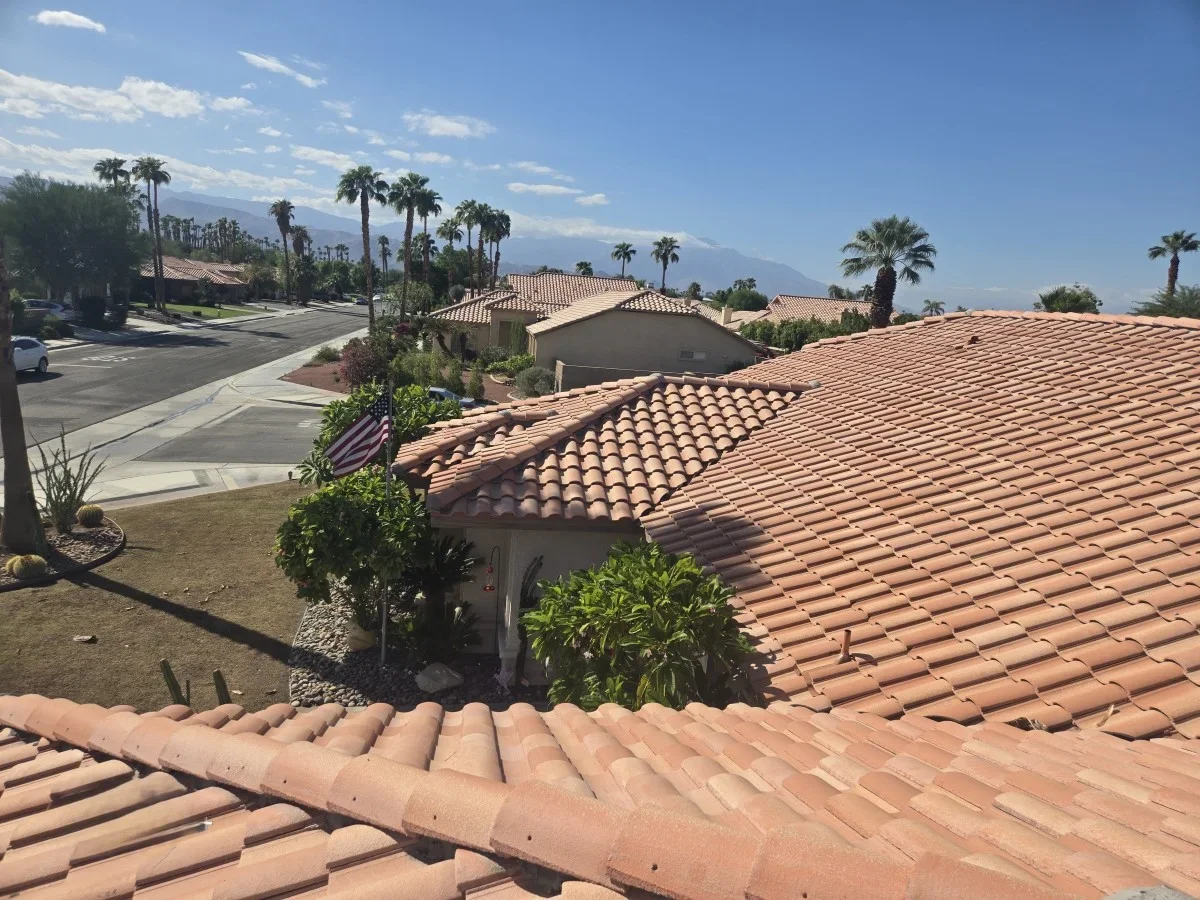
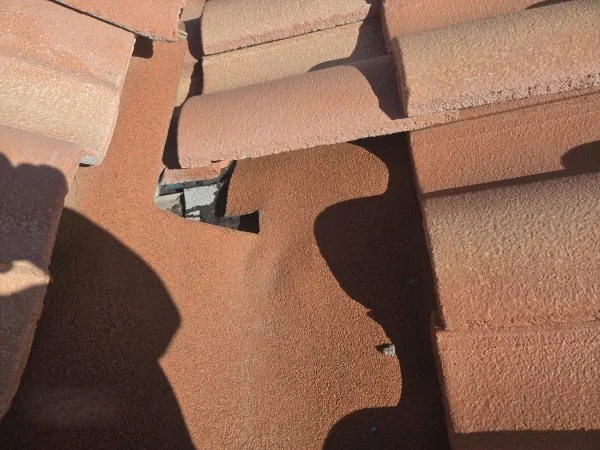
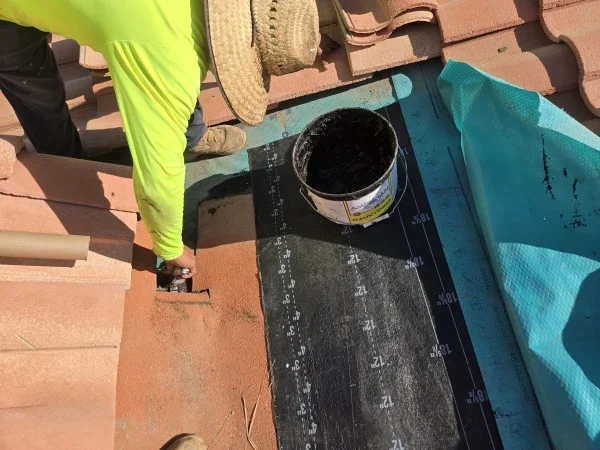
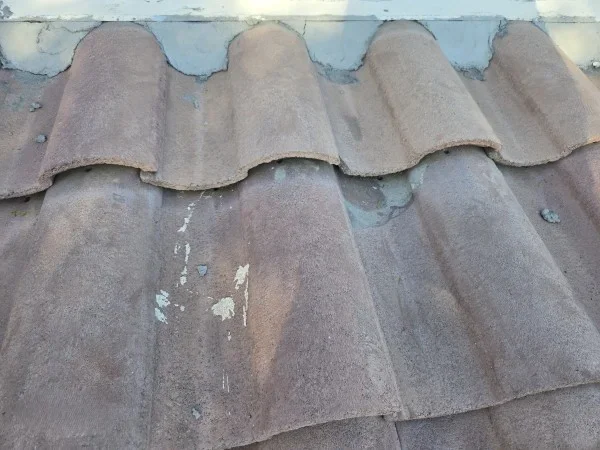
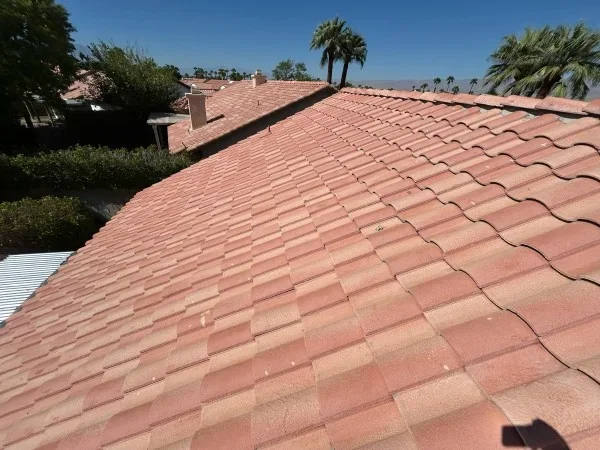
Tile is the most common steep-slope roof we see on Spanish, Mediterranean and post-war ranch homes from the Valley to the Eastside. Concrete tile can outlast 2 underlayments. When the felt underneath has failed and the tile is sound, a lift-and-relay (express item 23) replaces the underlayment and flashings, reuses the tile and skips the cool roof requirement. When the tile is cracked, discontinued or too heavy for the framing, we replace it with a CRRC-rated tile that meets the City's 0.25 aged reflectance. Light colors pass easily. A tile rated between 0.20 and 0.25 passes Title 24 and fails the City value, so we check the CRRC listing before we order.
Architectural asphalt shingle
Shingle is the lightest and least expensive steep-slope roof and it sails through the express permit. It is Class A rated when installed to the listed assembly. The catch in Los Angeles is color: a shingle has to reach 0.25 aged reflectance to count as a City cool roof, and standard dark shingles fall below it. Ask to see the CRRC product ID on your bid.
Spray foam with a coating, for flat and low-slope roofs
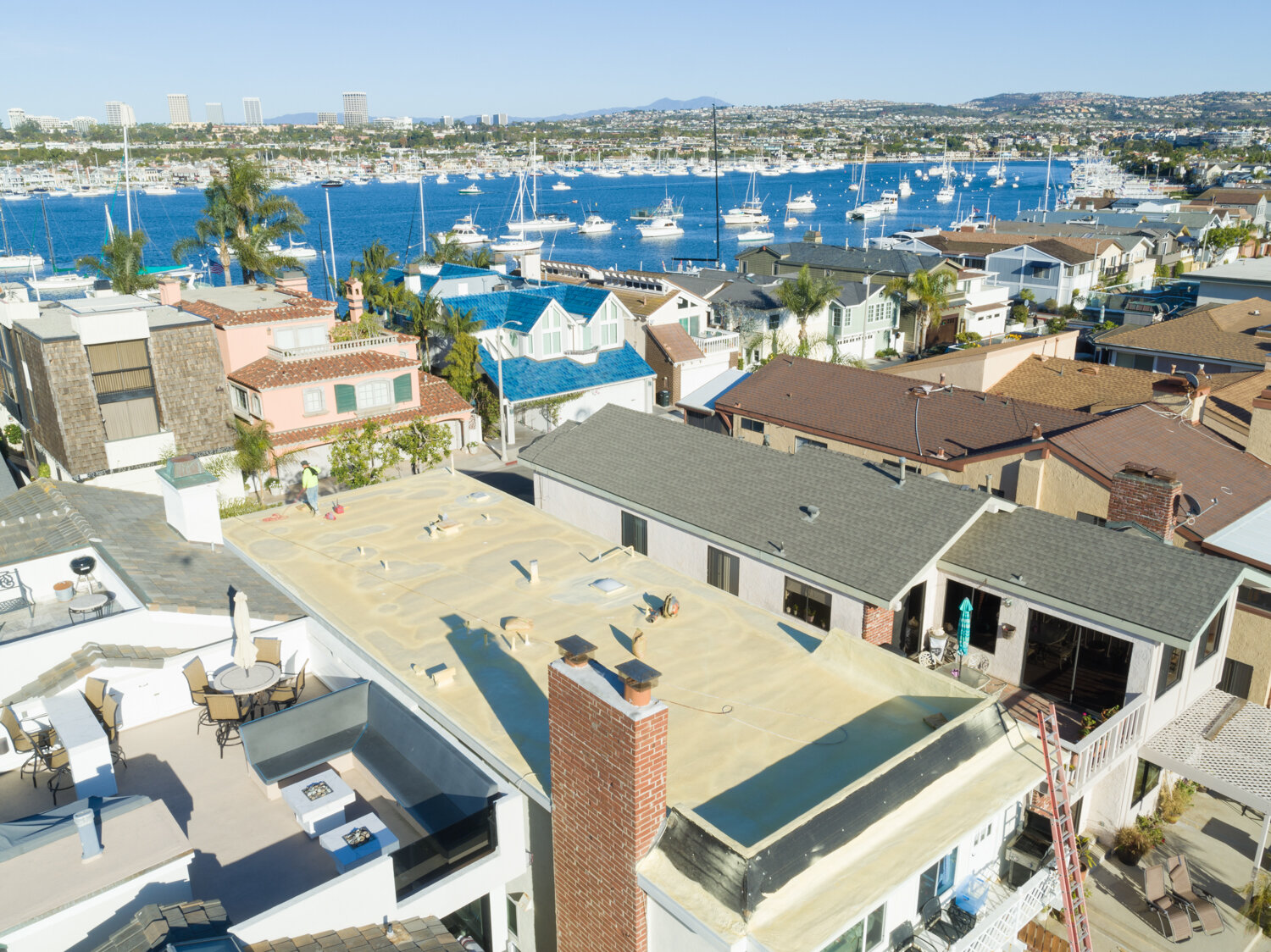
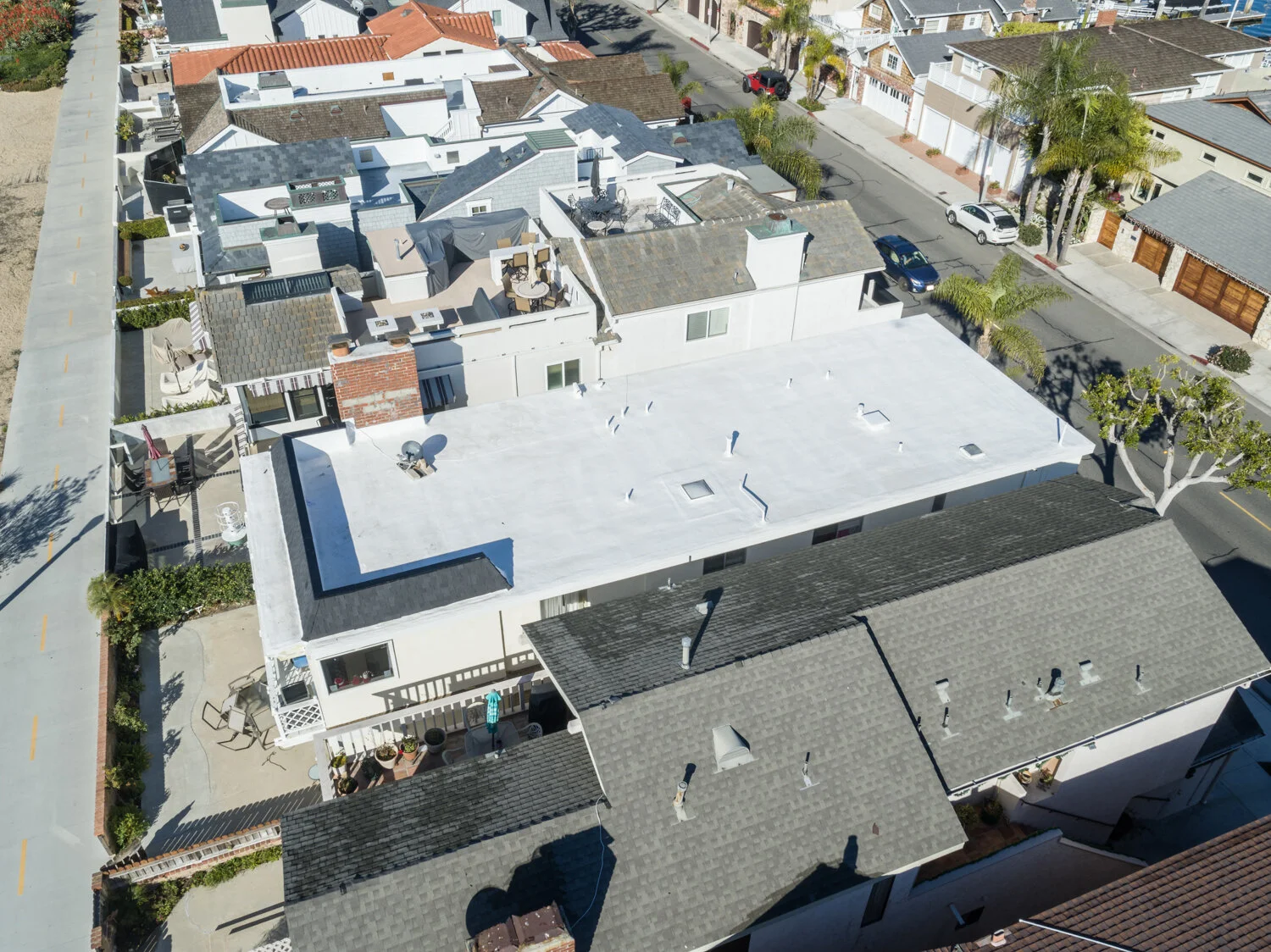
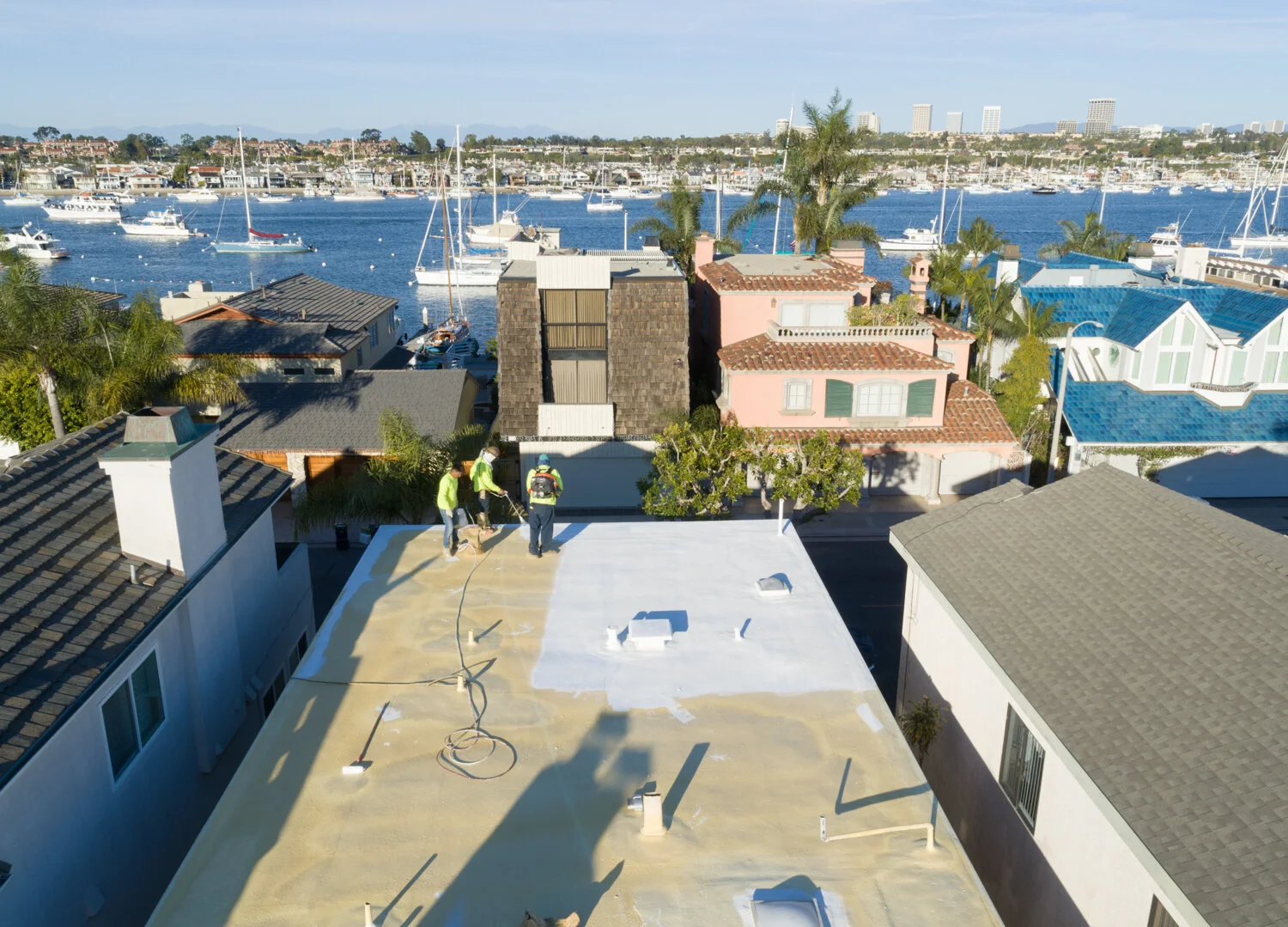
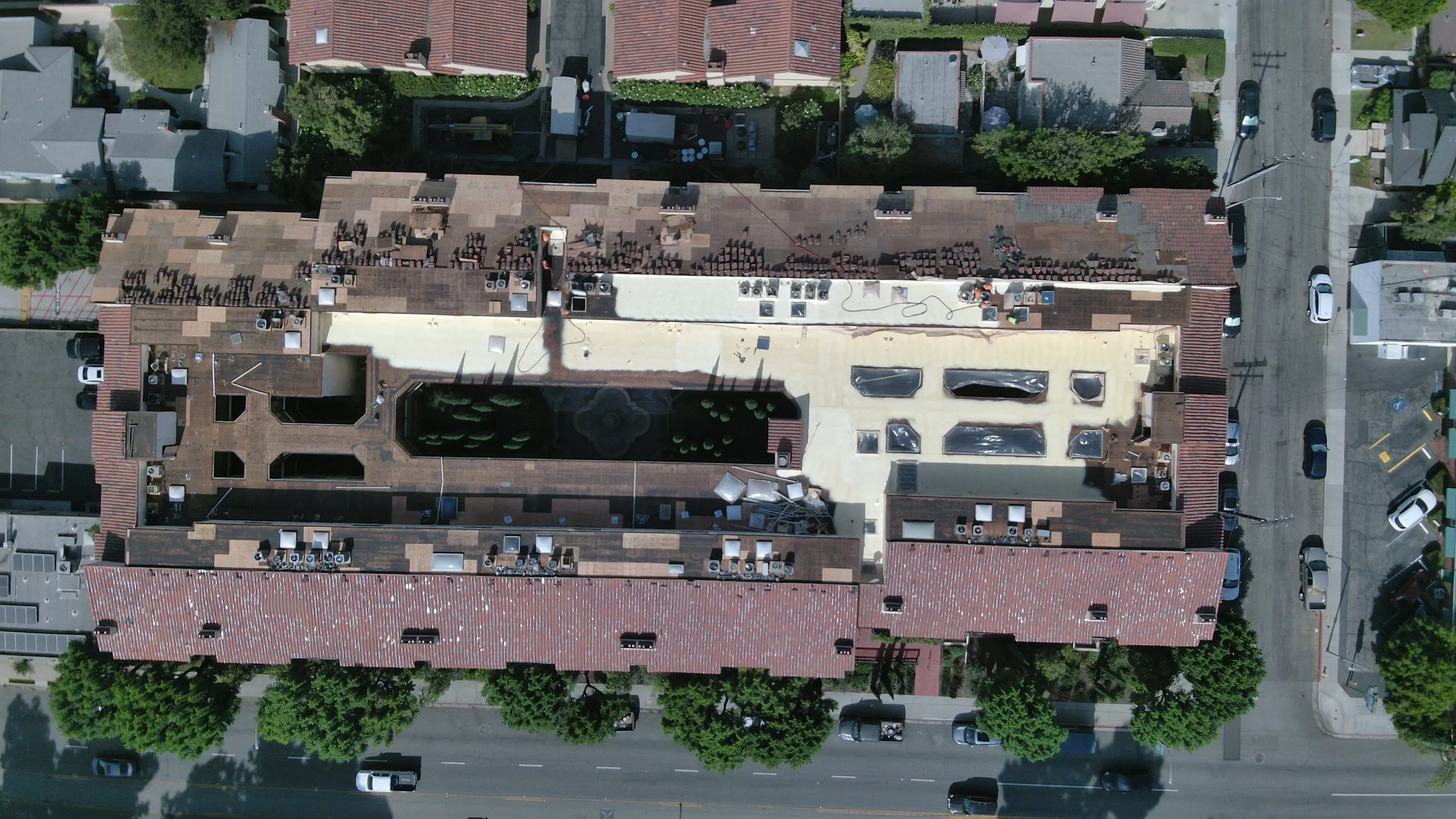
Spray polyurethane foam (SPF) is sprayed on as a liquid, expands into a single layer with no seams, and is topped with a reflective coating. On a flat LA roof it does 3 things a torch-down or rolled roof can't: it adds insulation on top of the deck, it builds slope to push water toward drains, and a white coating with a CRRC listing at 0.65 or higher meets the City's low-slope value. LAMC Table 1512.1 permits SPF over an existing built-up (tar and gravel) roof, so a sound deck can keep its old roof underneath as a base. Our crew includes 12 General Coatings certified foam applicators out of about 60 roofers.
Coating over an existing roof
A silicone or acrylic coating over an existing low-slope roof or an existing foam roof is express permit item 25. It's the right call when the roof is dry, the deck is sound and the problem is age, not water in the insulation. A foam roof that gets recoated on schedule keeps going without a tear-off. A roof with wet insulation underneath does not get coated by us. We core it first and tell you what we find.
Flat roofs on mid-century LA homes
Los Angeles has more flat and low-slope residential roofs than most cities, and the post-war tracts are where we see the most failures. Balboa Highlands in Granada Hills is a good example: Joseph Eichler built the tract in 1962-1964 with designs by Jones & Emmons and Claude Oakland, in 3 rooflines (flat, A-frame and slant). The LA Conservancy lists it as a local historic district. Owners there have been asking about foam since at least 2005, when one wrote on the Eichler Network forum that foam over the original roof made the insulation difference "night and day."
The same pattern repeats in Valley ranch houses, hillside post-and-beam homes and 1960s flat-roof additions all over the city. The roof is thin, the ceiling is the underside of the deck, and the house has almost no insulation between the bedroom and the sun.
What we look for on these roofs:
Ponding: any water standing 48 hours after rain means the roof needs slope, not a patch
Wet insulation: we cut a core sample before we recommend a coating or a foam recover
The existing layers: tar and gravel can be foamed over per Table 1512.1; modified bitumen shows "NP" (not permitted) for SPF in that table, so we confirm with LADBS before we bid foam over mod-bit
Historic review: in an HPOZ, a change to the visible roofline or material goes through City Planning before LADBS issues the permit
Fire zones, insurance and the Class A roof
The Palisades Fire started January 7, 2025 and destroyed 6,837 structures, most of them in Pacific Palisades. Since then, LA homeowners in the hills have asked us 2 questions more than any other: what roof keeps the insurance, and what roof keeps the house.
The California Department of Insurance's Safer from Wildfires program lists the home-level steps that qualify for a premium discount. A Class A fire-rated roof is first on the list. The program says most roofs qualify, including asphalt shingle, concrete, brick and masonry tile. Wood shake does not. 3 more items on the list touch the roof line: ember-resistant vents with 1/16 to 1/8 inch noncombustible metal mesh, enclosed eaves, and a 5-foot ember-resistant zone around the house.
Inside a Very High Fire Hazard Severity Zone, LADBS already requires Class A on an express reroof. Outside one, Class B is still legal. Our view: on any LA house within sight of a hillside, put on Class A. Shingle, concrete tile and clay tile all reach Class A when installed to their listed assembly, so the choice rarely costs you the look you wanted.
When we inspect a hillside home, the report covers the roof covering's fire class, the vents, the eaves, the gutters and the debris in the valleys. That's the list your insurer and the Zone 0 rules will both ask about.
Rain: what an El Niño winter does to an LA roof
On October 8, 2026, NOAA's Climate Prediction Center issued an El Niño Advisory and put the chance of a strong-to-very strong El Niño through January-March 2027 above 83%. A strong El Niño raises the odds of a wet Southern California winter. It doesn't guarantee one.
Downtown Los Angeles averages 14.25 inches of rain a season. The last 2 seasons swung hard either side of that:
A dry season hides roof problems. A wet one finds them all at once, and every roofer in the county gets booked out the same week. The roofs that fail first are the ones with cracked flashings at chimneys and walls, clogged scuppers on flat roofs, and underlayment that has been baking under tile for 25 years. If your roof is over 20 years old, the time to have it checked is before the first storm, not during it.
What moves the price of a residential roof in Los Angeles
We price every LA roof after the Roof Health Check, because the 6 things that move the number are things nobody can see from the street or a satellite photo.
| Cost driver | Why it moves the price in LA |
|---|---|
| Deck condition | Old skip sheathing or rotted plywood has to be replaced with solid sheathing before an express reroof. |
| Number of existing layers | 2 or more layers means a full tear-off. |
| Weight change | Going to a heavier tile can trigger plan check and structural review. |
| Cool roof product | The City's 0.25 and 0.65 values limit color and product choices. |
| Fire zone | Class A assemblies, ember-resistant vents and enclosed eaves in Very High zones. |
| Access | Hillside lots, steep driveways and street parking add labor and haul time. |
We don't publish a flat price because 2 houses on the same block can land in different price tiers once the deck is open. You get a written proposal that lists the system, the product, the CRRC rating and the permit path. Financing is available through Acorn Finance.
5 jobs we turn down
We'd rather tell you now than waste your morning:
Gutter cleaning. We'll note clogged gutters on your report, but we don't run a gutter crew.
Very small repairs far outside our core service area. A single cracked tile in the far reaches of the county is a job for a local handyman.
Coating over a wet roof. If the core comes back wet, we won't coat it, and you shouldn't let anyone else either.
Wall foam insulation on its own. We've moved away from it.
A roof that needs engineering we can't see. If the framing has sagged or a past remodel cut rafters, we'll stop and tell you to bring in a structural engineer before anyone reroofs.
Start with the report, not the quote
Every LA job starts with a free Roof Health Check. We walk the roof, photograph every defect, check the flashings, vents and drains, and core flat roofs when the surface tells us to. Within 24-72 hours you get a written report with photos and a plain recommendation: repair, recoat, relay or replace. If repair is enough, the report says so.
From there the steps run in order: proposal, contract, scheduling, installation, final inspection with LADBS, invoicing, then our warranty and maintenance program. Warranty terms depend on the roof system. Foam and coating systems carry manufacturer-backed warranty programs based on the system selected, and we schedule annual inspections and recoats to keep them valid.
Who's on your roof
Dave Bienek started roofing at 15, working beside his father, who roofed HOA communities. He went full-time in 1998 and founded Vision Roof Services in 2014. That HOA background is why our reports read the way they do: board members and property managers need photos, dates and line items, and homeowners turn out to want the same thing.
Today we run about 60 roofers out of offices in Mission Viejo and Palm Desert. Our Los Angeles work includes the Paramount Studios lot at 5555 Melrose Avenue. We're a BBB A+ accredited business and a 2024 Best of BuildZoom winner, and our Palm Desert office holds a 4.8-star Google rating across 42 reviews.
The maintenance program exists because we plan to be back on your roof in a year for the inspection. We build it knowing we're the ones who'll have to look at it. You'll see the same company at your house next year, not a new salesperson.
Residential roofing services in Los Angeles
Roof repair and leak tracing on tile, shingle and flat roofs
Full reroofs with City of LA cool roof products and LADBS permits
Tile lift-and-relay with new underlayment and flashings
Spray foam roofing for flat and low-slope homes
Roof rejuvenation and recoats for aging flat roofs
Solar roofing, including reroofing under existing panels
New construction roofing for custom homes and ADUs
Annual inspections and maintenance plans
For our full list, see roofing services in Los Angeles. Owners of apartment buildings and commercial property can start at our Los Angeles roofers page. Read more about Vision Roof Services and Dave Bienek.
Los Angeles residential roofing questions
Does my new roof have to be a cool roof?
Yes, if your house is inside the City of Los Angeles and you're replacing more than 50% of the roof. The product has to be CRRC-rated and, under the LA Green Building Code, reach 0.25 aged solar reflectance on a steep roof or 0.65 on a flat one. Repairs, partial replacements of 50% or less, and tile lift-and-relay jobs are exempt.
I'm in Venice. Doesn't the coastal zone get a cool roof exemption?
Under Title 24 alone, a steep-slope reroof in Climate Zone 6 has no cool roof requirement. The City's express permit condition for houses doesn't carve out a climate zone, so we build Venice, San Pedro and Palisades reroofs to the City value. If LADBS tells you otherwise for your parcel, get it in writing.
Can I replace my wood shake roof with new shakes?
No. Wood shake and wood shingle roofs are not permitted anywhere in the City of Los Angeles under LAMC 91.1505.1, including fire-retardant-treated shakes.
Do I need a permit for a roof repair?
Most full and partial reroofs need an LADBS permit, and a coating over an existing roof is its own express permit item. Small repairs may be exempt depending on value and scope. LADBS makes that call, not the roofer. We'll tell you which path your job is on before work starts.
Can you foam over my tar and gravel roof?
Often, yes. LAMC Table 1512.1 permits spray foam over an existing built-up roof, as long as the deck is sound and the insulation is dry. We core the roof to check. Over modified bitumen the table reads differently, so we confirm with LADBS before we bid it.
How long does a reroof take?
An average single-family reroof typically takes 2-5 working days on the roof. The permit is express, so it issues without plan check. If the deck turns out bad once the old roof is off, a supplemental permit changes the scope and adds days.
How do I get paid for referring a neighbor?
Our referral program pays $500 for a referred job with a purchase order of $10,000 or more, and 5% of the purchase order for jobs under $10,000. Details are on our referral page.
Book your free Roof Health Check
A written report with photos in 24-72 hours, a clear answer on repair versus replace, and the permit path and cool roof product named before you sign. Call (949) 779-5664 or book online.
Vision Roof Services, Inc. · 23372 Madero, Ste E, Mission Viejo, CA 92691 · (949) 779-5664 · connect@visionroof.net · CSLB #651509 · Open 8-5pm M-F
Reviewed by Dave Bienek, founder, roofing in Southern California since 1992. Last updated October 2026.