
Solar Roofing In Los Angeles, CA
We build and certify the roof under your solar array. A licensed C-46 or C-10 solar contractor installs the panels. You get one roof warranty, one leak owner, and a permit path checked against LADBS rules before anyone orders racking.
For LA commercial buildings, HOAs and multifamily owners first, plus homeowners. Written Roof Health Check report in 24-72 hours. Call (949) 779-5664.
Solar roofing in Los Angeles, CA is two jobs on one roof. Vision Roof Services does the roof half: the condition report, tear-off or spray foam recover, mount blocking, flashing at every penetration, the coating and the roof warranty. A licensed C-46 or C-10 solar contractor does the panel half: design, racking, wiring, inverter, battery and the LADWP interconnection. We have completed about 7,500 roofing jobs across Southern California since Vision Roof Services opened in 2014, and our founder Dave Bienek has been on roofs since 1992.
In the City of Los Angeles the roof decides 3 things before the first panel goes up. It decides whether the array needs a building permit at all, because LADBS only waives it for a roof with 1 layer of roofing and an array under 4 pounds per square foot. It settles whether you hit a fire-class problem, because panels in a Very High Fire Hazard Severity Zone have to match the Class A roof under them. Then there's how many times you pay to pull the panels off and put them back. Get those 3 right and the solar side goes fast.
What we do on an LA solar job, and what we don't
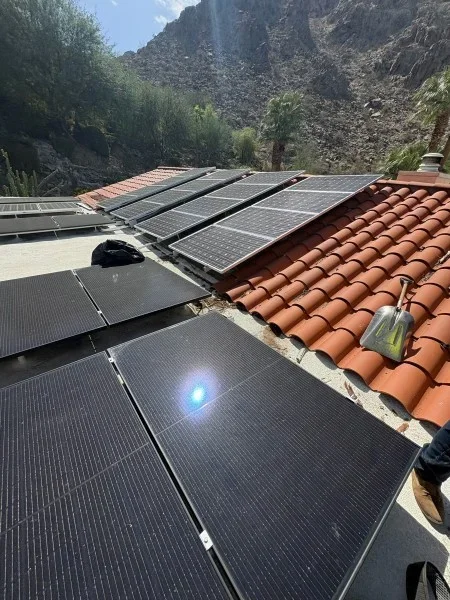
We are a C-39 roofing contractor, CA License 651509. We do not sell, wire or install solar panels. California splits the work by license: the roof is ours, the electrical system belongs to a C-46 solar or C-10 electrical contractor. That split matters most on the day a stanchion leaks. If one company owns the roof and another drilled through it, you want it written down who owns that hole before anyone drills.
| Roof scope: Vision Roof Services | Solar scope: your C-46 or C-10 contractor |
|---|---|
| Written roof condition report and remaining-life call | Array design, module and inverter selection |
| Tear-off, re-roof, or spray foam recover of the roof | Racking layout and module mounting |
| Blocking and structural attachment points at the rafters or deck | DC and AC wiring, rapid shutdown, labeling |
| Flashing and waterproofing at every penetration | Inverter, battery and main panel work |
| Cool roof coating, recoat schedule, roof warranty | LADBS electrical permit and LADWP interconnection application |
| Detach-and-reset coordination when the roof is replaced later | Monitoring and the production warranty |
If you already have a solar contractor, we work with yours. If you don't, we start on the roof and you pick the solar company with our report in hand. On a new roof under a new array, the cleanest version is one schedule: we finish the roof, the solar crew mounts to our blocking, and we flash and seal behind them.
The LA Array-Ready Roof Check: 6 lines your roof has to clear
Before a solar array goes on an LA roof, it should clear 6 lines: remaining roof life, roof layers, attachment weight, fire class, the cool roof rule under the array, and the LADWP path. We call it the LA Array-Ready Roof Check and we run it on every Roof Health Check that has solar in the plan. Lines 2 through 6 come straight from LADBS and LADWP documents, starting with the LADBS solar energy systems bulletin, so you can check our work.
The check doesn't replace the solar contractor's structural or electrical design. It tells both crews what the roof can carry before anybody orders racking.
1. Roof life vs array life.
Passes when: 15+ years of roof life left, or the re-roof is scheduled before the install. Module power warranties commonly run 25-30 years. Line 1 is a judgment call, so we put the number in writing: how many years we think your roof has, and why.
Source: Roof Health Check findings
2. Roof layers.
Passes when: 1 layer of roofing material. A second layer drops the array out of the LADBS building permit exemption. Lines 2 and 3 are where LA roofs fail most on paper. A roof that was overlaid once in the 1990s looks fine from the street and still has 2 layers on it.
Source: LADBS P/GI 2023-027, Sec. I.A
3. Weight and attachment.
Passes when: Array and supports weigh 4 psf or less, 60 lb max per support, supports 48 in. on center max, 5/16 in. lags into solid rafters or blocking, array on no more than half the total roof area, no overhang past any edge.
Source: LADBS P/GI 2023-027, Sec. I.A
4. Fire class.
Passes when: Roof is Class A where Class A is required (Very High Fire Hazard Severity Zones). Rooftop PV carries a matching UL fire classification. LAFD roof access pathways stay clear at ridges, hips and valleys. Line 4 catches hillside homes and buildings in the fire zones.
Source: LADBS P/GI 2023-027, Secs. IV, V, XII
5. Cool roof under the array.
Passes when: Re-roofs over 50% of a home's roof use a CRRC-rated cool roof product. Commercial re-roofs follow Title 24 141.0(b)2B. The open field gets a reflective coating either way. Lines 5 and 6 cost nothing to get right early and a lot to fix after the inspector shows up.
Source: LADBS P/GI 2026-003, Items 4-5
6. LADWP path.
Passes when: System sized at 1 MW or less for net metering. Over 10 kW-AC needs an Interconnection Agreement. Batteries skip the fast track and need fire department plan check.
Source: LADWP NEM Guidelines; LADBS P/GI 2026-003, Item 16
Why one layer of roofing decides your LA solar permit
LADBS lets a rooftop solar array skip the building permit only when every condition in its solar bulletin is met, and "one layer of roofing material only" is one of them. Miss it and the array goes to building plan check, with a roof plan, a rafter layout and design calculations. The electrical permit is required either way.
This is the line that surprises owners. Plenty of LA roofs were recovered once already, a new layer of shingles over the old or a cap sheet over a tired built-up roof, and a second layer was legal when it went on. Nobody remembers it. Then the solar designer pulls up a drone image, sees a clean roof, and schedules the install. The inspector climbs up and finds 2 layers.
Our Roof Health Check includes a layer count. On a shingle or tile roof we lift at an edge or a vent. On a flat roof we cut a small core, photograph it and patch it the same visit. If you have 2 layers, you have 2 choices before solar:
Tear off to the deck and re-roof. That resets the roof life, puts you back at 1 layer and keeps the array inside the exemption if the other conditions are met.
Leave both layers and let the solar contractor take the array through LADBS plan check with an engineer's numbers. Slower, more paperwork, and you still have an old roof under a 25-year array.
On a commercial flat roof, the math changes again. LA's building code (LAMC 91.1512) lets spray foam go over built-up roofing, and a foam recover is a different conversation from a second layer of the same membrane. If your building is commercial, the LADBS plan check is likely anyway once the system goes past 10 kW or onto ballast, so the question becomes which roof you want under the array for the next 25 years. Our commercial roofing in Los Angeles page covers the flat roof options and the cool roof numbers that come with them.
Penetrating mounts vs ballast on LA flat roofs
On an LA flat roof you can bolt the array down through the roof or hold it down with weight. Penetrating mounts add little load and need flashing at every post. Ballast adds no holes and a lot of weight, and LADBS treats ballasted arrays as an engineering job.
For a ballasted system, the LADBS solar bulletin asks for design to SEAOC PV1 and PV2, a sliding test by an LADBS-approved agency, an engineer of record's analysis showing the array raises demand on the roof framing by no more than 5% and on the lateral system by no more than 10%, and a recorded maintenance affidavit that keeps the original roofing in place. That affidavit is a long-term promise on your title. Read it before you sign.
| Penetrating (attached) mounts | Ballasted racking | |
|---|---|---|
| Roof penetrations | 1 per support post | None, or a few seismic tie-downs |
| Added weight | Low | High, concentrated at blocks and the perimeter |
| LADBS path in the city | Exemption possible on 1-2 family homes if all bulletin conditions are met; otherwise plan check | Engineer of record, SEAOC PV1/PV2, sliding test, recorded affidavit |
| Who owns leaks | Whoever flashed the post: get it in writing | Roofer, if the ballast pads protect the membrane |
| Best match | Spray foam, new membrane, tile and shingle | Strong decks with load to spare and a membrane under warranty |
Our call on most LA commercial roofs: an attached system over a fresh foam roof, flashed by us. Foam takes a penetration better than any membrane we install, and the attachment points can be blocked and marked before the solar crew arrives. Ballast earns its place on concrete decks with plenty of capacity, where holes are the bigger risk than pounds.
How solar mounts attach to a spray foam roof without leaking
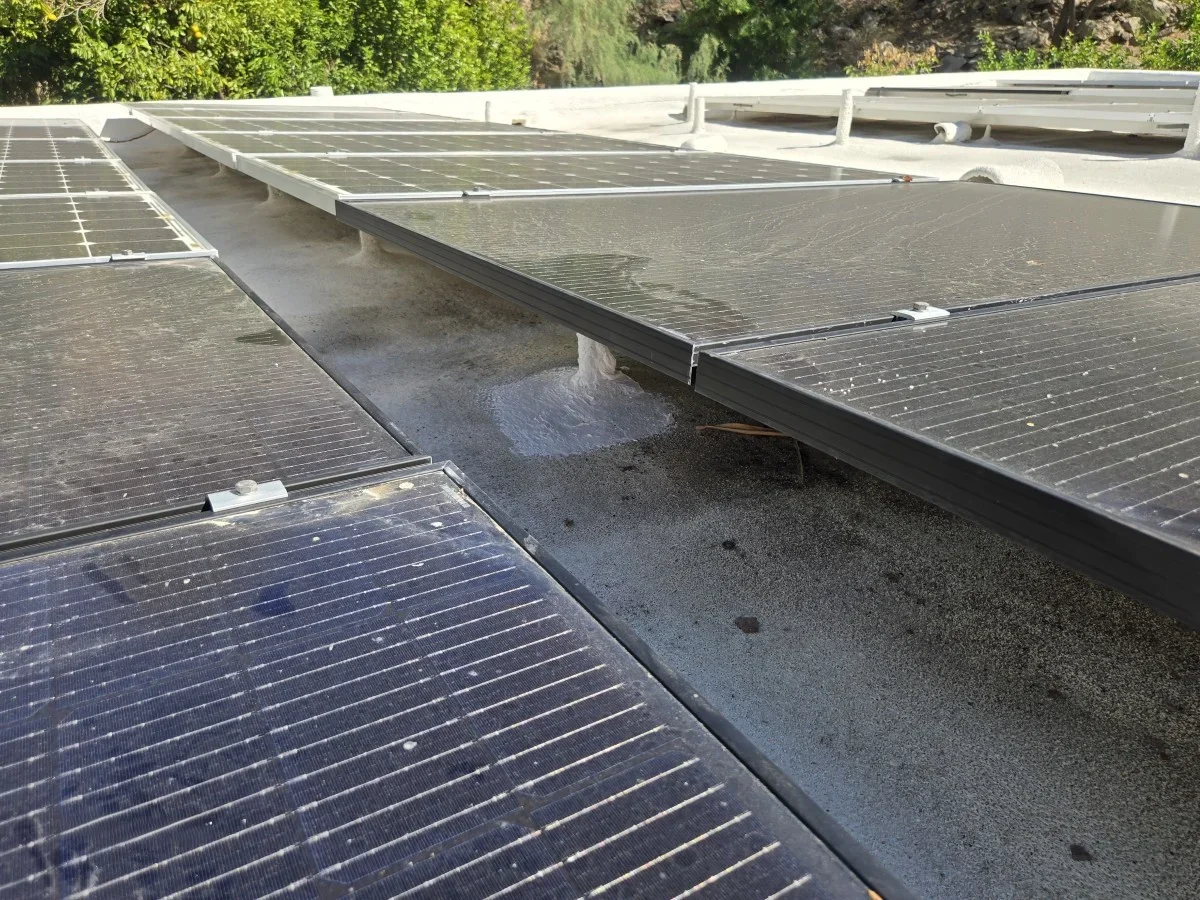
Spray polyurethane foam goes on as a liquid and rises into one continuous layer with no seams. When a solar stanchion goes through it, we foam up around the base and coat over it, so the flashing and the roof become the same material. That is why foam is our first pick under solar on commercial flat roofs, and why our crews do it often enough to have a routine.
The numbers that matter under an array:
Insulation: closed-cell roofing foam runs about R-5.5 to R-6.5 per inch, so 2 inches adds roughly R-11 to R-13 over the deck.
Density: 2.5 to 4.0 pounds per cubic foot. Light enough that a recover adds well under a pound per square foot of dead load per inch.
Compressive strength: roofing grades are rated above 40 psi, which is what lets crews walk the roof and lets mounts bear on it.
Coating: 20 to 40 mils dry film thickness of silicone or acrylic over the foam, base coat applied within 24 hours of spraying. In the South Coast air basin, roof coatings have to meet SCAQMD Rule 1113 VOC limits, 50 grams per liter for standard roof coatings.
Recoat cycle: about every 10 to 20 years. A recoat renews the roof without a tear-off.
That last line is the one that changes the solar math. A membrane roof under a 25-year array almost always gets torn off once during the array's life, which means a detach and reset. A maintained foam roof gets recoated instead. The open field and the stanchion bases can be recoated with the array in place where the panels sit high enough for spray access. Low flush-mount rows may still need modules lifted for the recoat, and we'll tell you which yours are during the Roof Health Check.
Our spray foam crews are trained and certified under General Coatings, and we are members of the Spray Polyurethane Foam Alliance. About 12 of our 60 roofers are certified foam applicators. For specs, foam over existing roofs and cost ranges, see spray foam roofing in Los Angeles.
Detach and reset: the line item missing from most solar quotes
If you put a 25-year array on a roof with 8 years left, you have already bought a detach and reset. You just haven't been billed for it. Pulling the panels, storing them, re-roofing and reinstalling them is its own project in LA: a licensed solar contractor disconnects and reconnects, the reinstall is permitted work with the City, and LADWP may need a modified interconnection application if anything about the system changed.
LA solar companies price detach-and-reset per panel. One LA County installer published $250 to $350 per panel in September 2026, or about $5,000 to $7,000 for a 20-panel home system, and that figure excludes the roofing and any broken tile. Treat it as a market reference, not our price. We don't do the electrical half.
Our position: if the roof has under 15 years left, re-roof or recover first. The money you spend now is money you were going to spend at year 8 anyway, plus a detach and reset, plus a few weeks of panels sitting in storage instead of making power. If the roof has 15-plus years and a clean report, put the array on it and set a recoat or inspection date in the warranty file. Not every roof needs replacing before solar. We'll tell you when yours doesn't.
| Cost line on an LA solar roof | Published market range | Source and date |
|---|---|---|
| Spray foam roof, 2-4 in. foam + silicone coating | $7.00-$11.75 per sq. ft. | National cost guides, 2025-26 |
| Recoat of an existing foam or coated roof | $1.50-$3.50 per sq. ft. | National cost guides, 2025-26 |
| Solar detach and reset (solar contractor) | $250-$350 per panel | One LA County installer, Sept. 2026 |
| LADBS solar and re-roof permit fees | Set by LADBS fee schedule per job | Confirm at permit |
Ranges are market references for budgeting, not Vision Roof Services quotes. Your price comes from your roof's square footage, deck condition, tear-off needs and coating system, in writing after the Roof Health Check.
Cool roof rules and fire zones under an LA solar array
LA has its own cool roof rules on top of the state's, and solar changes where they apply. LADBS's 2026 express permit bulletin says a residential re-roof covering more than 50% of the roof has to use a CRRC-rated cool roof product, and commercial re-roofs follow Title 24 Section 141.0(b)2B. The City's Green Building Code lists roof area under solar among its cool roof exceptions. The state's 2025 Title 24 exception is narrower: it names building-integrated PV panels, not standard racked arrays.
What we do with that: we coat or roof the whole field to the cool roof number your building needs, including the area that will sit under panels. Arrays get moved, re-sized and removed over 25 years, and a black patch under a removed array is a code problem waiting for the next permit. A white roof under the panels also runs cooler, and solar modules lose output as they heat up. For the LA-specific reflectance values by building type, see our roofers in Los Angeles page.
Fire zones are the second LA wrinkle. In a Very High Fire Hazard Severity Zone the roof has to be Class A, and the LADBS solar bulletin requires panels on that roof to carry a fire classification that matches it. LAFD roof access pathways have to stay clear around ridges, hips and valleys. For hillside homes in the fire zones, we confirm the zone, the roof class and the pathway layout before the solar design is final. After the January 2025 Palisades Fire, nobody in those neighborhoods wants to learn about Class A at inspection.
Commercial, HOA and multifamily solar roofs in Los Angeles
Commercial and multifamily owners in LA have 3 money questions on a solar roof, and only 1 of them is about panels. The other 2 are the roof under the panels and the federal deadline.
The deadline first. Under the 2025 federal budget law, homeowners lost the 25D residential solar credit after December 31, 2025. The commercial credit under Section 48E is still there, for systems owned by a business, including leases and power purchase agreements, but solar projects that began construction after July 4, 2026 have to be placed in service by December 31, 2027 to qualify. From today that's about 14 months, and a roof that has to be replaced first sits inside that window. Confirm your eligibility with your tax advisor. We're roofers, not CPAs.
LADWP is the second difference. Los Angeles buildings buy power from the city-owned utility, not from Southern California Edison, and LADWP writes its own solar rules. Its net energy metering guidelines cover systems up to 1 MW, carry export credits forward on the bill, and require an Interconnection Agreement for systems over 10 kW-AC: short form from 10 to 30 kW, long form with a single-line diagram above 30 kW. LADWP has also run programs that buy rooftop solar output outright: its Feed-in Tariff paid up to 14.5 cents per kWh on 10-year-plus contracts as of February 2024 reporting, and its multifamily Virtual Net Energy Metering pilot lists $0.145 per kWh for 30-500 kW systems in its June 2025 guidelines. Both have capacity limits, so check availability with LADWP before you plan around them. Under any of these, the array has to stay on the roof for a decade or more, which brings us back to the roof.
The roof itself: foam goes over most existing flat roofs without a tear-off, so tenants keep working and the landfill bill shrinks. It self-flashes every stanchion. And it renews on a recoat cycle instead of a replacement cycle. For an HOA, that means the array and the roof can be planned in the same reserve study instead of colliding in the next capital cycle. Our commercial work has included roofs for Yamaha, Paramount Studios, LifeStorage and American Tower. See current jobs on our featured projects page.
Our fit: commercial and HOA low-slope roofs, flat roof replacement, foam recovers, recoats and annual maintenance programs. If the building needs work beyond solar prep, see all of our roofing services in Los Angeles, from repairs to full replacement.
Solar-ready roofs for Los Angeles homes
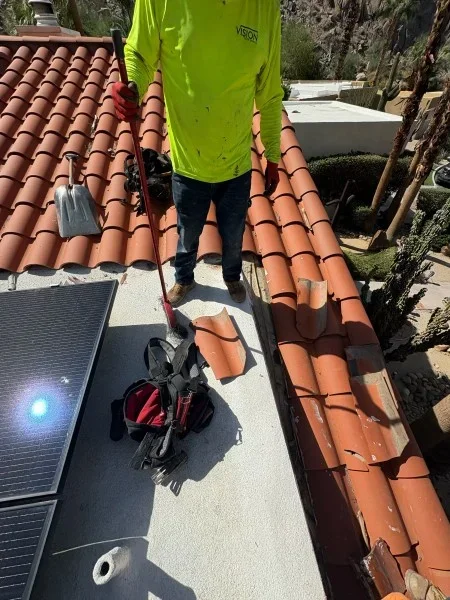
For an LA home, solar roofing usually means one of 3 jobs: re-roofing before the array, a tile lift-and-relay under it, or a re-roof under an existing array. LADBS treats each one differently.
A re-roof with a covering under 6 pounds per square foot can go through LADBS express permitting, and over 50% of the roof replaced means a CRRC-rated cool roof product. A tile lift-and-relay, where we pull the tile, put down new underlayment and reset the same tile, is its own express permit item and the bulletin says no cool roof compliance is required for it. That makes it a common way to give a sound tile roof another 20-plus years of waterproofing before solar, without changing the look of the house. Most of the leak risk on a tile roof sits in the underlayment, not the tile.
On the solar side, the City issues the electrical permit online for contractors on 1-2 family homes when the system is 10 kW or less on a single-phase service panel rated 225 amps or less, among other conditions. A battery tied to the system goes to the fire department for plan check. Your solar contractor handles that paperwork. We handle the roof it sits on.
The homeowner credit is gone for systems paid for after 2025, which pushes more LA homeowners toward leases and PPAs. Ask who owns the roof penetrations on a leased system and what happens to the panels when the roof needs work. The lease paperwork usually says. For tile, shingle and flat-roof homes, see residential roofing in Los Angeles.
When to schedule the roof: before the 2026-27 rain season
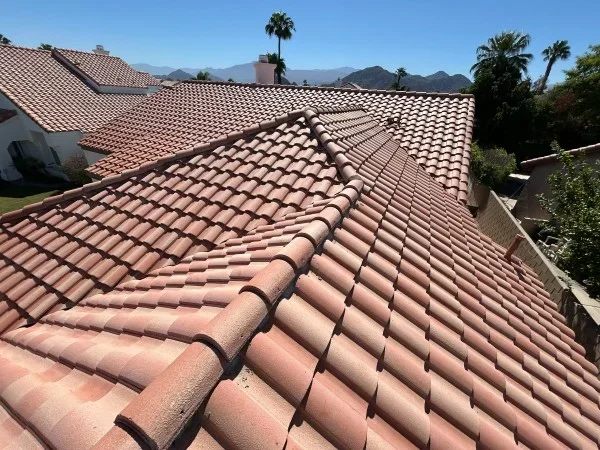
Schedule the roof before the solar install and, if you can, before the rain. NOAA's Climate Prediction Center issued an El Niño Advisory on October 8, 2026, putting the odds of a strong to very strong event through January-March 2027 above 83%. Downtown LA's normal rainfall is 14.25 inches a season. Last season, 2025-26, brought 19.07.
A roof that leaked a little last winter will leak more under an array, because the panels hide the wet spot and the stanchions add holes. Booking now gets the roof done while it's dry and gets you in front of the solar crew's schedule. We've watched owners wait until the first January storm. It doesn't go well, and the solar company won't mount to a roof that's actively leaking.
When we're the wrong call for your solar project
We're not the right company if you only need panels. We don't install modules, inverters or batteries, and we won't pretend to. Call a C-46 solar contractor and send them our way if the roof comes up.
We're also not the right call if your roof has 15-plus years left, one layer, and a solar contractor who will put the flashing detail and the leak responsibility in writing. Put the array on. Book an inspection in a year. That's it. And we don't take very small repairs outside our core service areas, or gutter cleaning.
We are the right call when the roof is older than the array will be, when it's flat and commercial, when you need a foam recover with no tear-off, or when you want one company to own the roof warranty under the panels for the next 25 years.
How a solar roof project runs with us
Every job starts with a free Roof Health Check and a written report with photos, sent within 24 to 72 hours of the visit. Here's the full sequence:
Initial contact. Tell us the building, the roof type and where the solar project stands.
Roof Health Check. We inspect, photograph, count layers, check drainage and run the LA Array-Ready Roof Check.
Proposal. A written scope: re-roof, recover, recoat or no work, with blocking and flashing details for the array.
Contract approval.
Scheduling, coordinated with your solar contractor's install date.
Installation of the roof and the mount blocking.
Final inspection, ours and the City's.
Invoicing. Financing is available through Acorn Financing.
Warranty and maintenance program, with annual inspections and a recoat schedule where the system calls for one.
Most projects run from several days to several weeks depending on size. A home tile lift-and-relay is days. A large commercial foam recover is weeks, and we phase it so the building stays open.
Who's on your roof
Dave Bienek started roofing at 15, working HOA roofs with his father, and has worked in the trade full-time since 1998. He founded Vision Roof Services in 2014. Today we run 60 trained roofers, and our LA County work is run from the Mission Viejo office. The full family story is on our about page.
CA License 651509, licensed and insured
BBB A+ accredited
Best of BuildZoom 2024
General Coatings certified spray foam applicators
Member, Spray Polyurethane Foam Alliance
4.8 stars across 42 Google reviews on our Palm Desert profile
If you know an LA building owner planning solar, our referral program pays for introductions that turn into jobs.
Solar roofing in Los Angeles: questions we get
Will solar void my roof warranty?
It can. Manufacturer coverage usually survives a penetration that was detailed and flashed the way the manufacturer specifies. The workmanship warranty is the one at risk, because a second contractor cutting into a roof another contractor warranted is the usual way it gets voided. Before anyone orders racking, get in writing who owns the penetration detail and which warranty covers a leak at a stanchion. When we do the roof and the flashing, that answer is us.
Does NEM 3.0 apply to my LA building?
Not if you're an LADWP customer. NEM 3.0, the state's net billing tariff, covers investor-owned utilities like Southern California Edison. LADWP is city-owned and runs its own net energy metering program, which covers systems up to 1 MW. Some cities next to LA buy power from SCE, so check the name on your bill.
Do I need a building permit for solar on my LA home?
Sometimes not. LADBS waives the building permit for rooftop solar that meets every condition in its solar bulletin, including 1 layer of roofing, 4 psf or less, supports 48 inches on center or closer, and an array covering no more than half the roof. The electrical permit is always required. Miss any building condition and the array goes to plan check.
Can spray foam go over my existing roof if solar is coming later?
Usually, on a flat or low-slope roof in sound condition. LA's roof code allows foam over built-up roofing, and we confirm what's under yours with a core sample. Wet insulation or a failed deck has to come out first. Foam over other existing membranes is a case-by-case LADBS question we resolve before the proposal.
Is there still a federal tax credit for solar?
For homeowners who buy their system, the 25D credit ended for expenditures after December 31, 2025. For business-owned systems, including leases and PPAs, the Section 48E credit remains for solar placed in service by December 31, 2027 if construction began after July 4, 2026. Your tax advisor makes the final call.
How often should a roof under solar be inspected?
Once a year, and after any major storm. Panels hide ponding, debris and coating wear, and stanchion seals are the first thing to go. Our maintenance program includes the annual inspection and the recoat schedule.
Do you serve all of Los Angeles?
We serve the City of Los Angeles and surrounding LA County, with commercial and HOA work as our main focus there. See the full list on areas we serve in Los Angeles.