Commercial Roofers In Santa Ana, CA
Vision Roof Services installs and maintains commercial low-slope and spray foam roofs in Santa Ana and across Orange County. CSLB #651509, General Coatings certified, 60 roofers on the crew.
Who we are for
A commercial roofer who reads the city's rules before writing your bid
If you own or manage a commercial building in Santa Ana, most of what decides your roof budget was written down before anyone climbed a ladder. The City published a re-roofing handout. The Energy Commission published the Climate Zone 8 table. The Department of Industrial Relations published the roofer rate for Orange County. Almost none of it shows up in the bids owners send us for a second opinion.
We read those documents first, then price the roof.
SPECIALTY
Commercial Spray Foam and low-slope
Spray polyurethane foam roofing and coating systems are our core work. We also install and service TPO, PVC, and other single-ply low-slope roofs on warehouses, tilt-ups, and multi-tenant buildings.
LOCAL
Orange County commercial work
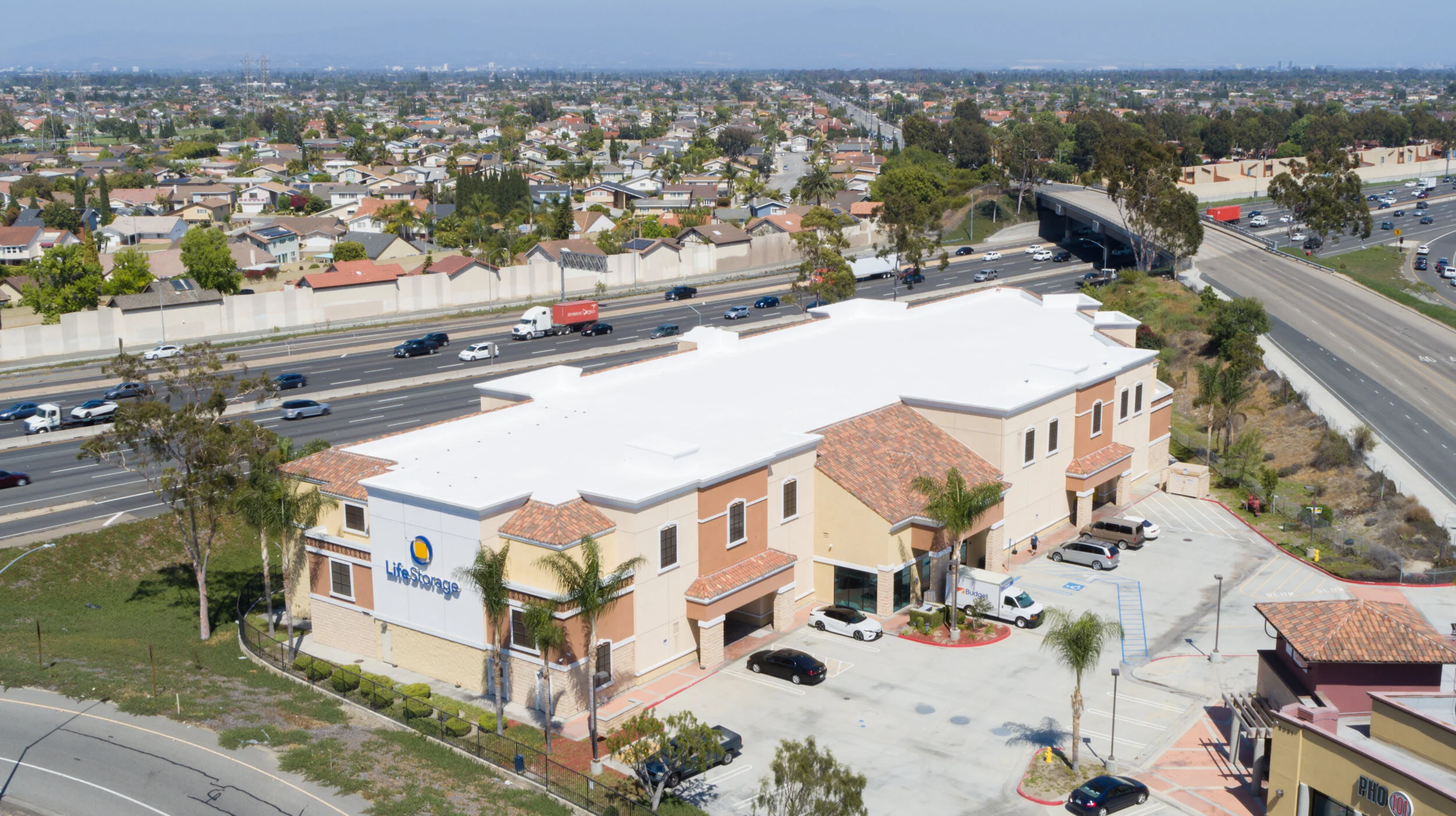
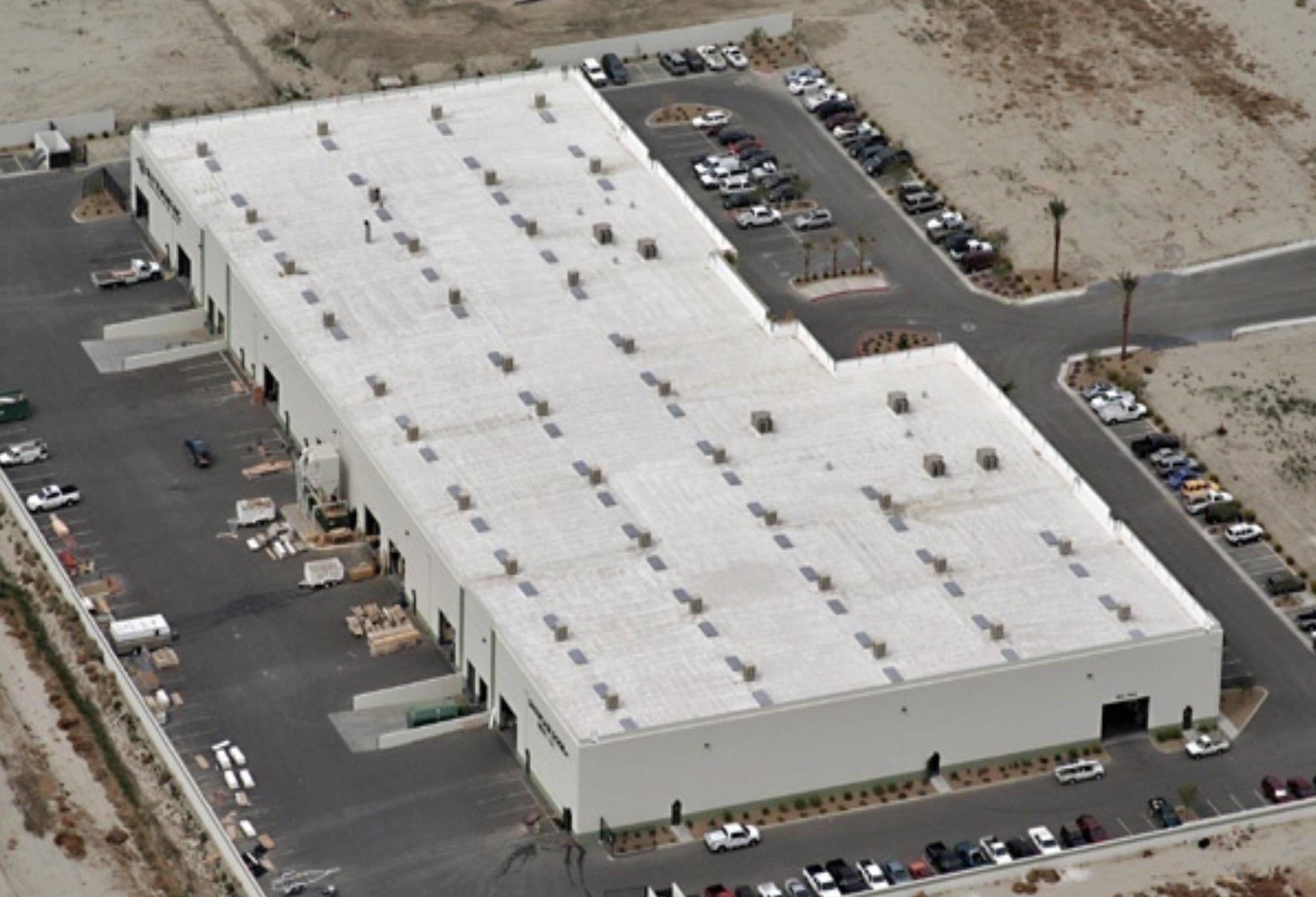
Recent Orange County commercial projects include the LifeStorage facility in Costa Mesa and the Yamaha facility in Buena Park. Buena Park is in Climate Zone 8, the same Title 24 zone as Santa Ana, so the same cool-roof row applied there.
PROCESS
inspection before proposal
Every job starts with a free Roof Health Check: a documented inspection with photos, and a written report in 24 to 72 hours. The bid follows the roof instead of a guess.
When a Santa Ana commercial reroof needs a permit, and when it does not
A building permit is required for all re-roofing in Santa Ana except repairs totaling less than 100 square feet. That number is in the City of Santa Ana roofing requirements handout, and it is the cleanest line in the whole process.
A 3-square patch over a failed flashing is a repair. A recover across a 40,000 square foot tilt-up is not, and no amount of calling it maintenance changes that.
Santa Ana also runs a PBx Express permit path. A like-for-like commercial reroof is on the City's list of permits that can be issued the same day with no plan check. That is a scheduling difference of weeks on a building where tenants are already unhappy about the leak. A bid that never mentions who walks into 20 Civic Center Plaza, or who logs into the permit portal, is not a complete bid.
Two numbers worth writing down before you collect proposals:
Santa Ana Building Safety: (714) 647-5800
Inspection scheduling: (714) 667-2738, at least 24 hours ahead
There is also a preroofing inspection before anything gets covered. Crews that have not worked in Santa Ana get caught by that one, because the roof is ready to go and the inspector has not been out yet.
The Climate Zone 8 numbers a Santa Ana plan reviewer is actually checking
Santa Ana is in California Title 24 Climate Zone 8. The Energy Commission uses Fullerton as the representative city for that zone. Most commercial roofing pages say "Title 24 compliant" and stop. Here is the row your plan reviewer opens.
For a conditioned nonresidential building, cool-roof requirements are triggered when you replace, recover, or recoat more than 50% of the roof area or more than 2,000 square feet, whichever is less. Whichever is less does a lot of work in that sentence. On a 30,000 square foot warehouse, 2,000 square feet is under 7% of the roof.
Low-slope nonresidential roof, Climate Zone 8
Prescriptive requirements, 2025 California Energy Code, Title 24 Part 6
| Requirement | Value |
|---|---|
| Aged solar reflectance (3-year) | 0.63 or higher |
| Thermal emittance | 0.75 or higher |
| Or Solar Reflectance Index (SRI) | 75 or higher |
| Continuous insulation, replacement | R-17 above deck, or the U-factor path at U-0.047 with R-10 above deck |
| Continuous insulation, recover | R-10 above deck (recover exception) |
Values are aged, meaning measured after 3 years of weathering, not off the fresh roll. The product has to be listed in the Cool Roof Rating Council directory, and the project needs CF1R and CF2R paperwork at plan review.
A repair is not an alteration under the energy code. A recoat, a recover, and a replacement all are. Crews who tell you a coating keeps you out of scope are reading the wrong section.
What changed on January 1, 2026. The 2025 California Energy Code applies to every permit applied for on or after that date. If your last reroof was priced against the older cycle, the insulation line is the part of the bid most likely to have moved.
Three things published about Santa Ana commercial roofs that are not true
We check the claims on the pages ranking for this keyword, because owners read them before they call us and arrive with the numbers already in their heads. Three of them do not hold up.
"About 74% of Santa Ana commercial buildings are flat or low-slope." Two contractor sites state this. Neither names a year, a dataset, or a method, and we could not find a source anywhere: not the Energy Information Administration's commercial buildings survey, which does not break out by city, and not the Orange County industrial market reports, which cover inventory but never slope. The number may even be close. It is still a number with nothing behind it, and we are not going to repeat it.
"Cool roofs need an SRI of about 64 in Santa Ana." That figure is real, and it belongs to the hotel and motel low-slope row at 0.55 aged reflectance and SRI 64. That reduced row applies in Zones 9 through 15. Santa Ana is Zone 8, which is excluded. A Santa Ana hotel reroof falls back to the standard nonresidential values above. Using SRI 64 here is how a CF1R gets kicked back.
"You need a C-39 license for any roofing work over $500." That was correct until January 1, 2025. AB 2622 raised the minor-work threshold to $1,000, with conditions. Vet contractors on license status, workers' compensation, bond, and discipline at cslb.ca.gov, not on a dollar figure lifted from an old blog post. Note that C-39 has required workers' compensation regardless of employee count since 2013, so a suspended-for-no-comp roofing license is not a paperwork lag, it is a stop sign.
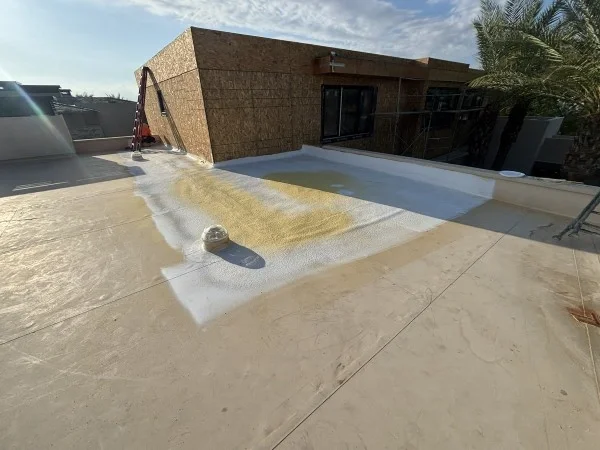
The Four-Document Test
Dave Bienek started roofing at 15, working alongside his father on HOA roofs. He went full-time in 1992 and founded Vision Roof Services in 2014. He'll still tell you the same thing he told the first property manager who ever handed him a flat-roof bid to look at: the screen that matters before a Santa Ana commercial job gets signed comes down to 4 documents. If a contractor cannot produce all 4, the price on the proposal is an opening offer, not a bid.
1. The core cut, showing the layer count
Santa Ana does not allow a recover where the existing roof already carries 2 or more applications of any type of roof covering. Everything comes off to the deck. That single rule ends a lot of "just coat it" pitches on the older industrial buildings around Harbor and the airport, and it is the biggest swing in the budget. Nobody can tell you the layer count from the parking lot.
3. The CF1R for your occupancy and slope
Not a brochure claiming cool-roof compliance. The compliance form, matched to the building's actual occupancy and slope, with the CRRC-listed product named on it.
2. The moisture survey, in writing
A roof can look fine and be soaked underneath. Wet insulation does not dry out under a new membrane, it rots the deck under a new membrane. This is the finding that turns a recover into a tear-off halfway through the job, and it is cheaper to know in week 1.
4. The DIR determination, if any public money touches the job
More on that below. A private warehouse bid and a school district bid are not the same number even when the membrane is identical white TPO.
We run all 4 during the Roof Health Check, before we quote. If you want the background on whether a coating or a replacement is the right call, we wrote that up separately.
Client Testimonials
“Vision Roof Services has been an invaluable partner in managing and maintaining the roofs of all my commercial buildings. Over the years, they have re-roofed multiple properties with their superior SPF roofing system, and the results have been outstanding. Not only have my buildings remained completely leak-free, but the energy demand has significantly decreased, which has saved me a great deal on operating costs. Their professionalism, attention to detail, and commitment to quality set them apart. I trust Vision Roof Services entirely to protect and enhance the value of my properties.”
“Vision Roof Services is our go-to partner for SPF roofing on our design-build custom homes in the Madison Club, La Quinta. Vision’s quality of work is exceptional, and their installations are always fast, efficient, and seamlessly integrated into our projects. Vision’s attention to detail and professionalism makes them an invaluable part of our team. I highly recommend them to anyone looking for top-tier roofing solutions.”

Clients


Structure and drainage: where Santa Ana is stricter than owners expect
Two areas catch commercial owners here, and both are in the City's handout rather than in anyone's proposal.
Weight and diaphragm. Structural calculations are required for roofing material heavier than 6 pounds per square foot. They are also required for re-sheathing more than 50% of a commercial building, because of roof diaphragm requirements. If your building is getting new sheathing across most of the roof, an engineer is in the job whether or not the bid says so.
Drainage. Santa Ana requires a minimum 4 inches per hour rainfall in roof drainage design. Not 2. We have seen 2 inches per hour repeated in write-ups about this city, and the City's own document says 4. The roof also needs a minimum 2% slope for drainage unless it is engineered for water accumulation. And PVC plastic pipe and fittings are not approved for condensate drains on roofs here, which is a small detail that fails an inspection at the worst possible moment.
Rooftop units that come off for the reroof go back secured for seismic loads. Equipment screens can carry their own permit.
Two Santa Anas, two different roofs
Downtown and the airport area are not the same product, and pricing them the same way is how a bid goes wrong.
Santa Ana is a Certified Local Government and has 3 National Register districts, with Downtown Santa Ana listed back in 1984. A building on the city historic register, the California Register, or the National Register gets reviewed against the Secretary of the Interior's Standards, and alterations need a Certificate of Appropriateness. Replacement material has to be compatible with the original building. That is Planning and the Historic Resources Commission on top of Building Safety, and it adds calendar you have to plan around. A Santora-era commercial roof is not a generic white membrane job because white membrane is cheap.
The airport area is the other Santa Ana. Big, low-slope, equipment-heavy industrial. The direction of travel there is worth noticing: in February 2024 Kearny Real Estate took down the 1982 Elevate @ Harbor office complex on South Harbor Boulevard near John Wayne Airport and replaced it with Harbor Logistics Center, roughly 163,000 square feet of warehouse, completed the following year. Office coming down, industrial going up. Those are exactly the roofs a commercial crew prices: wide spans, heavy rooftop equipment, tenants who cannot shut down.
Most owners we talk to have one or the other. A few have a building that used to be the other thing, and those are the interesting ones. We work the same two building types in Irvine and across the rest of our commercial roofing service area in Southern California.
What actually moves the number on a Santa Ana commercial roof
We price after the Roof Health Check, not before, and we do not publish a per-square-foot figure for a roof nobody has walked. What we can tell you is the order the variables matter in.
The layer count comes first, because 2 or more existing coverings means tear-off and disposal instead of a recover. Wet insulation comes second, for the same reason. The Title 24 insulation line comes third: published 2026 Southern California market write-ups put the insulation adder to meet the code line in the range of $2 to $6 per square foot, and that is an adder most owners have not budgeted. Access, tenant hours, and rooftop equipment come fourth. Public-works status, historic review, or a structural calculation each move the number again.
For reference and not as a quote, the same 2026 market write-ups put full membrane replacement in Southern California roughly in the $8 to $20 per square foot range installed, with restoration coatings well below that. They also note Orange County labor and staging running above inland pricing. Treat those as market ranges published by others, not as a Vision Roof Services price. Yours depends on the 4 documents above.
Financing is available through Acorn Financing when the capital timing is the problem and not the scope.
Our commercial roofing services
Spray polyurethane foam and coating systems are the specialty. Around them: roof replacement and retrofit, TPO and PVC single-ply, silicone and acrylic coating systems, fire-resistant coatings, waterproofing, cool roof systems, solar mounting coordination, and a maintenance program covering semi-annual inspections, drain clearing, leak repair, and emergency response.
Why owners here choose foam, and when they should not
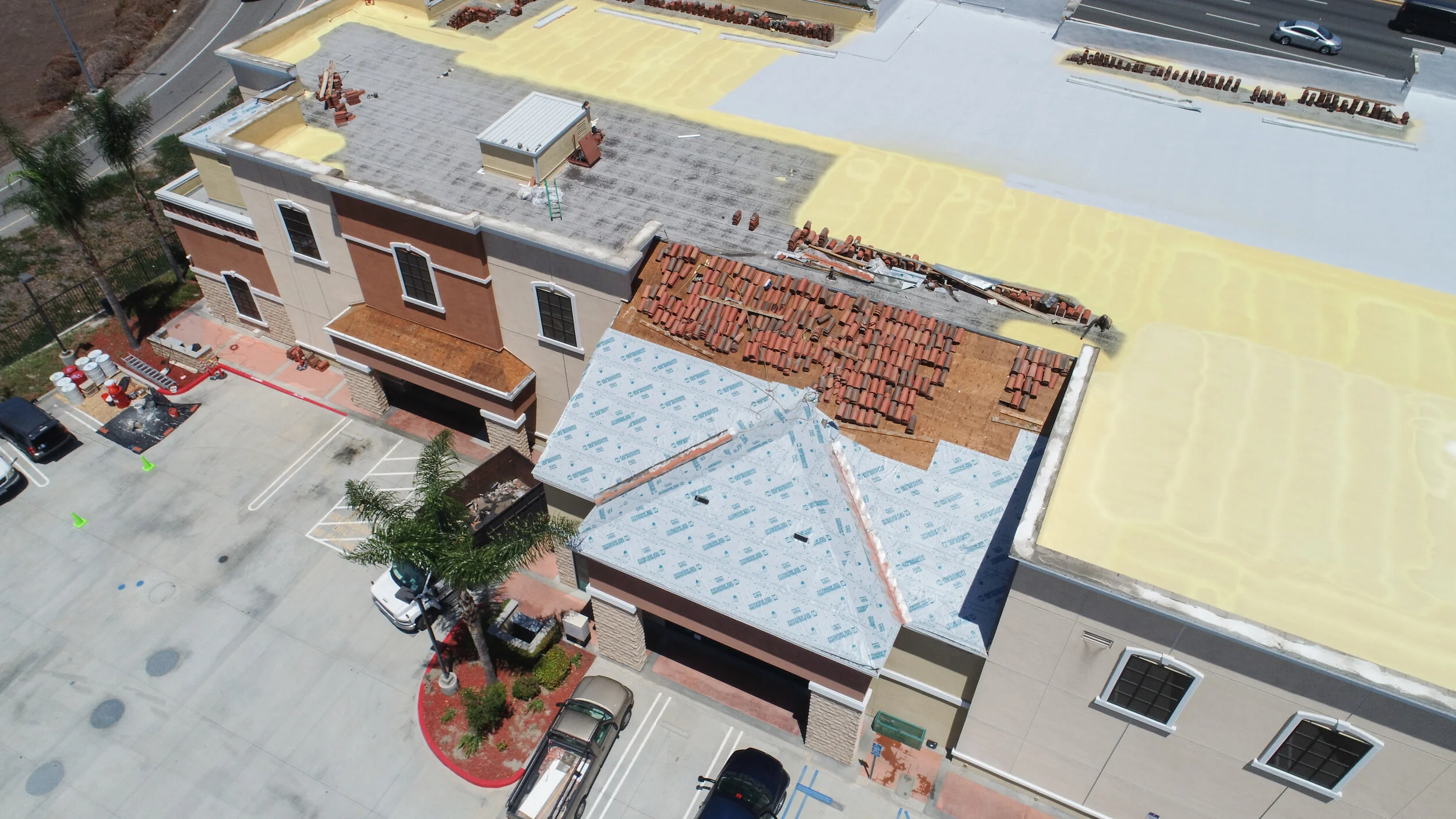
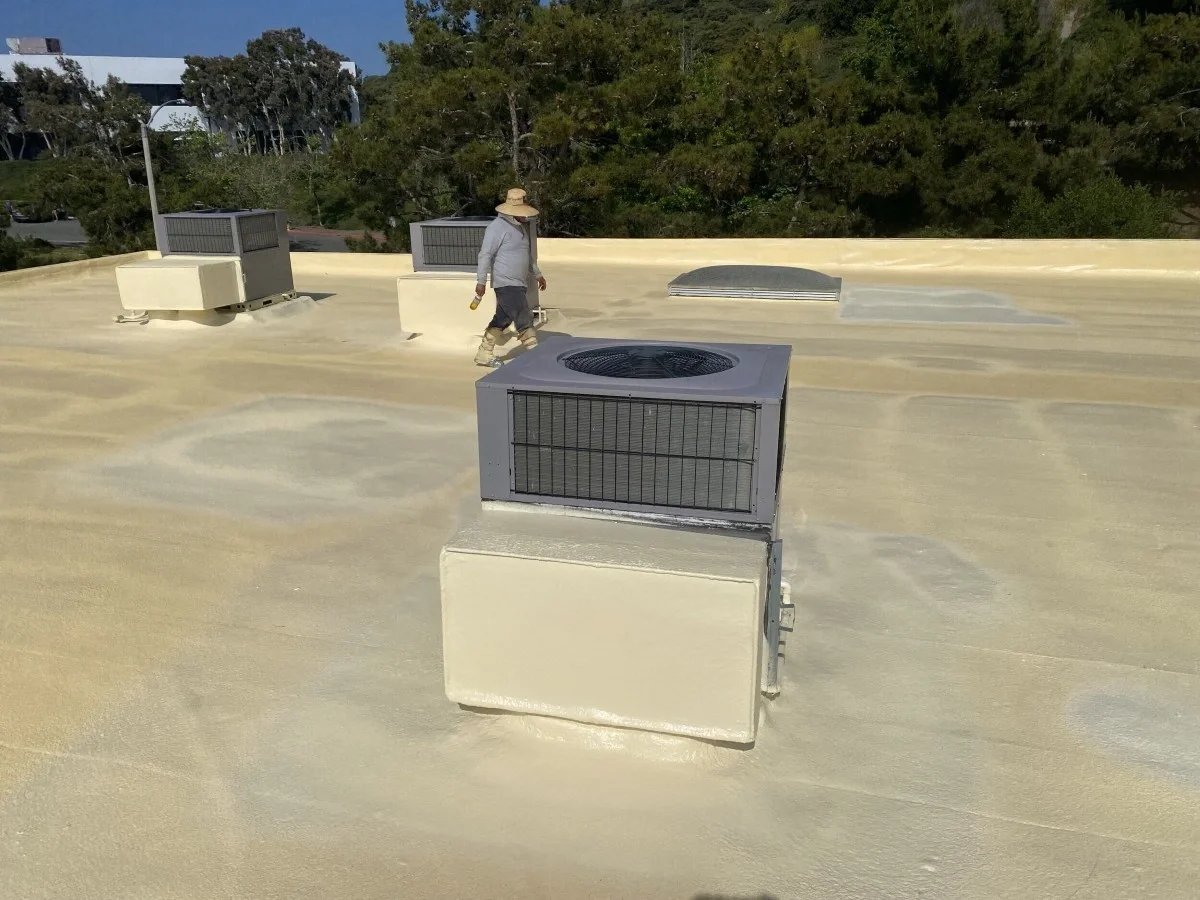
Spray foam goes on as a liquid and cures into one continuous surface with no seams, which is where most flat roofs leak first. It is light, it adds insulation value above the deck, and on a sound substrate it can often go over the existing roof, which cuts tear-off and landfill cost. On a Santa Ana warehouse with 40 penetrations and a dozen curbs, a poured surface seals better than sheet seams do. There is more on why commercial roofs are built flat if the background helps.
It is not right for every roof, and we will say so.
Good fit
Low-slope commercial roofs with a sound, dry substrate. Buildings where tenant operations make a full tear-off expensive. Roofs with heavy penetration counts and odd geometry. Owners who want a system renewed on a recoat schedule instead of torn off every 20 years.
Not the right call
Roofs with widespread wet insulation or structural problems a coating would only hide. Roofs already carrying 2 or more coverings, where the City requires removal anyway. Surfaces that cannot be cleaned and prepped properly. In those cases we recommend the repair or the replacement that actually fixes the roof, even when it is the larger job and even when a coating would have been an easier sale.
On energy: Climate Zone 8 is a cooling climate, and cool-roof surfaces cut rooftop heat gain, which can lower summer cooling load. California commercial electricity averaged about 25.5 cents per kilowatt-hour in the most recent full year of Energy Information Administration data, so the cooling load is worth money here. We will not put a savings percentage on your building without a modeled kilowatt-hour reduction for your footprint. A reflectance spec is a code requirement. It is not a savings claim.
Who we are not the right fit for
Small repairs outside our core service area, and gutter cleaning. If your job is a 60 square foot patch on a single-tenant building and nothing else, a smaller local outfit will serve you better and charge you less.
We lose bids on price, and we know it. The objection we hear most is that foam costs more upfront than a patch or a cheap membrane. It usually does. What we argue back is the maintenance cost across the service life of the system, and a roof that gets renewed on a recoat schedule instead of replaced. Some owners want their cake and to eat it, and we get it. But if the lowest number on the table is the deciding factor, we are probably not your roofer.
Specializing in Spray Polyurethane Foam (SPF)
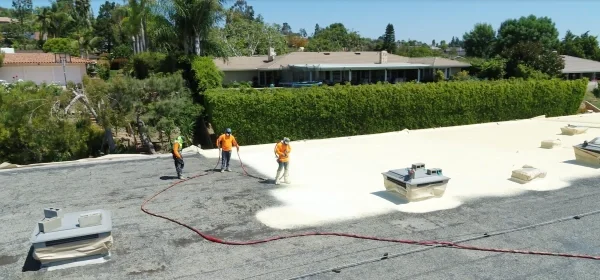
This General Coatings video displays the commercial spray foam roofing process.
For property owners and managers, polyurethane spray foam roofing is an ideal solution for preserving the value of commercial buildings. This advanced roofing system provides unparalleled protection against the region's intense sun, heat, and occasional heavy rains.
By offering superior insulation and creating a durable, seamless seal, our spray foam roofs help maintain stable indoor temperatures and significantly reduce energy costs. This not only improves the building's energy efficiency but also enhances its overall structural integrity, ensuring long-term value and reliability.
Our spray foam roofing is adaptable to various roof shapes and sizes, making it the perfect choice for commercial properties seeking sustainable and cost-effective roofing solutions. With VRS, you can trust that your investment is protected by a high-performance roofing system designed to last.
The Vision Roof Services process
Initial contact. Tell us the building, the roof, and the problem.
Roof Health Check. Documented inspection with photos, core cut and moisture findings where needed. Written report in 24 to 72 hours.
Proposal. System options and a firm price matched to what the inspection found, with the permit path named.
Contract and scheduling. Including night and weekend windows where tenant operations require it.
Installation. Most projects run several days to several weeks depending on size and access.
Final inspection and warranty. City sign-off, then annual inspections with a recoat schedule as needed.
Track record
60 - roofers on the crew, 12 certified SPF applicators
1992 - the year founder Dave Bienek started in roofing
A+ - BBB accredited, 2024 Best of BuildZoom
Credentials
CSLB #651509, licensed & insured
General Coatings certified (2025 Platinum Award)
BBB A+ accredited
2024 Best of BuildZoom[✓]Spray Polyurethane Foam Alliance member
Commercial roofing questions we get in Santa Ana
Do I need a permit to reroof my Santa Ana commercial building?
Yes, unless the repair totals less than 100 square feet. Santa Ana requires a building permit for all other re-roofing. A like-for-like commercial reroof may qualify for the City's PBx Express path and be issued the same day without plan check, which is worth asking about before you assume a plan-check timeline. Inspections are scheduled at (714) 667-2738 with at least 24 hours notice.
Can I recover my existing roof instead of tearing it off?
Only if the roof carries fewer than 2 existing applications of roof covering. At 2 or more, everything comes off to the deck. The other disqualifier is moisture: widespread wet insulation has to be removed regardless of layer count. A core cut and a moisture survey answer both questions in one visit, and that is what the Roof Health Check is for.
Does my reroof have to meet Title 24 cool-roof rules?
If you replace, recover, or recoat more than 50% of the roof area or more than 2,000 square feet, whichever is less, on a conditioned nonresidential building, yes. In Climate Zone 8 that means a CRRC-listed product at aged solar reflectance 0.63 and thermal emittance 0.75, or SRI 75, plus the insulation line and CF1R and CF2R paperwork at plan review. The 2025 Energy Code applies to permits applied for on or after January 1, 2026.
My building is downtown. Is anything different?
If it sits in a historic district or on a register, yes. Alterations get reviewed against the Secretary of the Interior's Standards and need a Certificate of Appropriateness, with Planning and the Historic Resources Commission involved alongside Building Safety. Replacement material has to be compatible with the original building, which rules out defaulting to whatever membrane is cheapest. Build the review time into your schedule.
Is a public-works roof priced differently than a private one?
Yes. Prevailing wage applies, the contractor has to be registered with the Department of Industrial Relations, and the Orange County Roofer determination currently sets straight time at $73.99 an hour all-in. AB 889, effective January 2026, also tightened fringe-benefit documentation. Ask any bidder on a public job to show DIR registration before anything else.
How often should a commercial roof be inspected?
At least twice a year, and after any major storm or Santa Ana wind event. Semi-annual inspections, drain clearing, seam and flashing checks, and infrared moisture scanning are what keep a roof off the replacement list and inside its warranty. Neglect is the fastest way to shorten the life of a good roof.
Will adding solar void my roof warranty?
Not if it is coordinated correctly. Mounts and penetrations have to go in to the roofing manufacturer's specification, and the roof under the array should be sound before panels go on. The cleanest result comes from sequencing the roofing and the solar mounting so one party owns the watertight detail.
Start with a Free Roof Health Check
A licensed Vision Roof Services roofer inspects your Santa Ana commercial roof, documents what we find with photos, and sends a written report in 24 to 72 hours. No cost, no obligation.
Vision Roof Services has completed roughly 7,500 roofing projects across Southern California since 1992, with Orange County commercial work including the LifeStorage facility in Costa Mesa and the Yamaha facility in Buena Park. A Santa Ana commercial reroof needs a City permit unless the repair is under 100 square feet, and a conditioned nonresidential roof triggers Climate Zone 8 cool-roof compliance once you alter more than 50% of the area or more than 2,000 square feet, whichever is less. Most projects run several days to several weeks. Call (949) 779-5664 for a Roof Health Check. Vision Roof Services works out of Mission Viejo, about 14 miles from Santa Ana, and serves Santa Ana, Irvine, Tustin, Costa Mesa, and Anaheim.
Or call us at (844) 348-ROOF to discuss your project’s requirements.
Our Work
Take a look at some of the projects we’ve completed in the gallery below.
Visit the Featured page to see more.