Why Are Commercial Roofs Flat? The Real Reasons
Most commercial roofs are flat for one plain reason: money. A flat roof costs less to build across a big footprint, holds the HVAC and solar gear a business runs, and meets energy code without a tall frame. That's why flat roofs sit on warehouses, offices, and retail boxes while houses keep their pitched shingles. But "flat" is the wrong word. A good commercial roof still slopes, only slightly, so water drains instead of pooling. And the flat design that saves money up front is the same one that fails early when nobody watches the drains. Vision Roof Services has put roofs on Southern California commercial buildings since 1992, about 7,500 of them, so here's the real story on why commercial roofs are flat, which system fits which building, and what goes wrong.
Commercial roofs are flat because a low-slope design is cheaper to build over a large footprint, supports rooftop HVAC and solar equipment, gives crews safe access for maintenance, and meets cool-roof energy codes. Most are not perfectly level, though. They carry a slight slope, at least 1/4 inch per foot, so water runs off instead of ponding.
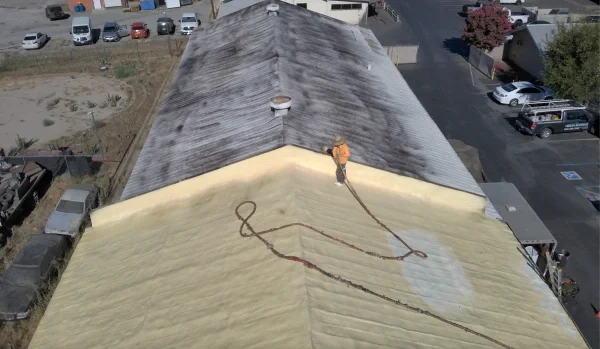
So are commercial roofs flat, or only low-slope?
No, and that's the first myth to drop. A commercial roof looks flat from the parking lot, but codes require a slight pitch so water leaves the roof. Under the 2018 International Building Code, new low-slope membrane roofs need a minimum slope of 1/4 inch per foot. On a re-roof, the code instead asks for positive drainage, meaning the roof clears standing water within 48 hours of rain, a standard the National Roofing Contractors Association backs for membrane and foam systems.
Roofers call these low-slope roofs, not flat roofs, and the label matters. A low-slope roof runs at a pitch of 3 in 12 or less, too shallow for standard shingles, so it needs a membrane, foam, or metal system built to shed water across a near-level surface. Get the slope right and the roof drains. Get it wrong and water sits, which is where most early failures begin.
Flat wins on cost and structure at commercial scale
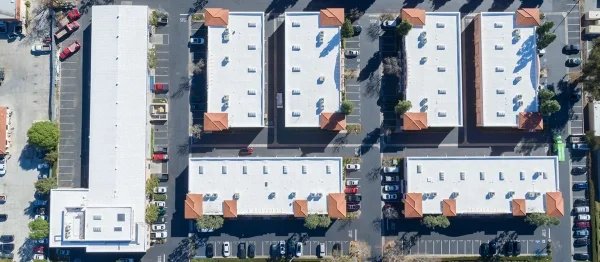
The real driver is size. The average U.S. commercial building is big, and a big roof is cheaper to build flat. The U.S. Energy Information Administration counted 5.9 million commercial buildings holding 97 billion square feet in 2018, and that floorspace grew 11 percent in 6 years. Spread a pitched roof over a footprint that size and the framing, materials, and labor climb fast.
A flat roof skips most of that. It sits on a simple deck over steel bar joists or concrete, spans wide open floors without a tall truss system, and covers far less surface area than a peaked roof over the same building. That means less material, less framing, and less labor. For a developer pricing a 50,000 square foot warehouse, the gap is real money.
Houses go the other way for a reason. A home is small enough that a pitched roof costs little more, sheds rain and snow on its own, and matches the look buyers want. Scale flips the math. What's cheapest on a house is rarely cheapest on a warehouse.
A flat roof turns the top of the building into usable space
A flat roof is a working surface, and that's worth nearly as much as the cost savings. Air handlers, condensers, exhaust fans, and solar arrays all need somewhere to sit, and a flat roof puts them up top, out of sight and off the ground. That keeps mechanical gear out of the leasable floor area below and away from tampering.
It also makes the roof easy to service. A crew can walk a low-slope roof safely to inspect seams, clear drains, and service the units, work that a steep roof makes slow and risky. Some owners go further and use the space for a deck, a garden, or more panels. On a commercial building, the roof isn't wasted square footage. It earns its keep.
Flat commercial roof systems in 2026, compared
There's no single best flat roof, only the right system for your building, budget, and how long you'll own it. Here's how the main low-slope systems compare on typical Southern California service life and where each fits.
| System | How it works | Typical service life | Best for |
|---|---|---|---|
| TPO / PVC (single-ply) | Heat-welded reflective membrane, light and bright | 20 to 30 years | Commercial roofs that want reflectivity and a fast install |
| EPDM (single-ply) | Rubber membrane, flexible in heat | 20 to 30 years | Large, simple roofs with few penetrations |
| Built-up roof (BUR) | Layers of asphalt and felts, gravel-surfaced | 20 to 30 years | Heavy-traffic roofs that need a thick, tough surface |
| Modified bitumen | Asphalt sheets modified for flex, torched or self-adhered | 15 to 25 years | Smaller commercial and residential flat sections |
| Standing-seam metal | Interlocking panels at the low end of the slope range | 40 years or more | Owners who want the longest life and low upkeep |
| Spray polyurethane foam (SPF) | One sprayed layer, no seams, then a coating | 30 to 50 years with recoats | Roofs with odd shapes, penetrations, or ponding to level out |
| Coatings (silicone / acrylic) | Fluid-applied membrane over a sound roof | 10 to 20 years per coat, renewable | Restoring an aging roof without a tear-off |
Two systems solve problems the others can't. Among the main low-slope systems, aspray foam roof goes on as one continuous layer that self-flashes around every pipe and curb, adds insulation, and can be sprayed to fill low spots that pond. Because foam is renewable, you recoat it on a schedule instead of tearing it off, which is why a maintained foam roof can run for decades. Coatings do the same for a roof that's worn but sound: a fluid-applied silicone or acrylic layer that restores the surface and reflectivity for a fraction of a full replacement.
What drives the cost of a flat commercial roof
The price of a commercial flat roof moves on about 5 things, not one. Size and shape set the baseline, since more square footage and more penetrations mean more labor. Tear-off is the swing factor, because hauling off an old roof and repairing wet decking can cost as much as the new system. Then the system itself: a single-ply membrane, a built-up roof, spray foam, and a coating all price differently. Insulation to hit energy code adds cost, and so does access, since a roof crews can't stage on easily takes longer.
That's why we won't quote a flat roof by the square foot over the phone. A coating over a sound roof and a full tear-off with new insulation aren't the same job, and pricing them alike would be a guess. For owners who want the work done now and paid over time, we offer financing through Acorn Financing. The honest number comes after someone looks at your roof, not before.
Why do so many flat roofs leak early?
Because water sits when the slope or the drains fail, not because flat roofs are bad. This is the part most sales pages skip. A flat roof only works if water leaves it fast. When a drain clogs, a scupper runs too small, or the deck sags, water ponds. Ponding ages the membrane, works open the seams, and turns a pinhole into a soaked deck.
On the roofs we inspect, ponding near drains, curbs, and rooftop units causes more early failures than the brand of membrane underneath. The flat design that saved money at construction is the same one that punishes a skipped inspection. That's the trade-off nobody mentions: a flat roof is cheaper to build and less forgiving to ignore. Fix the slope with tapered insulation or added crickets and you often save a roof that a tear-off quote would have condemned.
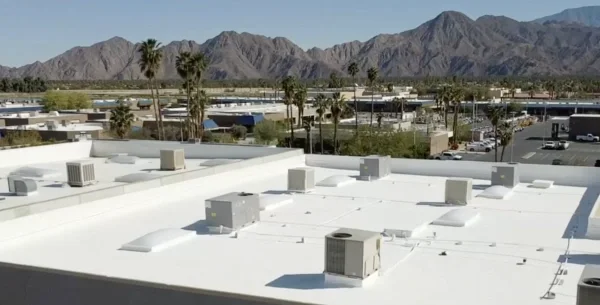
Do flat roofs save energy in Southern California?
Yes, when the surface is reflective, and in California it isn't optional. A dark roof soaks up the sun; a bright, reflective one bounces heat back. The U.S. Environmental Protection Agency reports that a cool roof can cut peak cooling demand by 11 to 27 percent in air-conditioned buildings, and in buildings without air conditioning it can drop peak indoor temperatures by 2.2 to 5.9 degrees Fahrenheit.
For commercial buildings in California, reflectivity is written into the energy code. The state's Title 24 standard, updated for 2026, sets low-slope roofs at a minimum aged solar reflectance of 0.63 and thermal emittance of 0.75, or an SRI of 75, as summarized by the Cool Roof Rating Council. A white single-ply membrane or a coated foam roof clears that bar and cuts heat gain at the same time. We won't promise a dollar figure on your utility bill, because savings ride on your building and equipment, but the code is real and the physics is well documented.
What we see on Southern California commercial roofs
Here's the track record behind that, not a slogan. Vision Roof Services has completed about 7,500 roofs since Dave Bienek started in the trade in 1992, with the company founded in 2014. Commercial buildings we've roofed include the LifeStorage location in Costa Mesa and the Yamaha facility in Buena Park, plus work for names like Paramount Studios. Behind that is a 60-person crew, 12 of them trained and certified in spray foam through General Coatings, and membership in the Spray Polyurethane Foam Alliance, the trade body that sets SPF practice.
We're commercial-first and foam-first, but the reason owners call us back is simpler: we look before we quote. Every job starts with a free Roof Health Check, an on-roof inspection with photos and a written report back within 24 to 72 hours. If the deck is sound, a coating or a foam-over often restores the roof with no tear-off. If it's failing, we say so. We hold a BBB A+ rating, a 2024 BuildZoom Top Contractor nod, and a 4.8-star Google rating, and we're licensed and insured under California license 651509.
We handle commercial flat roofs across Orange County and Riverside, out to the Coachella Valley from Palm Desert to La Quinta, plus commercial work in Los Angeles and San Diego and projects in Arizona, Nevada, and Texas. So the short answer holds: commercial roofs are flat because flat is cheaper to build, easier to use, and code-friendly, as long as someone keeps the water moving. If yours is pooling water or past its second decade, book a free Roof Health Check and you'll have a written report, with photos, within 24 to 72 hours. Call 844-348-ROOF.
FAQs
Why are most commercial roofs flat?
Most commercial roofs are flat because a low-slope design is cheaper to build over a large footprint, supports rooftop HVAC and solar equipment, gives crews safe access, and meets cool-roof energy codes. Flat roofs are not perfectly level, though. Codes require a slight slope, at least 1/4 inch per foot, so water drains instead of pooling.
Are flat commercial roofs completely flat?
No. A commercial roof looks flat but carries a slight pitch so water runs off. The 2018 International Building Code sets a minimum slope of 1/4 inch per foot for new low-slope membrane roofs, and re-roofs must drain within 48 hours of rain. Roofers call these low-slope roofs, not flat roofs.
What is the best flat roof for a commercial building?
It depends on how long you'll hold the building and how you use the roof, but reflective single-ply and spray foam are the most common commercial picks. A coated foam roof also meets California's Title 24 cool-roof standard of 0.63 aged solar reflectance for low-slope roofs. The right system gets set during an on-roof inspection, not from a catalog.
How long do commercial flat roofs last?
Single-ply, built-up, and EPDM flat roofs typically last 20 to 30 years with maintenance. A spray foam roof recoated on schedule can run 30 to 50 years, because you renew the surface instead of replacing the roof. Standing-seam metal can exceed 40 years.
Why do flat commercial roofs leak?
Flat commercial roofs usually leak because water ponds instead of draining. A clogged drain, an undersized scupper, or a sagging deck lets water sit, which ages the membrane and opens seams. Ponding near drains and rooftop units causes more early failures than the type of membrane underneath.
Do flat commercial roofs save energy?
A reflective flat roof can cut peak cooling demand by 11 to 27 percent in air-conditioned buildings, according to the U.S. EPA. In California, Title 24 requires low-slope commercial roofs to meet a 0.63 aged solar reflectance standard. Actual dollar savings vary by building, insulation, and equipment.
How much does a commercial flat roof cost?
Cost depends on roof size, the number of penetrations, whether the old roof needs a tear-off, the system you choose, and added insulation for energy code. A coating over a sound roof costs far less than a full tear-off with new insulation. A written inspection gives an accurate number; a phone quote is a guess.