Commercial Roofers In Huntington Beach, CA
Vision Roof Services installs and maintains commercial low-slope and spray foam roofs across Huntington Beach and coastal Orange County. CSLB #651509. General Coatings certified.
Who we are for
A commercial roofer that reads the city's paperwork before it quotes your roof
If you own or manage a commercial building in Huntington Beach, 3 things decide whether a bid is real: the license classification that pulls the permit, a system that meets the cool-roof and insulation minimums for Climate Zone 6, and an honest read on whether your roof needs a recoat, a recover, or a tear-off. Vision Roof Services brings all 3.
SPECIALTY
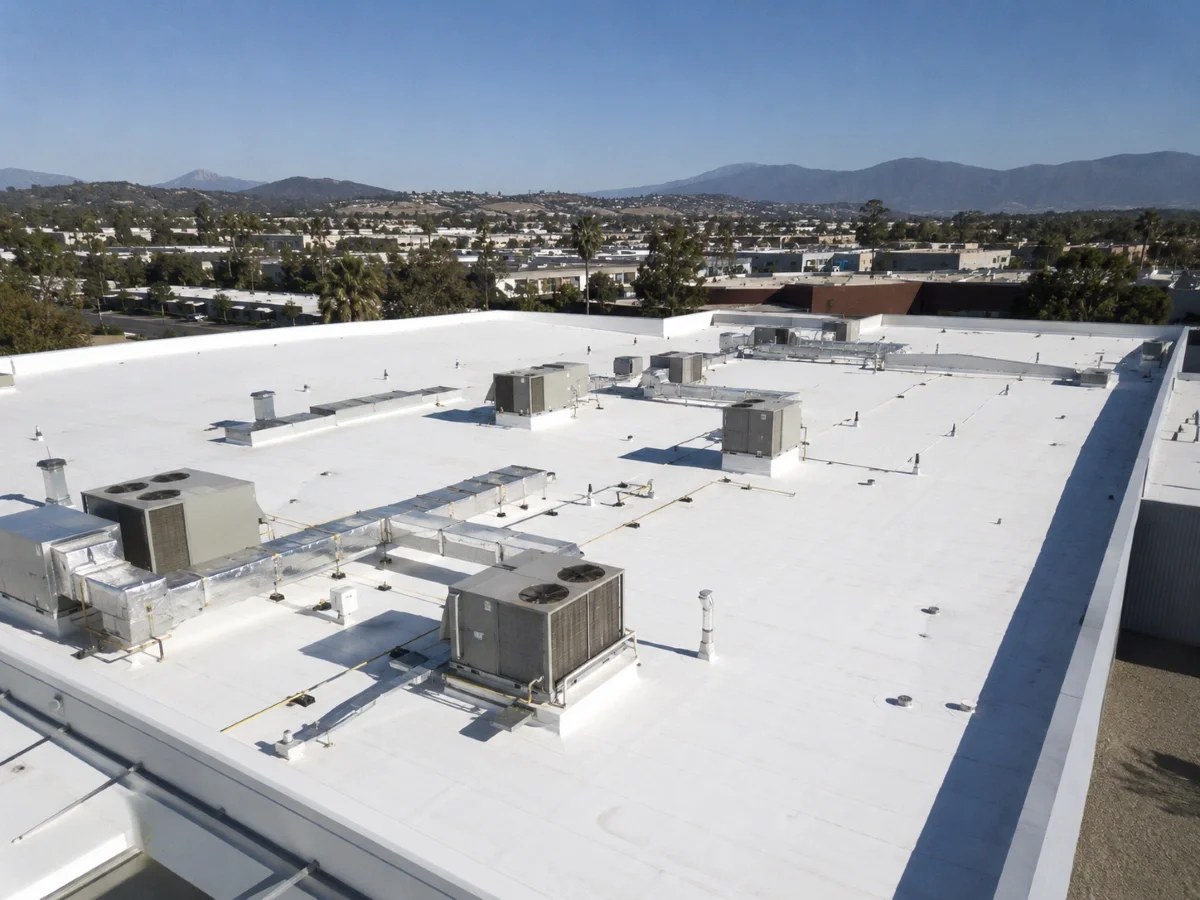
Commercial spray foam
Spray polyurethane foam and coating systems are our core work. We also install and service TPO, PVC, and other single-ply low-slope roofs. See our spray polyurethane foam roofing systems.
LOCAL
Orange County commercial work
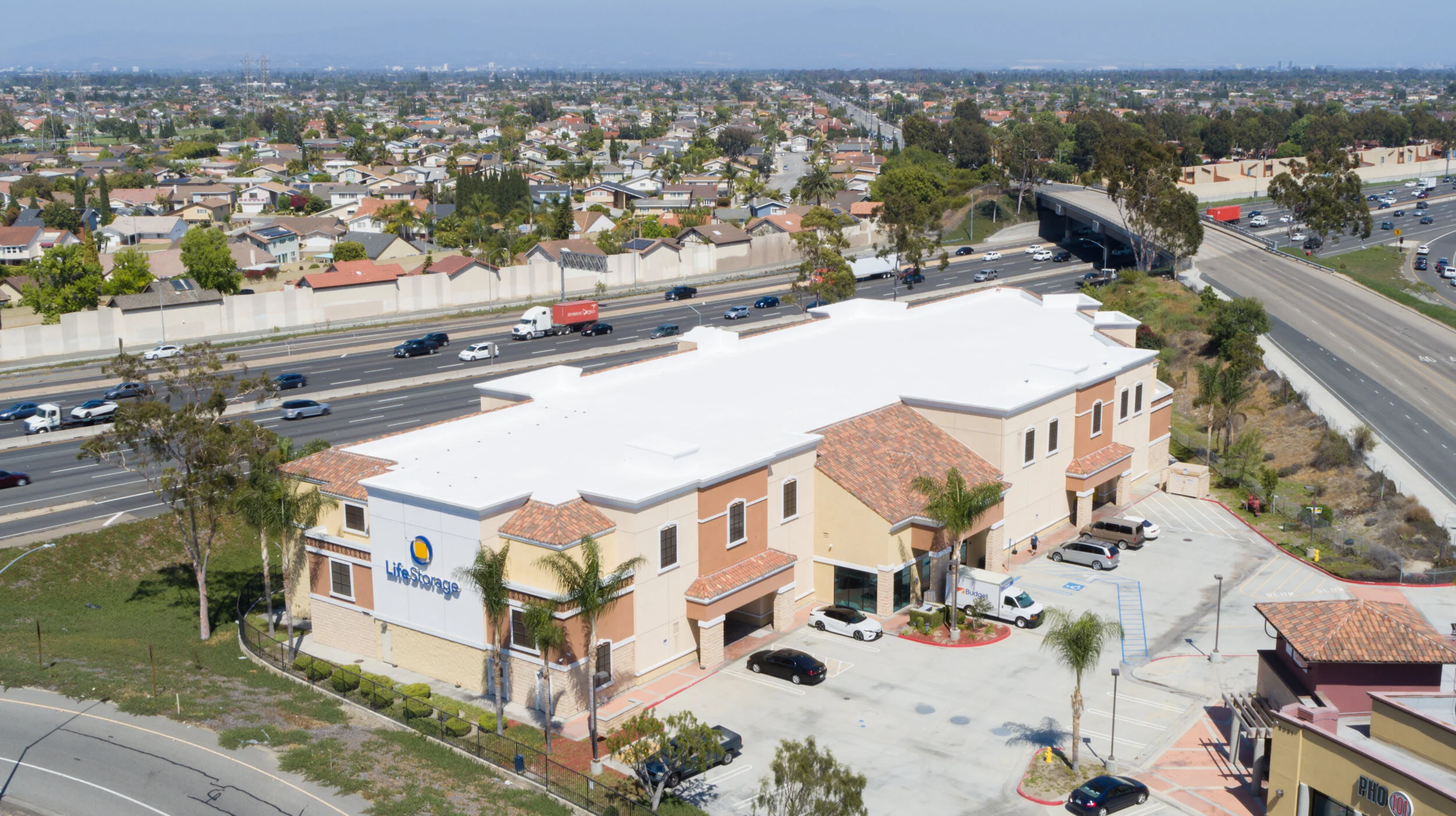
Orange County commercial work includes the LifeStorage facility in Costa Mesa and the Yamaha facility in Buena Park. Our Orange County office is in Mission Viejo, roughly 25 miles from Huntington Beach.
PROCESS
Inspection before proposal
Every job starts with a free Roof Health Check: a documented inspection with photos, and a written report in 24 to 72 hours, so the bid matches the roof instead of a guess.
What Huntington Beach's 2026 cool-roof code actually requires
Huntington Beach is in California Title 24 Climate Zone 6. For a nonresidential or hotel/motel low-slope roof, the 2025 Energy Code took effect January 1, 2026, and it applies to your project when you replace, recover, or recoat more than 50% of the roof area or more than 2,000 square feet, whichever is less. Most roofing pages write "Title 24 compliant" and stop. Here are the numbers a plan reviewer is actually checking.
Title 24 Climate Zone 6 minimums, nonresidential low-slope roof alterations, effective January 1, 2026
| What gets checked | Zone 6 minimum | Where it comes from |
|---|---|---|
| Aged solar reflectance (3-year) | 0.63 | 2025 Energy Code, nonres low-slope alterations |
| Thermal emittance | 0.75 | Required together with the reflectance value above |
| Or Solar Reflectance Index (SRI) | 75 | Single-metric alternative to the pair above |
| Continuous insulation | R-17ci | Climate Zones 6, 7, and 8 |
| Or assembly U-factor | U-0.047 | R-10ci minimum above the roof deck on this path |
| Product listing | CRRC-rated | Product ID goes on the city's re-roof application |
Values are aged, meaning measured after 3 years of weathering, not off a fresh sample. The product has to be listed in the Cool Roof Rating Council directory, and the CRRC number is a field on the city's own form.
The R-30 number is wrong, and it is on a lot of 2026 cost pages
Search "California commercial roof cost 2026" and you will find pages pricing "Title 24 R-30 compliance" into the insulation line at $2 to $6 per square foot. That is not the Huntington Beach number. It is not the Orange County number either.
The 2025 Energy Code splits nonresidential roof alterations into 2 insulation buckets. Climate Zones 1 through 5 and 9 through 16 get the tighter path, R-23ci or U-0.037. Climate Zones 6, 7, and 8 get R-17ci or U-0.047. On the U-factor path, at least R-10ci has to sit above the deck. Every city in Orange County sits in 6 or 8. So the R-17ci path covers the whole county, coastal and inland.
The gap between R-17ci and R-30 is 2 to 3 inches of polyiso across your entire roof. On a 20,000 square foot warehouse off Gothard Street that is real money, and it is money you do not owe. If a bid prices R-30 on a Huntington Beach building, the contractor either copied an inland assembly or does not know which zone you are in. Ask which climate zone they used and which table they pulled from.
Dave Bienek, who started roofing in 1992 and founded Vision Roof Services in 2014, puts it plainly: the insulation line is where the 2 bids on your desk diverge, and almost nobody explains it. We put the zone, the R-value, and the CRRC product ID in writing on every commercial proposal.
Recoat, recover, or replace: what each one triggers
This is the single biggest swing in your budget, and it is also where the code gets misread most often. The 50% / 2,000 square foot trigger applies to all 3 paths. What the trigger pulls in is different for each.
What the Title 24 trigger pulls in, by scope
| Your scope | Cool-roof reflectance required? | Insulation required? | The practical read |
|---|---|---|---|
| Recoat (liquid-applied over a sound surface) | Yes, once you cross the trigger | No. The recoated area is not required to be insulated | The cheapest path to compliance when the substrate is dry and sound |
| Recover (new system over the existing one) | Yes | Not the full R-17ci, if at least R-10ci of new insulation goes above the existing roof | Middle path. Only legal if the roof is not already carrying 2 layers |
| Replace (tear-off to deck) | Yes | Yes, full R-17ci, or U-0.047 with R-10ci above deck | Highest cost, and the only option once the deck or the insulation is wet |
Two things fall out of that table that the ranking pages never say.
The first: "we will just coat it and skip the energy paperwork" is not safe once you cross the area threshold. Recoating is named in the trigger. You still owe the reflectance values and the compliance forms.
The second, and this one saves money: crossing the trigger with a recoat does not drag the insulation requirement along with it. The recoated area is exempt from the insulation stack. That distinction is worth tens of thousands of dollars on a large low-slope roof, and it is the reason a Roof Health Check that proves your substrate is dry can change the entire shape of the project. If you are weighing the 2 paths, our breakdown of roof coating versus replacement walks through how we make that call.
There is also a tapered-insulation allowance at drains, so building positive drainage into the design does not automatically fail the R-value math, as long as the average across the roof meets the table.
What the Huntington Beach re-roof application actually asks for
The city's Re-Roof Application is the most useful document in this whole process, and it is public. It runs a single page. It asks for slope, number of existing layers, existing material, tear-off versus overlay versus new sheathing, the cool-roof CRRC number, underlayment type and weight, the ICC evaluation report number, weight per square foot, and the fire classification of the proposed material.
Four lines on that form matter more than any badge on a homepage.
No more than 2 layers, per Chapter 15 of the California Building Code. If your building already carries a recover on top of an original system, "we will overlay it to save money" is not a plan. It is a failed inspection and a tear-off change order. Count your layers before you take bids, not after.
Class B minimum, per Huntington Beach Municipal Code. The city amended CBC Table 1505.1 in HBMC 17.04.140 and 17.04.150: every construction type, IA through VB, needs at least a Class B fire-retardant roof covering, and the requirement attaches to any existing structure where more than 50% of the roof area is replaced in a 1-year period. Note what that is not. A lot of California roofing copy quotes Class A as a statewide default. In Huntington Beach the floor is Class B, and whether you owe Class A depends on your construction type and whether the address sits inside a mapped Fire Hazard Severity Zone. That gets checked on the address, not assumed.
A 6.0% automation fee is added to all permit fees, under city Resolution 2023-21. It is printed on the form. Budget it, because a permit estimate that leaves it out is 6% light before the first inspection.
License classification is written into the form, not left to the honor system. The application states that every roofing permit issued to either a C-39 (roofing) or B (general) contractor requires a valid state license and current workers' compensation. If a B-licensed general contractor is pulling the permit and roofing is the primary trade, the roofing has to be subcontracted to a C-39, and the B holder still needs an active workers' comp policy at the time of issuance. "Licensed and insured" on a website does not tell you which license is pulling your permit. Ask.
Re-roofing an area smaller than 100 square feet is exempt from a permit under HBMC 17.04.050, as long as the work still satisfies all applicable application requirements. Everything above that is a permit, submitted through the Huntington Beach Permit Center at 2000 Main Street, Huntington Beach, CA 92648, (714) 536-5241. The city does not currently offer expedited plan review, so a complete first submittal is the only way to save weeks.
Inspections run in sequence, and the sequence is the point: pre-roof or tear-off, framing where required, then final. The deck is supposed to be seen before it disappears under a membrane. If a crew wants to tear off Friday and close the roof Saturday with no deck inspection, that is not scheduling flexibility. That is a process problem.
Do you need a Coastal Development Permit? Usually not.
Huntington Beach Municipal Code Chapter 245 requires a Coastal Development Permit for development inside the coastal zone unless the work is exempt or categorically excluded. Maintenance, alteration, or addition to an existing structure is on the exemption list.
The exemption goes away in specific situations. The ones commercial buildings actually hit: property in an appealable area where the work increases internal floor area by 10% or more or increases height by 10% or more, property on a beach, wetland, sand dune, stream or lake, or seaward of the mean high tide line, property within 50 feet of the edge of a coastal bluff, a change in the intensity of use, or a prior coastal permit that said future additions need their own permit.
A like-for-like membrane replacement on an existing commercial roof does not add floor area and does not add height. Read against the exemption list, that is a normal building permit and nothing more.
We are flagging this because the two failure modes are both expensive. One is a contractor who treats every building near Pacific Coast Highway as a Coastal Commission hearing and prices in months of entitlement you do not owe. The other is a contractor who has never read Chapter 245 and misses a case that genuinely needs a permit. The fix takes 10 minutes: map the parcel, check whether it sits in an appealable area, read the exemption list. We do that during the Roof Health Check.
The one Huntington Beach commercial roof job you can read in public
Private commercial bids in this market are not published. One city job is, and the staff write-up is more useful than any testimonial.
On August 19, 2025, the Huntington Beach City Council accepted the lowest responsive bid on the Park Bench Café roofing and siding improvements at 17732 Goldenwest Street, a city-owned building in Huntington Central Park. Southland Roofing, Inc. bid $120,000, and the Council authorized change orders up to a 15% contingency, which puts the contract at $138,000. Three other bids were rejected as non-responsive over bid violations. (Source: City of Huntington Beach Council File 25-628, project CC-1789.)
Read the scope, not the number. The flat roof was old, it leaked, it did not drain, and water ponded on it long enough to destroy the wood siding above the roofline. The remedy was not a nicer membrane brand. It was replacing the sloped roof, replacing the flat roof, adding a drain and a pitch, and replacing the damaged siding. Which is a much bigger job than "the roof needs replacing" sounds like.
That is the failure mode we look for first on Huntington Beach commercial walks. Drains, overflows, pitch. We have walked buildings where the membrane was fine and the drainage had been wrong since the building went up in the eighties, and the owner had been paying for patch calls for years. A roof that cannot get rid of water will kill any membrane you put on it, and it will take the building envelope with it. If a bid on your building does not say how water leaves the roof, it is not a coastal commercial bid. It is a materials quote. We wrote more on why flat roofs leak if you want the longer version.
The Huntington Beach Commercial Reroof Readiness Check
Run these 6 questions before you collect a single bid. It is the same sequence we walk during a Roof Health Check, and it tells you what you are buying before anyone quotes it.
1. How many layers are up there?
Two is the cap under CBC Chapter 15. If you are already at 2, a recover is off the table and your options are recoat or tear-off. Pull the last permit or have someone cut a test square. This answer changes everything downstream.
2. Find out whether the substrate is wet
A roof can look fine and be saturated underneath. Ponding water and wet insulation are the costs that ambush owners mid-project. An infrared moisture scan before bidding is the difference between a fixed price and a change order.
3. Does your scope cross the 50% / 2,000 square foot trigger?
If yes, you owe aged solar reflectance 0.63 and thermal emittance 0.75, or SRI 75, with CRRC-listed products and the compliance forms at plan review. If you are recoating, you owe the reflectance but not the insulation.
4. Ask which climate zone the bidder used
Huntington Beach is Zone 6. The insulation target is R-17ci, or U-0.047 with at least R-10ci above the deck. If the bid says R-30, ask where that came from.
5. Who pulls the permit, and can you verify them today?
Check the CSLB license number, confirm the classification is C-39 or a B with a C-39 subcontract, confirm workers' comp is active, and confirm the Huntington Beach business license. Do it the week you sign, not from a badge graphic on a website.
6. Settle the rooftop units before anyone prices insulation
Lifted or left in place, who owns the curb, who re-flashes after the HVAC contractor, and does the new insulation thickness still clear the manufacturer's base flashing height. More on that next, because it is where most of the surprises live.
Rooftop units are where the roof and the code collide
On a commercial flat roof, water showing up near a packaged HVAC unit is often not a membrane failure. It is the curb, the unit itself, or a penetration that got moved after the roofing crew left. Field-wrapped membrane at a gas line or a conduit can be acceptable work. A plywood pad under a unit with a curb that was never flashed as a system is not.
The code piece makes this concrete. The 2025 Energy Code includes a flashing-height exception: where rooftop equipment curbs physically constrain the assembly, you install the maximum insulation the curb allows, up to the prescriptive requirement, or R-10ci, whichever is greater. Translated: if the units do not get lifted, you may not be able to stack the full R-17ci even when the table calls for it, and the exception is how you stay compliant.
That single detail decides scope on a lot of Huntington Beach medical, restaurant, and multi-tenant retail buildings, where lifting 4 rooftop units is a coordination problem across 3 trades and several tenants. Nobody wants to discover it after the polyiso is on the truck.
So we put it in the proposal as a matrix. Every unit, lift or no lift, who owns the curb, who re-flashes after mechanical, and the flashing height available versus the insulation thickness specified. It is the least interesting page in the proposal and it is the page that keeps the job from failing inspection, or from failing at the first rain after an HVAC tech walks the roof.
What a commercial roof costs in Huntington Beach
We do not publish a price for your building, because a number without a roof inspection behind it is a guess. What we can do is show you the planning bands the 2026 market is running on, so you can tell whether the bids on your desk are in the neighborhood.
These are published 2026 Southern California and California market ranges, not Vision Roof Services quotes. Treat them as a sanity check on a capital plan, not as an estimate.
Published 2026 market planning ranges for commercial low-slope systems. Not a quote.
| System | Typical 2026 installed range (per sq ft) |
|---|---|
| Restoration coating over sound substrate | $1.50 to $4.50 |
| EPDM | $7 to $11 |
| SPF with silicone, 2 to 4 inches | $7 to $12 |
| TPO | $8 to $12 |
| Modified bitumen / built-up | $8 to $13 |
| PVC | $9 to $15 |
| Standing-seam metal | $12 to $30 |
Sources: 2026 Southern California commercial roofing cost guides and a 2026 SPF cost guide, listed at the end of this page. Coastal work in Los Angeles and Orange County is commonly quoted 15% to 25% above inland for the same system.
What actually moves your number is not the logo on the membrane. It is whether a second layer has to come off, whether you owe the full R-17ci stack or a recoat exemption, whether the rooftop units get lifted, and whether the edge metal and fasteners are specified for salt air instead of standard galvanized. Those 4 lines explain most of the spread between 2 bids on the same building.
Why owners choose spray foam, and when they should not
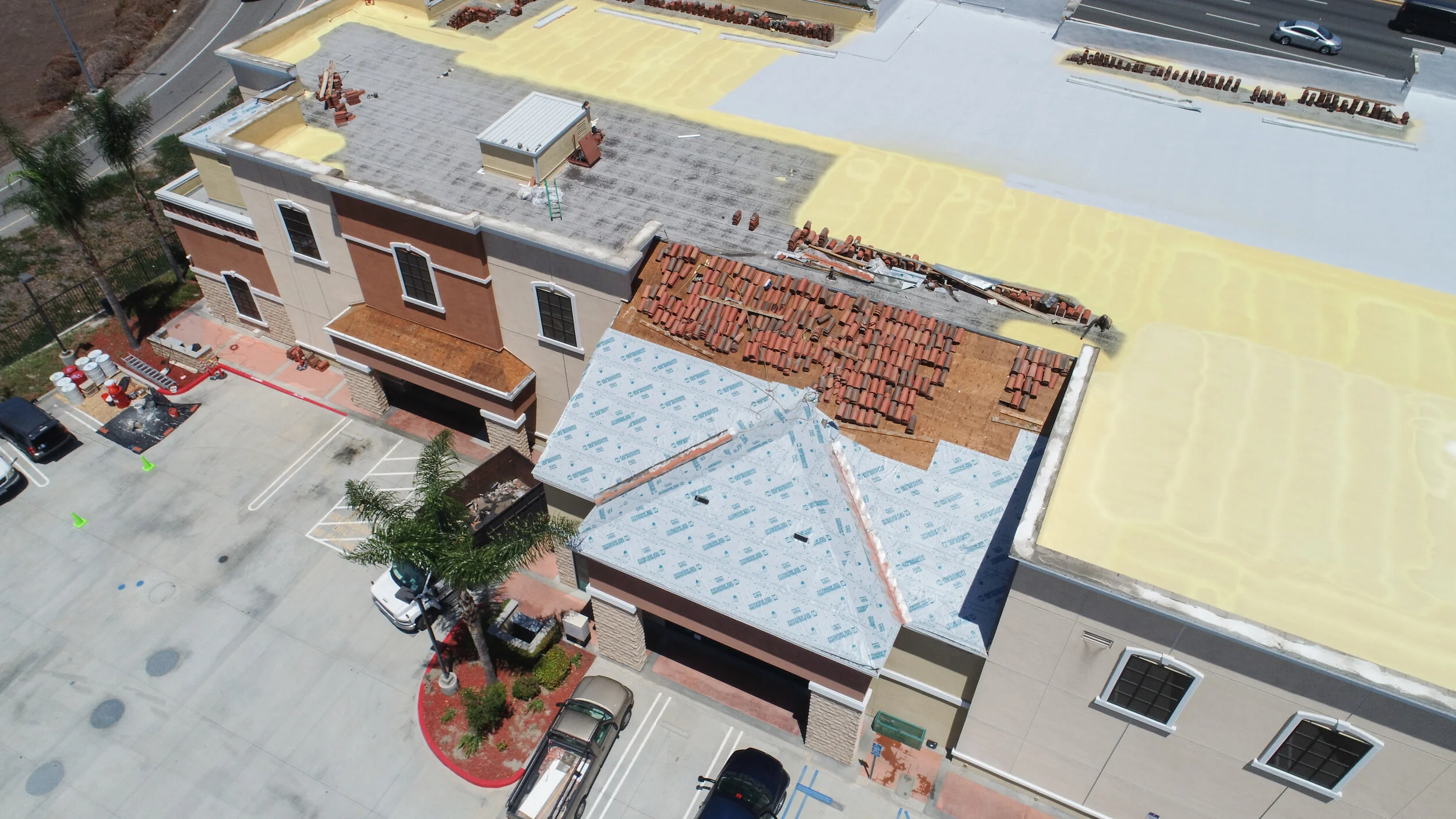
Spray polyurethane foam goes down as a liquid and cures into a single continuous surface with no seams, which is where most flat roofs leak first. It is light, it adds insulation, and on a sound roof it can often go over the existing system, which cuts tear-off and landfill cost. It is not right for every building, and we will tell you when it is not.
Good fit
Low-slope commercial roofs with a sound, dry substrate. Buildings where tenant operations make a full tear-off expensive or disruptive. Roofs with a lot of penetrations and odd geometry, where a poured surface seals better than sheet seams.
Not the right call
Roofs with widespread wet insulation or structural problems that a coating would only hide. Surfaces that cannot be cleaned and prepped properly. Buildings already carrying 2 roof layers where the code requires the tear-off anyway. In those cases we recommend the repair or replacement that actually fixes the roof, even when it is the larger job and even when it costs us the sale.
We also do not take gutter cleaning, and we are not the right call for small repairs well outside our service area. If your job is a 200 square foot patch in a city we do not cover, a local handyman will serve you better than we will.
Energy performance varies by building, insulation, and use. Cool-roof surfaces cut rooftop heat gain, which can lower summer cooling load. We do not promise a fixed savings number.
Our commercial roofing services
Vision Roof Services covers the full range of commercial low-slope work, with spray polyurethane foam as the specialty. See all commercial roofing services.
Roof installation
New roof construction
Roof replacement
Roof retrofitting
Roof coating and specialty systems
Spray polyurethane foam roofing
Fire-resistant coatings
Waterproofing and green roof installation
Solar panel installation and roof integration
Cool roof systems
Energy and code compliance
Climate Zone 6 cool-roof compliance
CRRC product selection and documentation
Energy-efficient roof assemblies
Consultation and advisory
Pre-construction planning
Material sourcing and cost strategy
Safety and compliance advisory
Maintenance and repair
Routine inspections and maintenance
Leak detection and repair
Roof cleaning and debris removal
Emergency roof repairs
The Vision Roof Services process
01 - Initial contact. Tell us the building, the roof, and the problem.
02 - Roof Health Check. Documented inspection with photos. Written report in 24 to 72 hours. No cost, no obligation.
03 - Proposal. System options and a firm price matched to what the inspection found, with the climate zone, R-value, and CRRC product ID written in.
04 - Contract and scheduling. Including night and weekend windows where tenant operations require it.
05 - Installation. Most projects run several days to several weeks depending on size.
06 - Final inspection and warranty. City sign-off, then annual maintenance with a recoat schedule as needed.
Track record
60 roofers on the crew, 12 of them certified spray foam applicators
1992 the year founder Dave Bienek started in roofing; Vision Roof Services was founded in 2014
7,500 roofing projects completed to date
Credentials
CSLB #651509, licensed and insured
General Coatings certified, 2025 Platinum Award
BBB A+ accredited
2024 Best of BuildZoom
Spray Polyurethane Foam Alliance member
Client Testimonials
“Vision Roof Services has been an invaluable partner in managing and maintaining the roofs of all my commercial buildings. Over the years, they have re-roofed multiple properties with their superior SPF roofing system, and the results have been outstanding. Not only have my buildings remained completely leak-free, but the energy demand has significantly decreased, which has saved me a great deal on operating costs. Their professionalism, attention to detail, and commitment to quality set them apart. I trust Vision Roof Services entirely to protect and enhance the value of my properties.”
“Vision Roof Services is our go-to partner for SPF roofing on our design-build custom homes in the Madison Club, La Quinta. Vision’s quality of work is exceptional, and their installations are always fast, efficient, and seamlessly integrated into our projects. Vision’s attention to detail and professionalism makes them an invaluable part of our team. I highly recommend them to anyone looking for top-tier roofing solutions.”

Clients


Specializing in Spray Polyurethane Foam (SPF)
This General Coatings video displays the commercial spray foam roofing process.
For property owners and managers, polyurethane spray foam roofing is an ideal solution for preserving the value of commercial buildings. This advanced roofing system provides unparalleled protection against the region's intense sun, heat, and occasional heavy rains.
By offering superior insulation and creating a durable, seamless seal, our spray foam roofs help maintain stable indoor temperatures and significantly reduce energy costs. This not only improves the building's energy efficiency but also enhances its overall structural integrity, ensuring long-term value and reliability.
Our spray foam roofing is adaptable to various roof shapes and sizes, making it the perfect choice for commercial properties seeking sustainable and cost-effective roofing solutions. With VRS, you can trust that your investment is protected by a high-performance roofing system designed to last.
Frequently asked questions
What climate zone is Huntington Beach in for Title 24?
Climate Zone 6. That puts a nonresidential low-slope re-roof on the R-17ci path, or U-0.047 with at least R-10ci above the deck, rather than the R-23ci path used in most of the state. The cool-roof reflectance minimums are the same statewide: aged solar reflectance 0.63 and thermal emittance 0.75, or SRI 75.
Does my Huntington Beach re-roof have to meet the cool-roof rules?
If you replace, recover, or recoat more than 50% of the roof area or more than 2,000 square feet, whichever is less, yes. The 2025 Energy Code took effect January 1, 2026. Recoats are inside the trigger for reflectance. The recoated area is not required to be insulated, which is the exception most bids miss.
Do I need a Coastal Development Permit to re-roof a building in Huntington Beach?
Usually not. HBMC Chapter 245 exempts maintenance and alteration of existing structures, and a like-for-like roof replacement adds no floor area and no height. The exemption drops away on beaches, wetlands, sand dunes, streams and lakes, within 50 feet of the edge of a coastal bluff, and in appealable areas where the work adds 10% or more of floor area or height. Map the parcel before you assume either way.
Can I just add another layer over what is there?
Only if the building is currently at 1 layer. The Huntington Beach re-roof application caps it at 2 layers under CBC Chapter 15. At 2 already, your options are a recoat or a tear-off.
What fire rating does my roof need?
Class B is the floor in Huntington Beach under HBMC 17.04.140 and 17.04.150, and it attaches to any existing building where more than half the roof is replaced within a year. Class A may be required depending on construction type and whether the address falls inside a mapped Fire Hazard Severity Zone. Check the address rather than assuming a statewide default.
How long does a commercial spray foam roof last?
Maintained properly, an SPF roof is a long-term system. The foam can last decades, and the protective top coat is renewed on a recoat schedule instead of torn off. Published 2026 guidance puts silicone recoat intervals at roughly 10 to 20 years. What decides real service life is maintenance: semi-annual inspections, drain cleaning, and timely recoats. Neglect shortens even a good foam roof.
Can spray foam go over my existing roof?
Often, yes. SPF is light and can go over many sound existing roofs, which avoids tear-off and landfill cost. The deciding factor is the substrate. Widespread wet insulation has to come off first. A moisture scan during the Roof Health Check tells us which path your roof is on.
How often should a commercial roof be inspected?
At least twice a year, and after any major storm or Santa Ana wind event. Semi-annual inspections, infrared moisture scanning, drain cleaning, and seam checks catch small problems before they become tear-offs. On coastal buildings, add a look at the edge metal and fasteners, because salt air goes after those first.
Will adding solar void my roof warranty?
Not if it is coordinated correctly. Mounts and penetrations have to be installed to the roofing manufacturer's specification, and the roof under the array should be sound before panels go on. The cleanest result comes from coordinating the roofing and the solar mounting so one party owns the watertight detail.
Free Roof Health Check
A licensed Vision Roof Services roofer inspects your commercial roof, documents what we find with photos, and sends a written report in 24 to 72 hours. We include the layer count, the moisture read, the drainage assessment, the climate zone, and whether your scope crosses the Title 24 trigger. No cost, no obligation, no pressure.
Or call us at (844) 348-ROOF to talk through your building.
Our Work
Take a look at projects we have completed in the gallery below.
Visit the completed roofing projects page to see more.