Why Are My Shingles Curling? Causes, Fixes, And Costs
If you're asking why your shingles are curling, the short answer is age. At Vision Roof Services we get the call about it most often in the weeks after the first real wind of the season. The asphalt in a shingle dries out and shrinks around the fiberglass mat underneath it, and the edges lift. That's what curling is, and on the roofs we inspect it nearly always means the roof is near the end of its service life rather than carrying a defect somebody can go up and fix.
The National Association of Home Builders put the service life of an asphalt shingle roof at about 20 years in its 2007 study of home components, and how long a roof lasts here depends heavily on which side of the mountains it sits on. A curling roof at 18 years is doing what it's supposed to do. A curling roof at 6 years is a different conversation, and so is a roof that's buckling instead of curling. Those 2 words get used as if they mean the same thing. They don't, and the difference decides whether you're calling your installer or calling for a replacement quote.
Shingle curling is the upward lift of asphalt shingle edges or tabs as the asphalt loses its volatile oils, hardens and shrinks against the reinforcing mat. It shows up first at tab corners and lower edges. Heat, ultraviolet light and daily temperature swings drive it, so it appears earliest on sun facing slopes and on roofs past 12 years old.
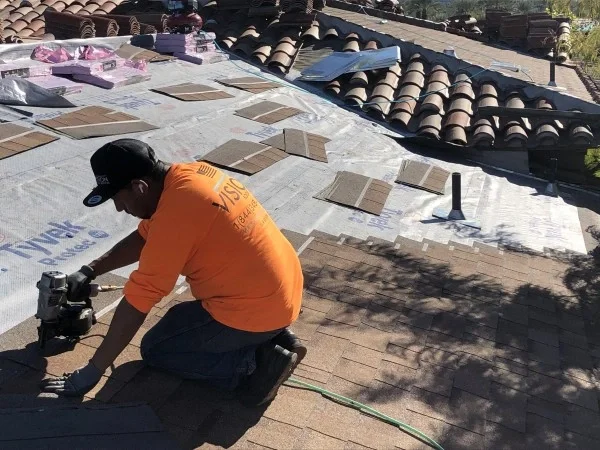
What causes shingles to curl?
Asphalt aging causes curling, and heat and sunlight set the pace. A shingle is asphalt over a fiberglass or organic mat, topped with ceramic granules that shield the asphalt from ultraviolet light. As granules wash off, more asphalt gets exposed. The asphalt loses its lighter oils, gets brittle, absorbs moisture more readily and distorts. Then it curls.
Temperature is the accelerator. The Department of Energy's Guidelines for Selecting Cool Roofs reports that conventional dark roofs can reach 150F or more in summer sun, and that a cool roof under the same conditions could stay more than 50F cooler. The guide is careful about what that means for durability, saying higher temperatures can speed up material degradation but that more study is required to quantify these effects. Researchers are still working on it. A 2026 NIST conference paper by Abdelwahab, Brown-Giammanco and Sung put shingles through ultraviolet exposure and combinations of temperature and humidity and tracked discoloration, mechanical changes and chemical changes to the adhesive strip.
The practical version for a homeowner in La Quinta: your roof spends 4 months a year cooking at temperatures no lab has to simulate.
Cupping, clawing and buckling are 3 different problems
They look similar from the driveway and they point at different causes. The National Roof Certification and Inspection Association separates the first 2 by shape. Cupping is when the edges of the shingle turn upward and the center goes concave. Clawing is when the edges stay flat and the center bulges up, or the tabs curl downward. Both are aging.
Buckling is not. Buckling is a wave or ridge running through the shingle field, and it comes from what's underneath. The Asphalt Roofing Manufacturers Association's technical bulletin on buckled shingles , revised March 2024, lists 7 possible causes. The first is wood deck panels absorbing rain or dew during construction. The second is individual boards on a plank deck expanding and contracting against each other as their moisture content changes. ARMA also calls out roof decking not spaced a minimum of 1/8 inch apart, uneven decking, moisture trapped in the system wrinkling the underlayment, abnormal deck movement from structural or seismic causes, and distortion that only looks like buckling because nails weren't driven flush or the bundles were stored badly.
| Curling and cupping | Buckling | |
|---|---|---|
| What you see | Lifted edges and tab corners, worst on sun facing slopes | Waves or ridges running across the shingle field, often in lines |
| Root cause | Asphalt aging, heat and ultraviolet exposure | Deck moisture, deck movement, underlayment wrinkling, workmanship |
| Typical roof age | 12 years and up | Often under 5 years, sometimes within months of install |
| Spread pattern | Follows sun exposure | Follows deck seams and framing |
| Repairable | Rarely. The material itself is spent | Often. Fix the cause, relay or replace the affected shingles |
| Who you call | A roofer, for a replacement assessment | The installer who put it on, and check the workmanship warranty |
That last row is the part nobody tells homeowners. A roof that buckled 8 months after installation is a workmanship question before it's a money question.
Why are my shingles curling when the house next door looks fine?
Because 4 things differ between 2 identical looking roofs: which slopes face the sun, what season the roof went on, how many shingle layers are up there, and whether the deck was dry the day it was covered.
The install season one is measurable, and it's the finding roofing blogs skip. In an April 2017 study, the Insurance Institute for Business and Home Safety tested wind uplift on 80 shingle panels at speeds from 60 to 170 mph. Panels installed in summer facing south spent an average of 228 hours above 140F, the temperature IBHS notes is normally used to set seals in a kiln and the point where the sealant went tacky. Winter installed panels facing north averaged 37 hours, over a different exposure window. Winter installed panels resisted uplift less well across the board, and the winter north facing ones performed worst of any group tested. Same product, same crew, same nails, different bond.
Layer count is the other big one, and it's a common reason a roof lands on the replacement list sooner than expected. Shingles nailed over an existing roof sit on an uneven surface and hold less securely, which is why a second layer curls sooner and lifts easier in wind.
Why "add more attic ventilation" is usually the wrong answer in the Coachella Valley
In Palm Desert, more attic ventilation is usually the wrong fix for a curling roof. Every page ranking for this question leads with ventilation anyway, so it's worth understanding the mechanism before you pay for a retrofit.
The ventilation and moisture chain works like this: humid indoor air rises into the attic, hits the cold underside of the roof deck, condenses, wets the sheathing and the underlayment, and the swelling deck or the wrinkling felt pushes shingles up. That's a buckling mechanism, it needs a moisture load, and it's why the advice is sound in Florida and Ohio. In the low desert there's very little interior moisture to condense and the deck rarely gets cold enough to condense it. Notice what ARMA does with ventilation in that bulletin, which is the one document in this field written by the people who make the shingles. Poor attic ventilation doesn't get its own entry. It sits inside the cause about deck boards moving, because what ventilation does in ARMA's account is manage moisture and temperature under the deck, which then moves the wood. And ARMA's subject throughout is buckling. Not curling.
Attic ventilation still matters here. It matters for attic temperature and the load that puts on your air conditioning, and a 160F attic over a 20 year old roof is not helping anything. But adding ridge vents will not un-curl a shingle whose asphalt is spent, and we don't sell attic ventilation retrofits, so we've got no reason to tell you otherwise. If a contractor quotes ventilation work as the fix for curled tabs on a 20 year old desert roof, ask them to show you the moisture. Wet sheathing, stained underlayment, rusted nail points, mold on the deck. No moisture, no moisture problem.
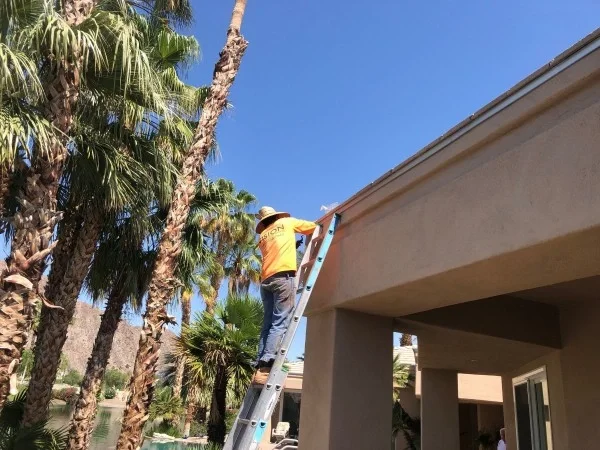
How long should a shingle roof last in Palm Desert versus Mission Viejo?
Use 20 years as the national benchmark and expect the desert to run shorter. The 2007 NAHB study of life expectancy of home components, produced with Bank of America Home Equity, gives asphalt 20 years, fiber cement 25, wood shakes 30, slate 50 or more, and lists copper and clay or concrete tile as lifetime materials.
Here's the honest limitation: that number is a national average from 2007 and nobody has published a climate segmented service life for asphalt shingles that we'd stand behind. What we can tell you is what we see. Vision Roof Services runs 2 offices about 90 miles apart, 1 in Palm Desert and 1 in Mission Viejo, and the same shingle fails 2 different ways between them. Desert roofs curl, crack and shed granules on the south and west slopes while the north slope still looks new. Roofs around Mission Viejo hold their shape longer and give us more algae staining, more sealant failure and more problems at flashings and valleys.
| Material | NAHB life expectancy | What we watch for in the low desert |
|---|---|---|
| Asphalt shingle | 20 years | Curling and granule loss on south and west slopes first |
| Fiber cement | 25 years | Weight and fastening, uncommon on re roofs here |
| Wood shake | 30 years | Splitting, cracking, fire code limits |
| Clay or concrete tile | Lifetime (underlayment is not) | Underlayment failure under intact tile |
| Copper | Lifetime | Rarely specified on residential work here |
Tile is worth flagging. The tile lasts a lifetime and the underlayment beneath it does not, which is why a 30 year old tile roof in Rancho Mirage can leak while looking perfect from the street.
Do curling shingles need to be replaced, or can they be repaired?
A curled shingle can't be repaired. The asphalt in it is spent, and no sealant, nail or adhesive puts the oils back. What you can decide is how much of the roof goes and how soon. 4 verdicts cover almost every roof we get called out to look at.
| What you see | Roof age | Verdict | Why |
|---|---|---|---|
| A few lifted corners on 1 sun facing slope, no leaks | Under 12 years | Monitor and document | The NRCIA notes curling is rare under 12 years. Photograph it, date the photos, re inspect in 12 months |
| Waves or ridges across the field, seams visible in the pattern | Under 5 years | Workmanship review, not a repair | Get the installer back and ask for a deck moisture inspection before anyone replaces a shingle. Check the workmanship warranty first |
| Curling on a small section, roof otherwise sound, no granule piles in the gutters | 12 to 18 years | Spot replace and start budgeting | Buys time. Put the replacement in next year's budget rather than an emergency |
| Curling across more than 10 to 15 percent of the surface, or on 2 or more slopes, plus cracking and granule loss | 15 years and up | Replace | Past 10 to 15 percent of the surface, the NRCIA's own guidance is that this is no longer a localized repair issue |
Those percentage and age figures come from NRCIA inspector guidance rather than from a published study, so treat them as thresholds experienced inspectors use, not as laboratory findings. The pattern holds up against what we find on roofs. Our crews have completed around 7,500 jobs, and the roof that gets spot repaired at 20 years is almost always back on the replacement list inside 3 years.
What curled tabs do in a Santa Ana wind
They give the wind something to grab. Asphalt shingles resist uplift because a heat activated adhesive strip glues each course to the one below it. IBHS measured average uplift failure between 117 and 127 mph across roof slopes from 2:12 to 12:12, with only a 10 mph spread between the shallowest and steepest slopes tested.
Read that number carefully, because it describes shingles with intact seals. A curled tab has already pulled free of its adhesive strip. It's outside the test envelope, which is why a Santa Ana event nowhere near 117 mph can take tabs off a curling roof and leave the sealed roof next door untouched. If you've been putting off a decision on a curling roof, the wind season is the argument for deciding before October rather than after.
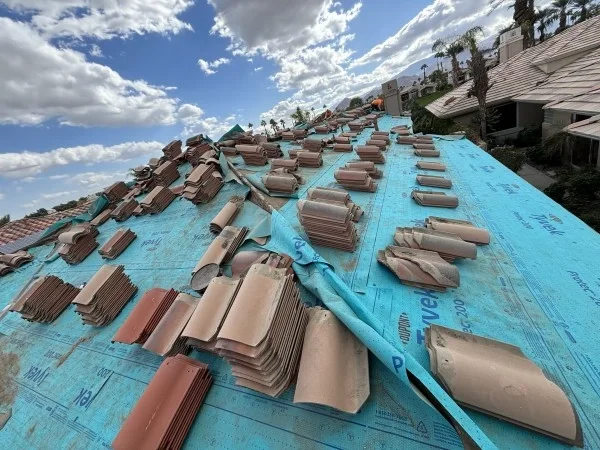
What a 2026 replacement quote should include
5 items, and if a quote is missing them you can't compare it to anything. We see homeowners hand us 3 bids that differ by thousands of dollars and describe 3 different jobs.
Tear off or overlay, stated plainly, with the number of existing layers written down. A deck inspection with a written unit price for replacing damaged sheathing, so a bad deck doesn't become a change order argument on day 2. The underlayment product by name. Ventilation work priced separately and only if the contractor documented moisture. Warranty terms in years, with workmanship and manufacturer coverage listed as 2 different things.
On cost, our own 2026 Southern California guide puts architectural asphalt shingles at $4.50 to $9.00 per square foot installed, with most full replacements landing between $10,000 and $30,000. Pitch, layer count, deck condition and access move a job inside that range, and what the other materials cost matters if you're weighing tile or metal instead. Financing runs through Acorn Financing if the timing is wrong for a cash job.
What we check on a free Roof Health Check
We go up, photograph it and send you a written report in 24 to 72 hours. No sales pitch attached to the report, because the report is the product.
What we're looking at: which slopes have curled and how far the curling has spread as a percentage of the surface, granule accumulation in gutters and at downspout outlets, whether tabs have lost their seal, nail placement and whether nails have backed out, the condition of flashings and valleys, and any sign of actual moisture on the deck or the underlayment. That last one is what separates a real ventilation problem from a sales pitch. Dave Bienek has been in roofing since 1992 and founded Vision Roof Services in 2014, and the company now runs 60 roofers across residential and commercial work. Our Palm Desert office holds a 4.8 star rating from 42 Google ratings.
So if you're still wondering why your shingles are curling, the odds are that your roof told you its age and you heard it correctly. Get it documented before the wind does the deciding. You can book the Roof Health Check and have photographs and a written assessment in hand this week.
FAQs
Why are my shingles curling after only 5 years?
Curling that early points at something other than age, because the NRCIA notes curling is rare on shingles under 12 years old. The usual causes are a defective batch, shingles laid over an existing roof, or nails placed too high or driven proud. Get it inspected and photographed before the manufacturer's claim window matters, and keep the original invoice and product name.
Can you glue or nail curling shingles back down?
You can, and it doesn't last. The curl comes from asphalt that has hardened and shrunk, so fastening the edge down puts stress on brittle material and often cracks it. Roofing cement on a curled tab is a way to get through a wind season, not a repair.
Why are my shingles curling on 1 side of the roof only?
Sun exposure. South and west slopes take the most ultraviolet light and the highest surface temperatures, and the Department of Energy's cool roof guidelines put conventional dark roofs at 150F or more in summer sun. Uneven curling across slopes is the normal pattern for heat driven aging, and it's a reason a roof can look fine from the street and be finished on the back.
Is shingle curling covered by insurance or warranty?
Curling from normal aging is not an insurance loss. The California Department of Insurance lists wear and tear or maintenance among the perils a homeowners policy generally does not cover, so aged out shingles are a maintenance expense. A windstorm that tears off those weakened shingles is a different question, and on an actual cash value policy any payout carries what the state calls a fair and reasonable deduction for physical depreciation. Buckling on a recent roof is a separate matter and usually belongs with the installer's workmanship warranty.
How much curling means I need a full replacement?
NRCIA inspector guidance puts the line at 10 to 15 percent of the roof surface, past which curling is no longer treated as a localized repair. Curling on 2 or more slopes, or curling alongside cracking and heavy granule loss, points the same direction. Below that, a spot repair with a budgeted replacement date is reasonable.
Do curling shingles always leak?
No, and that's what makes them easy to ignore. A curled roof can shed water for years and then fail in 1 wind event, because the curl breaks the adhesive seal that keeps water from tracking sideways under the course above. The leak usually arrives with wind driven rain rather than with steady rain.
Is a shingle roof the right choice for a Coachella Valley home?
It's the cheapest option up front and the shortest lived one in this climate, which is why concrete tile and metal are common on desert re roofs. The 2007 NAHB study puts asphalt at 20 years against a lifetime rating for clay and concrete tile, though tile underlayment needs replacing long before the tile does. On low slope sections, foam and coating systems outlast shingles by a wide margin. Worth pricing all 3 before defaulting to shingles because that's what's up there now.