Desert Heat Roof Damage: What A Coachella Valley Summer Does To Your Roof
A desert roof almost never tells you it's failing. Desert heat roof damage surfaces two ways instead: as a leak during the first real rain, and as tiles or shingles that come off in a wind event the roof should have shrugged off. Both start the same way. All summer, sun and heat pull the flexibility out of every material up there, and by September the roof is more brittle than it looks from your driveway. Most homeowners here inspect in spring. That's about six months too late. If your roof is past 12 years, or nobody has walked it since last summer, Vision Roof Services will give you a written report with photos through a free Roof Health Check.
Desert heat roof damage is the gradual loss of flexibility, seal, and reflectivity in roofing materials caused by high surface temperatures and daily ultraviolet exposure. It shows up as cracking, curling, granule loss, dried-out flashing seals, and chalked coatings. The damage builds quietly across several summers, then surfaces as a leak or a wind loss.
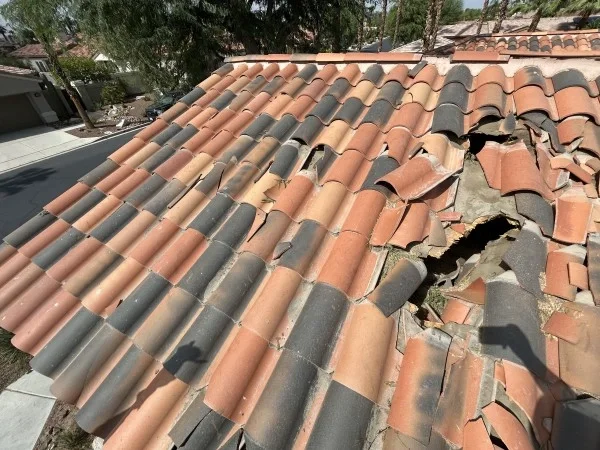
What does desert heat do to a roof?
Heat attacks a roof four ways, and they compound. UV breaks the chemical bonds in the material, high surface temperature drives out the oils and plasticizers that keep it flexible, the daily expansion and contraction cycle works every seam and fastener loose, and trapped attic heat cooks the deck from underneath.
Ultraviolet light does the slowest and most permanent work. On asphalt shingles it degrades the petroleum binder that holds the mat together, so the shingle stops flexing and starts cracking. The granules on top exist mostly to block that UV, and once the binder loosens its grip on them, the loop feeds itself: fewer granules, more exposed asphalt, faster breakdown, more granules in your gutters. That gritty black sand you sweep off the driveway is the roof telling you where it is in the process.
Thermal cycling is the one people underestimate. Every material on a roof expands when it heats and contracts when it cools, and out here that swing runs from a 70-degree dawn to a deck well past 150 degrees by mid-afternoon, then drops again after sunset. That's not 90 cycles a summer, which is how it usually gets described. It's roughly 365 a year, every year, because the roof cycles in January too. Over a 20-year roof that's about 7,300 rounds of stretch and shrink working at fastener holes, seam laps, and the sealant strips that hold shingles down.
Then there's the attic. A poorly vented attic under a dark roof holds heat for hours after sundown, which bakes the underside of the deck and drives up what your AC has to fight. The U.S. Environmental Protection Agency reports that reflective roofing can reduce peak cooling demand by 11 to 27 percent in air-conditioned homes and lower maximum indoor temperatures by 2.2 to 5.9 degrees in homes without AC. The roof is part of your cooling system whether you treat it that way or not.
How hot a Coachella Valley roof got in 2026
Hotter than most roofing materials were designed around. The U.S. Department of Energy puts it plainly: conventional roofs can reach 150 degrees or more on a sunny summer afternoon, while a reflective roof stays more than 50 degrees cooler. That 50-degree gap is the difference between a material aging on schedule and aging early.
Air temperature decides how many of those afternoons you get. On July 5, 2024, the National Weather Service confirmed Palm Springs had hit 124 degrees, an all-time record that broke the 123 set four times before. Palm Desert's July mean daily high sits near 106, and NOAA's records for the Palm Springs airport station show 42 days at or above 110 last year. Compare that to the High Desert, where roofing companies also write about extreme heat: Apple Valley's July mean daily high is 99 degrees and its all-time record is 116, a temperature Palm Springs passed by eight in 2024. The valley is the harder climate, and roofs here should be judged against it, not against a coastal warranty chart.
I've been on desert roofs since 1992, and the pattern barely changes. The material almost never fails where the brochure says it will. It fails at the plumbing vent boot that went hard and split, at the flashing sealant that shrank away from the stucco, at the underlayment nobody can see under perfectly good tile.
Heat damage usually shows up later as wind damage
Heat rarely takes a roof off by itself. It softens the roof up, and the next windstorm collects. Every other desert roofing article treats those as two separate problems, and they aren't.
Researchers at the National Institute of Standards and Technology published laboratory work in 2026 on the long-term durability of asphalt shingle roof covers. They exposed shingles to UV along with combinations of temperature and humidity, and tracked discoloration, changes in mechanical properties, and chemical alteration of the adhesive strip. Their finding matters more than the individual damage photos every roofer posts: the ability of asphalt shingles to withstand direct mechanical loads may be compromised after weathering exposures including extreme heat, thermal cycling and UV.
Translate that to a Coachella Valley street. A shingle roof takes 42 days over 110 degrees. The sealant strips that bond each course down give up their tack. The mat underneath gets brittle. In November a wind event rolls through and peels a section off, and the insurance adjuster writes it up as wind damage. It was heat damage that made the wind possible.
So two things follow. Wind ratings on a 15-year-old desert roof are not the wind ratings on the box. And a roof that came through a windy week fine is not proof the roof is fine, only proof the wind wasn't strong enough yet.
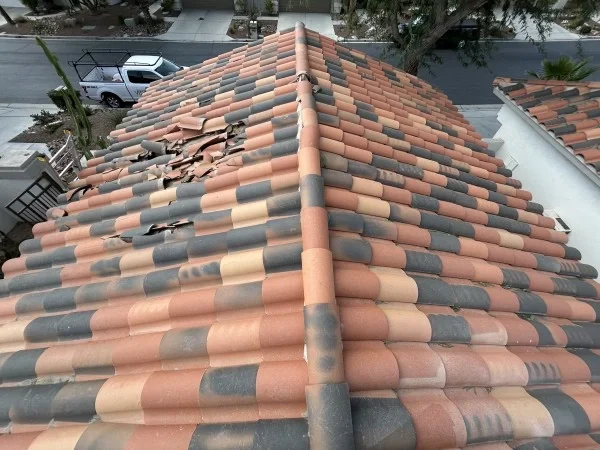
How each roofing system ages under desert heat
Every system fails differently out here, and knowing which failure yours is heading toward tells you whether you're looking at maintenance or replacement. This is what we see across the valley, not a lab table.
| System | What heat attacks first | What you'd notice | What renews it |
|---|---|---|---|
| Asphalt shingle | The binder and the sealant strips | Curled edges, cracks, granules in gutters | Nothing. Once it's brittle it gets replaced |
| Concrete or clay tile | The underlayment, not the tile | Leaks with no visible tile damage | Lift the tile, replace the underlayment, reset the tile |
| Standing-seam metal | Fasteners and seam sealant | Loose fasteners, sealant pulling away at seams | Reseal seams and penetrations |
| Single-ply flat membrane | Seam laps and the sheet itself | Seams opening, membrane pulled tight at curbs | Restoration coating if the deck is dry |
| Sprayed foam with coating | The coating, which chalks and dulls | A dusty surface, a hotter roof, foam showing through | Recoat on schedule |
Tile is where desert homeowners get caught. The tile can be fine at 40 years while the felt under it turned brittle at 22, and the tile is what you can see. When we re-roof a tile home we usually pull the tile, replace the underlayment, and reset the same tile, which keeps a sound field of tile out of the landfill.
Foam and coatings have the opposite problem: they're renewable, but only if somebody renews them. Reflectivity is not permanent. A coating chalks under UV, the surface dulls, and the roof quietly stops being a cool roof while looking acceptable from the street. The Spray Polyurethane Foam Alliance, the trade body we belong to, notes that an SPF roof inspected and recoated every 5 to 20 years can last the life of the building. Skip the recoat and the same roof fails early. If you're weighing a reflective system, our breakdown of cool roofs in the Coachella Valley covers which ones hold up here.
What heat damage looks like from the ground
You can catch most of it without leaving the yard. Look for curled or lifted shingle edges, cracks and splits across shingles or flat roof membranes, faded or bleached patches where the color has burned off unevenly, and a dull chalky film on a coated roof. Check your gutters and the base of downspouts for granule buildup that goes beyond a light dusting. Inside, watch for a cooling bill that climbed without a rate change, ceilings that feel warm to the touch in the afternoon, and any stain that appears after the first rain.
None of that tells you how far along the damage is. That takes someone on the roof checking the boots, the flashing laps, and the underlayment condition. What you can see from the driveway is the last stage, not the first.
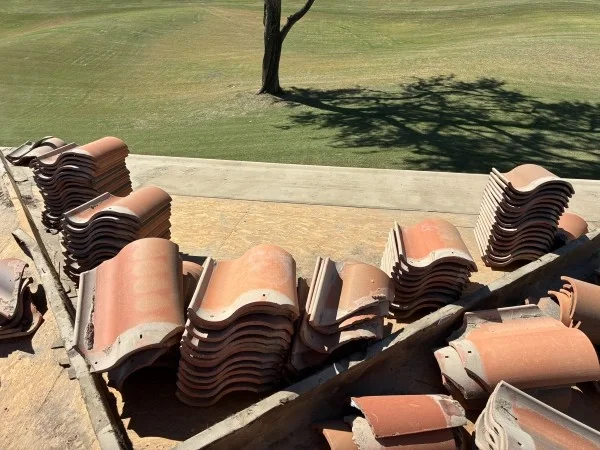
When should you check a desert roof for heat damage?
In September, right after the heat season, and again after any significant wind event. That timing is the single cheapest change a desert homeowner can make. By early September the roof has absorbed everything the summer had, the damage is at its most visible, and there's still a rain season ahead of you to fix things before they leak. Spring inspections catch the same problems six months later, after the roof has already been tested.
An annual roof inspection also builds the paper trail that matters if you ever file a wind claim, because a documented pre-storm condition is worth having. Our free Roof Health Check is built for that: a technician walks the roof, photographs the condition, checks flashing, boots and underlayment, and you get a written report back in 24 to 72 hours with a straight call on whether to maintain, recoat, or replace. Maintenance costs less than replacement, and the whole point of looking in September is to still have the choice.
We've completed about 7,500 roofs since I started in this trade in 1992. We run 60 roofers, including a dozen applicators certified through General Coatings, and our Palm Desert profile holds a 4.8 star rating across 42 Google reviews. Our residential roofing crews work Palm Desert, La Quinta, Rancho Mirage, Palm Springs, Indian Wells, Indio and Cathedral City, with the full list on our areas we serve page.
Book a Roof Health Check before the rain starts. Call 844-348-ROOF.
FAQs
What is desert heat roof damage?
Desert heat roof damage is the gradual loss of flexibility, seal, and reflectivity in roofing materials caused by high surface temperatures and daily UV exposure. It shows as cracking, curling, granule loss, dried-out flashing seals, and chalked coatings. It builds across several summers, then surfaces as a leak or a wind loss.
How hot does a roof get in the Coachella Valley?
The U.S. Department of Energy reports that conventional roofs reach 150 degrees or more on a sunny summer afternoon, and a reflective roof stays more than 50 degrees cooler. Air temperature decides how often that happens. The National Weather Service confirmed an all-time record of 124 degrees in Palm Springs on July 5, 2024, and the airport station logged 42 days at or above 110 last year.
Does desert heat shorten how long a roof lasts?
Yes, and mostly by making the roof easier to damage. NIST's 2026 laboratory work found that weathering including extreme heat, thermal cycling and UV can compromise an asphalt shingle's ability to withstand mechanical loads, which is what wind uplift applies. The material ages faster here, and it also gets less able to survive a storm.
Can desert heat roof damage be repaired, or does the roof need replacing?
It depends on which layer failed. Dried-out vent boots, flashing seals and worn coatings are repairs, and a foam or flat roof with a dry deck can often be restored with a recoat instead of a tear-off. Brittle, cracking asphalt shingles are past repair. An inspection is what separates the two.
Why are there granules in my gutters?
Granules shield the asphalt underneath from UV. As heat and sun break down the binder holding them, they release, and heavy accumulation in gutters means the shingle is losing its shield. The process accelerates once it starts, because more exposed asphalt degrades faster and sheds more granules.
When is the best time to inspect a desert roof?
September, after the heat season, plus a check after any major wind event. The damage is most visible right after summer, and you still have time before the rain. Vision Roof Services returns a written Roof Health Check report with photos in 24 to 72 hours.