Roof Leaking With No Rain? 8 Causes And Fixes
If your ceiling is dripping and it hasn't rained in weeks, the water isn't coming through your roof covering. A roof leaking with no rain means the water is coming from something on your roof or inside your house. In order of how often we find it: an air conditioning condensate line or drain pan, a plumbing line, condensation on ducts and cold surfaces, water already trapped inside the roof assembly from an older storm, a rooftop evaporative cooler, solar or equipment penetrations, and irrigation or washdown water. Each one leaves a different signature, and you can narrow it down in about 15 minutes before you call anyone. Here's how, and here's who to call once you know.
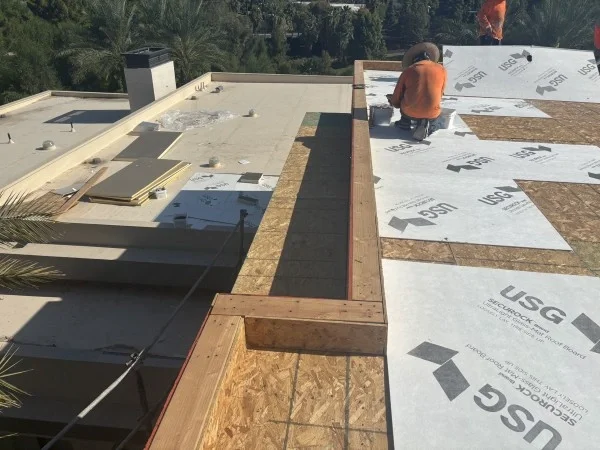
What is a roof leak with no rain?
A roof leak with no rain is water reaching your ceiling from a source other than falling rain. The usual sources are air conditioning condensate, a plumbing line, condensation on cold surfaces, or water stored inside the roof assembly since the last storm. The roof covering itself is often intact.
Can a roof leak without rain?
Yes, and it happens often enough that it's a normal service call, not a freak event. Water damage is expensive, and it doesn't need weather to start. ISO data published by the Insurance Information Institute makes the point. Between 2018 and 2022, homeowners filed 1.61 water damage and freezing claims per 100 policies. The average claim ran $13,954. Wind and hail claims came in more often, 2.82 per 100, but cost less at $13,511.
Read that again. The water claim that nobody watched on the news cost more than the storm claim. Water damage and freezing made up 27.6 percent of all homeowners losses in 2022.
That's the case for treating a dry-weather drip as urgent. It's also why the diagnosis matters more than the repair. Patch the wrong thing and you've paid for nothing.
The 8 sources we find when it hasn't rained
Every one of these puts water above your ceiling without a drop falling from the sky. We've had crews on roughly 7,500 roofs since 1992. Leaks are still the most common reason the phone rings at Vision Roof Services.
1. The air conditioning condensate line or drain pan
This is the first thing we check on a summer call. Your evaporator coil pulls moisture out of the air and drains it through a small pipe. Algae, dust, or a wasp nest blocks that pipe, the primary pan fills, and the water goes over the edge. If the secondary pan under the unit is cracked or already full, the water lands on your ceiling drywall.
The tell: the stain grows while the AC runs and stops growing overnight when the system cycles off. If your air handler sits in the attic or in a closet under the roof, check the pan for standing water before you call a roofer.
2. Rooftop package units and HVAC curbs
On a commercial building, the leak is usually at the equipment, not the field of the roof. Package units sit on curbs, and every curb is a hole somebody flashed years ago. Condensate lines discharge onto the roof surface or into a scupper that no longer drains, and the water sits there working at the seam.
Property managers, this is the one worth checking first. We find failed curb flashing and misrouted condensate on commercial roofs more than any other single cause in dry months. The stain shows up in the room under the unit, which is rarely the room where the tenant complains.
3. A rooftop evaporative cooler
Swamp coolers put a water reservoir on your roof and run it constantly. The Department of Energy notes that most residential evaporative coolers are installed in a down-flow arrangement on the roof, and that they continually use water. A stuck float, a failed bleed line, or a pan full of mineral scale sends that water onto the deck instead of through the cooler.
DOE recommends checking the pads, filters, reservoir, and pump at least once a month in hot climates. Pads get replaced at least twice a season. Most of the coolers we find leaking haven't been opened in years.
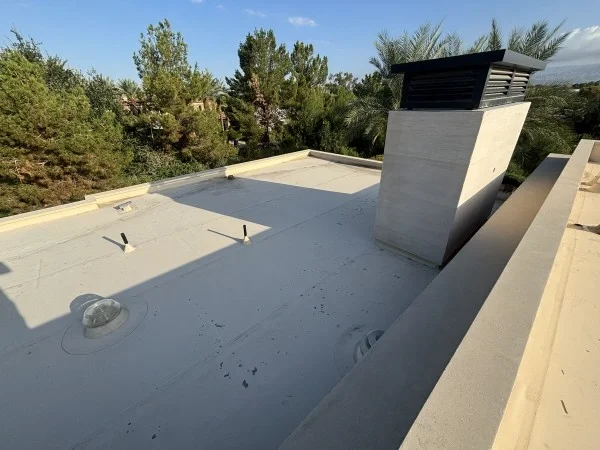
4. Plumbing: supply lines, drains, and the water heater
A pressurized supply line in a wall or attic leaks whether it's raining or not. A drain line only leaks when somebody upstairs uses water, which is why the stain seems to come and go for no reason.
The tell: run a shower for 10 minutes and watch. If the drip picks up, you need a plumber, not a roofer. If it doesn't change at all and the AC is off, look up at the roof.
5. Condensation on ducts and cold surfaces
This is where the national articles get our climate backwards. Their version is warm indoor air condensing on a cold roof deck in winter, which is a heating-climate problem. Here the common version runs the other way. A 130 degree attic meets a cold supply duct, or the cold underside of a conditioned ceiling, and the duct sweats. During monsoon weeks, when dew points climb, it sweats a lot. We see it in Palm Desert, La Quinta, Phoenix, and Las Vegas every summer.
Condensation shows up as broad dampness, not a defined drip point. Insulation goes flat and dark over a wide area. The wood stays damp with no stain trail pointing to a hole.
6. Water already trapped inside the roof
A low-slope roof can hold water inside itself for weeks. Once water gets past the surface into the insulation or foam core, it moves sideways along the deck, and it comes out when heat drives it out. So the drip can start on a 105 degree afternoon in August from a storm that happened in July.
This is the cause the generic articles wave at and never explain. It's also the one that decides whether you need a repair or a replacement, because a wet core doesn't dry out on its own. If your roof is a spray foam roof, the foam itself rarely leaks. Water gets in where the top coat wore through, then sits in the substrate below.
7. Solar arrays and anything else bolted to the roof
Every mount, conduit, and stanchion is a penetration. Racking flexes with heat, sealant hardens, and the lag bolt that was watertight in 2019 isn't now. Panels also shade and cool the surface beneath them, so condensate forms and drips where no rain ever reaches. The array itself is usually fine. The flashing detail under it is what fails.
8. Misters, irrigation, and washdown water
Patio misters aimed at a wall, an irrigation head hitting a parapet, a maintenance crew rinsing a walkway, a pressure washer on a second-story deck. All of it is water arriving at your roof edge under pressure from a direction the roof was never detailed for. In the desert this is a real category, not an edge case.
Is it a roof leak or condensation?
Look at the shape of the wet area. A leak makes a defined stain with a center and a trail, and it usually has a ring or a hard edge where it dried between events. Condensation makes broad, even dampness with no center, often across a whole insulation bay. It comes back on a schedule tied to temperature, not to weather.
Two more tests. Feel the wet insulation: leak water is dirty and leaves a tea-colored ring, while condensate is clean. Then check the timing. Condensation peaks in the early morning and during humid spells. An equipment leak follows the run cycle of whatever sits above it.
Symptom to source: who should you call first?
Match what you're seeing to the likely source before you spend money on the wrong trade.
| What you see | Likely source | Call first | Usual fix |
|---|---|---|---|
| Stain grows while the AC runs, stops overnight | Condensate line or drain pan | HVAC tech | Clear the line, replace the pan, add a float switch |
| Drip picks up when a shower or sink runs | Drain line | Plumber | Reseal or replace the failed joint |
| Steady drip with the AC off and no water running | Supply line or roof | Plumber, then roofer | Isolate the line, then a moisture survey |
| Broad damp area, clean water, worst in the morning | Condensation on ducts or ceiling | HVAC tech or insulation contractor | Seal and insulate ducts, air-seal the ceiling plane |
| Water on the roof around a cooler, no rain for weeks | Evaporative cooler overflow | HVAC tech | Float, bleed line, pan service |
| Drip starts on a hot day weeks after a storm | Water trapped in the roof assembly | Roofer | Moisture survey, then targeted repair or recover |
| Stain under or beside a rooftop unit | Curb flashing or condensate routing | Roofer | Rebuild the curb flashing, reroute the discharge |
| Stain near a solar mount or conduit | Penetration flashing | Roofer | Reflash the penetration, not just resealant |
| Stain along a parapet or exterior wall line | Misters, irrigation, or wall flashing | Roofer | Correct the water source, rebuild the flashing |
If 2 rows fit, treat it as a roof call. A roofer with a moisture meter can rule the roof in or out in one visit, and that answer tells the other trades where to look.
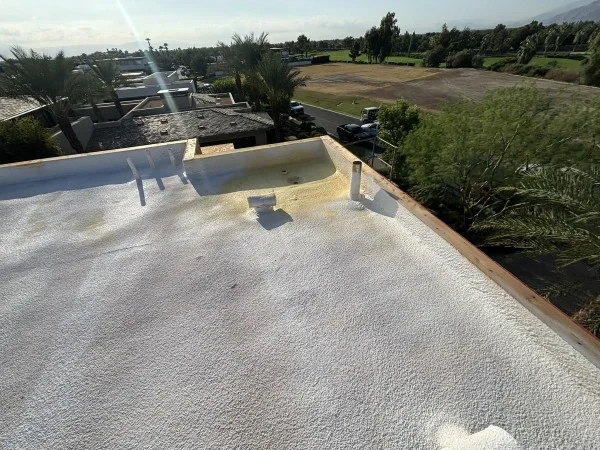
Why is my flat roof leaking weeks after the storm?
Because the water never left. On a low-slope roof, water that gets past the surface soaks into the insulation or the foam substrate and spreads along the deck. Heat then pushes it through the weakest spot in the ceiling below, which can be 20 feet from where it entered and 3 weeks after it rained.
Two things follow from that. The stain is not a map of the hole. And a patch placed over the stain fixes nothing, because the entry point is somewhere else entirely. If you want the degradation side of this, ponding, UV, and monsoon wind, we covered why flat roofs leak in its own piece.
How do roofers find water they can't see?
With instruments, not guesses. A moisture survey maps the wet area inside the roof before anybody opens it up. Infrared imaging is the common method, and a published standard covers it. That's ASTM C1153, the standard practice for locating wet insulation in roofing systems using infrared imaging. The National Roofing Contractors Association calls infrared non-destructive and non-intrusive, with a live view of the wet areas. NRCA also notes that the ASTM standard addresses nighttime inspections.
Wet insulation holds heat longer than dry insulation, so after sundown the wet area glows on the camera while the dry roof cools. A capacitance or nuclear meter confirms it, and a small core cut proves it. Then you know 2 things you can't know any other way: where the water is, and how much of the roof is still dry.
That sequence is what our free Roof Health Check is built around. We scan, photograph, and send you a written report within 24 to 72 hours of the visit, and you see the same images we do. It also settles the repair-or-replace question honestly, because a dry deck means repair and a wet core means something bigger.
Why the desert version is different
Because the assumption everyone starts with is wrong here. The standard advice is to check the AC first on the theory that air conditioners make a lot of water. In the desert they don't. The Department of Energy's condensate capture mapping puts low-humidity Western areas in its lowest categories for how much condensate is worth collecting. Dry air yields little of it.
So the AC is still the first thing we check, but not for the reason the national articles give. The problem is the blocked path, not the volume. A line that drains fine all summer backs up completely once algae closes it. And the secondary pan that's supposed to catch the overflow usually hasn't been opened in 5 years. Small water volume, zero drainage, and nobody looking still equals a ceiling stain.
The second desert-specific thing: our roofs are mostly flat or low-slope, so trapped water is a much bigger share of dry-weather calls here than in a shingle market. We work across Orange County, Riverside County, the Coachella Valley, Los Angeles, San Diego, Phoenix, Tucson, Las Vegas, Reno, Dallas, Houston, and Austin. The pattern holds in all of them.
What does it cost to fix a leak with no rain in 2026?
It depends on what's leaking, which is the point of diagnosing before quoting. A condensate line clear-out is a small HVAC bill. Reflashing a rooftop unit curb or a solar penetration is a modest roofing repair. A wet insulation core is the expensive outcome, and the size of the wet area sets the number.
We don't quote a flat price sight unseen, because substrate condition, square footage, tear-off, and coating system all move it. [Insert VRS approved starting ranges here once signed off.] What we will tell you before we start: whether the deck is dry, and whether a coating beats a replacement on your roof. If the timing is tight, we offer financing through Acorn Financing.
What happens if you wait
The water gets more expensive, and mold needs less time than most people think. The CDC states that constant moisture is required for Stachybotrys chartarum to grow. It names water damage, leaks, condensation, infiltration, and flooding as the moisture sources. A dry-weather leak supplies that every day, with nothing to interrupt it.
One correction to what you'll read elsewhere. The CDC also states that no test proves an association between Stachybotrys chartarum and particular health symptoms. It says all molds should be treated the same with respect to potential health risks and removal. So skip the "toxic black mold" scare copy. Fix the moisture and the mold question resolves itself.
Meanwhile the wet insulation stops insulating and your cooling bill climbs. A wet deck also loses strength where the fasteners hold. By the time the ceiling shows it, the repair is no longer a small one.
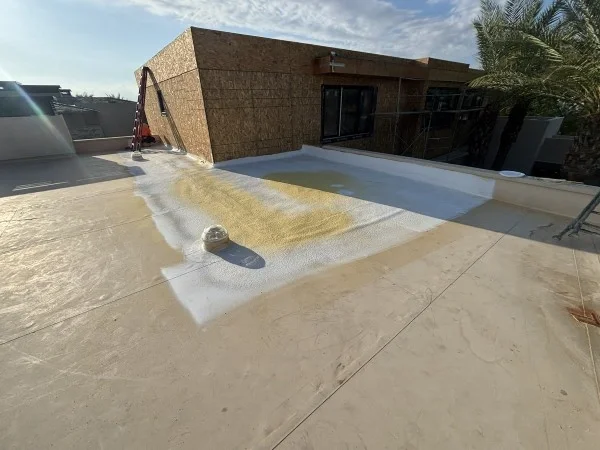
How to keep it from happening again
Put eyes on the 3 water sources above your ceiling on a schedule. Nothing on this list needs a contractor except the roof scan.
Have the condensate line cleared and the secondary pan checked at every annual HVAC service, and ask for a float switch if you don't have one.
Open the evaporative cooler monthly during the cooling season, per DOE guidance, and replace pads at least twice a season.
Walk the roof after every monsoon storm and clear the drains and scuppers.
Get the roof inspected twice a year. The Spray Polyurethane Foam Alliance recommends twice-yearly inspection and a recoat schedule for foam roofs. That's the same cadence we use on every low-slope system. We wrote more on how often to inspect a roof in Southern California.
Aim misters and irrigation heads away from walls and parapets. Cheapest fix on this page.
Get the water found before you pay for a repair
A roof leaking with no rain is a diagnosis problem first. Anyone who quotes you a repair without scanning for moisture is guessing with your money.
Dave Bienek started roofing at 15 and has worked in Southern California roofing since 1992. Vision Roof Services runs 60 roofers, 12 of them certified in spray foam through General Coatings. We hold 4.8 stars across 42 Google reviews on our Palm Desert profile. Our commercial work includes the LifeStorage location in Costa Mesa and the Yamaha facility in Buena Park.
If water is showing up on your ceiling and it hasn't rained, book a free Roof Health Check and you'll have a written report with photos within 24 to 72 hours. Call 844-348-ROOF.
FAQs
Can a roof leak with no rain?
Yes. Water reaches the ceiling from air conditioning condensate, plumbing lines, condensation on ducts, rooftop equipment, or water already trapped in the roof from an earlier storm. ISO data published by the Insurance Information Institute puts the average water damage and freezing claim at $13,954, which is higher than the average wind and hail claim at $13,511. A dry-weather leak is not the cheap kind.
How do I tell if it's my AC or my roof?
Watch the timing. If the stain grows while the air conditioner runs and stops when it cycles off overnight, it's the condensate line or drain pan. If it drips with the AC off and no water running anywhere in the house, look at the roof and get a moisture survey.
Why is my roof leaking with no rain weeks after a storm?
Water that got into the insulation or foam core moves sideways along the deck and comes out when heat drives it through the ceiling. On a low-slope roof that lag can run 2 or 3 weeks. The stain will not be under the entry point, which is why moisture scanning matters more than patching.
Can a swamp cooler cause a ceiling leak?
Yes, and it's common on desert homes. The Department of Energy notes that most residential evaporative coolers are mounted on the roof in a down-flow arrangement and use water continuously. A stuck float, a failed bleed line, or a scaled-up pan puts that water on the roof deck.
Who do I call first, a roofer or a plumber?
Run the shower for 10 minutes. If the drip gets worse, call a plumber. If it doesn't change and the AC is off, call a roofer and ask for a moisture survey rather than a patch quote.
Does insurance cover a leak that happened with no rain?
It depends on your policy and the cause, and sudden equipment failure is treated differently from long-term seepage. Water damage and freezing accounted for 27.6 percent of homeowners insurance losses in 2022 per ISO data, so carriers look closely at these claims. Photograph everything and get a written inspection report before you file.
Can a slow leak with no rain cause mold?
It can, because the CDC states that constant moisture is what mold growth requires, and a dry-weather leak supplies moisture every day. The CDC also says no test proves an association between Stachybotrys chartarum and particular health symptoms, and that all molds get treated the same for removal. Stop the water and the problem stops growing.