Roof Core Sample: The 6 Answers One 2-Inch Plug Gives You
A roof core sample is a 2-inch plug cut out of your roof, all the way down to the deck. Somebody pulls it so they can read the assembly instead of guessing at it. On a low-slope roof it's the only way to count the roof coverings up there. It also measures wet insulation, confirms the deck, and collects the material for an asbestos lab. In Southern California that last one isn't a courtesy. South Coast AQMD Rule 1403 requires that a facility "shall be thoroughly surveyed for the presence of asbestos prior to any demolition or renovation activity." The rule names roofing felts and roofing tiles. The core is where that survey starts.
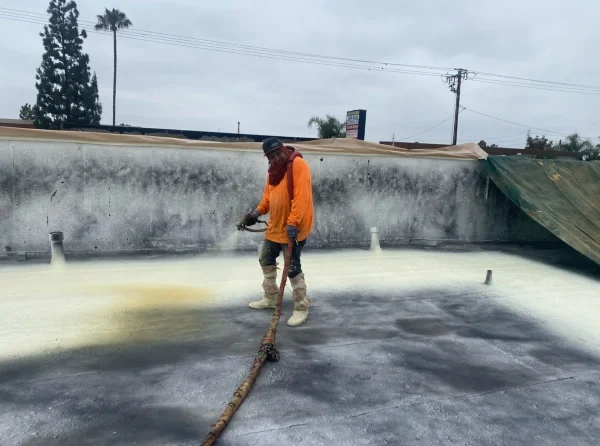
What is a roof core sample?
A roof core sample is a full-depth plug, usually 2 inches in diameter, cut through every layer of a roof assembly down to the structural deck and removed for inspection. It shows the membrane, cover board, insulation, vapor retarder and deck in stacked order, along with each layer's thickness and how it was attached.
The tool matters less than the read. A hollow core cutter pulls a clean 2-inch plug and patches easily, but it compresses foam insulation and tops out around 8 inches of depth. A reciprocating saw or a knife-and-saw combination cuts a 4-inch to 12-inch square instead. That disturbs the layers less and leaves room to see fastener patterns and adhesive lines. On a deep tapered insulation system, the square cut is the only one that reaches the deck.
One rule doesn't change with the tool: nobody cuts through the deck. The plug stops at the top of the steel, wood or concrete.
The 6-Answer Core
We pull cores to answer 6 questions. Every one of them changes the scope or the price of the next roof, and 3 of them are legal questions in California, not roofing questions.
| The answer in the plug | What it decides | Why it costs you money if you skip it |
|---|---|---|
| Layer count | Recover, or full tear-off | Code stops a recover once a roof carries 2 coverings. On a low-slope roof you cannot count layers from the edge, so the plug is the only count you can trust |
| Wet insulation, by percentage of the field | Whether foam or coating can go over the existing roof at all | Water trapped under a new system keeps rotting the deck and kills adhesion. It's also the most common reason why flat roofs leak again a year after a repair |
| Deck type and condition | Fastener selection, load capacity, corrosion risk | A gypsum or lightweight-concrete deck will not hold the fasteners a steel deck will. Nobody finds that out from a walk-around |
| Existing insulation thickness | Whether the energy code forces added R-value on the alteration | Insulation added late is a change order. Insulation priced up front is a line item |
| Asbestos content | Whether the job needs a certified survey, a notification and a registered contractor | A missed survey stops the job. See the California section below |
| Foam thickness and coating mils, on an SPF roof | Recoat, or replace | This is the difference between maintaining a roof and buying a new one |
Nothing in that table comes from a drone photo or an infrared map. It comes from the plug.
How a core sample gets taken
Expect the crew to walk the roof before anyone cuts. Cores go in the field of the roof, away from ponding areas, seams, drains and penetrations. A plug pulled out of a puddle tells you about the puddle, not the roof.
The sequence is short. Clear the surface down to the membrane, gravel and dirt included. Cut the plug or the square. Lift it out intact and photograph it against a tape measure, because the thicknesses are the record. Bag the layers separately if any of them are heading to a lab. Then patch: mastic in the hole, an insulation plug set slightly below the surface, mastic over the top, and 2 felt or membrane target patches, the smaller one first. Replace the gravel and mark the spot with paint so the next person can find it.
Marking matters more than it sounds. A patched core nobody can find later becomes a suspect every time that roof leaks.
Will the cut leak?
No, not when it's patched the same day by the crew that cut it. A 2-inch hole in a roof built to shed water is a repair with a known detail. The patch uses the same material and method as any puncture repair.
The risk isn't the hole. It's a core cut on a Friday by somebody who intends to come back Monday. Ask, before anyone touches your roof, whether the cores get closed the same visit. If the answer isn't yes, that's the end of the conversation.
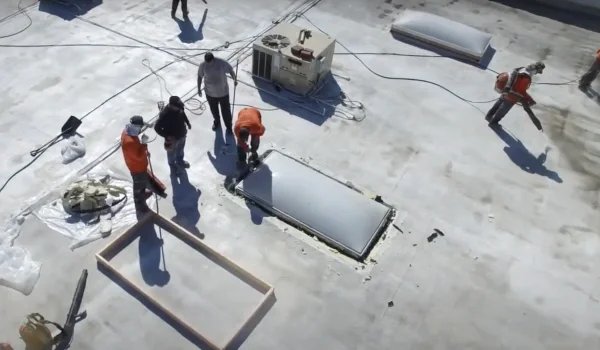
Why a moisture scan is not a diagnosis
Infrared, impedance and nuclear scans find suspects. They don't convict. The published standards behind those methods say so.
NRCA's Professional Roofing laid this out in a December 2025 review. ASTM C1153 is the standard practice for locating wet insulation with infrared imaging. It requires that "verification of infrared data must be carried out by one of the following invasive test methods: cores...or a combination of cores and moisture meter probes." ASTM D7954 covers electrical impedance scanners. It requires that "cores taken shall be retained for gravimetric analysis for the verification stage." ANSI/SPRI/IIBEC NT-1 is the nuclear method. It treats its field readings as relative and requires core cuts with gravimetric analysis to quantify them.
Gravimetric means the lab weighs the sample wet, dries it, and weighs it again. That's the number. The scan gave you a map.
So a contractor hands you an infrared image with red blotches and a tear-off quote to match. That's unverified data with a price attached. The scan is worth running. It's how we decide where to cut, and scanning first is faster and cheaper than coring a grid. But the scan is the question and the core is the answer.
| Moisture scan | Core sample | |
|---|---|---|
| What it produces | A map of suspect areas | A measured, physical record |
| Coverage | The whole roof | The spot you cut |
| Damage to the roof | None | One patched hole per core |
| Tells you layer count | No | Yes |
| Tells you deck condition | No | Yes |
| Usable for asbestos testing | No | Yes |
| Standing under ASTM C1153, D7954 and NT-1 | Relative reading, needs verification | The verification |
Is a roof core sample required in California in 2026?
For asbestos, yes, in practice. The survey is required, and on a roof the survey means sampling the roofing layers.
South Coast AQMD Rule 1403 covers Los Angeles, Orange, Riverside and San Bernardino counties. That takes in La Quinta, Rancho Mirage, Buena Park and Costa Mesa. Every commercial tear-off our Palm Desert crews run falls under it. It requires a thorough asbestos survey before any demolition or renovation. The surveyor has to be certified by Cal/OSHA and have completed an EPA-approved Building Inspector Course. The report documents the lab, the sample locations and the test methods. The material threshold is more than 1 percent asbestos. Notification goes to the district no later than 10 working days before work starts. San Diego County sits under its own rule, APCD Rule 1206. It requires a survey before renovation or demolition "regardless of the age of the facility," with the same 10 working day notice. Rule 1403 carves out one exception, a single-unit house where less than 100 square feet of intact material comes off.
Then there's the contractor side. Cal/OSHA's registration requirement in Title 8 section 341.6 covers any employer doing asbestos-related work on "100 square feet or more of surface area of asbestos-containing material." That registration has to be in hand before work starts, not during.
Add it up and the timeline is the real issue. Survey, lab turnaround, notification, and 10 working days of waiting. Start that after you've signed a contract and picked a start date, and you've pushed your own roof back by weeks. Start it with the core samples during the inspection, and it runs in parallel with the proposal.
Coring a spray foam roof is a different job
A foam roof doesn't have layers you can count. It has a thickness and a coating, and both get measured, not eyeballed.
There's a standard written for exactly this. ASTM D7119, currently D7119/D7119M-21(2026), is the Standard Guide for Sampling Spray Polyurethane Foam and Coating in Roofing. It covers pulling specimens from an SPF roof in the field, for both evaluating an existing system and quality assurance on a new one. A core taken under that guide gives you foam thickness, core density and compressive strength per ASTM D1621. It also shows the adhesion between coating and foam, and between foam and substrate. A slit sample gives you the cell structure, how many coats of coating are on there, and the dry film thickness in mils.
Dry film thickness is the whole ballgame on a foam roof. The coating is what stops UV from eating the foam, and once it's worn thin the clock is running. Measure it and you know whether this roof needs a recoat or a replacement. That's the same question we work through in coating against full replacement. Guess at it and you either replace a roof that had years left in it, or you coat over foam that's already saturated.
Vision Roof Services runs 12 General Coatings certified foam applicators out of 60 roofers, with roughly 7,500 completed jobs behind us. Those include the LifeStorage facility in Costa Mesa and the Yamaha facility in Buena Park. We're a member of the Spray Polyurethane Foam Alliance, and spray foam roofing across Southern California is the work we do most of.
How many core samples does a roof need, and where?
No standard sets a number, and any contractor who quotes you one off the top of their head is quoting a habit, not a requirement.
Placement beats count. Cores belong in each distinct roof area, because a building that's been reroofed in sections carries different assemblies under one roofline. Cores belong at both a high point and a drain. Matching thicknesses at both mean the deck itself is sloped. Different thicknesses mean the slope was built with tapered insulation or a poured topping. That single comparison tells a designer more than a scatter of random cores. And cores belong at the low, middle and high readings from the moisture scan, which is the practice Professional Roofing describes for verification.
On a 100,000 square foot warehouse with one continuous assembly, a handful of well-placed cores answers everything. On a 20,000 square foot building that's been patched by 4 different contractors, it won't.
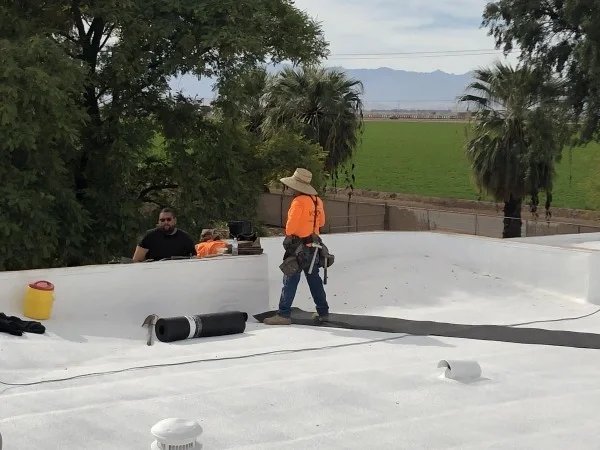
The warranty question nobody in this business mentions
Cutting into a roof that's still under a manufacturer warranty can put that warranty at risk. None of the articles telling you to get a core sample will mention it.
Before anyone cuts, find out 2 things. Is the system still inside its warranty term, and does that warranty set conditions on who opens the assembly and how the repair is made? Get the answer in writing from the manufacturer or the warranty holder, not from the crew standing on your roof. On a no-dollar-limit warranty this is not a formality.
What a core sample costs, and who pays
Some contractors bill core sampling as a separate line, some fold it into an inspection, and some do it free and keep the findings. That third one is the trap. A core that produces a verbal "yeah, it's wet" bought you nothing, because you can't hand a verbal to a property manager, an insurer or a bidder.
Our Roof Health Check includes the walk, the documentation and a written report with photos, back to you inside 24 to 72 hours. Insist on the deliverable, from us or anyone else. You want layer-by-layer thicknesses, photos of each plug against a tape, and the lab result if material went out. You also want a marked roof plan showing where each core was pulled and how it was patched. That report is what gets you comparable bids instead of 3 quotes built on 3 different sets of assumptions. It's also what turns a price range into a real number.
What the plug tells us about your next roof
A roof core sample costs you one patched hole, closed the same day. What it replaces is a set of assumptions that show up later as change orders: the second layer nobody counted, the wet insulation nobody measured, the asbestos survey nobody started, the foam thickness nobody checked. If your building is already showing its age, the core turns suspicion into a scope, and a scope into a schedule you can plan around.
Book a free Roof Health Check and we'll cut the cores, pull the samples, patch the holes and send you the report.
FAQs
What is a roof core sample?
A roof core sample is a full-depth plug, usually 2 inches in diameter, cut through every layer of a roof down to the structural deck and removed for inspection. It shows the membrane, insulation, vapor retarder and deck in stacked order along with each layer's thickness. On a spray foam roof, ASTM D7119 covers the same test and adds foam thickness, density and coating dry film thickness in mils.
Will a roof core sample cause a leak?
Not when the hole is patched the same day it's cut. The patch is a known repair detail: mastic, an insulation plug, more mastic, then 2 target patches with the smaller one first. The real risk is a core left open overnight, so confirm before the visit that every core gets closed the same day.
Is an asbestos survey required before a roof tear-off in California?
Yes. South Coast AQMD Rule 1403, which covers Los Angeles, Orange, Riverside and San Bernardino counties, requires a thorough asbestos survey before any demolition or renovation activity, with notification to the district no later than 10 working days before work starts. The material threshold is more than 1 percent asbestos, and the rule names roofing felts and roofing tiles. San Diego County's APCD Rule 1206 requires a survey regardless of the building's age.
How many core samples does a flat roof need?
No standard sets a number, so treat any fixed figure as a habit rather than a requirement. Placement is what matters: one core in each distinct roof area, one at a high point and one at a drain to show whether the deck or tapered insulation creates the slope, and cores at the low, middle and high readings from a moisture scan.
Can a core sample tell me if I can coat or foam over my existing roof?
Yes, and it's the only test that can. The core gives the layer count, which decides whether code allows a recover at all, and the moisture content of the insulation, which decides whether anything will bond. Foam and coatings cannot go over a wet assembly, because the trapped water has nowhere to go and adhesion fails.
Does a core sample void my roof warranty?
It can. Cutting into a system still inside its warranty term may breach conditions about who opens the assembly and how the repair is made. Get written confirmation from the manufacturer or warranty holder before anyone cuts, especially on a no-dollar-limit warranty.
What's the difference between a core sample and a moisture scan?
A scan maps suspect areas across the whole roof without damaging it. A core is a physical, measured record of one spot. ASTM C1153 requires that infrared findings be verified by invasive methods including cores, and ASTM D7954 and ANSI/SPRI/IIBEC NT-1 require cores with gravimetric lab analysis, so the scan finds the problem and the core proves it.