How To Budget For A Commercial Roof Replacement
When you budget for a commercial roof replacement, budget the decision before the number. Most owners do it the other way around. They get one replacement quote, drop that figure into next year's capital plan, and find out at bid time that the price moved and the roof may not have needed replacing at all.
Two numbers to start with. Roofing coating and asphalt prices climbed 9.7% between January and July 2026, per the Bureau of Labor Statistics producer price index. And on a 10,000 square foot low-slope roof, a full tear-off runs $65,000 to $120,000 while a silicone restoration runs $20,000 to $70,000. Same building, same leak, a spread of roughly $50,000.
So a working budget answers 2 questions, in this order. Which of the 4 repair paths does this roof need? And what will that path cost when the crew shows up, not today? Everything below is how we price commercial roofing in Southern California, and the order matters more than the arithmetic.
What does it mean to budget for a commercial roof replacement?
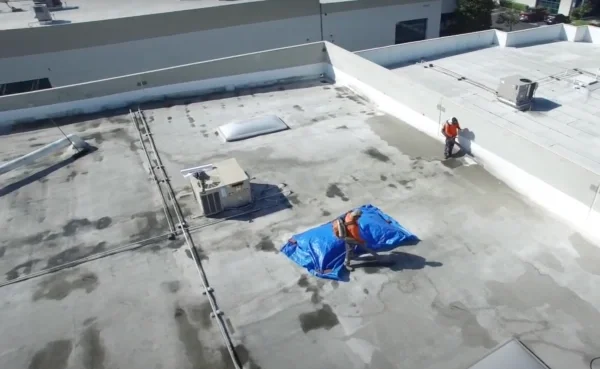
Budgeting for a commercial roof replacement means pricing the repair path the roof actually needs, not just the roof. It covers the system choice, tear-off or recover, any code-required upgrades, a contingency for what's under the membrane, and an allowance for material prices moving between bid and mobilization.
What does a commercial roof replacement cost in 2026?
Most commercial low-slope work in Southern California lands between $3.50 and $12 per square foot installed, depending on the system and how much comes off first. On a 25,000 square foot building that's a range wide enough to sink a capital plan, which is why the system decision comes before the budget line.
Our 2026 installed ranges:
| System | Installed cost per square foot |
|---|---|
| Silicone restoration coating | $3.50 to $7 |
| TPO membrane | $5.50 to $8.50 |
| Modified bitumen | $5.50 to $9 |
| Spray polyurethane foam (SPF) | $5.50 to $9.50 |
| Built-up roof (BUR) | $6.50 to $11 |
| PVC membrane | $7 to $12 |
We publish the full breakdown, including residential and tile, alongside current per square foot pricing for the region. Two things move a quote off these ranges faster than anything else: wet insulation you can't see from the parking lot, and roof access. A building with no crane setback and 40 rooftop HVAC curbs costs more to re-roof than a clean warehouse deck of the same size. Not by 5%. Sometimes by 30%.
Your budget number expires faster than your roof does
A roof budget written 12 months ago is probably wrong today, and it's wrong in one direction. The Bureau of Labor Statistics index for roofing asphalts, pitches, coatings and cement sat at 264.6 in January 2026. By July 2026 it hit 290.3. That's a 9.7% jump in 6 months, and a 29.8% climb since January 2020.
Run that against a real project. A $400,000 tear-off budgeted in January needs about $439,000 in July. Nobody's contingency line was built for that.
This is where we part company with the standard advice. Every roofing article tells owners to start budgeting 12 months out, and that part is right. What's wrong is what they tell you to lock. Fixing a dollar figure a year ahead of a job in this market is how owners end up short, cutting scope in month 11, or approving a change order they never agreed to in principle.
Lock the decision. Leave the number open, with terms.
That index covers asphalt and coating products rather than TPO membrane or polyiso board, so read it as a signal for the coating and built-up side of the market, not a forecast for every system. It's still the closest published measure of where roofing material prices are heading, and it's moving up.
Budget the decision before the number: 4 ways out of a failing roof
A failing commercial roof has 4 exits, not one, and 3 of them cost less than replacement. The point of an inspection is to find out which exit this roof qualifies for before anyone writes a capital request.
| Option | Cost per sq ft | Added service life | Cool roof code trigger | Building disruption |
|---|---|---|---|---|
| Tear off and replace | $5.50 to $12 | 20 to 30 years | Yes | Highest. Deck is open |
| SPF over the existing roof | $5.50 to $9.50 | 40 years or more with maintenance | Yes | Low. No tear-off, fast install |
| Silicone restoration coating | $3.50 to $7 | 10 to 20 years, renewable | Usually treated as maintenance, confirm with your building department | Lowest. Crews work around you |
The Spray Polyurethane Foam Alliance, which we belong to, puts a maintained foam roof at 40 years or more of service life, with inspections twice a year. That's the part owners miss on the budget side. A foam roof gets recoated instead of replaced, so the 30-year cost curve looks nothing like a membrane's.
Dave Bienek's rule after 34 years on roofs: a roof leaking in 3 spots is usually a repair, a roof holding water across 40% of its surface is usually a decision. We walk through the whole decision in our guide to coating versus full replacement.
If you skip this step, you're not budgeting a roof. You're budgeting the most expensive option on the list by default.
How long does a commercial roof replacement take?
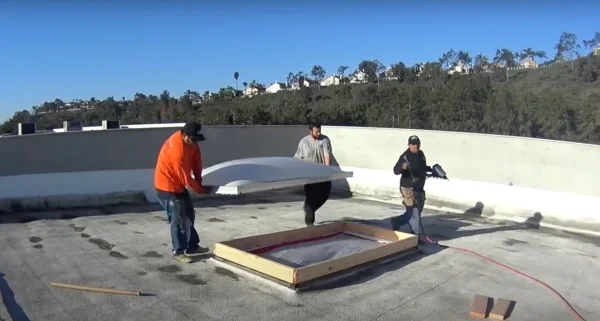
Plan 9 to 12 months from first inspection to final invoice, with the crew on site for a small fraction of that. On most commercial buildings the install itself runs several days to several weeks, and the paperwork and permitting around it takes far longer than the roofing.
The install window is the part owners overestimate and the front end is the part they underestimate. A 20,000 square foot foam roof can go down in under a week in good weather. Getting to that week takes months of inspection, specification, bidding, permitting and tenant notice. We break the on-site phase down in detail in our post on how long the install takes.
Weather is the hard constraint nobody negotiates. Coatings and foam need dry substrate and a temperature window. In the Coachella Valley that rules out much of July and August for some systems. In Orange County it's the winter rain that moves schedules.
How to budget for a commercial roof replacement over 12 months
Work backwards from the install month, and treat each phase as locking one thing. This is the sequence we run with property managers and building owners.
Months 12 to 9: get the roof measured, not quoted. A written inspection with photos, core samples where the deck is questionable, and moisture readings. This is the step that decides between the 4 options above. Our Roof Health Check is free and the written report with photos comes back in 24 to 72 hours.
Months 9 to 6: fix the scope. System, thickness, insulation, drainage corrections, curb and penetration count, warranty term. Every line item named. This is what you lock, and it's what makes 3 bids comparable later.
Months 6 to 3: bid it and write the price terms. Ask every bidder 3 things in writing. How long does this price hold? Is there a material escalation clause, and what index is it tied to? What's the not-to-exceed for deck replacement per square? A bid that answers none of those 3 is not a price you can plan against.
Months 3 to 1: permit, schedule, notify. Permit review time varies by city. Tenants need real notice, not a week's warning. Rooftop equipment vendors need coordination.
Install month: mobilize. Confirm the material price against the contract terms you wrote in month 6. This is the day the escalation clause either saves you or costs you.
Financing exists if the capital budget won't stretch. We work with Acorn Financing, which spreads the cost while the roof stops leaking now rather than next fiscal year.
How much contingency does a commercial roof budget need?
Carry 2 contingencies, not one, because a roof budget faces 2 unrelated risks. The industry standard of 10% to 15% treats them as a single pot, and that's why it runs out.
The first is scope risk: wet insulation, a rusted deck, a drain that has to move. That one shrinks with real information. Core samples and moisture scans in month 12 can take a 15% unknown down to 5%. It's the only contingency you can buy your way out of.
The second is price risk, and an inspection does nothing for it. Given a 9.7% move in 6 months, a project bid in January and installed in September should carry an escalation allowance in the 5% to 10% range on materials, or a contract clause that handles it. Most owners carry neither.
So the honest number is 5% scope plus 5% to 10% escalation on a job with a long runway, and it should be written as 2 line items so you can see which one you're spending.
What Title 24 adds to a Southern California roof budget
In California, replacing or recovering a low-slope commercial roof triggers cool roof requirements that add real cost to the material line. Permit applications filed on or after January 1, 2026 fall under the 2025 Energy Code, per the California Energy Commission.
For nonresidential low-slope alterations, including roof recoverings, the prescriptive path calls for a minimum aged solar reflectance of 0.63 and thermal emittance of 0.75, or a Solar Reflectance Index of 75 as the alternative. Those Title 24 requirements apply in climate zones 2, 4, and 6 through 15, and the product has to carry a Cool Roof Rating Council label.
Read that list against your address. Palm Desert, La Quinta, Rancho Mirage and Indio all sit in climate zone 15. Orange County sits in zones 6 and 8. Every one of them is inside the trigger, which is why our roofers in Palm Desert spec the reflectance values into the proposal rather than discovering them at plan check.
Two budget consequences. Compliant materials cost more than non-compliant ones, so a quote that doesn't name the reflectance value may be pricing the wrong product. And a plan check rejection in month 2 pushes the install past the weather window, which costs more than the material ever did.
Dave Bienek has been roofing in Southern California since 1992 and founded Vision Roof Services in 2014. We've completed about 7,500 jobs, including commercial work for Yamaha in Buena Park and LifeStorage in Costa Mesa, and we run 60 roofers with 12 certified spray foam applicators among them.
Comparing bids that are not apples to apples
Three roofing bids on the same building will almost never price the same scope, and the cheapest one is usually the one that left something out. Line them up against the scope you locked in month 9, not against each other.
Five things to check on every bid:
1. Insulation R-value and thickness. A quote that skips it is quoting a thinner roof.
2. Tear-off versus recover. Different jobs, different disposal cost, different code path.
3. Coating mil thickness, if it's a restoration. Warranty length tracks mils.
4. Deck repair: allowance, unit price, or excluded entirely.
5. Warranty: workmanship years, manufacturer years, and what voids it.
If one bid is 20% under the others, find the line it's missing before you celebrate. In our experience it's almost always insulation, deck allowance, or coating thickness.
Keeping the building open while the work runs
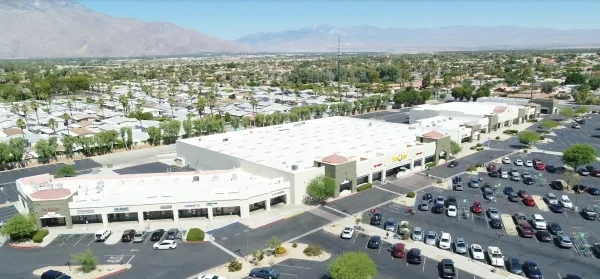
Most commercial roof work happens over an operating business, and the disruption is manageable if the coordination happens in month 3 rather than the week before. Noise, odor and roof access are the 3 things tenants actually feel.
Tell tenants the real dates and the real hours. Move sensitive inventory out from under the active work area, not the whole building. Coordinate with your HVAC vendor before the crew arrives, because rooftop units get disconnected and reset. And ask the contractor which system they're proposing, because a tear-off over an occupied medical suite is a different conversation than a coating over a warehouse.
Restoration and foam both win here. No tear-off means no open deck overnight and no debris chute in the parking lot.
Start with the inspection. Knowing which of the 4 paths your roof qualifies for is the entire difference between a budget that holds and one that gets revised twice. That's how to budget for a commercial roof replacement without guessing: measure the roof, lock the scope, and write the price terms before the market writes them for you. Our Roof Health Check is free, and the written report with photos comes back within 72 hours.
FAQs
How much does it cost to replace a commercial roof?
Commercial low-slope replacement in Southern California runs about $3.50 to $12 per square foot installed in 2026, depending on the system. On a 10,000 square foot building a full tear-off with a new membrane lands around $65,000 to $120,000, while a silicone restoration on the same roof runs $20,000 to $70,000.
When should I start budgeting for a commercial roof replacement?
Start 9 to 12 months before you want the crew on site. Use months 12 to 9 for the inspection, months 9 to 6 to lock the scope, and months 6 to 3 to bid it and write the price terms. Lock the scope early and leave the dollar figure open, because roofing material prices moved 9.7% in the first half of 2026 alone.
Do I have to replace the roof, or can it be restored?
A failing commercial roof has 4 options: tear off and replace, recover, spray foam over the existing roof, or a restoration coating. Three of them cost less than replacement. Scattered leaks on a structurally sound deck often point to restoration, while widespread wet insulation usually points to replacement. A core sample answers it.
How much contingency should a commercial roof budget carry?
Carry two. Budget about 5% for scope surprises like wet insulation or deck damage, which a proper inspection shrinks. Then carry another 5% to 10% for material price escalation between bid and install, which no inspection can reduce. Splitting them shows you which one you are actually spending.
Does Title 24 apply to my roof replacement?
In California, low-slope nonresidential roof replacements and recoverings must meet cool roof requirements in climate zones 2, 4, and 6 through 15. The prescriptive path calls for an aged solar reflectance of at least 0.63 and thermal emittance of 0.75, or an SRI of 75. Permits filed on or after January 1, 2026 fall under the 2025 Energy Code.
How long does a commercial roof replacement take?
Plan 9 to 12 months from first inspection to final invoice. The crew is only on site for a small part of that, usually several days to several weeks depending on size and system. Permitting, specification and tenant coordination take up most of the calendar.
Is financing available for a commercial roof replacement?
Yes. Vision Roof Services works with Acorn Financing, which spreads the cost over time instead of requiring the full amount from this year's capital budget. That matters when a roof is actively leaking and the replacement cycle would otherwise wait for the next fiscal year.