Can You Repair Just A Section Of A Flat Roof? The Rules That Decide It
Yes. You can repair just a section of a flat roof, and on a foam or coated roof you usually should. Age isn't the test. What matters is whether the coating still protects what's under it, whether the insulation around the damage is dry, and whether the patch stays under the size that triggers California's energy code. Get those 3 right and the repair holds for years. Get them wrong and you'll pay for the same roof twice.
Almost every page answering this question is written about asphalt shingles. Flat roofs don't work that way. There are no shingles to match and no slope to shed water fast, so damage spreads sideways under the surface instead of running off. This is what actually decides it on a low-slope roof in Palm Desert, La Quinta, or Orange County.
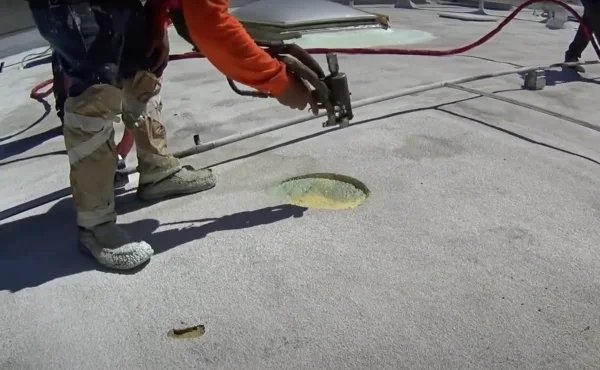
What is a sectional flat roof repair? A sectional flat roof repair removes and rebuilds only the damaged part of a low-slope roof, then ties the new material back into the surrounding membrane or foam. On a spray foam roof, a crew cuts out the wet foam, sprays new foam to match the old thickness, and recoats the patch so water can't creep under the edge.
Can You Repair Just a Section of a Flat Roof?
Yes, when the damage has a clear edge and the rest of the system is dry and still coated. That's a common situation on foam roofs, not a rare one.
The Insurance Institute for Business & Home Safety puts it plainly in its spray foam roof guidance: damage to an SPF roof "does not require roof replacement" and "can usually be repaired economically." IBHS also reports that a maintained foam roof lasts in excess of 30 years, with the protective coating reapplied every 10 to 20 years depending on the coating type and its original thickness.
That's the whole argument for repairing a section. The foam is the waterproofing. The coating is the sunscreen. If the sunscreen is still doing its job everywhere except one 200 square foot area, you fix the 200 square feet.
Dave Bienek has been in roofing since 1992 and founded Vision Roof Services in 2014. In that time the pattern hasn't changed much: the roofs that fail early are the ones nobody looked at, not the ones that got patched.
Why Roof Age Is the Wrong Test for a Flat Roof
Roof age is a weak predictor on a low-slope roof, and leaning on it costs building owners money.
Every competing article on this topic uses the same rule: under 15 years, repair it; over 20 years, replace it. That rule came from asphalt shingles, where the shingle itself wears out on a clock. Foam and coating systems don't age that way. They age by exposure, and exposure is fixable.
A 25 year old foam roof that got recoated twice can be in better shape than an 8 year old single-ply with wet insulation under the seams. We've cut cores out of both. The old foam came out dry.
So swap the question. Instead of asking how old the roof is, ask 3 things:
1. Can you still measure coating thickness across the field, or is the foam showing through?
2. Does a moisture scan come back dry outside the damaged area?
3. Does water clear the roof after it rains?
The Asphalt Roofing Manufacturers Association defines ponding water as "the water which remains on a roof 48 hours or longer." If you have standing water 48 hours after a storm, a patch won't fix the reason it's there. That's a drainage problem, and drainage problems are one of the main reasons flat roofs leak in the first place.
The 2,000 Square Foot Line That Turns a Repair Into a Code Job in 2026
In California, a low-slope roof alteration covering more than 50 percent of the roof area, or more than 2,000 square feet, whichever is less, triggers the state energy code. Cross that line and the work is no longer a simple repair.
This is the number nobody publishes, and it's the single most useful fact on this page.
The 2025 California Energy Code, Title 24, Part 6 took effect January 1, 2026. Section 141.0(b)2Bi sets the trigger for nonresidential low-slope roof alterations at "more than 50 percent of the roof area or more than 2,000 square feet of roof, whichever is less." Once you're over it, the altered portion has to meet an aged solar reflectance of 0.63, a thermal emittance of 0.75, and a Solar Reflectance Index of 75. Insulation requirements come with it under Table 141.0-C. Residential low-slope alterations have their own version at Section 150.2(b)1Iii(a).
Read the "whichever is less" part twice. On a 40,000 square foot warehouse, 50 percent is 20,000 square feet, but the 2,000 square foot line hits first. So a repair on a big commercial roof crosses into code territory much sooner than owners expect.
3 things follow from that:
- A genuine section repair, under both thresholds, stays a repair. No cool roof upgrade, no added insulation.
- A "repair" that creeps past 2,000 square feet has just become a code job with a bigger budget.
- Sometimes the smarter move is to go all the way. If you're at 1,900 square feet on a 6,000 square foot roof, the incremental cost of doing the whole thing while the crew is up there can beat 2 separate mobilizations. Cool roof rules aren't only a cost, either. A reflective surface cuts cooling load, which is why cool roofs matter so much in the Coachella Valley.
You can read the full standards through the California Energy Commission.
One more code note. The old "25 percent rule" that roofers still quote was pulled from the International Building Code and International Residential Code back in 2003. The National Roofing Contractors Association confirms that any roof replacement or recover now has to meet reroofing requirements regardless of size, while true repairs using like material stay exempt. If someone tells you 25 percent is the national rule, they're 23 years out of date.
Which Flat Roof Damage Can Be Repaired in Sections?
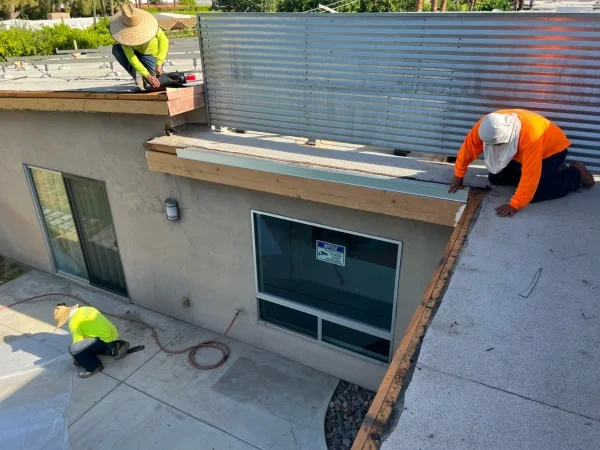
Damage with a clear boundary and dry material around it. That covers most of what we get called out for.
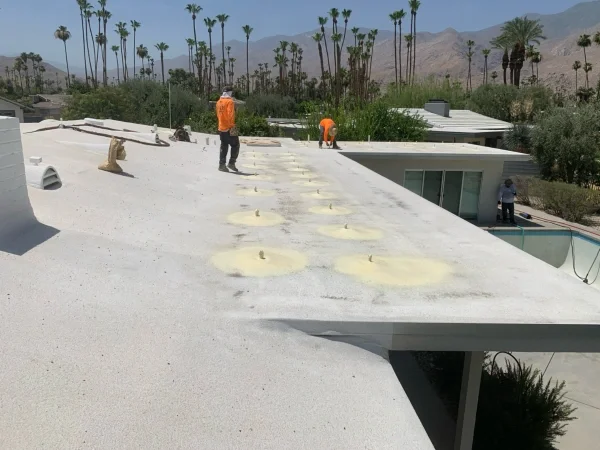
The Spray Polyurethane Foam Alliance sets a workable threshold in SPFA-122. Small blisters, cracks and breaks under 3 inches in diameter get repaired with a compatible sealant. Clustered blisters call for removing the top pass or top 2 passes of foam and respraying. VRS is an SPFA member, and those documents are what our crews work from.
Good candidates for a section repair:
- Punctures from dropped tools, HVAC service traffic, or debris after a wind event
- Failed pitch pans and flashing at curbs, vents and skylights
- A run of blisters in one corner where the coating wore thin
- Storm damage confined to one elevation
- A single seam split on a single-ply roof with dry insulation on both sides
SPFA is direct about the limit, though: "No repair procedure should be attempted to a degraded or moist surface." Patching over wet material buys a few months, then the leak comes back somewhere else.
When a Section Repair Won't Hold
A patch fails when the problem is under the surface, not on it. 4 situations turn a repair into a bad investment.
Wet insulation past the damage line. Water travels laterally under a flat roof. The stain on the ceiling is often 20 feet from where it got in. SPFA-122 calls for a non-destructive moisture survey followed by moisture probes or core samples in suspect areas. Skip that step and you're guessing.
2 or more coverings already up there. NRCA notes that replacement is mandatory once a roof carries 2 or more applications of roof covering, or when the substrate is water-soaked or deteriorated. You can't add a third layer.
Standing water after 48 hours. ARMA recommends a minimum quarter inch per foot of slope so water drains. If it doesn't, the patch sits in a pond.
Coating worn out across the whole field. If the foam is showing through in the corners, at the curbs and in the middle, one patch is the wrong tool. That roof needs a recoat across the whole surface, which is a different job with a different scope.
Repair or Replace: What We Check on a Flat Roof
| What we check | Points to a section repair | Points to replacement |
|---|---|---|
| Coating thickness | Measurable across the field, wear is local | Worn through to the foam in several areas |
| Moisture survey | Dry outside the damaged area | Wet insulation spreading past visible damage |
| Damaged area | Under 2,000 sq ft and under 50% of the roof | Over either line, which triggers Title 24 |
| Existing layers | 1 roof covering | 2 or more coverings already in place |
| Drainage | Water clears within 48 hours | Standing water 48 hours after rain |
| Damage pattern | Punctures, blisters, failed flashing in 1 area | Splits following seams across the whole roof |
Will Insurance Pay for the Whole Roof if Only Part Is Damaged?
In California, it might have to. This is where building owners leave money on the table.
California's Fair Claims Settlement Practices Regulations, Title 10 CCR Section 2695.9(a)(2), states: "When a loss requires replacement of items and the replaced items do not match in quality, color or size, the insurer shall replace all items in the damaged area so as to conform to a reasonably uniform appearance."
On a shingle roof, people argue about color match. On a flat roof the argument is stronger and less understood. A new coating over a patch won't match the aged surface around it, and coating chemistry matters too. If the original product is discontinued, a spot repair can leave 2 systems on one roof that weather at different rates.
That's a coverage conversation worth having before you accept a partial scope. We're not attorneys and this isn't legal advice, but the regulation is public and your adjuster has read it.
How We Decide: The Roof Health Check
We inspect before we quote, and the report is written down. That's the whole process.
Vision Roof Services runs a free Roof Health Check on every job. A crew documents the roof with photos, checks coating condition and drainage, probes for moisture where the scan flags it, and sends a written report back in 24 to 72 hours. You get the findings whether you hire us or not.
The company has completed roughly 7,500 roofing projects. Our Palm Desert roofing crews cover the Coachella Valley, and we run commercial work across Orange County, Los Angeles and San Diego. Past projects include a full commercial SPF restoration for the Yamaha office facility in Buena Park and a foam roof on the Invisible House in Joshua Tree.
60 roofers work for us. 12 of them are trained and certified spray foam applicators through General Coatings. That matters for a section repair more than it does for a tear-off, because matching new foam to old foam and getting the coating tie-in right is where sloppy patches fail.
If you want the technical background on the system, our spray foam roofing page covers how it's installed and maintained. And if you're trying to work out whether you can repair just a section of a flat roof on your building, book a Roof Health Check and we'll put the answer in writing.
FAQs
Can you repair just a section of a flat roof, or does the whole roof have to go?
You can repair just a section when the damage has a clear boundary and the material around it is dry. IBHS states that spray foam roof damage does not require roof replacement and can usually be repaired economically. The limit is moisture: SPFA guidance says no repair should be attempted on a degraded or moist surface.
How big can a flat roof repair be before code kicks in?
In California, more than 50 percent of the roof area or more than 2,000 square feet, whichever is less, triggers Title 24 Part 6 requirements under Section 141.0(b)2Bi. Above that line the altered area has to meet an aged solar reflectance of 0.63, thermal emittance of 0.75, and an SRI of 75, plus insulation requirements.
Can you repair just a section of a spray foam roof?
Yes, and foam is one of the easier systems to repair in sections. SPFA-122 covers sealant repairs for blisters, cracks and breaks under 3 inches across, and removal of the top foam passes where blisters cluster. The new foam is sprayed to match existing thickness, then recoated.
How long does a flat roof section repair last?
As long as the surrounding system does, if the substrate under it was dry. IBHS reports maintained foam roofs lasting in excess of 30 years with recoats every 10 to 20 years. A repair over wet insulation is a different story and typically leaks again within a year.
Does a partial repair void my roof warranty?
It depends on who does the work and what the manufacturer requires. Most coating and foam warranties require repairs to be made with compatible products by an approved applicator. Unapproved patching is a common way owners lose coverage without realizing it. Check the warranty document before anyone touches the roof.
Will my insurer pay to redo the whole roof surface?
Sometimes. California regulation 10 CCR 2695.9(a)(2) requires insurers to replace all items in the damaged area to conform to a reasonably uniform appearance when replaced items don't match in quality, color or size. Whether that reaches the full roof depends on the loss and your policy.
Do I need a permit to repair just a section of a flat roof?
Usually not for a small repair, but permit rules are set locally and thresholds vary between Palm Desert, Riverside County and Orange County jurisdictions. Any work that counts as an alteration rather than a repair generally requires one. Confirm with your city building department before the crew starts.