Yes, rooftop HVAC units damage commercial roofs, and on most buildings we inspect the unit isn't the real problem. The missing record of who walked on the roof is.
Your rooftop HVAC unit sits on a curb that was cut into the roof deck. It drips water all summer. It gets serviced by people who don't work for your roofer. Each of those 3 facts is a leak waiting to happen. Each one is preventable.
Here's what almost nobody tells building owners. The roofing industry's own trade group says the roof is the wrong place for this equipment. In its spray foam roofing manual, the National Roofing Contractors Association writes that "NRCA does not recommend using a roof as a location for HVAC equipment." So you're managing a setup the industry advises against, usually with no written rules for the trades who walk on it.
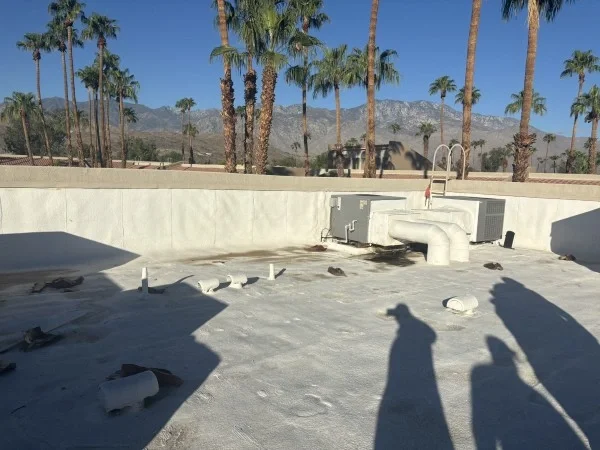
What counts as rooftop HVAC roof damage?
It's damage caused by the equipment, or by the people servicing it, and it's rarely one dramatic event.
Rooftop HVAC roof damage is any roof failure caused by mechanical equipment or by servicing it. It shows up 4 ways: leaks at the curb where the unit meets the roof, water from the condensate line, punctures and crushed insulation from foot traffic and dropped tools, and split seams from vibration and shifting load.
Why the roof is the wrong place for an HVAC unit
Because 2 trades share one surface and neither one owns it. NRCA names this directly. Its SPF manual states that "there often is a lack of clearly defined responsibility for the weatherproofing of HVAC units among the parties involved."
Read that again. The leak isn't a mystery. It's an org chart problem.
We see it play out the same way. The HVAC company says the roof failed. The roofer says the unit was set wrong. The owner pays twice and still has a wet ceiling tile. At Vision Roof Services we've worked on roofs across Southern California since 1992, and the buildings with the fewest HVAC leaks aren't the ones with the newest roofs. They're the ones with a written record of every unit.
That's the contrarian part of this article. You can't prevent rooftop HVAC damage by buying a better roof. You prevent it by deciding, in writing, who is responsible for the 2 feet of roof around each unit.
How do you tell if the leak is the unit and not the roof?
Look at where the water shows up inside and when. HVAC leaks follow the equipment, not the weather.
4 signs point at the unit:
1. It leaks when it isn't raining. A roof leak needs rain. A condensate leak needs a hot day and a running unit.
2. The stain is under or beside the unit. Water travels, but it usually enters close to the curb.
3. It started after a service call. If the ceiling got wet in the 2 weeks after a technician was up there, that's your answer.
4. You've paid for the same leak more than twice. Repeat repairs in one area mean the source was never the field of the roof.
If the water shows up far from any equipment, the cause is probably in the roof itself. There are reasons why flat roofs leak that have nothing to do with your air conditioning.
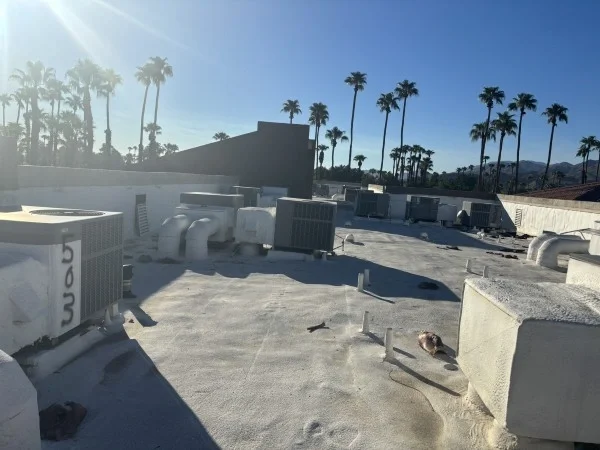
The 6 ways rooftop HVAC units damage a commercial roof
Every failure we find traces back to one of these.
1. The curb and its flashing
The curb is the box the unit sits on. Installing one means cutting the deck, setting the curb, and waterproofing all 4 sides. That last part is roofing work, and it's the part that gets rushed.
NRCA's SPF construction details call for an 8 inch minimum flashing height at curbs and equipment supports, with the coating carried 2 inches higher than the foam. Short flashing is the single most common defect we find. Wind-driven rain and pooled water don't care that the unit is expensive.
2. Condensate that never leaves the roof
A running unit pulls water out of the air and has to put it somewhere. When the line is short, clogged, or aimed at the roof surface, that water sits.
Standing water finds the weakest point. On foam it soaks any exposed edge. On single-ply it works the seams. Then it grows algae, holds dirt, and quietly erodes the surface for years before you see a stain.
3. Foot traffic and dropped tools
An HVAC technician isn't trained to protect your roof, and shouldn't be expected to be. He's carrying a gauge set, a drill, and sometimes a compressor.
A dropped screwdriver punctures a membrane. A dropped compressor crushes insulation. Neither shows up as a leak that week. Both show up in a core sample 2 years later.
4. Added load and shifted load
Units get replaced with heavier ones. Somebody adds a curb adapter. Somebody sets a new condenser on sleepers laid straight on the roof surface.
The same NRCA details ask for 24 inches of clearance between walls and curbs, and enough room between supports to remove and replace the roofing underneath. Crowd that space and the next repair means cutting around equipment nobody wants to move.
5. Vibration and loose fasteners
A rooftop unit shakes all day. Over years, that movement works fasteners loose, opens flashing laps, and cracks sealant at the corners.
This is the failure mode owners never suspect, because nothing looks wrong from the ground.
6. Refrigerant, oil and cleaning chemicals
Coil cleaner, compressor oil, and solvent get spilled during service. Some of them soften coatings and membranes.
Ask any technician who has cleaned a coil on a hot roof whether the runoff went into a bucket. The honest ones will tell you it didn't.
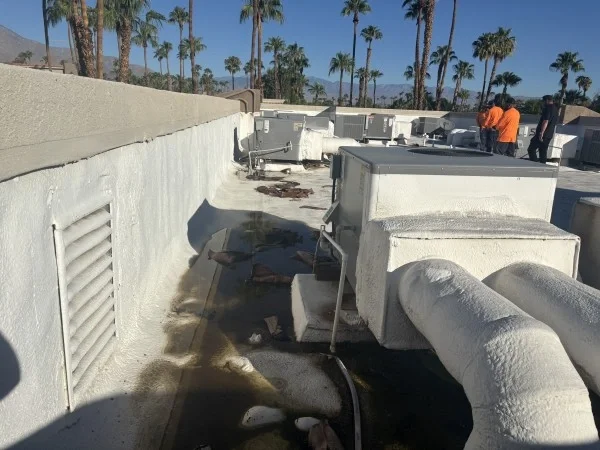
What does HVAC damage look like on a foam roof?
Different from a membrane, which is why a generic answer fails you. Foam and coating take service traffic in a way single-ply doesn't, and they fail differently.
| Roof system | What service damage looks like | Where it leaks first | What the repair involves |
|---|---|---|---|
| Spray foam with coating | Boot prints, crushed foam, coating worn thin, granules scuffed away | Coating at the base of the curb, right above the foam line | Cut out wet foam, re-spray, re-coat, add walkpads |
| TPO or PVC single-ply | Scuffs, punctures, cuts from dropped tools, lifted seams near the unit | Seams and curb flashing | New flashing, welded patch, walkway pads |
| Modified bitumen or built-up | Cracked surfacing, displaced gravel, blisters beside the unit | Base flashing laps at the curb | Rebuild the flashing, re-surface the walk path |
| Metal panel | Loosened fasteners, scratched finish, oil canning near the unit | Penetration boots and fastener rows | Re-seal penetrations, replace fasteners |
Foam has one advantage here that matters. It's repairable in place. On the Yamaha office roof in Buena Park, we restored 5,000 square feet of existing flat roof instead of tearing it off, corrected the slope to stop ponding, and finished with a Title 24 compliant cool roof coating and a 20 year maintenance agreement. Nothing came off the building. Nobody moved out for a week.
Who pays when an HVAC tech damages the roof?
Whoever can't prove otherwise. That's what decides it, and it's why documentation beats argument.
Here's the pattern we watch every summer. A technician services a unit in July. In October it rains. The ceiling gets wet. By then nobody can say what the roof looked like in June, so the building owner pays.
| What we find | Why it costs what it costs | Who ends up paying, in practice |
|---|---|---|
| Curb flashing failed, insulation still dry | Local repair, no tear-out | Building owner |
| Wet insulation under the curb | Cut out and replace the wet area, then re-flash | Depends on the record |
| Condensate on the roof for years | Repair plus a drainage correction | Building owner |
| Puncture found after a service visit, no photos | Full repair, unassigned | Building owner |
| Puncture with dated photos before and after | Repair billed to the trade that caused it | The HVAC contractor or its insurer |
That's what we see in the field, not legal advice. Your contracts and your insurer decide who actually pays.
One more thing owners don't consider. Roof work near an edge is regulated. Under OSHA's walking-working surfaces rule, anyone working less than 6 feet from a low-slope roof edge needs a guardrail, safety net, travel restraint, or personal fall arrest system. Between 6 and 15 feet the same protection applies, except that a marked designated area is allowed when the work is both infrequent and temporary. If your units sit near a parapet, the trade you send up there has obligations, and so do you.
How high should an HVAC curb be?
At least 8 inches above the roof surface, per NRCA's construction details for foam roofs, with coating carried 2 inches above the foam.
Measure yours. Take a tape measure to the base of any unit and check the height from the finished roof surface to the top of the flashing. Under 8 inches, you're on borrowed time. Buried by a recoat, add-on insulation, or a foam re-spray that raised the roof height without raising the flashing, and you're already leaking.
Those details also ask for 12 inches of clearance between pipes and curbs or walls. That sounds like a technicality until a roofer has to work in the gap you actually have.
Where is condensate supposed to go?
To an approved plumbing fixture or disposal area, not onto your roof. California's Mechanical Code, now in its 2025 edition based on the 2024 Uniform Mechanical Code, requires condensate to be collected and discharged to an approved point. It also requires overflow protection where a leak could cause damage.
So a condensate line dumping onto the roof surface isn't just a maintenance nuisance. It's a plumbing and mechanical detail that was never finished.
In the desert this looks different than it does on the coast. Less humidity means less condensate volume, so owners assume the risk drops. It doesn't. Mineral scale and algae clog the lines faster, and the discharge that does happen lands on a surface baking in July sun. Lawrence Berkeley National Laboratory's Heat Island Group puts the difference at about 55F on a typical summer afternoon between a clean white roof reflecting 80% of sunlight and a gray roof reflecting 20%. That's the difference between a coating that survives a decade of hot water and one that doesn't. It's a real factor on Palm Desert commercial roofs, where the coating around each unit is the first thing to give up.
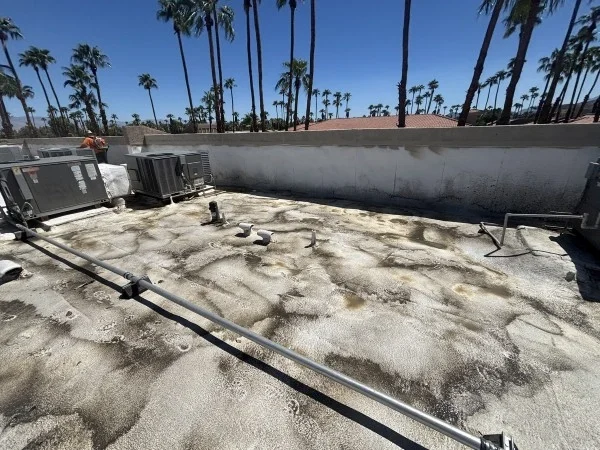
Should you replace the roof before or after the units?
Roof first, then the units, whenever the schedule allows it. NRCA's SPF manual is blunt about the order: "When possible, the mechanical units should not be set until the SPF roof system has been installed."
The reason is simple. Flashing a curb properly takes access to all 4 sides. Set the unit first and 2 of those sides are now under the equipment.
If your units have 5 years left and the roof has 2, do the roof now and plan the curb work into it. If the units go first, get your roofer on site the same week. Most of the commercial roofing work we're called in to fix could have been avoided with one coordinated day.
What to put in your 2026 HVAC service contract
5 lines. Add them at renewal and most of this article stops applying to your building.
1. Photos before and after every visit, including the curb, the condensate discharge point, and the walk path.
2. A named walk route to each unit, and the rule that crews stay on it.
3. No tool staging on the roof surface, only on walkpads or a set-down mat.
4. Immediate notice of any damage, in writing, same day.
5. A roofer present for any curb work, unit replacement, or new penetration.
Nobody will push back on these. They cost the HVAC contractor nothing, and they end the annual argument.
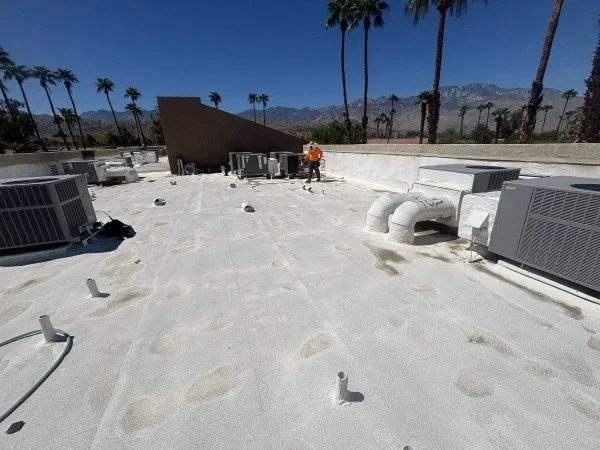
What we document on every rooftop unit
A photo file per curb, delivered as a written report. The Spray Polyurethane Foam Alliance recommends that SPF roofs be inspected twice a year and after severe weather, and says a foam roof can last 40 or more years with real maintenance. Twice a year is also about how often your units get touched.
Our Roof Health Check covers the units, not just the field of the roof. For each one we record the flashing height, the condensate discharge point, the walk path, the coating condition at the curb base, and anything a technician left behind. You get the report and photos back in 24 to 72 hours. That file is what you hand the next contractor before he goes up, and what you hand your insurer if something goes wrong after he comes down.
We've completed roughly 7,500 roofing jobs, run 60 roofers, and 12 of them are certified foam applicators through General Coatings. We're not guessing about what a serviced curb looks like after 10 years.
So can rooftop HVAC units damage a commercial roof? They already are, on most buildings, in a way nobody has photographed yet. Get the units documented before the next service call, decide in writing who owns the 2 feet around each curb, and the leak you keep paying for stops being your leak. Book a free Roof Health Check and you'll have the report and photos back in 24 to 72 hours. Call 844-348-ROOF.
FAQs
Can rooftop HVAC units damage a commercial roof?
Yes. Rooftop units damage commercial roofs 4 ways: leaks at the curb where the unit meets the roof, water from the condensate line, punctures and crushed insulation from service traffic, and split seams from vibration and shifting load. The National Roofing Contractors Association goes further and states that it does not recommend using a roof as a location for HVAC equipment.
Can rooftop HVAC units damage a commercial roof before you see a leak?
Yes, and that is the usual sequence. A dropped tool punctures the membrane or crushes the insulation, water enters slowly, and the wet area only turns up in a core sample a year or 2 later. So the signs worth watching are behavioral: a stain within 2 weeks of a service call, a leak on a hot dry day with no rain, or a repair you have paid for more than twice in the same spot.
How high should an HVAC curb be on a commercial roof?
NRCA's construction details for spray foam roofs call for a minimum flashing height of 8 inches above the roof surface at curbs and equipment supports, with the coating carried 2 inches higher than the foam. Measure from the finished roof surface to the top of the flashing. A recoat, added insulation, or a foam re-spray can raise the roof and leave you under 8 inches without anyone noticing.
Can condensate from a rooftop unit be discharged onto the roof?
No. California's Mechanical Code requires condensate to be collected and discharged to an approved plumbing fixture or disposal area, and requires overflow protection where a leak could cause damage. A line that ends over the roof surface is an unfinished mechanical detail, not a maintenance quirk, and the standing water it creates works on seams and exposed foam edges for years before a stain appears inside.
Who is responsible when an HVAC technician damages the roof?
By default, nobody is, which is the problem. NRCA states that there often is a lack of clearly defined responsibility for the weatherproofing of HVAC units among the parties involved. In practice the party who cannot prove the roof's prior condition pays, so dated photos of each curb before and after every service visit are what settle it. Your contracts and your insurer decide the rest.
Does HVAC service void a commercial roof warranty?
Read your warranty document before the next service call. What we see excluded most often is damage caused by other trades and penetrations made without the roofing contractor present, which is why curb work, unit replacements, and new penetrations should involve your roofer the same week.
How often should the roof around rooftop units be inspected?
The Spray Polyurethane Foam Alliance recommends inspecting SPF roofs twice a year and after severe weather, and reports that a foam roof can last 40 or more years with real maintenance. Twice a year also matches how often most rooftop units get serviced, so the practical answer is to inspect the roof around each unit on the same schedule as the equipment.