Commercial Roof Replacement Without Business Interruption: What Decides Whether You Stay Open
Yes, most commercial buildings stay open through a roof replacement. One question decides it, and it isn't the phasing plan in your contractor's proposal: does the new roof require opening the deck and driving fasteners through it over people's heads?
Every roofer will tell you they'll phase the work. Phasing is real, and we do it on every commercial job. It's also the easy part. I've been on roofs since 1992, and across roughly 7,500 completed jobs at Vision Roof Services the pattern hasn't moved: the buildings that ran straight through a reroof were the ones where we never opened the deck. The ones that had to shuffle shifts were the ones where we did.
So a commercial roof replacement without business interruption starts with a system decision. The calendar comes second.
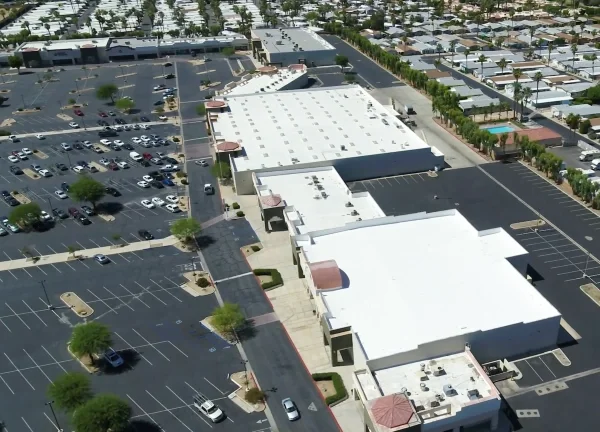
What is a commercial roof replacement without business interruption?
A commercial roof replacement without business interruption is a reroof sequenced so occupants keep working through it. The roof gets divided into sections, each one opened and made watertight the same day, with staging, access and rooftop air intakes planned around occupancy. Whether it works depends more on the roof system chosen than on the schedule.
The attachment method matters more than the phasing plan
The attachment method decides how much of your operation you have to work around. A new commercial roof connects to your building in 1 of 3 ways, and each one makes a different week for the people inside.
Mechanically fastened. Screws driven through the membrane and insulation into the deck. Thousands of them. That sound travels through the structure, not the air.
Fully adhered. Glued down instead of screwed. No fasteners through the deck, so the noise problem mostly goes away. The adhesive becomes the odor problem.
Recover or coating over the existing roof. The old roof stays put and keeps covering the deck the entire time. Nothing gets opened, so nothing has to be closed before the crew leaves.
That third path is the one nobody else writes about, and it's the one that changes your week.
How loud is a commercial reroof inside the building?
Loud enough to matter, and the loudest part is fastening, not tear-off. The University of Washington's Department of Environmental and Occupational Health Sciences measured the tools construction crews use and put a screw gun or drill motor at 97.7 dBA on average, with a maximum recorded level of 123.7 dBA. A hand power saw averaged 97.2 dBA. For scale, Cal/OSHA's exposure limits for noise under Title 8 section 5096 run 90 dBA across 8 hours and drop to 2 hours at 100 dBA. Cal/OSHA says that limit is designed to protect most, not all employees, and that more susceptible individuals can lose hearing at levels as low as 85 dBA over an 8-hour day.
Read those numbers honestly. Three caveats come with them. They're measured at the tool, not in your conference room one floor down. The 11 trades in that study didn't include roofers, so these are tool figures, not roofer figures. And both tools sit near the quiet end of that report's 10 loudest, which topped out at 103.0 dBA for a chipping gun.
I don't have a figure for what you'll hear inside your building, and neither does any contractor bidding your job. The mechanism is what you can act on: fasteners driven into a steel deck push sound through the structure, and structure-borne noise ignores ceiling tiles. Adhered systems and recovers don't do that at all.
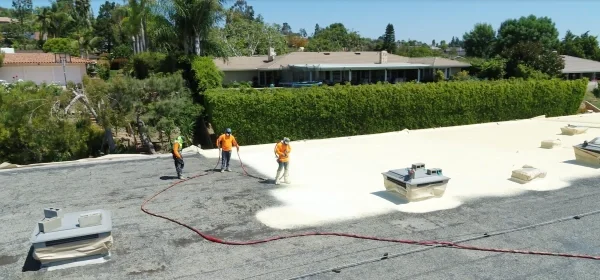
Which roof system disrupts your building least in 2026?
A foam or coating recover, because it's the only path that never opens the deck. Here's how the realistic options compare. Rankings come from the mechanism plus what we see on occupied buildings across Riverside, Orange, San Diego and Los Angeles counties.
| System | Fasteners through deck | Deck opened over occupants | Noise into building | Odor source | Roof open at end of day | Occupants usually stay |
|---|---|---|---|---|---|---|
| Tear-off, mechanically fastened single-ply | Yes | Yes | Highest | Low | Yes, until dried in | Yes, but expect shift changes |
| Tear-off, fully adhered single-ply | No | Yes | Moderate | Adhesive VOCs | Yes, until dried in | Yes |
| Recover board plus fastened single-ply | Yes | No | High | Low | No | Yes |
| Spray foam recover over existing roof | No | No | Low | Foam and coating, | No | Yes |
| Silicone or acrylic coating restoration | No | No | Lowest | Coating | No | Yes |
Put that table in front of the next contractor who bids your building and ask which row their proposal sits in. If they can't answer, you've learned something. Our commercial roofing proposals name the row.
Roofing odors and your rooftop air intakes
This is the part that gets skipped, and it's the one that generates the complaint emails. Roofing fumes reach people through the vents, not down through the deck.
The New York State Department of Health publishes a sequence for this that any commercial roofer should be following. Identify the fresh air intakes and account for them when the work is coordinated. Start work in areas remote from those intakes with the ventilation system operating, watching wind conditions and checking for complaints. Stage materials downwind and away from vents. Set any window air conditioners to recirculate, and keep operable windows shut unless they're upwind of the equipment and materials. Treat closing or covering the fresh air intakes as a last resort, not step 1.
That page names hot asphalt fumes and the volatile organic chemicals in rubber roofing adhesives. It doesn't cover sprayed foam, so I'm borrowing its sequencing logic, not its findings.
Now the part a roofer isn't supposed to say. That same health department states plainly that it's best to schedule roofing work when the building isn't occupied, and that school projects should be planned for when school isn't in session. That's true. On most commercial buildings you don't need to leave. On a food production line, a dental suite, or a school mid-semester, "we'll phase it" isn't a plan, and I'd rather you hear that from me now than discover it in week 2. The department also suggests self-adhering membrane products that emit little or no vapors, which is a real reason a recover isn't automatically the right answer.
What a spray foam recover trades away
Lower noise, in exchange for a short odor and overspray window and a code allowance you only get once.
Foam and coating are sprayed, and wind carries what's sprayed. Tenant vehicles, neighboring roofs, HVAC housings and adjacent property all need masking, and spraying stops when the wind comes up. Any foam contractor who doesn't raise overspray before you ask hasn't done enough occupied buildings.
The code limit is the second trade. You get one recover over an existing roof, and after that the next roof is a tear-off, so a recover spends a card you can't spend twice. Whether your building still qualifies comes down to a core cut, the same test that settles a coating against a replacement.
Third, a recover isn't a permanent exit from rooftop work. The RICOWI best practices guide for roofing, published jointly by the Roofing Industry Committee on Weather Issues, the Insurance Institute for Business & Home Safety and several roofing associations, says historical data indicate that maintained spray polyurethane foam roofs exhibit life spans in excess of 30 years, and that coatings generally need re-application every 10 to 20 years depending on coating type, original thickness and other factors. Read that as an industry figure, not an independent study; the guide names no dataset behind the 30 years. Either way, it's a shorter cycle, not no cycle.
And the fair counter-argument for membranes: factory fabrication does cut rooftop hours. Duro-Last states that up to 85 percent of membrane seams are factory-welded, and that a 50,000 square foot roof needs more than 7,500 linear feet of field seaming with roll goods against less than 1,300 with its custom-fabricated system. Its own graphics put those at 7,968 and 1,278 linear feet, calculated with 6-foot-wide roll goods against 5-foot laps. And 85 percent is a ceiling, not a typical job. Still, less welding above your ceiling is less disruption, and if your building needs a membrane that's worth paying for.
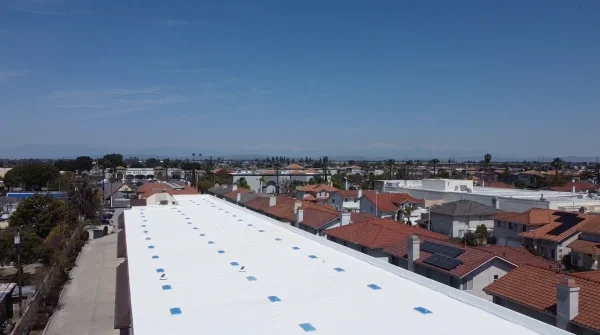
Which businesses can stay open, and which shouldn't
Most can. The exceptions aren't the buildings with the most people, they're the ones with an air quality or vibration constraint.
| Building type | The real constraint | Usually stays open |
|---|---|---|
| Self-storage | Unstaffed units, gate access, tenant vehicles | Yes |
| Warehouse and distribution | Racking under the work zone, dock and delivery routes | Yes |
| Office and professional | Rooftop air intakes, meeting noise | Yes, with intake sequencing |
| Retail center | Customer entrances, parking, sightlines to signage | Yes |
| Manufacturing | Vibration-sensitive equipment, dust into open processes | Usually, line by line |
| Multifamily and HOA | Residents home all day, patios and vehicles | Yes, building by building |
| School | Occupancy plus the health department's session guidance | Schedule around breaks |
| Medical and dental | Infection control, air handling | Case by case, often after hours |
| Restaurant and food production | Hood exhaust, open food, near-zero odor tolerance | Often no, plan the closure |
Two of ours worth naming: LifeStorage in Costa Mesa and the Yamaha facility in Buena Park, both in Orange County, 1 of the 4 Southern California counties we cover. Those 2 building types, self-storage and manufacturing, are the ones this question comes from most.
What we settle before a crew shows up
A written report and a section map, before you get a price. Our free Roof Health Check is a documented walk of your roof, and the written report with photos comes back in 24 to 72 hours.
Four things that report should tell you, whoever performs it. How many roof coverings you already have, because that decides recover against tear-off. Where your fresh air intakes sit relative to each work section. Whether there's moisture trapped in the existing assembly, which rules out a recover no matter what the layer count says. And the section map, so you can see which part of your building is under work in which week. On the foam and coating side that work runs through 12 certified spray foam applicators out of our 60 roofers, certified through General Coatings, across California, Arizona, Nevada and Texas.
A commercial roof replacement without business interruption isn't a promise a contractor makes in a proposal. Three things decide it, and you can check all 3 before you sign: which row of that table the proposal sits in, where your intakes are, and whether the deck gets opened at all. Ask every bidder those 3 questions, then book the Roof Health Check and we'll put the answers in writing.
FAQs
Can a business stay open during a commercial roof replacement?
Most can. Whether yours does depends on whether the new roof needs fasteners driven through the deck above occupied space, and on where your rooftop air intakes sit. A recover or coating over the existing roof never opens the deck, which is why self-storage, warehouse and retail buildings usually run straight through the job.
Which commercial roof system allows replacement without business interruption?
A spray foam or coating recover disrupts the least, because the existing roof keeps covering the deck the whole time and nothing is left open overnight. The roofing industry's RICOWI best practices guide, co-published with the Insurance Institute for Business & Home Safety, says historical data indicate maintained spray foam roofs last more than 30 years. A fully adhered membrane is the next quietest option, since it uses no deck fasteners.
How loud is a commercial roof replacement inside the building?
The fastening stage is the loud part, not the tear-off. University of Washington measurements put a screw gun or drill motor at 97.7 dBA on average with a 123.7 dBA maximum, and Cal/OSHA's noise limit is 90 dBA over an 8-hour day. Those readings are at the tool, not inside your building, but fasteners into a steel deck send sound through the structure, where ceiling tiles don't help.
Do rooftop HVAC units have to be shut down during roofing?
Usually not. The New York State Department of Health recommends starting work in areas remote from the fresh air intakes with the ventilation system running while watching the wind, and treating closing or covering intakes as a last resort. Getting the phase order right around your intakes is what keeps the units running.
How long does a commercial roof replacement without business interruption take?
Phasing adds time to the calendar even though it removes disruption, because crews work smaller areas and dry each one in daily. Most commercial jobs run 1 to 4 weeks of active work depending on square footage and system, which we break down stage by stage in our commercial installation timeline.
Can spray foam go over an existing commercial roof without a tear-off?
Often yes, and that's the main reason foam suits occupied buildings. Code permits one recover over an existing roof, so it depends on how many coverings are already there, and trapped moisture in the old assembly rules it out regardless. A core cut during the inspection answers both questions before you commit.