Why Commercial Roofs Fail Prematurely In Southern California
Most commercial roofs out here don't wear out. They get cooked, and then they get misdiagnosed.
Premature failure in this market almost never traces to the cause national roofing articles lead with. Freeze-thaw doesn't happen in Palm Desert. Neither does snow load. What ends flat roofs here is ultraviolet exposure, daily thermal movement, and drainage faults that stay hidden through 11 dry months before showing up in a single monsoon afternoon. Add one detail an installer rushed, and the clock starts on day one. I've been on roofs since 1992, and Vision Roof Services has completed roughly 7,500 of them. Below is what actually drives early failure in this climate, how to tell a roof that's finished from one that only looks finished, and why that difference is worth more than any inspection checklist.
Premature commercial roof failure means a roof stops keeping water out well before its rated service life ends. A single-ply or built-up system rated for 20 to 30 years that leaks at year 9 has failed prematurely. The cause is almost always a detail, a drain, or a coating that ran out, not the membrane itself.
What counts as premature commercial roof failure?
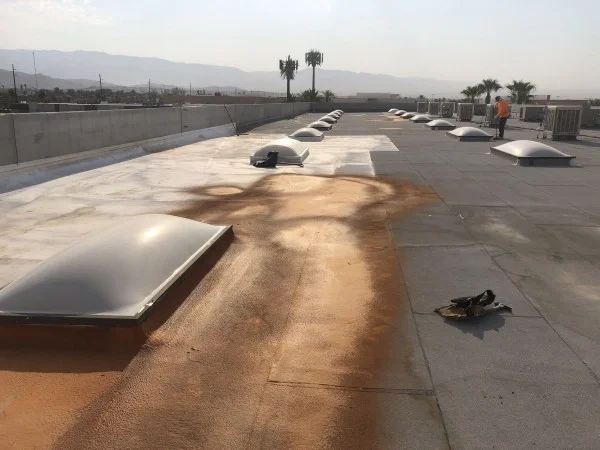
A roof has failed prematurely when it loses watertightness before roughly 70 percent of its rated life. On a 25-year system, that's any leak you can't trace to physical damage before year 17.
That definition matters because "the roof is shot" is a conclusion, not a finding. On the roofs we inspect across Riverside and Orange counties, the same five failure patterns show up on a predictable schedule. Knowing which one you're looking at tells you if you're buying a repair, a recoat, or a full replacement.
| Roof age | What usually fails | Why it fails here | What you see from below or on top |
|---|---|---|---|
| Year 1 to 3 | Details and terminations | Workmanship. Flashing, curbs, drain bowls, pitch pans | A leak that returns to the same spot every time it rains |
| Year 4 to 10 | The coating or top surface | Ultraviolet load. The surface chalks, thins, stops reflecting | Chalky or faded surface, first blisters, cooling costs creeping up |
| Year 8 to 15 | Seams and penetrations | Daily thermal movement works joints loose | Open laps, split sealant, flashing lifting at HVAC curbs |
| Year 10 to 20 | Insulation and deck | Water that entered years earlier and went unnoticed in dry months | Soft spots underfoot, ponding that deepens each season, ceiling stains |
| Any year | Whatever the last trade touched | New HVAC, solar, satellite or conduit set without a roofer present | A leak that starts within weeks of unrelated rooftop work |
Read that table by age and you can usually name the cause before anyone opens a core sample. A leak at year 2 is an installation problem. A leak at year 12 is a maintenance and drainage problem. They cost very different amounts to fix, and there are seven signs we look for that separate the two.
The desert failure clock: heat does the damage, not weather
Heat, not storms, is the dominant aging force on a Coachella Valley commercial roof. The numbers behind that are not close.
NOAA's 1991 to 2020 climate normals put Palm Springs at about 115 afternoons a year at or above 100 degrees, roughly 177 afternoons at or above 90, and an average July high of 108.6 degrees. Air temperature is only the starting point. The U.S. Department of Energy reports that conventional roofs can reach 150 degrees Fahrenheit or more on a sunny summer afternoon, while a reflective roof can stay more than 50 degrees cooler under the same sun.
Two things happen at those surface temperatures, and they compound.
The first is ultraviolet degradation. UV breaks down the top layer of almost every roofing surface. Coatings chalk and thin. Asphalt-based caps get brittle. Unprotected foam skins over and then powders. A coating engineered for 15 years somewhere with 40 rainy days a year does not get 15 years here, and that gap is the single most common reason a desert roof "fails early" when it is actually just past due for a recoat.
The second is thermal movement. A roof that swings from 150 degrees at 3 p.m. to the 70s overnight expands and contracts every single day of the year. Membranes move. Metal edge trim moves more. Fasteners work loose, laps peel back a fraction at a time, and sealant at penetrations splits. Nothing dramatic happens on any one day. Then year 11 arrives and half the curb flashings are open.
Reflectivity is the direct counter to both. The U.S. EPA reports that a cool roof can cut peak cooling demand by 11 to 27 percent, and in buildings without air conditioning it can lower maximum indoor temperatures by 2.2 to 5.9 degrees Fahrenheit. A surface that stays 50 degrees cooler also ages far slower. That's why in this climate a reflective coating is a service-life decision first and an energy decision second.
Why does a roof that sees 5 inches of rain a year still fail from water?
Because 4.61 inches of annual rain, the NOAA normal for Palm Springs, arrives in a handful of events, and a roof that can't drain has nowhere to put it.
This is the part that surprises building owners. Low rainfall doesn't protect a flat roof. It hides the defect. A drain that's half blocked, a low spot that formed as insulation compressed, a scupper set a half inch too high: none of that shows up in April. It shows up when 1.5 inches falls in 90 minutes in August and the water has nowhere to go.
Building codes treat this as a performance requirement rather than a slope number. As Mark Graham of the National Roofing Contractors Association explains in Professional Roofing, codes waive the 1/4:12 minimum slope on reroofs and recovers in favor of positive roof drainage, defined as the condition where "consideration has been made for all loading deflections on the roof deck and additional slope has been provided to ensure drainage of the roof within 48 hours of precipitation."
Note what that definition includes: deflection. Water is heavy. It ponds, the deck sags under the weight, the low spot deepens, and the next storm leaves more water than the last one. The membrane sitting in that bowl is the thing that eventually gives up, but the membrane is not the problem. The slope is.
Rooftop equipment makes it worse, and this is where desert buildings get hit twice. Every HVAC unit, condenser stand, solar mount and conduit run is a penetration and an obstruction. Set a new unit in front of a drain path and you've built a dam. We see leaks that start within weeks of a mechanical or solar install more often than leaks from any storm, and the roofing warranty usually doesn't cover them, because the roofer wasn't there.
If you take one operational rule from this article: call your roofer before another trade goes on the roof, not after.
Installation sets the first failure clock
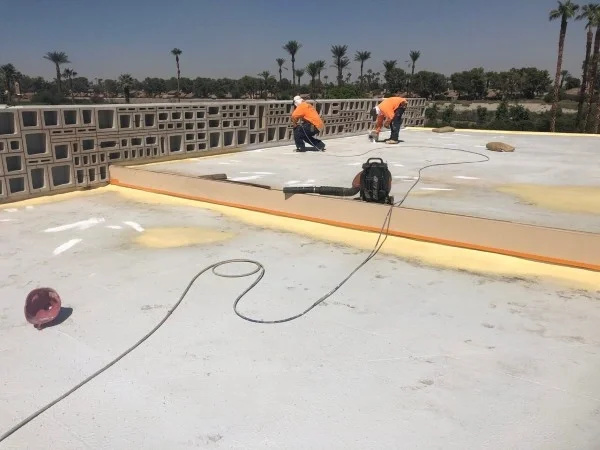
An early leak is a workmanship leak. On a roof under 3 years old, the membrane is fine and the detail is not.
The details that fail first are always the same ones. Flashing at parapet walls and HVAC curbs that was set but not properly terminated. Seams that were welded cold or too fast. Fastener spacing that opens the field to wind uplift. Adhesive applied outside its temperature window, which in this climate can mean applied at 2 p.m. in July when the substrate is 140 degrees rather than too cold.
Spray foam has its own version of this. Foam applied to a damp substrate, or in wind, or at the wrong ratio, will look acceptable on day one and delaminate later. That's why applicator training is not a formality. Of the 60 roofers at Vision, 12 are trained and certified spray foam applicators through General Coatings, and we're members of the Spray Polyurethane Foam Alliance. Our commercial roofing crews are our own employees, not day labor assembled per job, which is the single biggest predictor of whether the details get done right on a 40,000 square foot roof at 105 degrees.
One more current item worth knowing before you scope a reroof. California's 2025 Energy Code now governs the work: the California Energy Commission states that buildings whose permit applications are filed on or after January 1, 2026, must comply with the 2025 standards. Title 24 sets reflectance requirements for low-slope nonresidential roofs, so a commercial reroof in California is a code compliance project, not only a waterproofing one.
The 2026 reality: most commercial roofs called "failed" can still be saved
Here is something the rest of this category won't tell you.
Two statistics open nearly every article written on this topic: that every $1 spent on preventive maintenance saves $4 in emergency repairs, and that maintenance extends a roof's life by up to 50 percent. We went looking for the studies behind them. There aren't any. Both figures circulate across hundreds of roofing sites with no sample size, no methodology, and no institution attached. A third one, that 80 percent of roofs get replaced prematurely, has been quoted for over 30 years and nobody can trace where it started.
We won't repeat numbers we can't stand behind. What we can tell you is what we find when we open roofs.
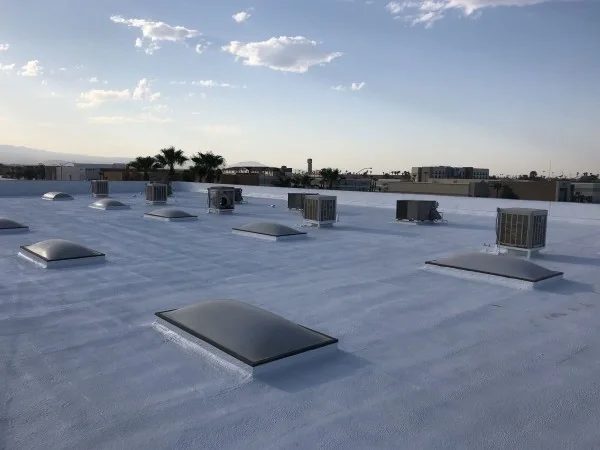
Most commercial roofs written off as failed in this valley are not failed. They're uncoated, undrained, or both. If the deck is sound and the insulation is dry, the roof is a candidate to recoat instead of replace, or to receive a foam-over that levels the ponding and adds insulation at the same time. That's a first-hand observation from our own inspections, not a published statistic, and it is the reason we lead with a moisture survey instead of a quote.
The one condition that rules it out is trapped water. Coating over wet insulation seals the problem in and buys nothing. That has to be found and cut out first, which is exactly what a core sample and a moisture reading are for.
| Option | When it fits | Typical downtime | Adds service life |
|---|---|---|---|
| Targeted repair | Isolated damage, substrate dry | Hours to 1 day | Buys time, doesn't reset the clock |
| Silicone or acrylic recoat | Sound, dry roof with a worn surface | Several days | 10 to 20 years per coat, renewable |
| Spray foam recover | Sound deck, ponding or many penetrations | Several days to 2 weeks | 30 to 50 years with scheduled recoats |
| Tear-off and replace | Wet insulation, failed deck, structural damage | 2 weeks or more | Full new service life |
The economics of that table are why we push maintenance rather than replacement. A roof kept coated is renewed on a schedule. A roof left alone until it leaks becomes a tear-off, and tear-offs are where the money and the downtime are.
How we catch early failure, and what an inspection actually turns up
An inspection that produces a verbal opinion is worth nothing. One that produces documentation is worth planning around.
Our free Roof Health Check is an on-roof inspection with photographs, moisture findings, and a written report back to you within 24 to 72 hours. Not a verbal "you need a new roof." A document with images you can put in a capital plan, hand to a board, or use to hold a manufacturer to a warranty.
What we're looking for, in order: standing water and where it sits 48 hours after rain; the condition of the coating or cap surface; every penetration, curb and termination; anything a non-roofing trade has installed since the last look; and moisture in the insulation under any suspect area.
The proof behind that process is roughly 7,500 completed roofs since I started in 1992, with the company founded in 2014. Commercial work includes the LifeStorage location in Costa Mesa and the Yamaha facility in Buena Park. We hold a BBB A+ accreditation and a 4.8-star Google rating across 42 reviews at our Palm Desert office. Licensed and insured, California license 651509.
Our Palm Desert crews cover the Coachella Valley from La Quinta and Rancho Mirage to Indian Wells, Indio and Cathedral City, and we handle commercial projects across Riverside, Orange, Los Angeles and San Diego counties. Financing is available through Acorn Financing when a capital project needs to move before the budget cycle does.
If your roof is past year 8, or you've had rooftop work done and nobody checked the roof afterward, book a free Roof Health Check and you'll have a written report with photos within 24 to 72 hours. Call 844-348-ROOF.
FAQs
What causes commercial roofs to fail prematurely in Southern California?
Ultraviolet degradation and daily thermal movement, made worse by drainage faults that stay hidden in a climate with under 5 inches of annual rain. NOAA records about 115 afternoons a year at or above 100 degrees in Palm Springs, and the U.S. Department of Energy reports conventional roof surfaces can exceed 150 degrees Fahrenheit in summer sun. Freeze-thaw, the cause most national articles lead with, is not a factor here.
How long should a commercial flat roof last in the desert?
Single-ply and built-up systems are typically rated for 20 to 30 years, but unprotected surfaces in this climate often need intervention well before that. A spray foam roof recoated on schedule can run 30 to 50 years because you renew the surface rather than replace the roof. The variable is not the membrane brand, it's whether the surface gets recoated and the drains stay clear.
Can a commercial roof that's leaking be recoated instead of replaced?
Often yes, if the deck is structurally sound and the insulation is dry. A silicone or acrylic recoat, or a spray foam recover, restores watertightness without a tear-off and without hauling the old roof to a landfill. Trapped moisture is the one disqualifier, which is why a moisture survey has to come before any coating decision.
How often should a commercial roof be inspected in the Coachella Valley?
Twice a year works for most buildings, plus a walk after any monsoon event and after any other trade has been on the roof. The post-trade inspection matters most: leaks that begin within weeks of an HVAC or solar install are one of the most common calls we get, and that damage usually falls outside roofing warranty coverage.
Does rooftop HVAC or solar work void my commercial roof warranty?
It can. Most manufacturer warranties exclude damage caused by other trades, and new penetrations made without the roofer present are a common exclusion trigger. Coordinate any rooftop equipment work with your roofing contractor before it happens, and get the penetrations flashed and documented.
What are the first signs of premature commercial roof failure?
A chalky or faded surface, blisters, open seams at laps, split sealant at penetrations, and water still standing 48 hours after rain. Inside the building, look for ceiling stains that reappear in the same place. A leak that returns to one spot points to a detail or termination problem rather than a worn-out membrane.
Does California's energy code affect my commercial reroof?
Yes. The California Energy Commission states that buildings whose permit applications are filed on or after January 1, 2026, must comply with the 2025 Energy Code. Title 24 sets cool-roof reflectance requirements for low-slope nonresidential roofs, so a commercial reroof in California has to meet energy standards as well as waterproofing ones.