7 Signs Your Commercial Roofing Needs To Be Replaced
Your commercial roofing is asking to be replaced when water pools and won't drain, when blisters spread across the membrane, when flashing cracks around your rooftop units, or when you're patching the same leak every winter. Some of those signs are loud. Most of them aren't.
I've spent years on flat roofs across Southern California. The buildings that get hit with a sudden roof failure almost always show warning signs first. Nobody read them.
Commercial roofing refers to the roof systems on business, industrial, and multi-family buildings, most of them flat or low-slope. Common types include single-ply membranes like TPO, EPDM, and PVC, plus built-up, modified bitumen, metal, and spray foam. Their main job is keeping water out and protecting what sits underneath.
Water always takes the easy way down. On a healthy roof it runs to the drains and off the building. On a tired roof it finds the weak seam and gets in.
One myth needs to die before we go further. You'll read everywhere that a commercial roof lasts 20 to 30 years, so 20 years means start planning. That benchmark is lazy. The National Roofing Contractors Association puts the real-world average service life of a low-slope commercial roof closer to 17 years. Install quality, drainage, and upkeep move that number far more than the calendar does. I've condemned 12-year-old roofs and signed off on 28-year-old ones.
So age is a clue, not a verdict. Here are the seven signs that actually matter.
Sign #1: Standing water and low spots
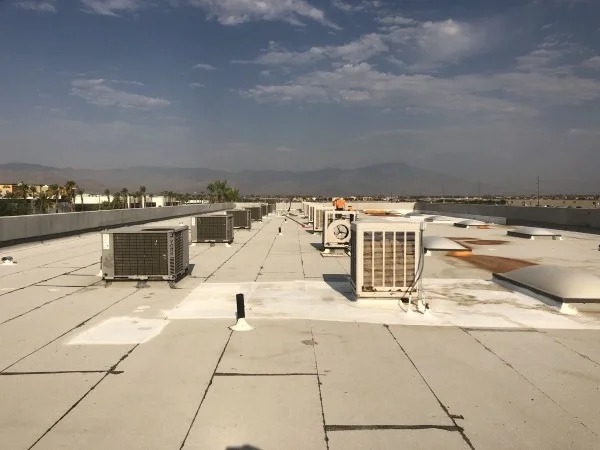
Standing water is one of the clearest signals something's wrong underneath. Low spots usually mean the insulation below has compressed or soaked up moisture. Left alone, they get worse, never better.
The best time to catch them is right after rain. In Southern California, that's the day an atmospheric river finally rolls through. Our Southern California commercial roofing crews walk roofs the morning after every big storm. Anywhere water sits longer than 48 hours is a problem.
First, check that every drain is clear. Leaves, a stray tarp, a tennis ball from the lot next door. If the drains are open and water still pools, the deck or the insulation is the culprit, and that needs a trained eye.
Sign #2: Is your roof past its prime?
Age still counts. A roof pushed past the lifespan of its material, with no maintenance history behind it, is living on borrowed time.
How long it should last depends entirely on what's up there.
| Roof type | Typical lifespan | How it usually fails | Inspection cadence |
|---|---|---|---|
| TPO (single-ply) | 20–30+ years | Punctures, oil and grease damage, seam separation | Twice a year |
| EPDM (single-ply) | 20–30 years | Shrinkage, weak taped or adhered seams | Twice a year |
| PVC (single-ply) | 20–30+ years | Brittleness with age, though it resists chemicals well | Twice a year |
| Built-up / modified bitumen | 15–25 years | Surface UV breakdown, blistering, needs recoating | Once a year |
| Spray foam (SPF) | 25+ years with upkeep | Needs a fresh top coat roughly every 10 years | Monthly drain checks |
| Standing seam metal | 40–60+ years | Loose fasteners, seam leaks, punctures | Once a year |
If your TPO membrane went down in 2008 and has never had a professional set foot on it, you're overdue. The material sets the ceiling. Whether you hit that ceiling comes down to roof maintenance and a little luck with the weather.
Sign #3: Blisters and bubbles in the membrane
Bubbling, also called blistering, shows up on membrane roofs like TPO, PVC, EPDM, and built-up systems. A blister forms when moisture or air gets trapped under the membrane and expands.
Bad installation causes it. So does poor ventilation. So does heat. Roofs that bake through Southern California summers and cool fast at night go through constant expansion and contraction, and that thermal cycling pries the layers apart. A reflective cool roof runs 50 to 60 degrees cooler than a dark one at peak summer, per EPA measurements, which is why they dominate flat-roof retrofits in hot markets.
Small blisters turn into big ones. Catch them early and a repair might save the roof. Ignore them and you're shopping for a new one.
Sign #4: Visible storm damage
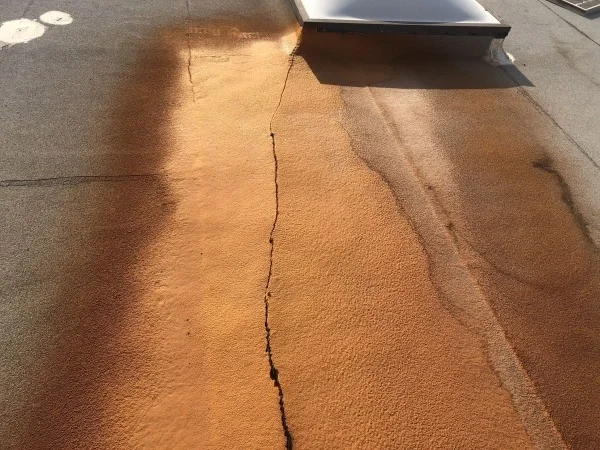
Your roof is not built to shrug off a storm. Hail, wind-driven debris, and the occasional heavy rain all take a toll.
Hail is sneaky. It can bruise and puncture a membrane without leaving a mark you'd notice from the ground. After any hailstorm, get the roof professionally inspected. The damage that voids your warranty or starts a slow leak is usually invisible until it isn't.
Sign #5: Cracked flashing and pitch pans
Flashing is the metal that seals the spots where your roof meets something vertical: walls, curbs, skylights, chimneys. Pitch pans are the metal collars around pipes and other penetrations. Together they're the front line against water sneaking in at the edges.
When flashing cracks or a pitch pan dries out and pulls away, water slips in right at the seam. These leaks start small and hide well. They'll rot decking and soak insulation for months before a stain ever shows up on someone's ceiling. A regular inspection schedule is the only reliable way to catch them.
Sign #6: Holes and tears you can't always see
This one sounds obvious, but most membrane punctures hide in plain sight. Commercial roofs are crowded. HVAC units, generators, exhaust fans, and in hospitals and factories, even more equipment. Every service call sends a technician across your membrane with tools and ladders.
A dropped wrench, a dragged condenser, a careless boot, a hard-set ladder. That's how most punctures happen, and they almost never get reported. The crew fixes the AC and leaves a quarter-inch hole behind.
Sign #7: What does wind really do to a flat roof?
Wind does more damage than people expect, and it does it quietly. Gusts, sustained Santa Ana events, and straight-line winds all stress a roof, and because there's usually no rain involved, nobody thinks to check afterward.
Membranes rarely blow off in one piece. What happens is the seams or the flashing edge let go. Single-ply membrane standards exist largely to deal with wind uplift, because uplift is where these systems fail. Most facility managers expect a seam to split. In practice, the system tends to give where the membrane ties into the flashing.
On big buildings, schools, malls, distribution centers, strong wind creates serious negative pressure that pulls up on the whole assembly. The more often your building takes a beating from wind, the sooner replacement lands on the calendar.
One more thing about wind. Check what your commercial policy covers, because wind damage is frequently covered, and that can change the math on a replacement.
Why smart building owners inspect before they replace
Every sign on this list shares one root cause: nobody was looking until it was too late. A real inspection is the only way to find trouble while it's still small and easy to fix.
A proper commercial roofing inspection covers four things:
The membrane surface, including ponding, blisters, debris, and UV wear.
Drainage, from the drains and scuppers to whether water actually leaves the roof.
Every flashing point and penetration, including curbs, pipes, vents, and HVAC connections.
The structure underneath, meaning decking, fasteners, and insulation moisture.
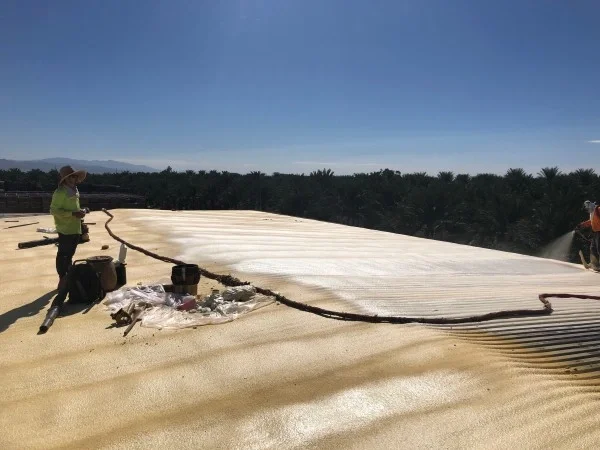
Now, about the "just coat it" advice you'll hear from some quarters. A fluid-applied repair and restoration coating can add 15 years to a sound roof, and it's a smart move when core samples come back dry. Put that same coating over wet insulation and you've sealed the rot inside. It buys you nothing and robs you of the chance to fix the real problem. Restoration works for healthy roofs. It's a waste of money for failing ones.
I'll level with you on what this article won't do. It won't hand you a replacement number, because that depends on your building, your membrane, your access, and the code upgrades that hit the moment you re-roof. Anyone quoting one sight-unseen is guessing.
And contractors are slammed right now. A 2025 workforce survey from the Associated General Contractors found 45% of firms reporting project delays from labor shortages, so the roof you decide to replace in spring might not get scheduled until summer.
The fix is boring and it works. The owners who avoid surprise failures all do the same thing. They get an experienced team on the roof on a schedule, not after the ceiling tiles turn brown. Getting on a preventive maintenance plan is the difference between a roof that quietly reaches 25 and one that fails at 14.
Our inspectors are trained to spot the hidden problems most people walk right past. If your commercial roofing is showing any of the seven signs above, or you just can't remember the last time anyone checked, that's your cue to act before the next storm makes the decision for you.
FAQs
What is the average lifespan of commercial roofing?
Most commercial roofing systems last 20 to 30 years, but the real-world average for low-slope membranes runs closer to 17 years, according to National Roofing Contractors Association data. Install quality, drainage, and maintenance affect that number more than age alone. Well-maintained roofs often last 25 years.
How often should a commercial roof be inspected?
At least once a year, and twice a year is better in climates with intense heat or heavy storms. Most major membrane manufacturers require documented annual inspections to keep the warranty valid, so skipping them can void coverage entirely. Spring and fall are the ideal windows.
When should you repair vs. replace a commercial roof?
Repair makes sense for isolated, recent damage on a roof that's otherwise sound. Replace when you're patching the same areas year after year, or when moisture scans show widespread wet insulation. Insurance also plays a role, since many carriers stop covering full replacement once a roof passes 15 to 20 years old.
Does standing water always mean my commercial roofing needs replacing?
Not always. Ponding can sometimes be fixed with added drains or tapered insulation if the membrane and the deck below are still in good shape, confirmed by a moisture scan. Persistent pondering on an older roof usually points to deeper trouble.
Can you install a new membrane over an old commercial roof?
Sometimes, if local code allows it, the existing roof is dry, and there aren't too many layers already in place. Energy codes often require added insulation on any re-roof, so a recovery isn't always the simpler path it looks like. A moisture survey should come first.
Will insurance cover a commercial roof replacement?
It depends on your policy and the roof's age. Many commercial carriers limit coverage or switch to actual cash value for roofs older than 15 to 20 years, and some analyses in 2025 found roughly 70% of major carriers enforcing 20-year thresholds. Replacing an aging roof can improve your renewal terms.