Can You Put A New Roof Over An Existing Roof? What California Allows
Yes, once. Building code lets you install a new roof over one existing roof. It does not let you go over two. If your building already carries 2 layers, the next roof means a full tear-off, and no contractor can write around that. On low-slope and commercial buildings the rules open up further, because spray foam and coating systems are designed to go over what's already there. I've been roofing in Southern California since 1992, and the recover question is the one I get asked more than any other. The answer is almost never about the number of layers. It's about what's underneath them.
What is a roof recover?
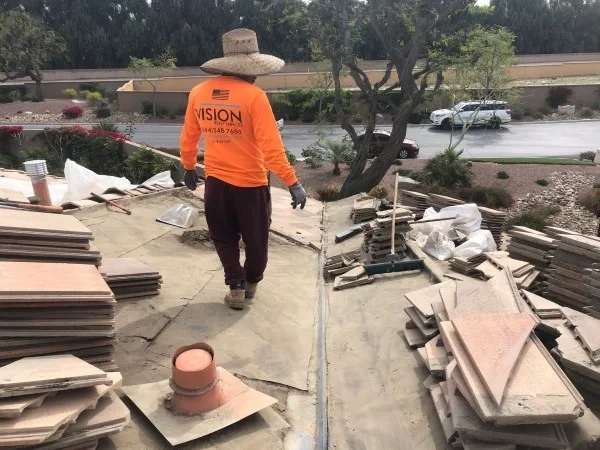
A roof recover is a new roof covering installed over the existing one, with no tear-off. Code treats it as an alteration, not a repair. A roof replacement strips everything to the deck. The difference matters legally and financially: a recover skips disposal cost and keeps the building dry, but it hides the deck from inspection.
What does the code actually allow?
One recover. Not two. The International Residential Code section on roof recover (R908.3.1.1 for houses, Section 1511 in the commercial code) blocks a recover in 3 situations: when the existing roof is water-soaked or has deteriorated far enough that it won't work as a substrate; when the existing roof is slate, asbestos-cement, concrete tile, or clay tile; and when the existing roof already has 2 or more layers of any type of roof covering.
Read that last one again. It says any type, not any shingle. A layer of built-up roofing under a layer of modified bitumen counts as 2. So does an old wood shake roof under an asphalt overlay.
California adopts these provisions through the state building and residential codes, and cities apply them at permit. Some jurisdictions add their own limits on top. Contra Costa County, for example, calls for structural review when roofing exceeds 6.0 pounds per square foot. A second layer of architectural shingles will put most houses close to that line.
Almost nobody publishes this next part. NRCA's reroofing guidance states that protective coatings are not counted as an additional layer under this rule. That single line changes the math on thousands of Southern California commercial buildings, and I'll come back to it.
What happens if a roof already has 3 or 4 layers?
Nothing good, and the cost lands on the current owner. Roofs with 3 and 4 layers exist because they were installed before the rule tightened, or without a permit. If you own one, 3 things follow. The next roof is a mandatory tear-off. Your disposal cost multiplies, because tear-off is priced by weight and you're paying to haul 3 roofs instead of 1. And a home inspector or appraiser who counts layers at the eave will flag it, which is a problem at sale.
I've never seen a jurisdiction approve a third layer. I've seen plenty of buildings carrying one.
How do I tell how many layers my roof has?
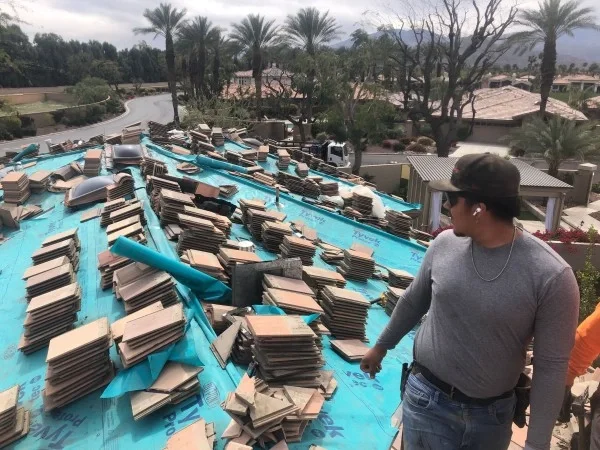
Go look at the rake edge or the eave, where the roof edge is exposed, and count the courses of material stacked at the drip edge. Each layer reads as a distinct band. One layer of asphalt shingle plus underlayment is roughly 1/2 inch thick there. Two layers reads closer to 1 inch, and the edge looks visibly fat. Flashing that sits proud of the field, or a vent collar extended with sealant, usually means something was added over it. Your city's permit history for the address is the third check, because a permitted re-roof lists whether it was a recover or a replacement.
If you can't tell from the ground, that's what an inspection is for. Our Roof Health Check includes core cuts on low-slope roofs, which is the only way to know for certain what's stacked up there, and we send a written report with photos within 24 to 72 hours.
Recover eligibility by roof type
Not every roof is a candidate, and the disqualifiers are specific. Here is how the common Southern California assemblies sort out.
| Existing roof | Recover allowed? | What governs it |
|---|---|---|
| 1 layer asphalt shingle, lying flat | Yes | Shingles must be flat, secured, and free of curling |
| 2 layers of anything | No | Code condition 3, tear-off required |
| Wood shake | Limited | Only with metal panels, shingles, or tile, plus a code-compliant separation |
| Slate, clay, or concrete tile | No | Code condition 2, named outright |
| Water-soaked or deteriorated deck | No | Code condition 1 |
| Built-up or modified bitumen, low-slope, dry | Yes | Common substrate for a foam or coating recover |
| Single-ply TPO or EPDM, dry and attached | Yes | Subject to a moisture survey and adhesion testing |
| Metal, structurally sound | Yes | Frequent foam recover candidate |
Does a recover still have to meet Title 24?
Yes, and this is where most quotes fall apart. A recover is an alteration under California's energy code, so it triggers the cool roof requirement.
Under the 2025 Energy Code, in effect since January 1, 2026, a single-family re-roof alteration in climate zones 4 and 8 through 15 has to meet Section 150.2(b)1I. Per the Cool Roof Rating Council's summary of the California requirements, a steep-slope roof needs an aged solar reflectance of at least 0.20 and thermal emittance of at least 0.75, or an SRI of at least 16. A low-slope roof needs aged solar reflectance of at least 0.63 and thermal emittance of at least 0.75, or an SRI of at least 75. The product has to carry a valid CRRC label.
Two consequences owners don't expect. A standard dark asphalt shingle generally will not clear the steep-slope threshold, so a like-for-like nail-over can fail energy compliance even when it passes the layer test. And on a low-slope roof, that 0.63 reflectance number is high enough that only a bright reflective surface clears it. A white silicone or acrylic topcoat over foam clears it comfortably. Aged gravel does not. Which products hold that reflectance through 10 desert summers is a short list, and cool roof selection is where most of the price difference shows up.
Climate zone is assigned per address, not per city, so verify yours against the California Energy Commission's zone finder before pricing anything.
Can spray foam go over an existing roof?
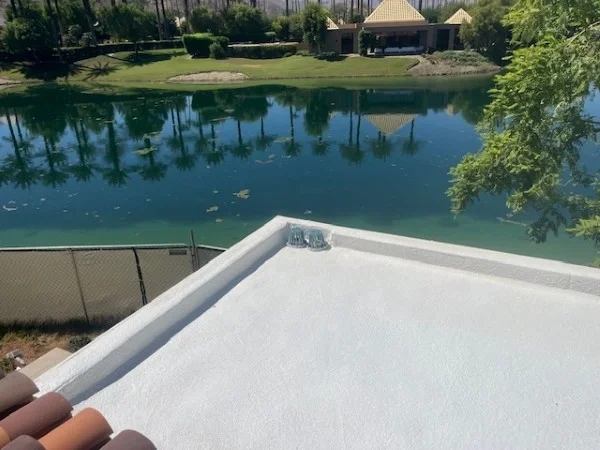
Yes, and it is one of the few systems built for it. Spray polyurethane foam is applied over an existing membrane rather than in place of it, which is why it dominates recover work on low-slope commercial buildings.
The Insurance Institute for Business and Home Safety's guidance on spray foam roofing sets out the conditions. The substrate has to be structurally sound, dry, and clear of loose gravel, dirt, and contaminants such as oil and grease. Closed-cell foam runs 2.5 to 4.0 pounds per cubic foot with an R-value near 5.5 to 6.5 per inch. A coated foam roof adds less than 0.5 pounds per square foot per inch of thickness, which is why it works on buildings that could never carry a second layer of shingles. Maintained systems show service lives over 30 years, and the Spray Polyurethane Foam Alliance puts coating life at 5 to 20 years depending on climate, coating type, and thickness.
The disqualifier is water. Foam cannot be applied over a wet assembly, because trapped moisture has nowhere to go and the adhesion fails. That's the whole decision, and it's why we cut cores instead of guessing.
Vision Roof Services runs 12 certified spray foam applicators out of 60 roofers, all trained through General Coatings, across roughly 7,500 completed jobs including the LifeStorage facility in Costa Mesa and the Yamaha facility in Buena Park. Most of it is spray foam recover work, not new construction.
The 4-Check Recover Test
Before anyone quotes you a recover, 4 things need an answer. If any one of them fails, the recover fails with it.
| Check | What it answers | How you answer it |
|---|---|---|
| Deck | Is the structural deck sound and dry? | Core cuts on low-slope. On steep-slope, soft spots underfoot and stains in the attic |
| Moisture | How much of the existing insulation is wet? | Moisture survey. Wet insulation stays wet under a recover and kills adhesion |
| Layers | How many roof coverings are up there now? | Count at the rake edge, confirm against permit history. One means options, two means tear-off |
| Code | What does the energy code require at this address? | Climate zone and slope, checked before product selection rather than after |
Can you put architectural shingles over 3-tab?
You can, but the roof will telegraph. 3-tab shingles are installed at a 5 inch exposure. GAF's architectural Timberline line is installed at 5 5/8 inches. That 5/8 inch difference accumulates, so after 8 courses the new shingles sit a full course out of step with the old ones underneath, and the roof reads as bumpy from the street.
The warranty consequence is bigger than the cosmetic one, and most articles get it wrong. Current architectural shingles carry a lifetime limited warranty with a 10-year non-prorated period, not the 30-year term you'll still see quoted online. 3-tab shingles carry 25 years with a 5-year non-prorated period. According to GAF's residential warranty comparison, the tiers that extend the non-prorated period to 50 years all require both qualifying accessories and a certified contractor. That contractor requirement, not the accessory list, is what most homeowners never hear about.
Three ways a recover fails after installation
Flashing, almost every time. A recover puts new material over old flashing at the chimney, the walls, and the penetrations. If that flashing was leaking before, it leaks after, and now it's buried. On low-slope roofs, drains and scuppers are the same story.
The second failure is trapped moisture. Water in the old assembly does not dry out under a new one. It moves, it delaminates the new system from the old, and it rots the deck out of sight.
The third is heat. Two layers of dark asphalt hold more heat than one, and in Indio or Palm Desert, where roof surface temperatures run brutal through summer, that shortens the life of the new layer. This is an observation from 30 years of desert work rather than a published figure, but it's consistent enough that I price a desert nail-over as a shorter-life roof than the same job in Orange County.
Recover savings versus a tear-off
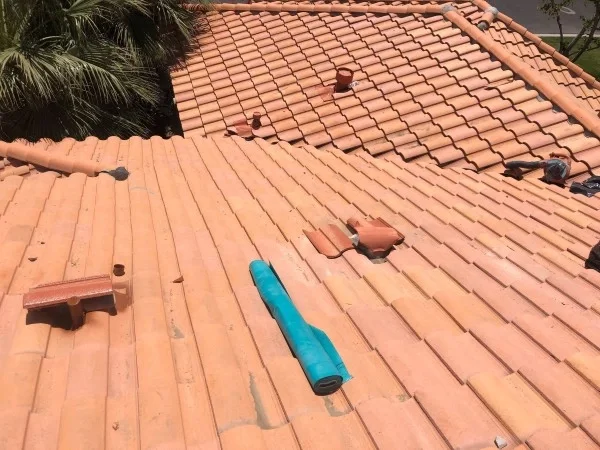
The savings come from 2 places: labor to strip the old roof, and disposal billed by weight. That's real money, and on a large commercial building it can decide whether a project happens this year.
| What you get | Recover | Full replacement |
|---|---|---|
| Tear-off labor | None | Full |
| Disposal cost | None | Billed by weight |
| Deck inspected | No | Yes |
| Flashing replaced | No | Yes |
| Building stays dry during work | Yes | Exposed between phases |
| Enhanced shingle warranty available | No | Yes |
What I tell owners: a recover on a sound, dry, single-layer roof is a good decision. A recover used to avoid finding out what's wrong is a deferral, and deferrals get expensive. On a commercial flat roof there's a third option sitting between the two, and coating versus replacement is where that call gets made.
When to stop considering a recover
Some buildings are past it. Standing water 48 hours after rain, more than a quarter of the insulation reading wet, deck deflection you can feel underfoot, or leaks in more than 3 locations. On flat roofs those failures trace to drains, seams, and parapet details that a recover won't touch.
Solar changes the math too. If panels are going up within the next 5 years, do the roof first and do it right, because pulling and resetting an array to fix a recover costs more than the recover saved.
What to ask before you sign
Ask the contractor to state, in writing, how many existing layers they counted and how they counted them. Ask for the moisture survey results on any low-slope roof. Ask which code section they're permitting under and what the energy compliance path is. Ask whether the manufacturer warranty they're quoting survives a recover, because several do not.
Any contractor who can't answer those 4 in writing is guessing about whether you can put a new roof over an existing roof at your address. We send a written Roof Health Check report with photos within 24 to 72 hours of the visit, and it names the layer count, the moisture readings, and the code path before there's a price on anything. Book a free Roof Health Check through the Palm Desert or Mission Viejo office.
FAQs
How many layers of shingles can you put on a roof?
Two, and only if the first layer qualifies. Code blocks a recover once a roof already has 2 or more layers of any roof covering, which makes 2 the practical ceiling and a tear-off mandatory after that. It also blocks a recover over slate, clay, concrete tile, and asbestos-cement regardless of layer count.
Can you put a new roof over an existing roof in California?
Yes, once, if the existing roof is dry, sound, and a single layer. California adds a second test that most states don't: the re-roof has to meet the energy code's cool roof requirement in climate zones 4 and 8 through 15, which a standard dark shingle often fails.
How do I know how many layers my roof has?
Look at the rake edge or the drip edge and count the stacked bands of material. One layer plus underlayment measures roughly 1/2 inch at the edge; 2 layers reads closer to 1 inch. On a low-slope roof the only reliable method is a core cut, which is part of our Roof Health Check.
Can spray foam be applied over an existing roof?
Yes, on built-up, modified bitumen, single-ply, and metal substrates, provided the assembly is dry and structurally sound. Per IBHS guidance, closed-cell foam runs 2.5 to 4.0 pounds per cubic foot at roughly 5.5 to 6.5 R per inch and adds under 0.5 pounds per square foot per inch, and maintained systems last over 30 years.
Does a second layer of shingles void the warranty?
It doesn't void the base material warranty, but it takes the enhanced tiers off the table. GAF's warranties that extend the non-prorated period to 50 years require both qualifying accessories and a certified contractor, and a recover typically can't satisfy the full system requirement.
Is a roof recover cheaper than a full replacement?
Yes, because you skip tear-off labor and disposal, which is billed by weight. The gap widens on large commercial roofs and on buildings carrying heavy existing assemblies.
What happens if my roof already has 3 layers?
Your next roof is a full tear-off, with no recover option. Expect higher disposal cost, since you're paying to remove 3 roofs instead of 1, and expect an inspector or appraiser to flag it at sale.