How long a tile roof lasts in Southern California depends on the layer you can't see. On our desert installs, the tile stays sound for about 40 to 50 years, but the underlayment, the waterproof layer under the tile, is usually spent at 20 to 25. Our weather decides how fast that happens.
The coast is easier on the underlayment. In a 2012 article for HOA boards, roof consultant Carl Brown put standard underlayment at about 25 years: closer to 15 to 20 in the desert because of the heat, and up to about 30 near the coast. That's a 10 to 15 year gap for the same roof.
I've worked on Southern California roofs since 1992 and founded Vision Roof Services in 2014. We've completed about 7,500 roofing jobs, and with offices in Palm Desert and Mission Viejo, our crews work in desert heat and near the Orange County coast.
Tile roof lifespan is the number of years the whole roof system, meaning the tile, underlayment, flashing, and fasteners, keeps water out before it needs major work. In Southern California, the tile usually outlasts everything under it. The underlayment wears out first, in about 15 to 30 years, depending on how much heat the roof takes.
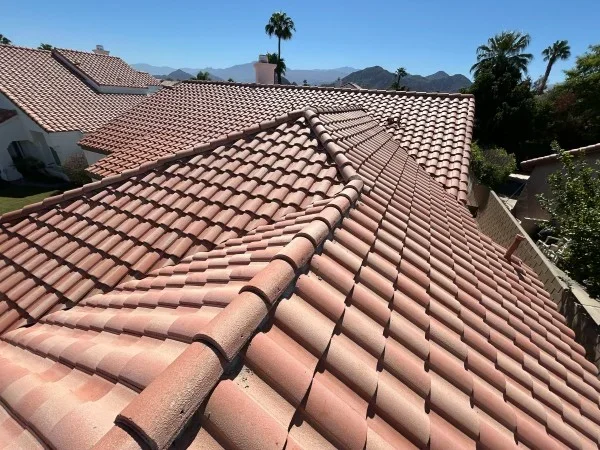
How long does a tile roof last in Southern California? 2026 numbers by part
Plan around 2 clocks. The tile runs for decades, and the underlayment under it runs 15 to 30 years. The table puts the published numbers next to what we see on our own desert jobs.
| Part of the roof | Typical life | Source |
|---|---|---|
| Clay or concrete tile, normal wear | 100+ years | InterNACHI life-expectancy chart |
| Clay or concrete tile, desert installs | About 40 to 50 years | Our desert installs |
| Underlayment, desert installs | 20 to 25 years | Our desert installs |
| Underlayment, desert (published) | 15 to 20 years | Carl Brown, AWS Consultants (2012) |
| Underlayment, coast (published) | Up to about 30 years | Carl Brown, AWS Consultants (2012) |
| Underlayment replacement, California HOA planning | About 30 years | Association Reserves (2019) |
| Flashing and valleys, desert installs | About 20 years | Our desert installs |
| Tile manufacturer warranties | 50+ years for most makers | Tile Roofing Industry Alliance |
InterNACHI, the home inspectors' association, lists clay and concrete tile at 100-plus years on its life-expectancy chart. Read the fine print, though. The chart says its estimates assume "normal wear and tear, and not extreme weather." I'd call a Coachella Valley summer extreme.
According to the Tile Roofing Industry Alliance, most makers back their tile with warranties of 50 years or more. That coverage is for the tile. The underlayment is a separate product with a much shorter life, and it's the part that leaks.
How does Southern California weather wear out a tile roof?
Desert roofs and coastal roofs wear out in opposite ways. In the desert, heat cooks the underlayment, and on the coast, moisture and salt go after the metal.
That's why the right fix in Newport Beach can be the wrong one in La Quinta. The California Energy Commission splits the state into 16 building climate zones. It measures our coast at Torrance (Zone 6) and San Diego (Zone 7), the inland valleys at Fullerton (Zone 8) and Riverside (Zone 10), and the low desert at Palm Springs (Zone 15).
Desert heat in the Coachella Valley
We work out of Palm Desert, where summer afternoons can run 110 to 120 degrees. The U.S. Department of Energy says a dark roof can hit 150 degrees or more in summer sun. Researchers at Lawrence Berkeley National Laboratory note that heat speeds up chemical reactions that break roofing materials down.
Tile shades the underlayment, but heat still builds under it every afternoon. Year after year, it bakes asphalt-based underlayment brittle from below. Then monsoon season brings microbursts that can pry up tile and lift roof edges in a single afternoon, and wind-driven rain finds the cracks.
Salt air and the marine layer on the coast
In Orange County, the marine layer keeps roofs damp for hours after sunrise, and salt in the air goes after metal first. On a tile roof, that's the flashing, the valley metal, and the fasteners, and salt can corrode them years ahead of schedule. The underlayment ages slower here because it isn't baking all summer.
Inland valleys and Santa Ana winds
Inland valleys, including inland South Orange County, get hotter summers than the coast, plus dry Santa Ana winds in fall and winter.
Wind alone rarely strips a properly installed tile roof. The Tile Roofing Industry Alliance says tile roofs can be designed to withstand winds up to 200 mph. What breaks tile is what the wind throws at it, like a branch or a patio umbrella. After a big wind event, walk the yard and look for tile pieces.
Wildfire embers ride the same winds
Santa Ana season is also fire season. CAL FIRE's home-hardening guide says California requires Class A roof coverings and names tile as one. It also tells homeowners to fill gaps between the roof covering and the sheathing so embers can't get in. On tile, check the open ends at the eaves and keep dry leaves out of the valleys and gutters.
Why does the underlayment fail before the tile?
Tile sheds water, and the underlayment stops it. Some rain gets under the tile, especially when wind drives it sideways, and the underlayment carries that water down to the eaves.
That layer is often asphalt-saturated felt, and heat dries it out until it splits. On desert roofs, we regularly find sound tile sitting on dead felt, which is why a crack-free roof can still leak. Leaks on tile roofs are 1 of the 2 calls we take most in the Coachella Valley.
Better underlayment helps, but it doesn't close the gap. Premium self-adhered products such as Westlake Royal's TileSeal HT carry a 30-year limited warranty, while most tile makers warrant their tile for 50 years or more.
What are the signs your tile roof's underlayment is failing?
The first signs usually show up inside, not on the roof. Watch for a ceiling stain after the first big rain, a musty smell in the attic, daylight through the roof deck, or a leak that comes back after a tile repair.
Outside, use binoculars from the ground instead of climbing up. Tile fragments or sandy grit in the gutters, slipped or cracked tiles, dark patches that don't match the tiles around them, and tile that's gone chalky and faded all mean the roof is aging. None of them prove the underlayment is gone, so the next step is lifting 1 or 2 tiles to look.
Concrete vs. clay tile in Southern California weather
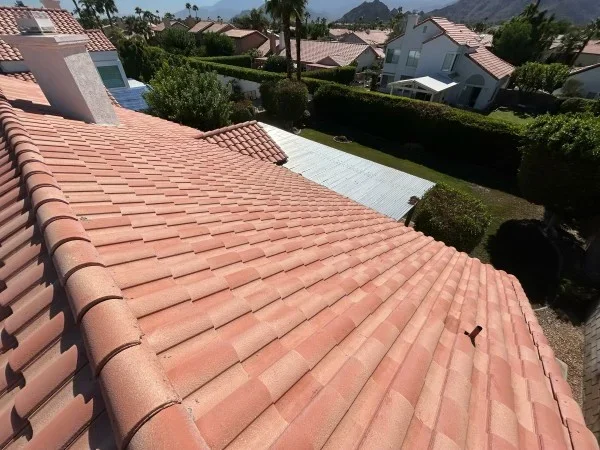
In our weather, neither tile decides the roof's lifespan, because both outlast the underlayment beneath them. Clay usually keeps its color longer, and concrete is the tile you'll see on most desert tract and HOA homes.
Concrete fades to a chalky finish in strong sun, then turns brittle and cracks under foot traffic. A white, powdery film on newer concrete tile is efflorescence, which the Tile Roofing Industry Alliance says is temporary and usually fades on its own.
Clay holds its color but breaks more easily under a dropped branch or a wrong step. If your clay color is discontinued, matching it is the hardest sourcing job we take on.
Why 50 years is the wrong number to plan around
Most 50-year and 100-year numbers describe the tile alone. Budget for a 50-year roof in the desert, and the underlayment will likely need replacing around the halfway mark.
Even our own roof lifespan chart lists tile at 50 to 100 years, because it's measuring the tile.
The reserve-study world has already changed its math. Association Reserves, which writes reserve studies for HOAs, used to plan for tile roofs with a small repair allowance. After older tile roofs at client communities needed full underlayment replacement, it now calls that project "a responsible expectation for tile roof owners." In California, it plans for that job about 30 years in.
Our desert jobs run shorter than that, at 20 to 25 years. My advice: plan your tile roof around the underlayment's age, and plan to keep your tile when that day comes.
What should you do at 15, 20, and 25 years?
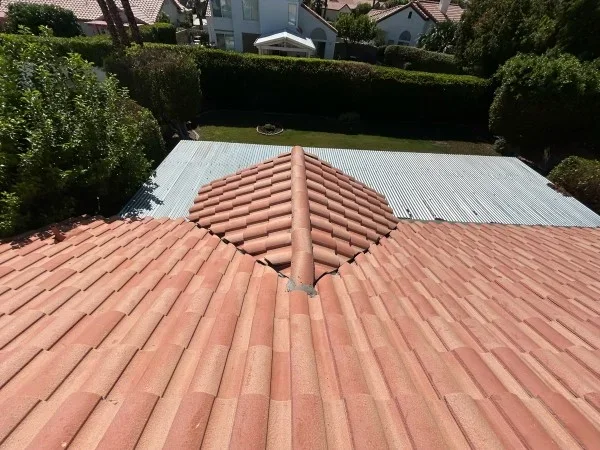
Let the underlayment's age set the job, because a tile roof can look fine from the street and still be near the end. Under 15 years, fix the tile. Past 20, look under the tile before you fix anything.
| Roof age and what you see | What's usually going on | The job |
|---|---|---|
| Under 15 years, 1 or 2 broken tiles, no leak | Underlayment still sound | Swap the broken tiles |
| 15 to 20 years, no leaks yet | Underlayment aging, fastest in the desert | Yearly inspection with 1 or 2 tiles lifted |
| Over 20 years, broken tiles or an active leak | Underlayment near the end | Lift-and-relay with new underlayment and the same tile |
| Over 25 years on the original underlayment | Underlayment and flashing both due | Lift-and-relay with new flashing |
| Brittle tile across the roof, more than 1 leak, or a sagging deck | The whole system is spent | Full replacement |
A Roof Health Check settles it. Our Four-Layer Check covers the tile, the underlayment, the penetrations and flashing, and the deck and attic side. Checking the underlayment means lifting 1 or 2 tiles, so a bidder who never opened your roof never checked it. You get photos of each layer and a written report in 24 to 72 hours, and it's yours whether you hire us or not.
If the roof is under 15 years old, broken roof tiles are usually a same-day fix. We match the tile, swap it, and leave the underlayment alone.
Keeping your tile: how a lift-and-relay works
When the underlayment fails and the tile is still sound, you can usually keep the tile. A lift-and-relay, sometimes called a tile reset, is the fix our residential roofing crews reach for most on older desert tile roofs.
Our crews lift and stack the tile, tear off the old felt, re-deck anything soft, install new underlayment, and set the same tile back down. For roofs over 25 years old, Brown also recommends new flashing during the re-set. Most of your existing tile is salvageable, so you don't pay for tile you never needed, and a sound field of tile stays out of the landfill.
Some tile will break on the way off. Published estimates run from about 5% (Association Reserves) to about 30% on roofs past 25 years old (Brown). Replacement pieces have to match, and if your color is discontinued, we track down salvage tile. That sourcing can cost more than the labor.
Keeping your own tile also keeps your HOA-approved color. In Mission Viejo, the HOA in most master-planned neighborhoods reviews material, color, and tile profile before the city signs off on a re-roof.
We don't post a flat price for a relay, because it depends on how much tile survives the lift, whether your color is still made, what the deck looks like once it's open, and the roof's pitch and height. You get an exact figure in writing after the Roof Health Check, and larger jobs can be financed through Acorn Financing. A relay still costs far less than all-new tile. Full replacement is for when the tile itself is spent.
Does your weather zone change the rules for a new roof?
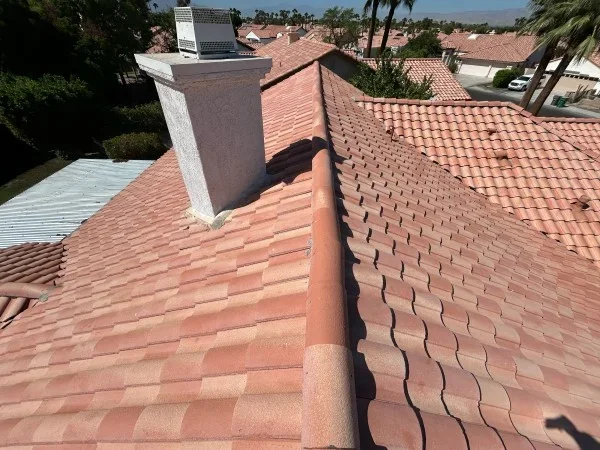
It can. Replace more than half of a sloped roof in an inland or desert climate zone, and California's cool-roof rule applies. On the coast, in Zones 6 and 7, it doesn't.
The 2025 Energy Code took effect January 1, 2026. For a steep-slope re-roof in Zones 4 and 8 through 15, the new roofing needs an aged solar reflectance of 0.20 or higher and a thermal emittance of 0.75 or higher. A Solar Reflectance Index of 16 or higher also works. Homes with R-38 attic insulation or a qualifying attic radiant barrier are exempt, and the Energy Commission lists tile among the materials that can meet the rule.
Palm Desert sits in Zone 15 and Mission Viejo in Zone 8, so the rule covers re-roofs around both of our offices. Look up your zone with the Energy Commission's climate zone tool. If you plan to reuse your tile, ask your roofer how your city handles the energy-code part of the permit.
HOA boards: plan reserves around the underlayment
California law already puts your roofs in front of the board every 3 years. Use those inspections to track underlayment age as well as broken tile.
Under Civil Code section 5550, a board must order a visual inspection of the association's major components at least every 3 years. That applies once those components are worth at least half the annual budget, not counting reserves. The reserve study then lists components with less than 30 years of useful life left. A desert tile roof with 20-year-old underlayment belongs near the top.
I learned this trade at 15 on HOA roofs with my father, and HOAs are still among the groups we work with most. Ask your reserve specialist to carry tile underlayment as its own line item, on a 20 to 30 year cycle depending on how close you are to the desert or the coast.
How to get more years out of a tile roof in Southern California
Keep people off the tile, and catch underlayment problems before they reach the ceiling.
Book an inspection once a year. In the desert, do it in September, right after the heat season, and again after any big monsoon or wind event. Most homeowners here inspect in spring, which is about 6 months late. Anyone on the roof, solar and HVAC crews included, should use walk boards and step on the tile's supported bottom edge, never the middle.
Before you add solar panels, check the underlayment's age, because pulling panels later to redo the roof is an expensive do-over. Our Roof Assurance Plans start at $499 and include an annual 30-point inspection plus cleaning of drains and roof valleys.
FAQs
How long does a tile roof last in Southern California?
The tile usually lasts decades. InterNACHI lists clay and concrete tile at 100-plus years under normal wear, and on our desert installs it stays sound for about 40 to 50 years. The underlayment under it sets the real lifespan, at about 20 to 25 years on our desert jobs and up to about 30 near the coast.
How long does a tile roof last in Southern California's desert heat?
On our Coachella Valley installs, the underlayment is usually spent at 20 to 25 years, even when the tile above it still looks fine. Roof consultant Carl Brown put desert underlayment at 15 to 20 years, compared with up to about 30 on the coast.
Can you replace the underlayment without replacing the tiles?
Yes. A lift-and-relay removes the tile, replaces the underlayment, and resets the same tile, which keeps your HOA-approved color. Published breakage estimates run from about 5% to about 30% on roofs past 25 years old.
Is a 20-year-old tile roof too old?
The tile usually isn't. In the desert, though, 20 years is when we start finding underlayment near the end of its life. Have a roofer lift 1 or 2 tiles so you can see the underlayment itself.
Do I need a cool roof when I replace a tile roof in Southern California?
It depends on your climate zone. In Zones 4 and 8 through 15, which include the inland valleys and the desert, replacing more than half of a steep-slope roof requires an aged solar reflectance of at least 0.20 and a thermal emittance of at least 0.75, or an SRI of at least 16. Coastal Zones 6 and 7 don't have that steep-slope rule, and homes with R-38 attic insulation are exempt.
Does salt air shorten a tile roof's life on the coast?
Salt air is harder on the metal than on the tile, so flashing, valley metal, and fasteners corrode first. The underlayment usually lasts longer near the coast, up to about 30 years by roof consultant Carl Brown's estimate, because it isn't baking all summer.
How often should a tile roof be inspected in Southern California?
Once a year, plus after a big wind or monsoon storm. In the desert, September works best, right after the heat season. HOA boards that meet the budget threshold in California Civil Code section 5550 must also order a visual inspection of major components at least every 3 years.
In Southern California weather, a tile roof past 20 years in the desert, or nearing 30 on the coast, needs someone to lift a tile and look before you spend money on anything else. Our free Roof Health Check does that for homes in Riverside and Orange counties, with a written report and photos usually within 24 to 72 hours. You'll see what's under your tile before anyone quotes you a new roof. Our Palm Desert office holds a 4.8-star rating across 42 Google reviews.