A flat roof leaking after a storm has a weak spot that normal weather doesn't reach. A downpour can raise the water on the roof above the top edge of a flashing or curb. Wind pushes rain sideways into parapet walls and around rooftop units. Hours of steady rain soak through coating that has worn thin. And drains that sat dry for months, packed with dust and palm debris, can't move the water fast enough. It spreads across the roof and finds every open seam. Big storms don't come often here. Palm Springs averages 3 days a year with 0.5 inch of rain or more, so a roof can stay dry for months and then drip overnight. The time the leak starts and the spot where it shows up inside tell you which of those 4 things happened.
A storm leak on a flat roof is water that gets inside only during heavy, long or wind-driven rain. Light rain runs off before it reaches the weak spot, so the roof looks fine for months between storms. On flat roofs, most of the leaks we chase start where the roofing stops at a wall, curb, pipe or drain.
I started roofing at 15, working next to my father, who ran a residential HOA roofing business in Southern California. In 2014, I founded Vision Roof Services in Palm Desert. Our crews have completed about 7,500 roofing projects, and the calls we get most are about leaks and aging flat roofs.
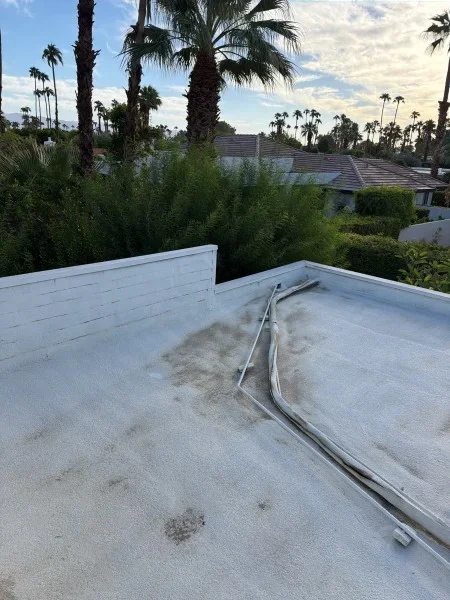
What the timing of a storm leak tells you
The timing of the drip points to where the water got in. Write down when it starts and stops, and which way the wind blows, and the search gets shorter before anyone climbs a ladder.
| When the leak shows up | What's usually happening | Where to look first |
|---|---|---|
| During the hardest rain, then it slows | Water rose above a flashing or curb, or the drains fell behind | Drains, scuppers, low spots, base flashings, curbs, door thresholds |
| Only when wind blows hard from the same direction | Rain is driven sideways into joints and openings | Parapet caps, wall flashing, stucco cracks, vents and units on that side |
| Hours into a long storm | Water sat on worn coating or open seams long enough to soak through | Low spots where water pools, blisters, split seams, old patches |
| Hours or weeks after the rain stops | Water trapped inside the roof is moving toward the ceiling | Wet insulation and the deck, often away from the stain |
The last row trips people up. A low-slope roof can hold water inside itself for weeks, and the drip can surface far from where the water got in. If a stain shows up on a dry, hot day, a roof leaking with no rain calls for a different search than a live storm leak.
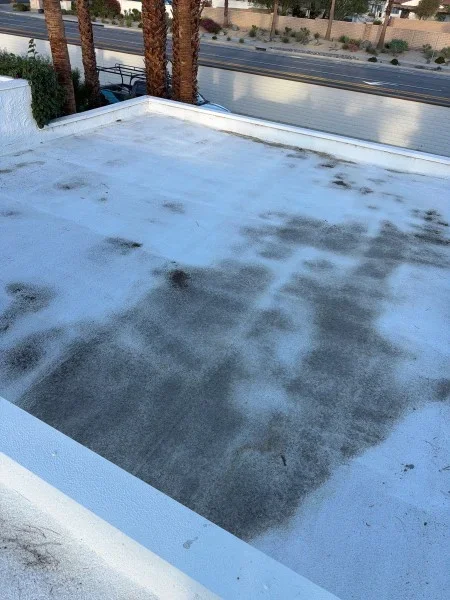
Why does a flat roof leak in heavy rain but not light rain?
Heavy rain changes how deep the water gets, how fast it has to drain, which way it moves and how long it sits. Light rain doesn't change any of them, which is why the roof stays dry in a drizzle.
Flat roofs aren't flat. The International Building Code calls for most new low-slope roofs to fall at least 1/4 inch per foot, a 2% slope. A re-covered roof can skip that minimum if it still drains within 48 hours of rain. Water moves slowly on a slope that shallow. It collects at the drains and backs up behind walls and rooftop curbs.
The water line rises past a flashing
Where the roofing stops at a wall, curb or pipe, it's sealed with flashing that turns up the side. In light rain, the water stays well below the top edge. In a downpour on a slow-draining roof, the water gets deeper. If it climbs above the top of the flashing, or reaches cracked sealant near the top, it runs behind the roofing and into the building. A low door threshold onto a roof deck fails the same way. That's why most of the leaks we chase on flat roofs start at these edges and openings.
Drains and scuppers fall behind
A flat roof sheds water only through its drains, scuppers and gutters. In the desert, those openings can sit dry for months while dust and palm debris pack them. When the first heavy storm hits, they can't move the water fast enough, and it backs up across the roof.
That's why the International Building Code requires backup overflow drains or scuppers where a parapet or other raised edge would trap water if the main drains back up. If your roof has a parapet and no backup way for water to leave, put that on your list before the wet months.
The National Roofing Contractors Association's roofing manual calls for no water left standing on the roof 48 hours after a rain. Water that stays longer is ponding water, and the desert sun breaks down the coating right where it sits.
Wind pushes rain into parapets and walls
Strong wind turns rain sideways. It drives water into the joints of parapet caps, cracks in stucco, wall flashing and the vents on rooftop units, places that straight-falling rain never reaches. When we find a stain along an outside wall after a windy storm, it almost always traces back to the flashing where the roof meets a wall or parapet.
Desert storms can bring that wind. During Hilary in August 2023, the National Weather Service recorded a 70 mph gust at Whitewater, northwest of Palm Springs. The heat does its damage between storms. Palm Springs averages 115 days a year at 100°F or hotter, and the daily swings expand and contract metal and sealant until old flashing pulls loose and cracks.
Long storms soak through thin coating
A short burst of rain runs off. A storm that lasts all night keeps water on the roof long enough to soak through coating that's worn thin, blistered or split. Desert sun breaks coatings down over time and blowing sand wears them thinner, so the low spots where water pools wear fastest. Old patches and the paths service crews walk to rooftop units also break down early.
How often does Southern California get a storm big enough to find a leak?
Not often, and far less in the desert. In NOAA's 1991-2020 climate normals, Palm Springs averages 3 days a year with 0.5 inch of rain or more, and fewer than 1 day a year with 1 inch or more.
| Weather station | Rain in a normal year | Days with 0.5 inch or more | Days with 1 inch or more |
|---|---|---|---|
| Thermal (Desert Resorts Regional Airport) | 2.96 inches | 1.5 | 0.3 |
| Palm Springs Regional Airport | 4.61 inches | 3.0 | 0.6 |
| Riverside Municipal Airport | 9.37 inches | 4.9 | 1.2 |
| Santa Ana (John Wayne Airport) | 11.18 inches | 5.9 | 2.0 |
| San Diego (Lindbergh Field) | 9.79 inches | 6.2 | 2.2 |
| Downtown Los Angeles (USC) | 14.25 inches | 9.6 | 4.2 |
Source: NOAA 1991-2020 U.S. Climate Normals. Days are yearly averages.
At the east end of the Coachella Valley, a day with 1 inch of rain comes about once every 3 years. Near the coast it comes 2 to 4 times a year. A desert roof can look fine through a dry year and still leak in the first real storm, while a coastal roof gets tested most winters.
Most of that rain lands in winter. About 75% of Palm Springs' normal rain falls from December through March, and July through September adds about 14%. Summer brings less rain but can bring the biggest storm of the year. When Hilary hit in August 2023, the National Weather Service in San Diego reported that Palm Springs got 3.18 inches, 69% of its annual average.
If your building is in the Coachella Valley, our roofers in Palm Desert can check it before December, when the wet months start.
Don't wait for the next storm to find the leak
You can find a storm leak on a dry day, and in the desert you should. The usual advice is to wait for the next big storm and watch where the water comes in. In the Coachella Valley, the NOAA numbers above mean you could wait a year or more for a day with 1 inch of rain. Meanwhile, water from the last storm sits in the roof.
You don't need rain to find these failures. Dirt rings and stains around drains show how high water stood. Cracked sealant at the top of a flashing, a split at a curb corner and coating worn down at a low spot all show on a dry day. When we suspect wet insulation, a 2-inch core sample tells us whether it's wet before anyone quotes a fix.
That's the job of our Roof Health Check. We photograph what we find and send a written report within 24 to 72 hours, so you know what failed before the next storm finds it again. The check is free for homeowners, property managers and business owners.
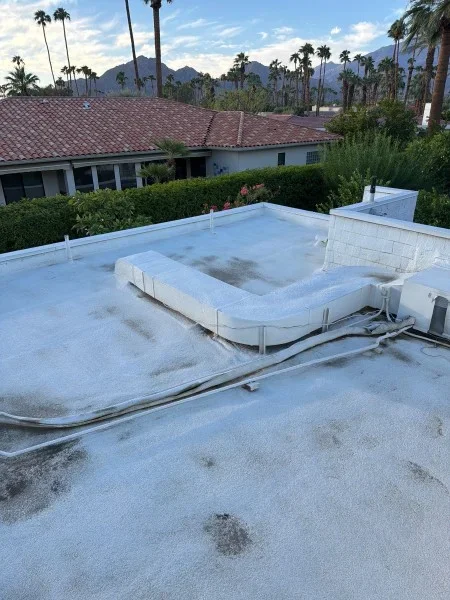
Can a spray foam roof leak after a storm?
Yes, but rarely through the foam itself. Foam goes on as a continuous layer with no seams, so storm leaks start where the topcoat has worn thin or at a penetration. Caught early, cleaning and recoating that area fixes it without a replacement.
The Spray Polyurethane Foam Alliance expects a foam roof to last 40 years or more with regular care. Its maintenance guidance calls for inspections twice a year and after severe weather. Our crew of 60 roofers includes 12 spray foam applicators certified through General Coatings. We restored the spray foam roof on Yamaha's office in Buena Park.
Foam costs more up front. Owners pick it because it has no seams to open, it's light, it can go over a sound existing roof without a tear-off and it can last decades with recoats.
Do you need a repair, a recoat or a new roof?
It depends on whether the deck and insulation under the leak are dry. If they're sound and dry, a repair, a recoat or a foam-over can stop the leak. If the insulation is wet across a wide area, or the roof is past its service life, replacement is the right call.
| Option | When it fits | What it involves |
|---|---|---|
| Repair | A single failed detail: a flashing, a curb, a drain or a split seam | Fix that detail and seal the area around it |
| Recoat or foam-over | The roof is sound and dry, but the coating is worn in spots across the roof | Clean and repair, then coat or spray foam over the existing roof |
| Replacement | Wet insulation across a wide area, or a roof past its service life | Remove the wet layers and install a new system |
Typical service life runs 20 to 30 years for TPO, PVC, built-up and EPDM roofs. Modified bitumen runs 15 to 25 years, and foam that gets recoated on schedule runs 30 to 50. We install and maintain each of these systems on flat and low-slope roofs, so the recommendation follows what we find on your roof.
Price depends on the roof's condition, whether anything has to come off, the square footage and the coating system. We give a firm price after the inspection, and financing is available through Acorn Financing.
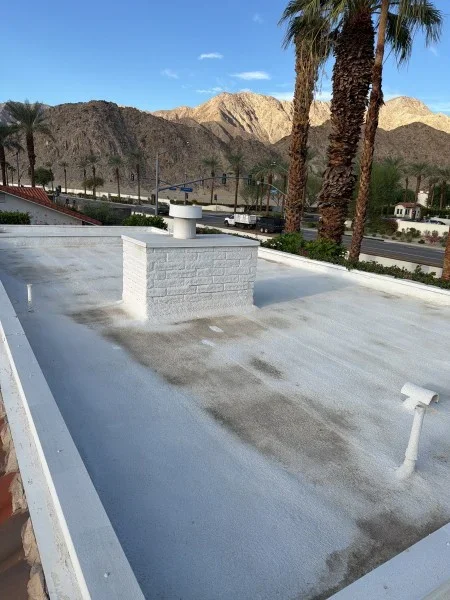
What to do with a flat roof leaking after a storm
Protect the room, record what the storm did and stay off the roof until it's dry.
Move what you can, catch the water and keep people out from under any ceiling that sags.
Take photos inside and out with the time showing. Roofers and insurers both use them.
Write down when the drip started and stopped and which way the wind blew. The timing table above turns that log into a starting point.
Stay off a wet roof, since coated surfaces get slick.
If you manage a building, tell tenants which suite was hit and keep water away from electrical equipment.
What to check before the 2026-27 rainy season
Check drains, flashing edges and worn coating now. About 75% of Palm Springs' normal rain falls from December through March, so fall is the time to fix what the summer sun opened up.
Clear every drain, scupper and gutter, and make sure overflow scuppers aren't blocked.
Look at the top edge of the flashing on walls, parapets and curbs for cracked sealant or gaps.
Check low spots for dirt rings, bare or blistered coating and old patches.
Check around rooftop units and pipes too, where service crews wear the roof down.
Book an inspection before the first big storm. For flat and foam roofs, we recommend an inspection twice a year and another after any big storm.
For HOAs and property managers, a written report with photos gives the board or owner something to act on. Our warranty and maintenance program sets an inspection and recoat schedule for each roof.
FAQs
Is a flat roof leaking after a storm an emergency?
Treat it as urgent even after the drip stops. A low-slope roof can hold water inside itself, and the lag before it shows again can run 2 or 3 weeks. The next storm will find the same opening. Get it found and fixed before then.
Why did my flat roof leak after a storm but not during it?
The water got in during the storm and then traveled. It can move along the deck or through the insulation and surface 20 feet from where it entered, 3 weeks after it rained. The stain shows where the water ended up, which can be far from where it got in.
How often should a flat roof be inspected in Southern California?
Twice a year, and again after any big storm. The Spray Polyurethane Foam Alliance recommends the same schedule for foam roofs. In the Coachella Valley, the fall inspection matters most, because about 75% of Palm Springs' normal rain falls from December through March.
Does ponding water mean my flat roof will leak?
On its own, no, but it raises the odds. Water still standing 48 hours after rain counts as ponding, and each inch of it adds about 5.2 pounds per square foot. Sun and standing water together break down the coating in that spot, and thin coating is where storm water gets through.
Can spray foam go over my existing flat roof?
Yes, if the existing roof and deck are sound and dry. Foam can go over them without a full tear-off, which cuts disposal and labor costs. If the insulation is wet, the wet layers come off first, and a core sample shows which case you're in.
How much does it cost to fix a flat roof leak after a storm?
It depends on what failed and how far the water spread. Resealing a flashing or clearing a drain is a small job, while wet insulation across a wide area can mean replacing that section or the whole roof. We give a firm price after the free Roof Health Check, and financing is available through Acorn Financing.
A flat roof leaking after a storm already has a weak spot waiting for the next one. Book a free Roof Health Check or call 844-348-ROOF, and we'll look for it on a dry day and send photos with a written report within 24 to 72 hours.