Do Metal Roofs Need Gutters? A Contractor's Guide
Yes. In almost every climate, metal roofs need gutters, even though the metal panels shed water without any trouble. The roof surface was never the part at risk. Your foundation, siding, and the soil around the building are. One inch of rain on a 1,000 square foot roof pushes more than 600 gallons of water off the edge, and with no gutter that water lands right at the base of the wall, where the U.S. Department of Energy's Building America program says the ground should slope away from the house by at least 6 inches over the first 10 feet.
Most articles get one thing backward: water leaves a metal roof faster than it leaves asphalt shingles, so an undersized gutter can overshoot in a hard rain. On metal, sizing and slope matter more, not less. What follows is what actually works, from the Vision Roof Services crew that has coated, foamed, and repaired metal and flat roofs on roughly 7,500 jobs across California, Arizona, Nevada, and Texas.
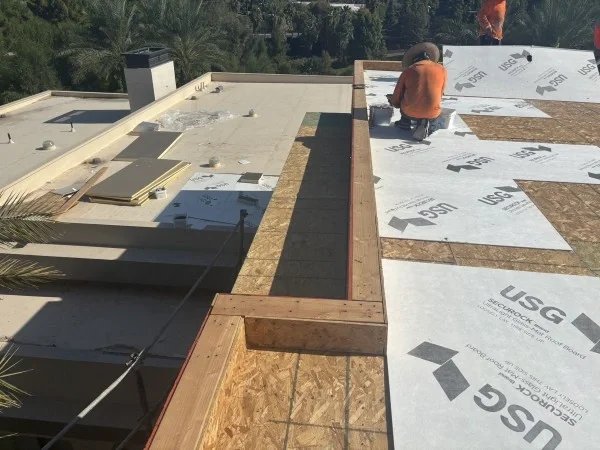
Do metal roofs need gutters?
Yes. Metal roofs need gutters in almost every climate. The metal resists the water damage gutters are built to prevent, but the ground and foundation below do not. A gutter catches the fast runoff and carries it away from the building. The exceptions are narrow: a few steep roofs in heavy-snow country skip gutters because sliding snow would tear them off.
So the real question isn't whether the roof can survive without them. It's whether the building can. In most cases, it can't.
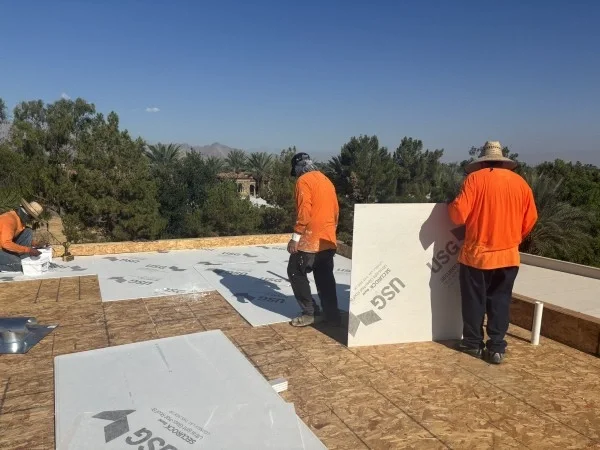
Why gutters matter more on metal, not less
Metal sheds water faster, which makes drainage a bigger job, not a smaller one. On a sloped roof the water gains speed and leaves the eave quickly, which is why metal roofing manufacturers recommend sizing the gutter up for steeper applications. A 5-inch gutter that would handle an asphalt roof can let a metal roof's runoff shoot straight over the front lip.
Skip the gutter and that water has to go somewhere. It sheets off the eave in a curtain, digs a trench in the landscaping, splashes back against the siding, and pools at the foundation. The Department of Energy guidance is blunt about the fix: get roof water discharged several feet past the wall and grade the soil so it drains away. Over one wet season, water pooling at the base is what cracks slabs and floods crawl spaces. The roof stays fine. The building pays for it.
What size gutters does a metal roof need?
Go bigger than the builder default. On most homes with a metal roof, that means 6-inch gutters instead of the standard 5-inch, paired with 3x4 inch downspouts instead of the smaller 2x3. The wider trough catches fast runoff before it overshoots, and the larger downspout moves close to twice the water and clogs far less. Set the slope at about a quarter inch of fall for every 10 feet so water runs to the outlets instead of standing in the channel.
| Gutter | Water it handles | Best fit | Metal-roof watch-out |
|---|---|---|---|
| 5-inch K-style | Baseline | Small roofs, low rainfall | Fast metal runoff can jump the lip |
| 6-inch K-style | About 40% more than 5-inch | Most metal homes, heavy rain | Pair with 3x4 downspouts |
| Half-round | High, and self-cleaning | Standing seam, long service life | Keep copper off bare steel panels |
| Box gutter | Very high | Commercial and low-slope metal | Needs pro design and coated seams |
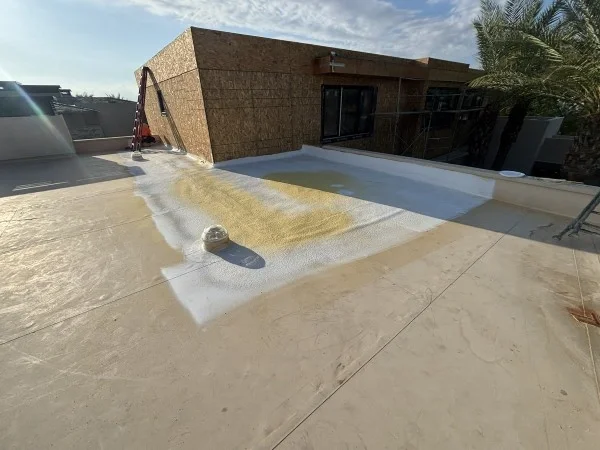
Matching gutter type to your metal roof
K-style and half-round both work well; water volume and metal chemistry decide between them. K-style holds the most water for its size and suits high-rainfall areas. Half-round cleans itself better and tends to last longer on standing seam roofs. Box gutters, built into the roof edge, carry the most water and show up on most commercial buildings.
One caution catches people off guard: mixing metals. Put copper gutters against a bare steel roof and you invite galvanic corrosion, where the two metals react and one slowly eats the other. It's a well-known reaction between dissimilar metals. Match the gutter metal to the roof, or separate them with the right fittings, and the system lasts decades instead of a few years.
Snow country: when skipping gutters is the right call
In heavy-snow regions, some steep metal roofs are better off without a standard gutter. Metal releases snow in sudden sheets, and that slide can shear a gutter right off the fascia. The answer isn't going without drainage; it's adding snow retention systems that hold snow on the roof until it melts, so the gutter below survives the winter. The high-desert edges of our service area, like Reno, deal with this. Palm Desert does not.
The desert problem: sudden storms, dust, and low slope
In the Coachella Valley the threat isn't steady rain. It's the storm you didn't plan for. Palm Desert, La Quinta, and Rancho Mirage run dry for months, then a summer monsoon drops an inch in an hour. Sun-baked, hard-packed soil can't soak that up fast, so on a gutterless roof the water runs straight at the foundation. Blowing dust and palm debris also load up open gutters, so guards and a real cleaning schedule matter more here than most people expect.
Low slope is the other desert issue. Patio covers, room additions, and commercial buildings often carry near-flat metal, where water doesn't race off the edge, it sits. Standing water finds every seam and fastener, and that's a different problem than a gutter can solve.
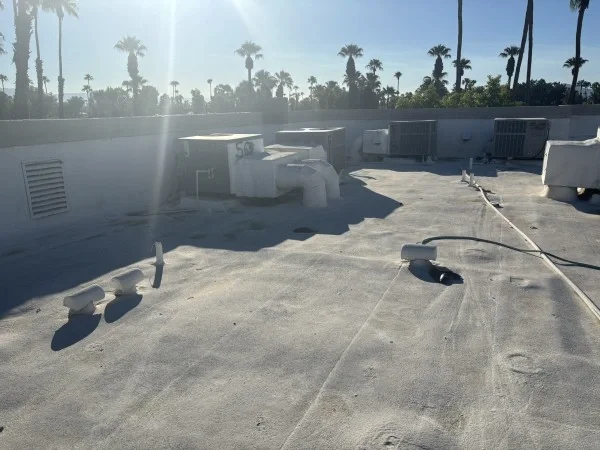
Where commercial metal roofs actually leak
On commercial and low-slope metal, the leak almost never starts in the middle of a panel. It starts at the seams, the penetrations, and the thousands of exposed fasteners whose rubber washers dry out and shrink in desert heat. A gutter won't fix any of that. A coating will.
This is the work we do most days. We restore aging metal and flat roofs with silicone coatings and spray polyurethane foam, sealing the seams and fasteners into one continuous surface that drains clean. We've done it on commercial roofs for owners like LifeStorage in Costa Mesa and the Yamaha facility in Buena Park, and it anchors the commercial roofing we handle across Southern California. When a building owner asks whether their metal roof needs gutters, the honest answer is that it usually needs gutters and a watertight surface, and the surface is where we start. If yours is leaking at the seams every winter, these are the signs a commercial roof has reached the end instead of needing one more patch.
Will adding gutters damage your metal roof?
Not when they're installed correctly. Good gutters attach to the fascia board behind the eave, not to the metal panels, so nothing punctures the roof or voids the panel warranty. The installs that fail in the first big storm are the ones screwed through panels or hung too low. Because metal work leaves no room for guesswork, this is a job for a roofer who reads how water crosses the whole roof, the same drainage check we run when we maintain a metal roof under a service plan. It helps to know the types of roof damage that trace back to bad flashing and drainage, because gutters are only one piece of it.
Your metal roof drainage plan for 2026
Short version: yes, metal roofs need gutters, sized up to 6-inch with 3x4 downspouts, sloped a quarter inch per 10 feet, and on commercial or low-slope metal, backed by a watertight coating at the seams. If you're not sure what your roof needs, that's the question our free roof health check answers. We inspect the surface, the seams, the fasteners, and how water actually leaves the roof, then send a written report with photos in 24 to 72 hours. If your metal roof is aging but still sound, a silicone coating or spray foam system can seal it and add years. Our Palm Desert team holds a 4.8-star Google rating. Book a Roof Health Check from any page on our site.
Frequently asked questions
Do metal roofs need gutters in a dry or desert climate?
Yes. Even in the Coachella Valley, metal roofs need gutters because the rain that does fall usually comes fast, in summer monsoon storms. Hard-packed desert soil sheds that water toward the foundation instead of soaking it in, so a gutter and a downspout that discharges a few feet from the wall still earn their keep.
What size gutters are best for a metal roof?
On most homes, 6-inch gutters with 3x4 inch downspouts, rather than the standard 5-inch gutter and 2x3 downspout. Metal sheds water fast enough to overshoot an undersized gutter, so the larger trough and wider downspout keep water in the system during a hard rain.
Will gutters damage a metal roof or void the warranty?
No, not when they attach to the fascia board behind the eave rather than to the metal panels. Fasteners driven through the roof panels are what cause leaks and warranty problems, which is why gutter work on metal belongs with an experienced roofer.
Do metal roofs in snowy areas need gutters?
Sometimes not. On steep metal roofs in heavy-snow regions, sliding snow can tear a gutter off, so some are built without one. The better fix is snow retention on the roof so gutters can stay in place and still protect the foundation.
Are gutters needed on a low-slope or commercial metal roof?
Yes, and often a box gutter that handles high volume. But on low-slope metal the bigger issue is standing water at seams and fasteners, which a gutter can't solve. That calls for a silicone coating or spray foam system to make the surface watertight.
How often should metal roof gutters be cleaned?
At least twice a year, per manufacturer guidance, and more often in dusty desert areas or under trees. Clearing them before the summer monsoon and after leaf drop keeps water flowing and stops the overflow that damages siding and foundations.