Spray Foam Roofing Pros And Cons For Desert Commercial Roofs
Spray foam roofing works better on a desert commercial building than almost anywhere else in the country, and it also fails faster here when the wrong crew sprays it. Both are true. The pros are real: one continuous surface with no seams to leak, big cooling savings in a climate that runs the AC five months a year, and a roof you recoat instead of tear off. The cons are real too. Overspray. A short list of crews who actually know foam. A coating that desert UV burns through sooner than the brochures let on. I've been on Southern California roofs since 1992, and Vision Roof Services has installed close to 7,500 of them. Here's when foam is the right call for a commercial roof, and when it isn't. If yours is leaking or past 15 years, start with a free Roof Health Check.
Spray foam roofing, or SPF (spray polyurethane foam), is a commercial roof system sprayed on as a liquid that expands into a solid layer of insulation with no seams. A protective elastomeric coating goes over the foam to shield it from sun and weather. It insulates, waterproofs, and gets recoated for decades instead of replaced.
What is spray foam roofing?
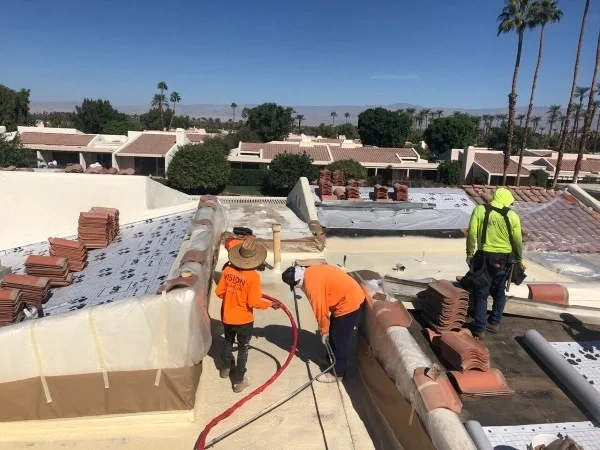
Spray foam roofing is two chemicals sprayed together that expand on contact into a hard, closed-cell layer of polyurethane, then get sealed under a coating. It bonds to the deck as one piece, self-flashing around every pipe, vent, and curb, so there are no seams or laps for water to get under. The foam does the insulating and the shaping; the coating does the weatherproofing and takes the UV hit. On a commercial building, that combination is why foam handles low slope, ponding spots, and roof penetrations better than a membrane cut and welded around them.
Foam has been used on roofs since the 1960s, so it isn't new or experimental. What's changed is the coatings, which now hold up longer under sun. The catch is that foam is manufactured on your roof, in real time, by the crew spraying it. Get the mix, the thickness, and the surface prep right and it lasts decades. Get them wrong and it fails early. More on that below, because in the desert it's the whole game.
The pros of spray foam roofing on a desert commercial roof
Foam's advantages line up almost perfectly with what a desert commercial roof has to survive: relentless sun, 115-degree summers, roof-deck temperatures past 150 degrees, and a monsoon that drives rain sideways. Here's where it earns its place.
It cuts cooling load, and that matters most in a dry, hot climate. Foam carries one of the highest insulation values of any roof system, about R-6 to R-7 per inch, on par with polyiso and well above single-ply over the same deck. Add a reflective coating on top and you get a cool roof that bounces solar heat instead of soaking it in. The U.S. EPA reports that a reflective cool roof can reduce peak cooling demand by 11 to 27 percent in air-conditioned buildings. The Spray Polyurethane Foam Alliance's life cycle cost study found the energy savings from foam are worth the most in dry climates, reaching about 29 percent of a roof's lifetime value in a place like Phoenix. I won't promise a number on your bill, because it rides on your insulation, your ductwork, and your HVAC as much as the roof. But in a cooling-dominated climate, foam is working for you five months a year.
It seals against monsoon rain because there's nothing to seal. Most commercial roof leaks start at a seam, a lap, or a flashing detail. Foam has none. It goes down as one continuous layer and self-flashes at every wall, curb, and penetration, so wind-driven monsoon rain has no edge to pry open. Because it's sprayed, we can also build slope into it, filling low spots and shaping drainage so water sheds instead of ponding. On a flat desert roof where summer storms dump fast, that's the difference between a dry building and a 2 a.m. phone call.
It's light, and it renews instead of replaces. Foam adds only about half a pound to three-quarters of a pound per square foot. A built-up gravel roof piles on 8 to 12 pounds. That lets foam go over many existing roofs without a tear-off. The structure carries less load, and nothing goes to the landfill. And when the coating wears, you recoat rather than rip off. The SPFA notes a foam roof inspected and recoated on schedule can last the life of the building. A properly coated and granulated foam roof also takes foot traffic and hail without a problem, so your HVAC techs can walk it.
Spray foam vs other commercial roof systems (2026)
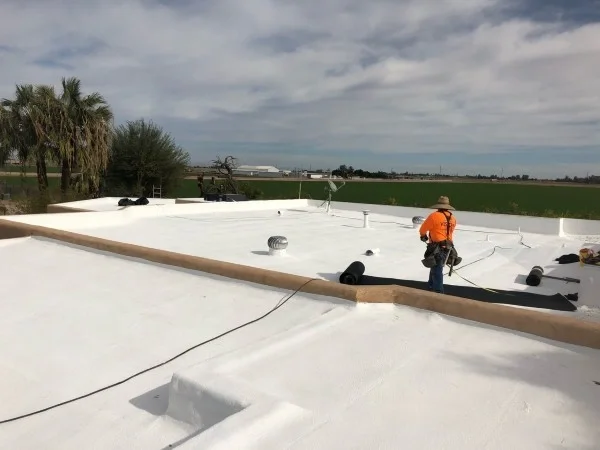
There's no single best commercial roof, only the right system for your building, your budget, and how long you'll own it. Here's how foam stacks up against the systems it usually competes with on a desert roof, from what we see across Southern California and Arizona.
| System | Seams (leak points) | Cool-roof option | Weight added | Renew without tear-off | Typical desert service life |
|---|---|---|---|---|---|
| Spray foam (SPF + coating) | None; self-flashing | Yes, reflective coating | 0.5 to 0.75 lb/sq ft | Yes, recoat on schedule | 30 to 50 years with recoats |
| TPO (single-ply) | Heat-welded seams | Yes, white membrane | ~2 to 4 lb/sq ft (system) | Limited | 15 to 25 years |
| EPDM (single-ply) | Taped or glued seams | Standard is dark, less reflective | ~2 to 4 lb/sq ft (system) | Limited | 15 to 25 years |
| Built-up / tar and gravel | Multiple plies | Low reflectivity | 8 to 12 lb/sq ft | Limited | 15 to 30 years |
Service-life ranges reflect what we see on desert roofs, not lab numbers. Yours move with sun exposure, coating quality, and whether the roof gets maintained. The pattern that repeats: the systems with seams leak at the seams, and the ones you can't recoat you eventually tear off. Foam's edge on a desert roof is that it has neither problem, as long as it's installed and maintained right.
The cons of spray foam roofing, and which ones actually bite in the desert
Foam has real downsides, and any roofer who won't name them is selling, not advising. If you're weighing a foam roof, these are the trade-offs to know, and how they change in a desert climate.
Overspray is the one your neighbors notice. On a windy day, the spray drifts as fine particles that land on cars, windows, and landscaping and cure on contact. It can cost up to $400 to clean foam off a car. A crew that knows what it's doing uses wind screens and edge shielding, keeps cars clear of the lot, and won't spray when the wind's up. Our rule is the same one every careful foam crew follows: too windy, we don't spray that day.
The weather limits are real, but not the ones a Midwest article warns you about. You'll read that foam can't go down below 55 degrees. True, and almost irrelevant in the Coachella Valley or Phoenix, where the spray season runs most of the year. The limit that actually bites here is moisture. Foam has to hit a bone-dry surface, and the desert's trap is morning dew. Spray over trapped dew and the coating blisters when the sun comes up. So the discipline that matters on a desert roof is timing: clear the dew every morning, and stop before it falls in the evening. Monsoon season adds its own window, since you can't spray a wet roof or beat an afternoon storm. This is scheduling expertise, and it's exactly what a local crew brings that an out-of-state bid doesn't.
The biggest con is that good foam crews are rare. Foam is mixed and cured on your roof, so the installer is the product. Too little coating thickness and the foam never reaches the heat it needs to cure into a closed cell. Too much and the cells blow apart. Skip the surface prep, spray over debris or moisture, and it delaminates. There's an ugly saying in this trade about crews that foam over anything, and those crews leave problems that surface years later. The industry has never required enough training or certification, so plenty of undertrained applicators pass through and quit. This is the real risk with foam, and it's why the section below on choosing an installer matters more than any spec.
Does a spray foam roof really pay for itself?
Probably, but not on the timeline every foam contractor quotes, and payback is the wrong thing to fixate on. You'll see "pays for itself in 5 years" repeated across the industry, usually pinned to a Texas A&M study. I went looking for that study to cite it here. The original source page is gone, and the number drifts between 4.5 and 5 years depending on who's copying whom. The one life cycle cost analysis I can actually put in front of you, from the Spray Polyurethane Foam Alliance, doesn't name a payback year at all. What it shows is a 13 to 56 percent cost advantage over membrane roofs across 30 years, driven by two things: you recoat foam instead of tearing it off, and the energy savings stack up, most of all in dry climates.
The money works like this. Foam usually costs more up front than a single-ply membrane. Over the life of the building it tends to cost less, because a recoat every several years is far cheaper than a tear-off and replacement every 15 to 20. That long-run advantage only shows up if you actually keep it recoated. A foam roof left to bake un-recoated in desert sun fails early and pays for nothing. One kept on a recoat schedule can outlast two single-ply roofs. The buying decision isn't "how fast does it pay back." It's "will this roof be maintained," which is a question about your contractor, not the foam.
What a commercial foam roof costs, and how to choose an installer
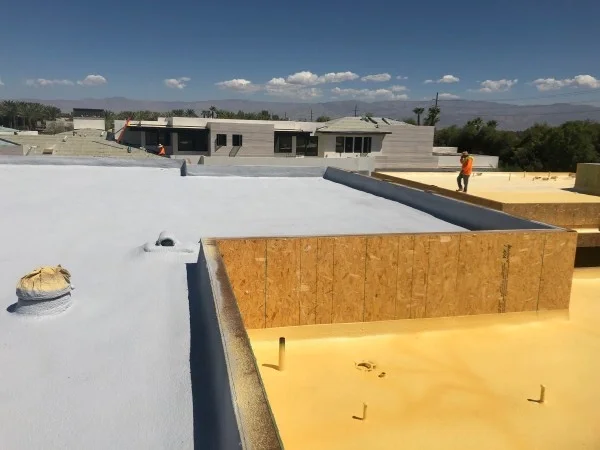
A commercial foam roof's price rides on four things: the condition of the existing roof, whether any of it has to come off, the square footage, and the coating system you choose. Tear-off and moisture repair move the number as much as the foam does. I'm not going to quote a per-square-foot figure that won't match your building, because a bad estimate helps no one. We price it after we've walked the roof, measured it, and shown you the options side by side. If the timing is tight, we offer financing through Acorn Financing so a roof that has to happen now doesn't wait on cash flow.
Choosing the crew is the part that actually determines whether foam works out, so vet hard. Ask how many foam roofs they've done and who trained their applicators. Ask to see local commercial jobs. For commercial foam roofing, that's what we're built around at Vision Roof Services: a 60-person crew with a dozen applicators certified through General Coatings, membership in the Spray Polyurethane Foam Alliance, and roughly 7,500 roofs behind us since 1992. Our commercial work includes LifeStorage in Costa Mesa and the Yamaha facility in Buena Park, and our client roster runs to names like Paramount Studios, KPRS, and American Tower. We hold a 4.8-star rating across 42 Google reviews on our Palm Desert profile.
One more question people ask: can foam go over my existing roof? Usually yes. Because it's light and self-flashing, spray foam roofing can be sprayed over a sound, dry built-up, single-ply, metal, or concrete roof, sometimes with a primer for adhesion. The one hard requirement is a moisture check first, because trapped water has to come out or you just seal the problem in. That check is the first thing we do on a Roof Health Check, and you get the written report with photos back in 24 to 72 hours. We cover the Coachella Valley and the wider desert Southwest; you can see the full list of areas we serve across California, Arizona, Nevada, and Texas.
Foam isn't the right roof for every building. But for a low-slope commercial roof in a hot, dry climate, the pros of spray foam roofing outweigh the cons more clearly here than almost anywhere, as long as you pick a crew that treats the install and the recoat schedule as seriously as you do. If you want to know whether your building is a fit, book a free Roof Health Check and you'll have a written answer, with photos, in 24 to 72 hours. Call 844-348-ROOF.
FAQs
What are the pros and cons of spray foam roofing?
The pros of spray foam roofing are strong energy savings in hot climates, no seams to leak, light weight, and a surface you recoat instead of replace. The cons are a higher upfront cost, overspray risk on windy days, a moisture-sensitive install, and a shortage of crews who do it right. On a desert commercial roof the pros tend to win, provided the roof is recoated on schedule.
How long does a commercial spray foam roof last?
A spray foam roof can last 30 to 50 years, and the Spray Polyurethane Foam Alliance says one recoated on schedule can last the life of the building. The coating is the clock, not the foam. In the desert, UV wears coatings faster, so plan on recoating toward the shorter end of the 5 to 20 year range.
How much does a commercial foam roof cost?
The cost depends on the existing roof's condition, whether it needs tear-off, the square footage, and the coating system. Foam usually costs more upfront than single-ply but less over the life of the building because you recoat instead of replace. We price it after a Roof Health Check and offer financing through Acorn Financing.
Do foam roofs really save energy in a hot climate?
Yes. A coated foam roof reflects heat and adds insulation, which lowers cooling load. The U.S. EPA reports reflective cool roofs can cut peak cooling demand by 11 to 27 percent in air-conditioned buildings, and the SPFA found energy savings are highest in dry climates like Phoenix. Actual dollar savings depend on your insulation and HVAC, so we don't promise a fixed percentage.
Can spray foam be applied over an existing commercial roof?
Often yes. Foam is light and self-flashing, so it can go over a sound, dry built-up, single-ply, metal, or concrete roof, sometimes with a primer. The requirement is a moisture check first, because trapped water has to be removed before recovering, or the new roof traps the problem underneath.
How often does a foam roof need to be recoated?
Every 5 to 20 years, per the Spray Polyurethane Foam Alliance, with the interval driven by the coating and the climate. Desert UV pushes toward the shorter end. Recoating is what lets a foam roof last for decades, and skipping it is the most common reason foam fails early.
Is spray foam roofing worth it for a desert commercial building?
For a low-slope roof in a hot, dry climate, usually yes. Foam's energy savings are largest here, it seals against monsoon rain with no seams, and you renew it by recoating. The one condition is maintenance and a qualified installer, since a neglected or poorly sprayed foam roof fails early.