Can You Put Solar Panels On A Metal Roof? A Roofer's Field Guide
A standing seam metal roof can last 50 years. The wrong row of screws can end its warranty in one afternoon.
Yes, you can put solar panels on a metal roof, and it's often the best roof to put them on. But on a metal roof the real question isn't "can you." It's whether the crew protects the roof that sits under the panels. That's a roofer's job, not a solar salesperson's. Vision Roof Services has installed and maintained roofs across Southern California since 2014, solar roofs included, and we approach every solar job as roofers first.
Can you put solar panels on a metal roof? Yes. Panels mount with clamps or brackets sized to your roof profile. Standing seam roofs use clamps that grip the raised seams with no holes at all. Exposed-fastener roofs, like corrugated and R-panel, need sealed penetrations driven into the framing below.
Why a metal roof is the best roof for solar
Metal roofs commonly last 40 to 70 years. Most solar panels carry 25 to 30 year warranties. So your roof outlives the panels, and you skip the nightmare that hits asphalt owners: paying to pull a full array off the roof just to replace the shingles underneath.
Metal is also light. At roughly 1.4 to 1.6 pounds per square foot, it carries a full solar array without extra framing on most homes (source: DECRA). Weight is almost never the problem.
Here is where "best roof for solar" quietly breaks down. That benefit only holds if the roof stays watertight and stays under warranty after the install. Both depend on the mount and the crew, not the panel brand.
How do you attach solar panels to a standing seam metal roof?
You clamp them to the seams. No holes.
A standing seam roof has raised vertical ribs. A seam clamp, bolts onto those ribs and holds the racking. Nothing penetrates the metal. That keeps the roof watertight, speeds up the install, and cuts labor because the crew skips flashing every foot.
One detail most solar crews skip: the clamp has to match your exact seam. A snap-lock seam, a mechanically seamed panel, and a nail-strip panel do not all take the same clamp. Over-torque the clamp and you can oil-can the panel, leaving a visible ripple. Ask the installer which clamp they're using for your profile and what torque spec they follow. If they can't answer, that's your sign.
How do you attach solar on a corrugated or exposed-fastener roof?
These roofs need penetrations, so the sealing method matters more than anything else.
Brackets mount on the high ribs, not the flat drainage channels, and fasten into the purlins or framing below, not just the thin sheet metal. Quality brackets carry a bonded rubber gasket at the base so the seal doesn't depend on a bead of caulk that dries out in three summers. Sealant alone is not a waterproofing plan.
Watch one more thing on corrugated roofs: fall-protection anchors. Because there's no seam to clamp to, crews often drill anchors straight into the roof, then remove them when the job's done. Those anchor holes have to be sealed too. We've traced more than one mystery leak back to an abandoned anchor point.
Does putting solar panels on a metal roof void the warranty?
It can, and this is the most expensive mistake homeowners never see coming.
You're actually dealing with three separate warranties: the metal panel and finish warranty from the roofing manufacturer, the workmanship warranty from whoever installed the roof, and the solar installer's warranty. Drilling into the roof can void the first two, depending on the manufacturer's terms. Western States confirms that penetrations can void a corrugated metal roof warranty outright.
Here's how to protect all three. Use non-penetrating seam clamps wherever the roof allows it. If penetration is unavoidable, make sure the crew follows the roofing manufacturer's approved attachment detail. And get the solar installer to warranty every roof penetration in writing, with their name on the leak.
Who pays when it does leak? Usually the homeowner watches the solar company and the roofer point fingers at each other. Settle penetration responsibility in writing before anyone gets on the roof. Before you let a crew mount solar, get the roof checked: our warranty inspection confirms the roof's condition and what the manufacturer requires, so the solar job doesn't quietly cancel your coverage.
What about galvanic corrosion between the mount and the roof?
Put two different metals together with a little moisture and one of them starts to corrode. None of the top-ranking guides mention this, and it's a real one.
Aluminum racking on a steel roof, or almost any hardware on a copper or Galvalume roof, needs compatible, isolated fasteners. Use stainless or coated fasteners rated for your roof metal, and avoid bare aluminum sitting directly on bare steel at the contact points. A solar-only crew rarely checks metal compatibility. A roofer does it by habit.
Do I need code items like rapid shutdown and permits?
Yes, and they aren't optional.
Residential solar needs module-level rapid shutdown under NEC 690.12, fire-access setbacks around the array, and a permit with inspection. On a metal roof, the array and rails also have to be bonded and grounded properly. This is standard work, but it gets glossed over by crews chasing a fast install. Confirm your installer is pulling the permit, not you.
How old is too old? Should you re-roof before adding solar?
If your metal roof is near the end of its life or the finish is failing, replace it first. You do not want to pay to remove panels in eight years.
A quick roofer's check before you go solar: look for fastener backout on exposed-fastener panels, seam separation on standing seam, coating or finish breakdown, tired flashing, and any soft decking. A young standing seam roof in good shape is ready today. Not sure where yours stands? A quick roof inspection settles it before you spend a dollar on solar.
How much does solar cost on a metal roof in 2026?
The mounting hardware runs about 10 to 25% of your total system cost.
Standing seam clamps cost more per part than basic asphalt feet, but they save labor because there's no flashing and the install is faster. On the right roof, a no-penetration job can net out cheaper than a penetrated one, with far less leak risk. For a real number on your roof and your panel layout, start with a free roof health check.
Is there still a solar tax credit for a metal roof install in 2026?
For homeowners who buy their system: no. This is the part every older article gets wrong.
The 30% federal residential solar credit, Section 25D, expired on December 31, 2025 under H.R. 1, the law known as the One Big Beautiful Bill. There was no step-down and no grace period. Any guide still promising you 30% was written before the law changed.
One narrow path is still open. Leased systems and power purchase agreements can access a 30% credit under Section 48E through 2027, if construction begins by July 4, 2026. State and utility incentives may also still apply. This isn't tax advice, so confirm your situation with a tax professional before you count on any credit.
Should you consider thin-film solar for a metal roof?
For most homes, no, even though the older guides pitch it.
Thin-film lies flat and pairs well with standing seam, but it delivers less power per square foot and residential supply is thin. Standard silicon panels on seam clamps are the stronger choice for nearly every house. Keep thin-film on the shortlist only for unusual cases, like a low-slope roof where standard racking won't work.
How to choose a crew that won't wreck your metal roof
Ask three questions before you sign. Which clamp or bracket are you using for my exact panel profile? Who warranties the roof penetrations, in writing? Are you following the roofing manufacturer's attachment detail? A good crew answers all three without flinching.
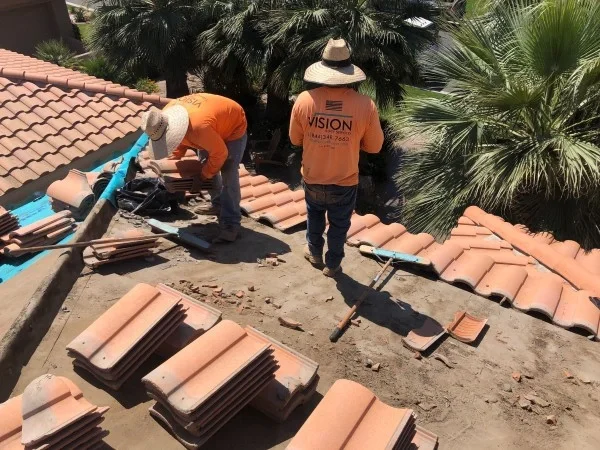
Vision Roof Services inspects the roof first, installs mounts to the manufacturer's spec, and stands behind the roof itself, not just the panels. We handle solar roofing start to finish for homeowners and businesses across Riverside, Orange, San Diego, and LA counties. Book a free roof health check or get a free quote.
Frequently Asked Questions
Can you put solar panels on a metal roof without drilling holes?
Yes, on a standing seam metal roof. Seam clamps grip the raised ribs and hold the racking with zero penetrations, which keeps the roof watertight and cuts labor. Exposed-fastener roofs like corrugated still need sealed penetrations.
Does putting solar panels on a metal roof void the warranty?
It can. Drilling can void the roofing manufacturer's warranty and the roofer's workmanship warranty, depending on the terms. Use non-penetrating clamps when possible, and get the solar installer to warranty every penetration in writing.
Will a metal roof outlast solar panels?
Almost always. Metal roofs commonly last 40 to 70 years, while most panels are warrantied for 25 to 30. You likely won't replace the roof before the panels, so you avoid removing and reinstalling the array.
How much does it cost to install solar panels on a metal roof?
Mounting hardware is roughly 10 to 25% of the total system cost. Standing seam clamps cost more per part but save on labor because there's no flashing, which can offset the difference. Get a free roof health check for a number specific to your roof.
Is there a federal solar tax credit in 2026?
Not for homeowners who buy their system. The 30% residential credit (Section 25D) expired December 31, 2025. A 30% credit may still apply to leases and PPAs through 2027 if construction starts by July 4, 2026. Ask a tax professional.
Can you install solar on a corrugated metal roof?
Yes. Brackets mount on the high ribs and fasten into the framing, sealed with bonded gaskets rather than caulk alone. Proper flashing and fastening into structure are what keep it from leaking.
Do metal roofs need reinforcement to hold solar panels?
Usually not. Metal roofing weighs only about 1.4 to 1.6 pounds per square foot and supports a solar array on most homes without extra framing.