

Roofers in Santa Ana, CA
The winds that stress roofs across Southern California are named after this city, and Santa Ana takes them first. On the older homes that fill Floral Park, Washington Square, and the streets around downtown, a hard wind event doesn't just lift shingles. It exposes the tired underlayment and the original spaced sheathing underneath. Vision Roof Services re-roofs Santa Ana homes for the way they were actually built, handles Title 24 compliance and the city permit, and prepares the historic review when your address calls for one. We've completed about 7,500 roofing projects across Southern California, and the roofing experience behind the company goes back to 1992.
What the Santa Ana winds do to a roof here
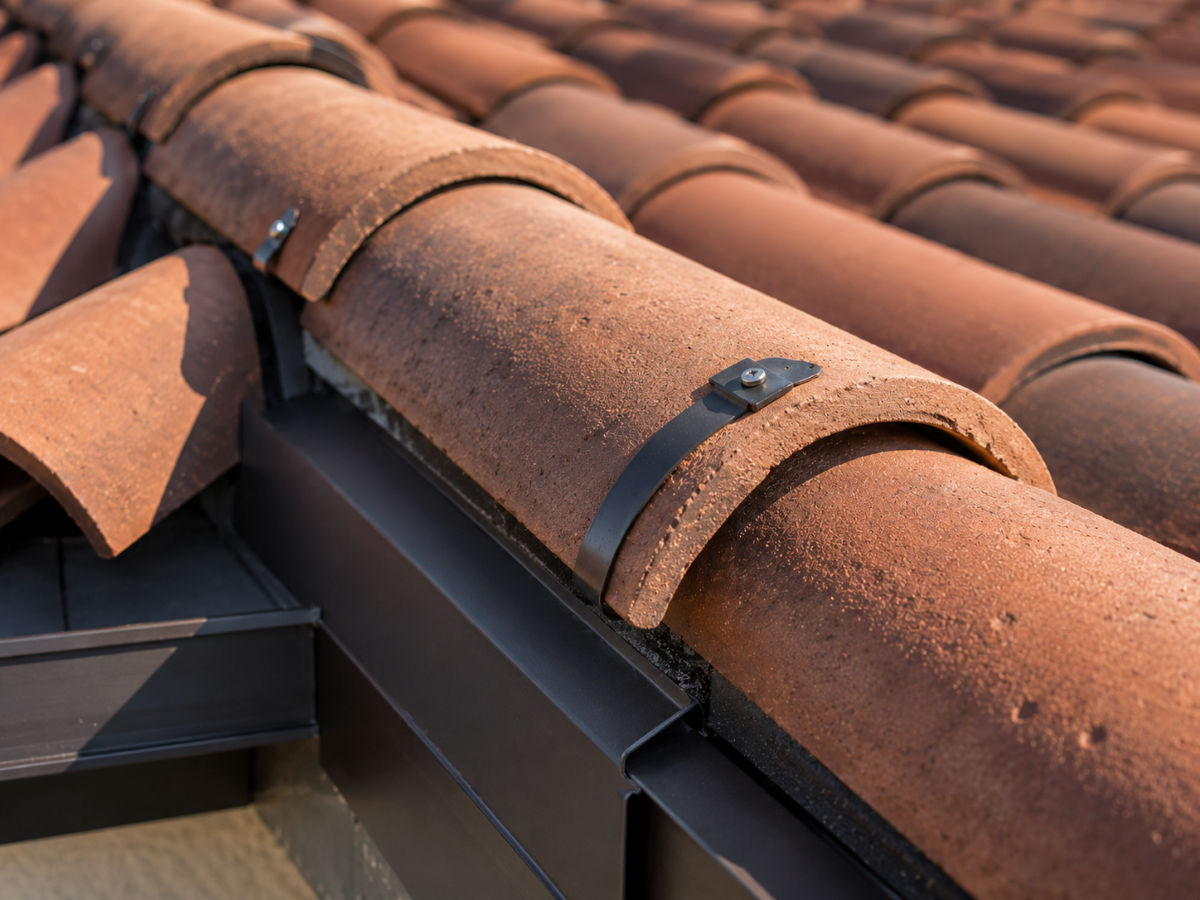
Santa Ana takes the winds it's named for at close to full strength. These hot, dry downslope winds routinely run 40 to 70 mph, and they peak from late October through January, the same stretch as fire season. They work on a roof in specific ways. They lift and crease shingle tabs, crack or slide tile along hips and ridges, loosen flashing and ridge caps, tear vent boots, and drive debris into the valleys and gutters. Nothing has to blow off for the damage to matter. A lifted tab or a loosened flashing edge is all the next rain needs to get inside.
For a planned re-roof, the calmer window is April through September, before wind and ember season starts. The upgrades worth asking about depend on your street: enhanced fastening patterns, wind clips on tile, impact-rated (Class F or H) shingles or standing-seam metal, and ember-resistant attic vents if you back to open space. On the Roof Health Check we note your wind exposure and flag the fastening and vent details specific to your roof.
Older Santa Ana homes need more than a shingle swap
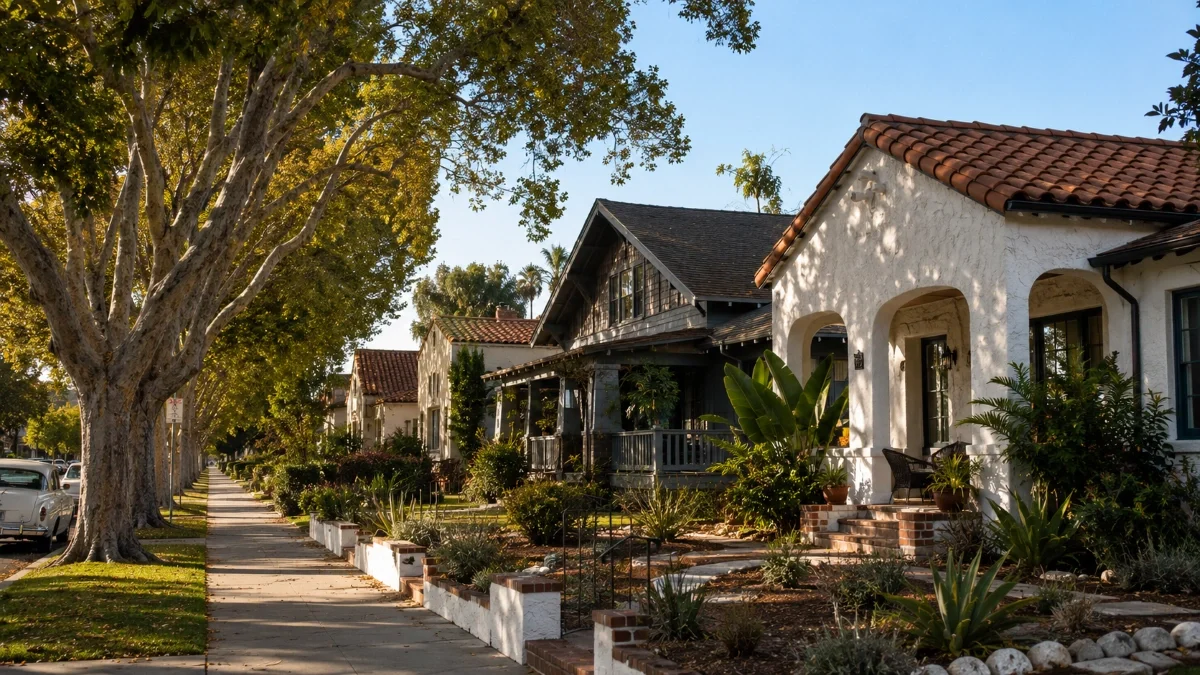
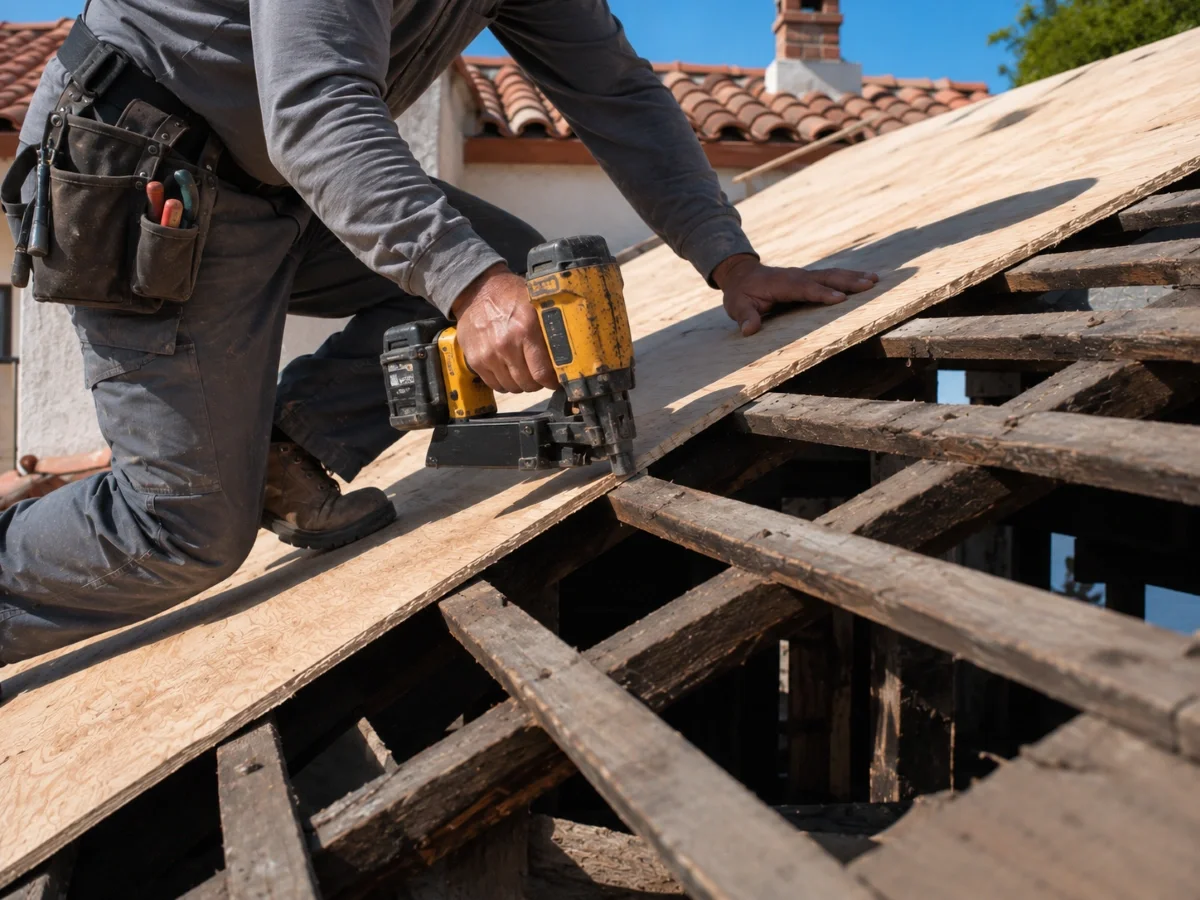
Much of Santa Ana was built before 1960, and the historic north-side neighborhoods go back to the 1920s and 1930s. A lot of those homes started with wood shake laid over spaced sheathing, the gapped boards you can see daylight through from the attic. You can't warranty a modern composition shingle or a tile system over spaced boards. The deck has to be sheeted solid first, usually with plywood or OSB over the original boards. It's the step that gets left out of a too-good bid, and it's the one a wind event makes obvious, because that's when the old underlayment finally gives up. When we inspect an older home, the condition of the deck is the first thing we document, so the re-decking is in the plan and the price from the start, not a surprise once the tear-off begins.
Title 24 cool-roof rules and the paperwork that proves it
Most of Santa Ana sits in California Energy Commission Climate Zone 8, where a steep-slope re-roof over more than about half the roof has to meet the cool-roof standard: an aged solar reflectance of 0.20 and a thermal emittance of 0.75, or a Solar Reflectance Index of 16, or an approved trade-off such as added attic insulation. The city's western edge can fall into Zone 6, where the trigger for a pitched roof is different. We confirm your exact zone from the state's zip-code tool at permit, so the requirement is priced in from the start instead of discovered at plan check.
Compliance runs on two documents, and both should show up on your job. The CF1R, filed with the permit, lists the CRRC-listed product and its reflectance rating. The CF2R, signed after the roof is on, confirms the product actually installed matches what was permitted. The 2025 Energy Code, in effect for permits filed on or after January 1, 2026, holds the residential steep-slope numbers where the 2022 code set them and tightened the rules for some building types. You can read the standard at the California Energy Commission.
Ask every bidder this
"How are you handling Title 24 on my roof?"
The CRRC-listed product and rating they'll put on the CF1R
Or the trade-off path they'll use, and why
Whether it's a named line item in the bid
That they'll hand you the signed CF2R at closeout
If your home is in a historic district, the roof needs review first
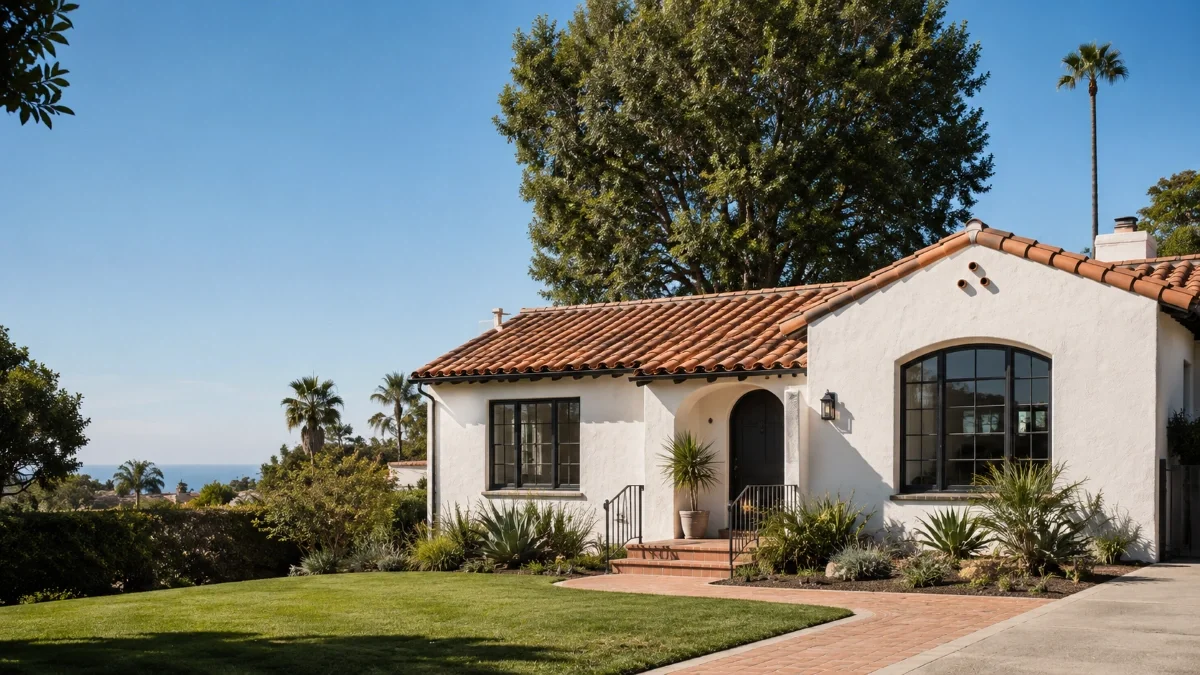
Santa Ana has three National Register historic districts and a citywide register of historic homes, and that changes how a re-roof gets approved. If your home is a contributing property in a district, French Park, Floral Park, Washington Square, Fisher Park, and Park Santiago among them, or it's on the Santa Ana Register of Historic Properties, the roof work has to meet the Secretary of the Interior's Standards for Rehabilitation and needs a Certificate of Appropriateness before the city issues the building permit. Material, profile, and color have to fit the home's period, and major changes go to the Historic Resources Commission.
Outside the historic districts, it's a standard building permit. A minor reroof can often be pulled same-day over the counter, and a full replacement goes through plan review. Either way the city inspects the deck at tear-off and again at final, and as of July 1, 2026, every application goes through the city's Accela online portal. We prepare whichever path your address requires, and we coordinate with the city's historic preservation office when a Certificate of Appropriateness is needed.
What we submit for you
The Certificate of Appropriateness package, when your home is a contributing property, with material and profile chosen to meet the standards
The City of Santa Ana building permit through the Accela portal
The CF1R Title 24 compliance certificate for plan check
A schedule built around historic review time, so the tear-off date holds
Most contractor sites say they handle permits. Few say what that includes. On a historic Santa Ana home, filing only the building permit and skipping the Certificate of Appropriateness is how a project gets red-tagged. This is familiar ground for us. Dave Bienek, who founded the company, learned roofing from his father, who specialized in the association and design-review side of the work, so the paperwork was part of the job long before it was ever a line on a website.
A Vision Roof Services framework
The Santa Ana Roof-Bid Test
Before you sign any roofing contract in Santa Ana, run the bid through five checks. Most homeowners clear the first two on price and skip the three that prevent the expensive surprises.
C-39 verified on the state board
California requires a C-39 roofing license for any roofing job over $500. Look the contractor up at cslb.ca.gov and confirm four things: the license is active, the $25,000 bond is on file, workers' compensation is current (roofers have to carry it even with no employees), and the complaint history is clean. One limit worth knowing: complaints closed before investigation don't show up for consumers, so a clean public record is a floor, not the full picture. After a big wind event, unlicensed door-knockers show up fast, and the state's enforcement actions track right behind them.
Title 24 named as a line item
The bid should say how it meets cool-roof compliance for your zone, which product goes on the CF1R, or which trade-off path it uses. If Title 24 isn't written into the scope, it isn't priced into the scope, and that gap comes back as a change order.
Permits and any historic review handled in writing
Confirm the contractor schedules the sheathing inspection, knows whether your address is in a fire zone, and rates the assembly accordingly: Class B minimum citywide on a major reroof, Class A in a Very High Fire Hazard Severity Zone.
A full written scope and payment schedule
Material, tear-off, deck re-sheeting, ventilation repairs, cool-roof compliance, permit and historic review, and the payment milestones, all on paper. On an older Santa Ana home the deck line is the one to read twice. Unclear scope and payment terms sit among the most common contractor complaints filed with the CSLB, and a written scope is what keeps you out of that column.
Recent local references
Ask for Santa Ana or nearby Orange County jobs from the last year, ideally an older home or the same system you're putting on. A real operator can name them.
Vision Roof Services is built to pass all five. Your Free Roof Health Check is the documented starting point: a written report with photos, your system options, and how compliance and approvals will be handled.
Commercial spray foam and flat-roof systems
If you manage a commercial building, a downtown Santa Ana storefront, or any flat-roofed property, spray polyurethane foam (SPF) and silicone recoats are the work we do most. SPF goes down as one continuous, joint-free layer, and it can often be applied over a sound existing roof, which cuts tear-off cost and keeps the old roof out of the landfill.
Owners pick foam for the same handful of reasons: a continuous waterproof surface with no seams to fail, a light load on the structure, a long service life when it's maintained, and lower tear-off cost. We've installed commercial systems for Yamaha, LifeStorage, KPRS, and American Tower, among others.
Foam does cost more upfront than a quick patch, and it isn't the right answer for every roof. Where it pays off is over time, because a maintained SPF roof gets recoated on a schedule instead of torn off and rebuilt. If your roof is near the end of its life and you're planning to sell inside a year or two, a coating may not make sense, and we'll say so on the inspection rather than sell you one. See our commercial spray foam roofing page for systems and warranties.
Every project starts with a Free Roof Health Check
A trained inspector documents your roof and sends a written report with photos within 24 to 72 hours, before you commit to anything. On an older home, that report answers the two questions that decide the whole job: the condition of the deck, and whether your address triggers Title 24 or historic review. From there, you decide.
The sequence
Roof Health Check with full photo documentation
A written report with condition findings and system options
A proposal with an itemized scope, deck and re-decking included
Scheduling and install with our own crews, not subcontractors
Deck and final inspections with the city
Enrollment in annual maintenance with recoat scheduling
We build for maintenance, not one-time jobs. Annual inspections and scheduled recoats keep systems under warranty and off the replacement cycle longer, and that's where the real savings on a roof come from. Financing is available through Acorn Financing, so a re-roof or a commercial foam system doesn't have to be a single lump payment.
Want the full picture first? See our roofing services, residential and commercial, across Orange County.
Who we're the right fit for, and who we're not
We're built for re-roofs, replacements, and commercial coating systems. A full shingle, tile, or metal re-roof, a flat-roof or SPF system, or a maintenance program that keeps a roof under warranty is our core work. A very small repair outside our core service areas, or gutter cleaning, isn't. For those, a local handyman will serve you better and for less, and we'll say so instead of sending a crew across the county for an hour of work.
A Southern California roofing company with a record you can check
Vision Roof Services has completed about 7,500 roofing projects across Southern California. The company was founded in 2014, and the roofing experience behind it goes back to 1992.
Dave Bienek started roofing at 15, working alongside his father. On the kind of older, character homes Santa Ana is full of, that history shows up in the work: matching a tile profile to a 1930s roofline, or spotting spaced sheathing before it becomes a change order. Our Win Together approach means the same for a customer as it does for our crew. You get clear communication and work that's documented at every step, and the relationship is built to outlast a single job.
BBB A+ Accredited
12 certified SPF applicators
2024 Best of BuildZoom
Financing via Acorn Financing
California License #651509
Licensed and insured
General Coatings certified
Spray Polyurethane Foam Alliance member
60 trained roofers
Reviewed by Dave Bienek, founder and licensed roofing contractor, Vision Roof Services. Roofing in Southern California since 1992.
Santa Ana roofing questions we hear most
My house is in a historic district. Do I need special approval to re-roof?
If your home is a contributing property in a district like French Park, Floral Park, or Washington Square, or it's on the Santa Ana Register of Historic Properties, yes. The roof has to meet the Secretary of the Interior's Standards and needs a Certificate of Appropriateness before the city permit. Material and profile have to fit the home's period. We prepare that package so it moves in the right order.
Does Title 24 apply to my re-roof?
In most of Santa Ana, which is Climate Zone 8, a steep-slope re-roof over more than half the roof has to use a CRRC-listed cool-roof product (aged solar reflectance 0.20, thermal emittance 0.75, or SRI 16) or an approved trade-off. The west edge of the city can be Zone 6, where the pitched-roof trigger differs. We confirm your exact zone at permit and file the CF1R for it.
My home still has the original wood boards under the roof. Is that a problem?
It's common on older Santa Ana homes, and it's manageable. Spaced or skip sheathing was fine under wood shake, but a modern shingle or tile system needs a solid deck, so we sheet over the original boards with plywood or OSB first. We flag it on the inspection so it's in the plan, not a surprise mid-tear-off.
Can a foam roof go over my existing roof?
Often, yes. If the surface underneath is sound and dry, SPF can be applied right over it, which cuts tear-off cost and disposal. If there's trapped moisture or failed decking, that has to be fixed first. The Roof Health Check tells us which case you're in before anyone quotes the work.
Do I need a new roof, or just a coating?
It depends on the condition underneath, and that's what the inspection is for. A roof with life left in the substrate is often a candidate for a recoat or rejuvenation. One that's leaking through failed decking isn't. We put the finding in writing with photos, so you're not taking our word for it.
How often should I have my roof inspected?
Once a year, and again after a major Santa Ana wind event. Wind damage often isn't visible from the ground, and catching a lifted flashing or a cracked tile early is the difference between a small repair and an interior leak.
Will adding solar void my roof warranty?
It can, if the panels are mounted through the roof by a company that isn't coordinating with your roofer. If you're weighing solar roofing, the safe order is roof first, or roof and solar planned together, so the penetrations are flashed correctly and the warranty stays intact.
Customer Testimonials
VRS has been building trust among the SoCal community for decades.


Start here
Get your free Newport Beach Roof Health Check
A trained inspector documents your roof and sends a written report with photos within 24 to 72 hours. No cost, no commitment. Prefer to talk it through first? Call the office.
Our Service Areas
Serving Southern California's Key Regions
Vision Roof Services is based in nearby Mission Viejo and works across Orange County, including Santa Ana, along with Riverside and San Diego counties, and commercial work into Los Angeles County. For a Santa Ana homeowner, that means a local crew that already knows the city's older housing stock, its historic-district rules, and the way the Santa Ana winds test a roof.

Riverside County, CA

San Diego County, CA

Orange County, CA

Los Angeles County, CA
Featured Projects
Explore Our Portfolio
Our portfolio runs from single-family re-roofs to large commercial SPF installations for names like Yamaha and LifeStorage. The featured projects page has a closer look at systems, scope, and scale.
Get to Know Us
Curious About The Team & Our Roofing Solutions?
The company traces back to Dave Bienek learning the trade from his father in the early 1990s, and it still runs on the same maintenance-first approach.
